
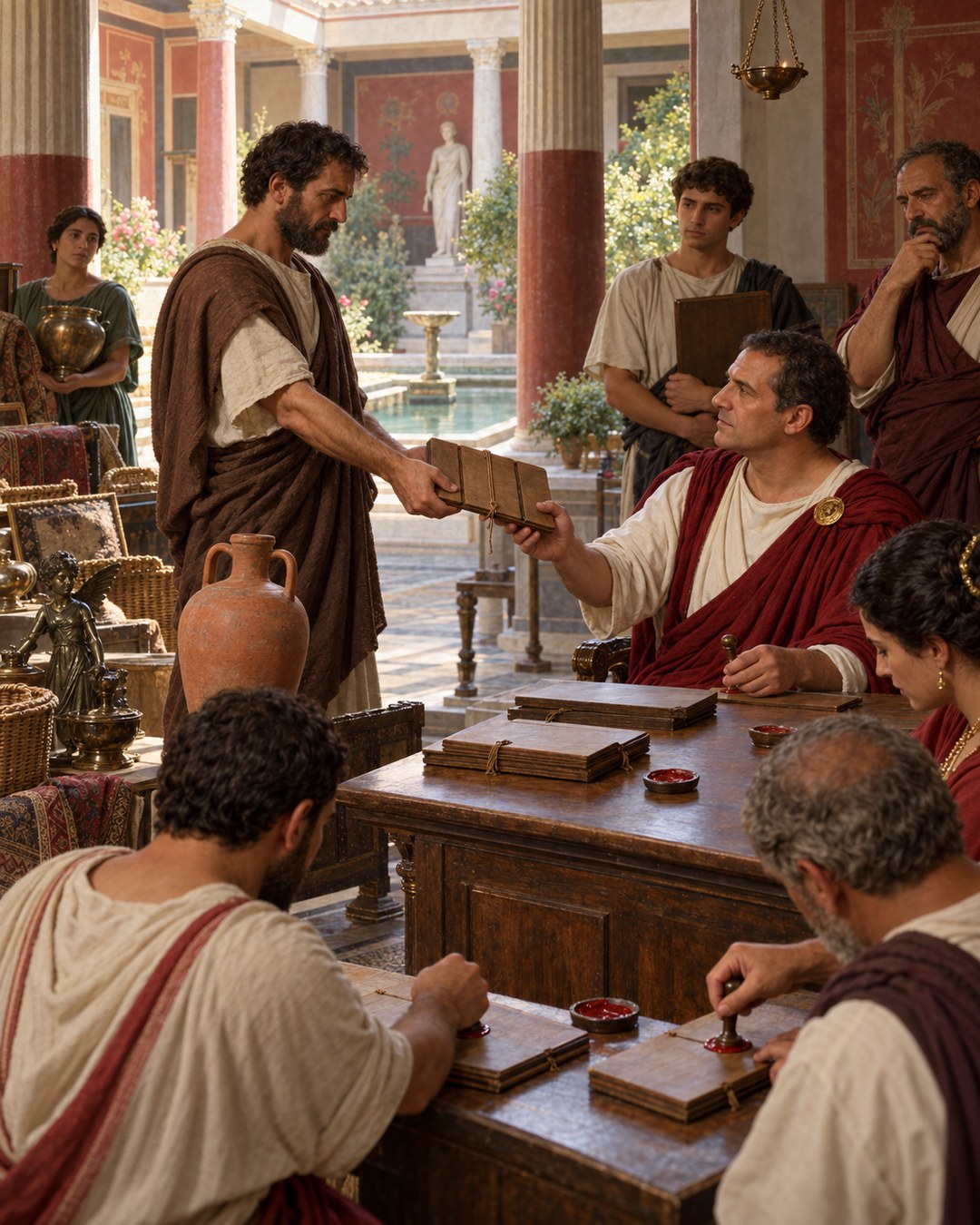
A seller in Pompeii had turned property into cash through an auction. The money did not move invisibly. It passed through Lucius Caecilius Iucundus, an intermediary whose wooden records fixed the settlement in names, figures, witnesses and seals. One surviving receipt makes the transfer unusually concrete: 37,332 sesterces, a premium of one fiftieth, and a rounded total of 38,079.
The document was not a ledger entry glimpsed by one clerk. It belonged to a triptych, three wooden leaves folded and tied together. Parties and witnesses signed; wax seals secured the closed object. Its survival in Iucundus’s house turns an ordinary act of settlement into one of the sharpest views we possess of business at Pompeii.
The importance of the archive lies in repetition. The tablets show that an auction required more than a crowd, a bid and a pile of coins. An intermediary had to deliver proceeds, deductions had to be intelligible, the recipient had to acknowledge payment, and witnesses had to make the result defensible. Finance became durable because a social gathering was compressed into a portable object.
A Business Archive Emerged from Volcanic Debris
The tablets were found in 1875 in the house associated with Lucius Caecilius Iucundus. A contemporary description quoted by Pompeii in Pictures places a group of wooden writing leaves in a small space above the portico of the peristyle. They occupied roughly half a cubic metre and had been kept together rather than scattered through the rooms.
The nineteenth-century account described 132 objects, including triptychs, diptychs and single tablets. The Italian state’s numismatic portal discusses 153 recovered documents. Those figures describe the material at different levels of counting, but both point to an archive rather than a lone receipt accidentally dropped behind a chest.
Vesuvius transformed the conditions of survival. Heat charred the wood. That damage also preserved forms that normally rot, while making the incised writing exceptionally difficult to read. The result is an archaeological paradox: catastrophe blackened the writing supports yet carried a working set of business records into the modern excavation.
The house matters because context connects the records to a person and practice. Detached tablets might reveal a transaction. A concentrated group in Iucundus’s property reveals accumulation—the deliberate keeping of evidence across many settlements.
Accumulation also changed the archive’s usefulness. One receipt could settle one disputed payment; a series could let its keeper revisit names, amounts and obligations across years of activity. The tablets were therefore not simply writing surfaces. Stored together, they became a working memory for an intermediary whose business depended on proving that many separate handoffs had been completed.
Auctions Ended with a Documented Handoff
The archive is often described as a banker’s archive, but the tablets reveal a more exact role. Many are receipts acknowledging sums Iucundus paid in relation to auctions. The seller’s property was sold; Iucundus handled the proceeds; the recipient then documented what had been delivered in front of witnesses.
The subjects were not confined to one commodity. The state portal lists real estate, securities, animals and enslaved people, along with rent, loans and tax collection. That range places the archive inside a city where wealth moved through land, living property, obligations and public payments. It also prevents a romantic picture of commerce: some transactions recorded the sale of human beings.
The sums varied. Many were only a few hundred sesterces, suggesting that this documentary service was not reserved for senatorial fortunes. Medium-scale merchants and landowners could need the same proof of settlement. A repeatable procedure made relatively ordinary deals legible enough to survive disagreement.
This is where the archive complements the eight-day market rhythm that brought country and town together. A market cycle explains when exchange concentrated. Iucundus’s tablets show what could follow a sale: arithmetic, acknowledgment, witnesses and retained evidence.
The Largest Receipt Preserved Its Arithmetic
The outstanding example concerns property belonging to Marcus Lucretius Lero. The recorded settlement is dated 22 January in the consulship of Nero Caesar and Lucius Antistius, or AD 55. Its calendar formula anchored the acknowledgment in a civic year, while the parties’ names fixed responsibility.
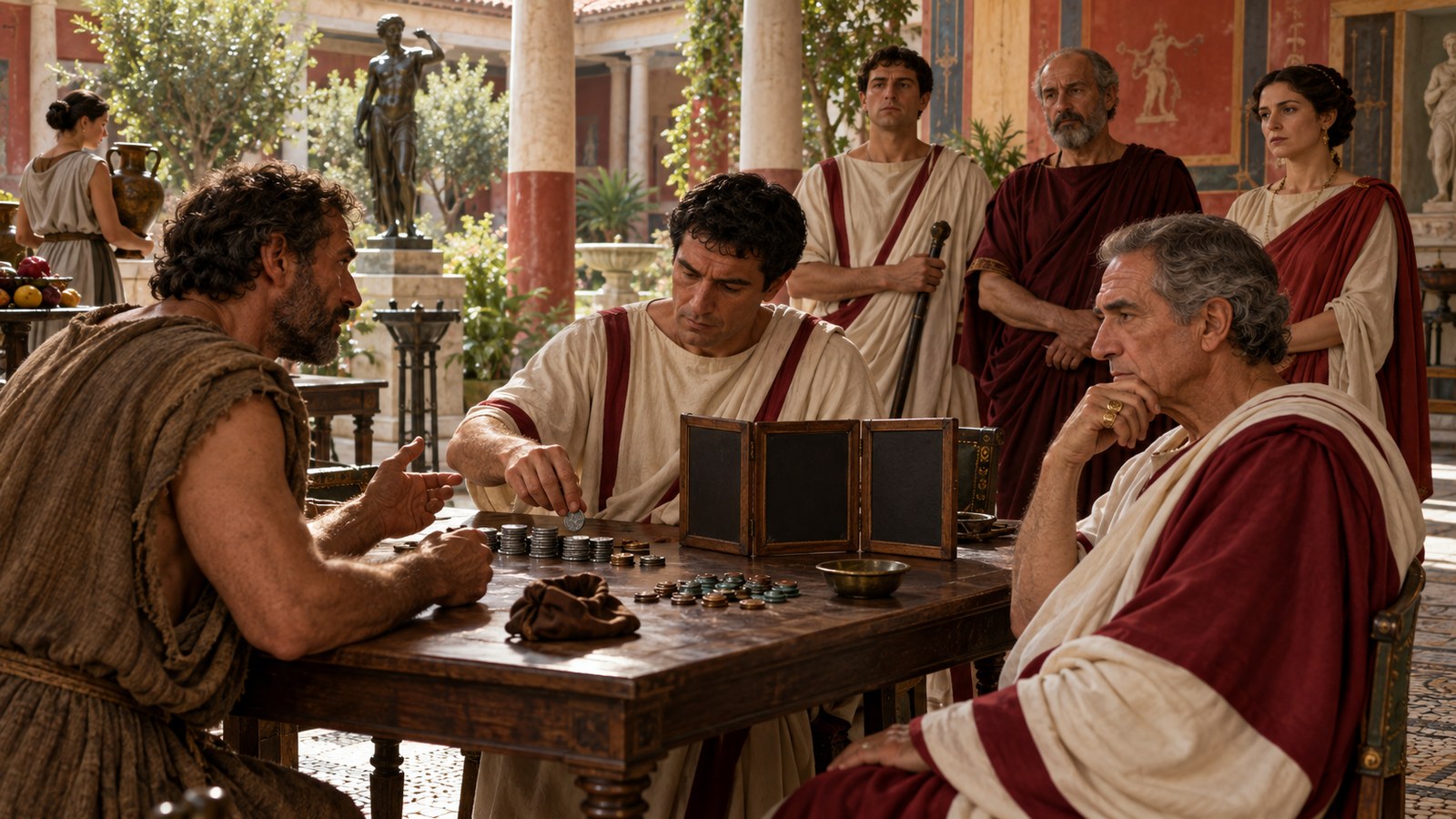
The base sum was 37,332 sesterces. A premium equal to one fiftieth produced 746.64 sesterces, rounded to 747. Together they made 38,079. The calculation is valuable because it shows the intermediary’s reward not as a vague assumption about profit but as a stated deduction that can still be reconstructed.
Nothing about that arithmetic required modern decimal notation on the ancient tablet; the portal gives the fraction and modern explanatory calculation. What the document establishes is the relationship among gross proceeds, the intermediary’s premium and the acknowledged sum. The receipt made the deduction part of the settlement instead of leaving it as an unspoken private understanding.
Roman calculation was often material and visible, as in the grooves and counters of an abacus. Here the significant point is different. Once the reckoning ended, its result entered a sealed instrument. Temporary counting became durable evidence.
Cord, Wax and Witnesses Protected the Result
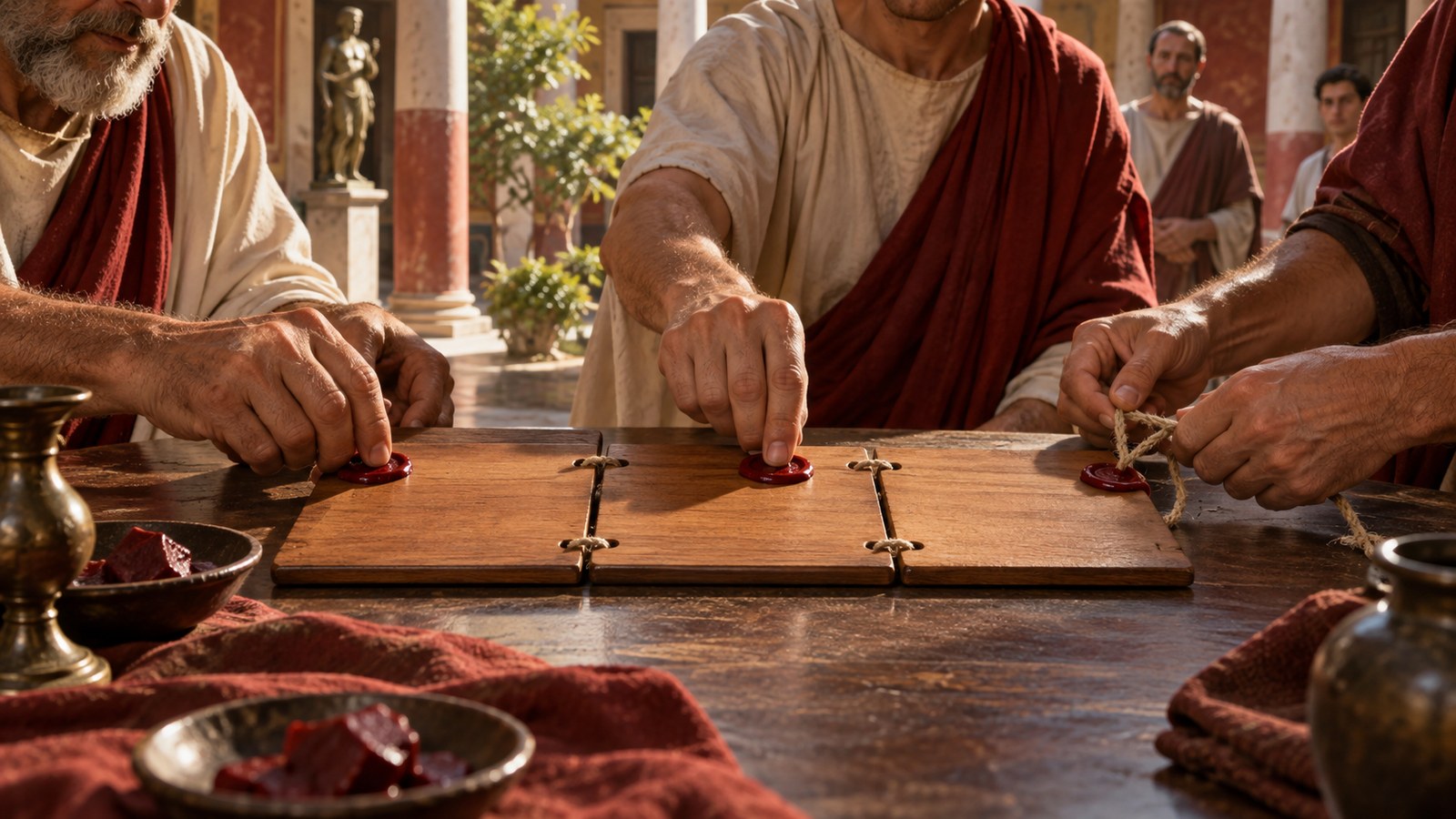
The receipt used a triptych. Three wooden leaves created six faces, though not every face carried readable text. Wax coated writing surfaces, and a pointed stylus cut the letters. The flat end of the same tool could smooth the wax for reuse, a practical advantage for daily notes but an obvious vulnerability for a completed obligation.
Closure answered that vulnerability. The tablets were folded, bound and sealed. Witnesses did not merely remember the transaction; their participation was attached physically to the object. Tampering with the interior would disturb the closure, while an exterior indication could identify the document without opening it.
The order of actions therefore mattered. Money was reckoned and delivered. A receipt was composed. Parties and witnesses authenticated it. The leaves closed, cord tightened, and seals converted an erasable surface into guarded evidence. The archive retained the finished object after the gathering dispersed.
The medium carried two opposite qualities at once. Wax was economical because it could be smoothed and used again, while a completed receipt needed resistance to alteration. Folding, binding and sealing did not remove erasability; they made access visible. A person could reopen the leaves, but not without disturbing the material signs that the witnesses had left around the closure.
We should not pretend that these records expose every negotiation or every unequal pressure behind a sale. They preserve the settlement that interested the document’s keeper. Yet that limitation is part of their value. Iucundus’s archive shows the point at which fluid bargaining hardened into a claim that could be produced later.
The 38,079-sesterce receipt is memorable because its numbers survive. Its deeper story is procedural. Pompeian finance depended on people assembling around a table, agreeing that payment had occurred, and building a small wooden barrier against denial. The triptych did not replace trust. It organized trust into names, arithmetic, witness rank and broken-seal consequences—then waited in the house in case memory failed.
Sources
Portale Numismatico dello Stato, “The House of Cecilio Giocondo”; Pompeii in Pictures, “House of Lucius Caecilius Jucundus.”