
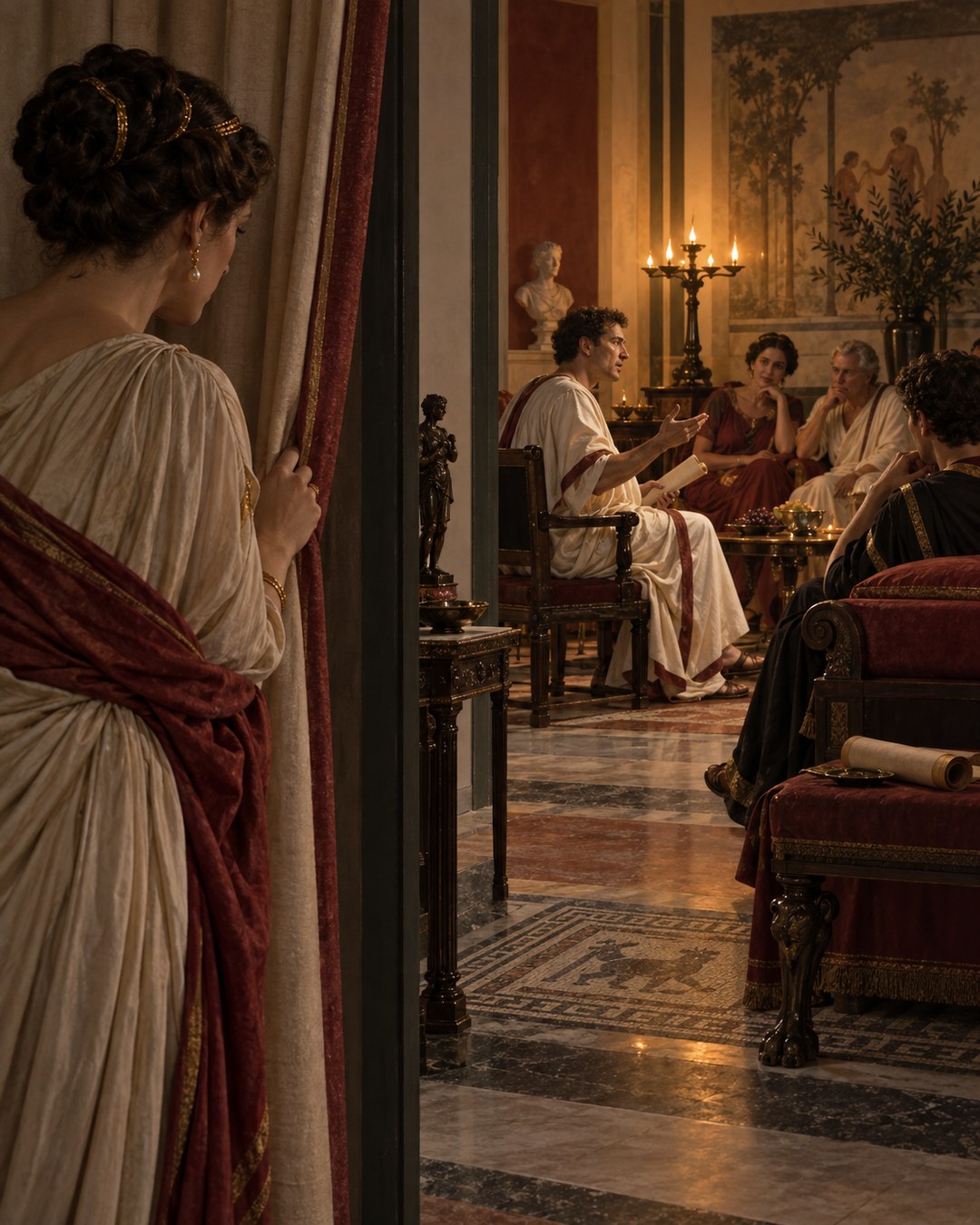
Calpurnia did not sit among the visible audience when Pliny the Younger recited his work. In his account, she concealed herself behind a curtain and listened. The fabric let sound through while keeping her outside the public arrangement of author, guests and praise. From there she heard the response to the man whose reputation shaped their household.
The curtain was only one part of her listening system. When Pliny pleaded a case, she placed people where they could send reports: how the speech was received, when applause came, and whether the case succeeded. At home she read his writings, learned them by heart and fitted his verses to a lyre.
These details make the marriage feel intimate, but they also demand caution. Calpurnia’s interests reach us through a letter written by Pliny to her aunt Hispulla. He selects the evidence, interprets its meaning and makes her devotion confirm his own literary worth. The portrait reveals a marriage in motion while also showing how an elite Roman man turned domestic affection into public self-description.
Hispulla was not a neutral destination. Pliny credits her with Calpurnia’s upbringing and with praising him before the marriage. By reporting the result back to that aunt, he completes a flattering circle: Hispulla formed the young woman, encouraged the match, and can now see her influence validated in the wife Pliny describes.
The Curtain Divided Presence from Visibility
Pliny presents the recitation as an event Calpurnia wanted to hear but did not join openly. The curtain solved that tension. It made her acoustically present and socially screened. She could follow the words and audience reaction without becoming part of the visible room in the same way as the invited guests.
That physical arrangement matters more than a generic statement that she supported his writing. Recitation was performance. Timing, voice and audience judgment gave a text a life beyond the scroll. By hearing the praise, Calpurnia encountered not only the work but the reputation being made around it.
The scene should not be inflated into a universal rule for Roman wives. Pliny describes one elite household and one marriage as he wished Hispulla to understand it. Even so, the partly hidden listener reveals how domestic space could touch literary publicity. A doorway and hanging cloth separated private woman from public audience, but neither stopped information.
Rome’s culture of being read aloud also appears in the attendants who read to Augustus through sleepless nights. Calpurnia’s case has a different engine. She was not providing background sound or clerical labor. She was following how a spouse’s authored voice landed among judges and peers.
Messengers Turned a Courtroom into Household News
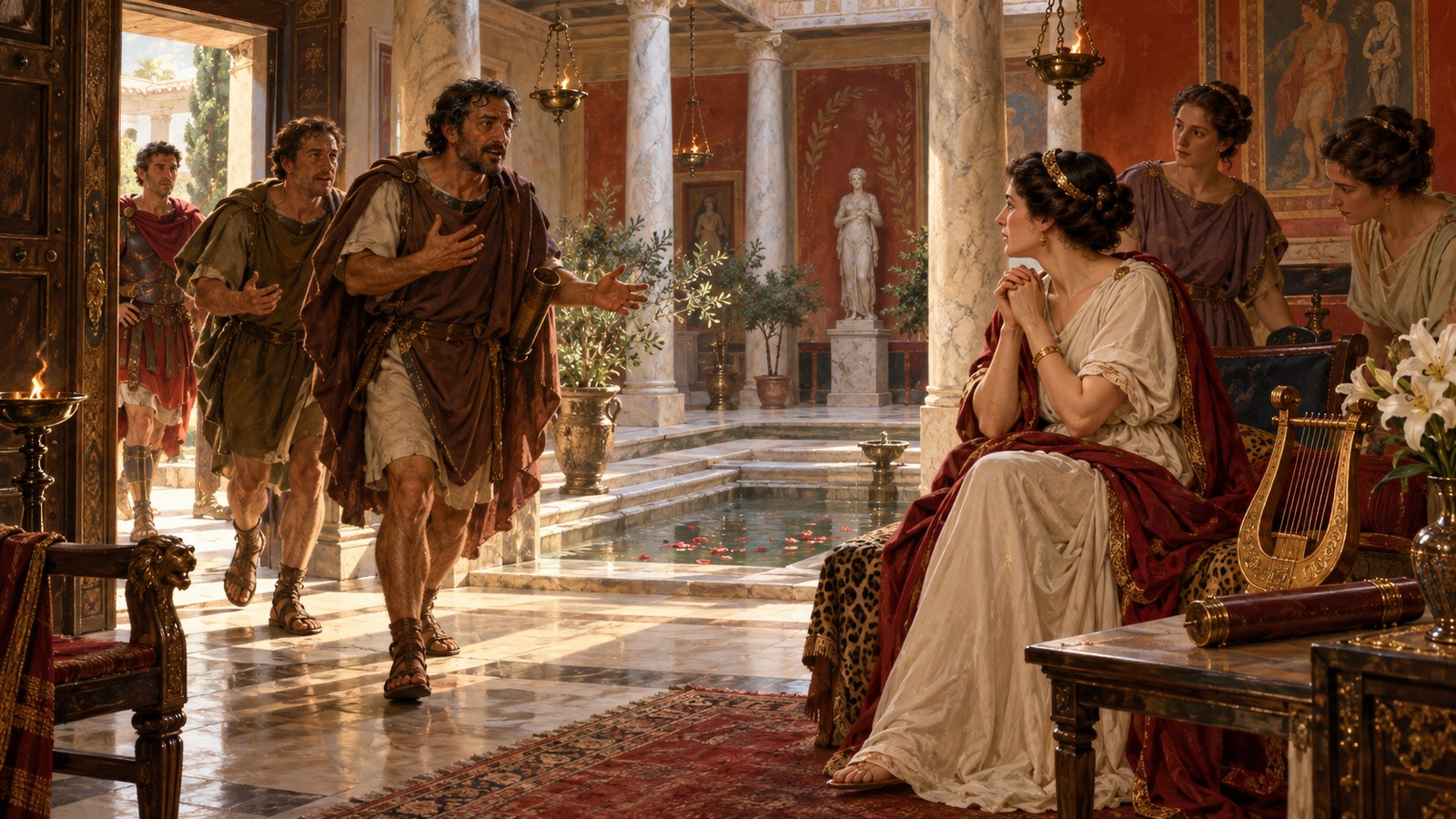
Court pleading placed Pliny beyond the curtain and beyond the house. Calpurnia could not hear the speech directly, so she arranged relays. Pliny says people informed her from time to time how he was heard, what applause he received and what success followed the case.
The sequence is vivid: a messenger leaves the public proceeding, crosses the city and enters the house carrying a fragment of reception. Another report updates it. Suspense becomes domestic in intervals rather than arriving only with the advocate at day’s end.
Applause and legal outcome were not identical. A speech might impress listeners while the case remained uncertain. Pliny’s list keeps both registers: immediate response and practical success. Calpurnia’s attention therefore tracked the craft of performance as well as the result that mattered to a client.
Pliny says she felt anxiety before he spoke and joy when the danger was over. He uses that emotional rhythm as proof that she cared for his honor. Yet the information network also shows initiative. Calpurnia did not merely wait. She positioned others to overcome distance and obtain a running account.
His Verses Moved from Memory to Lyre
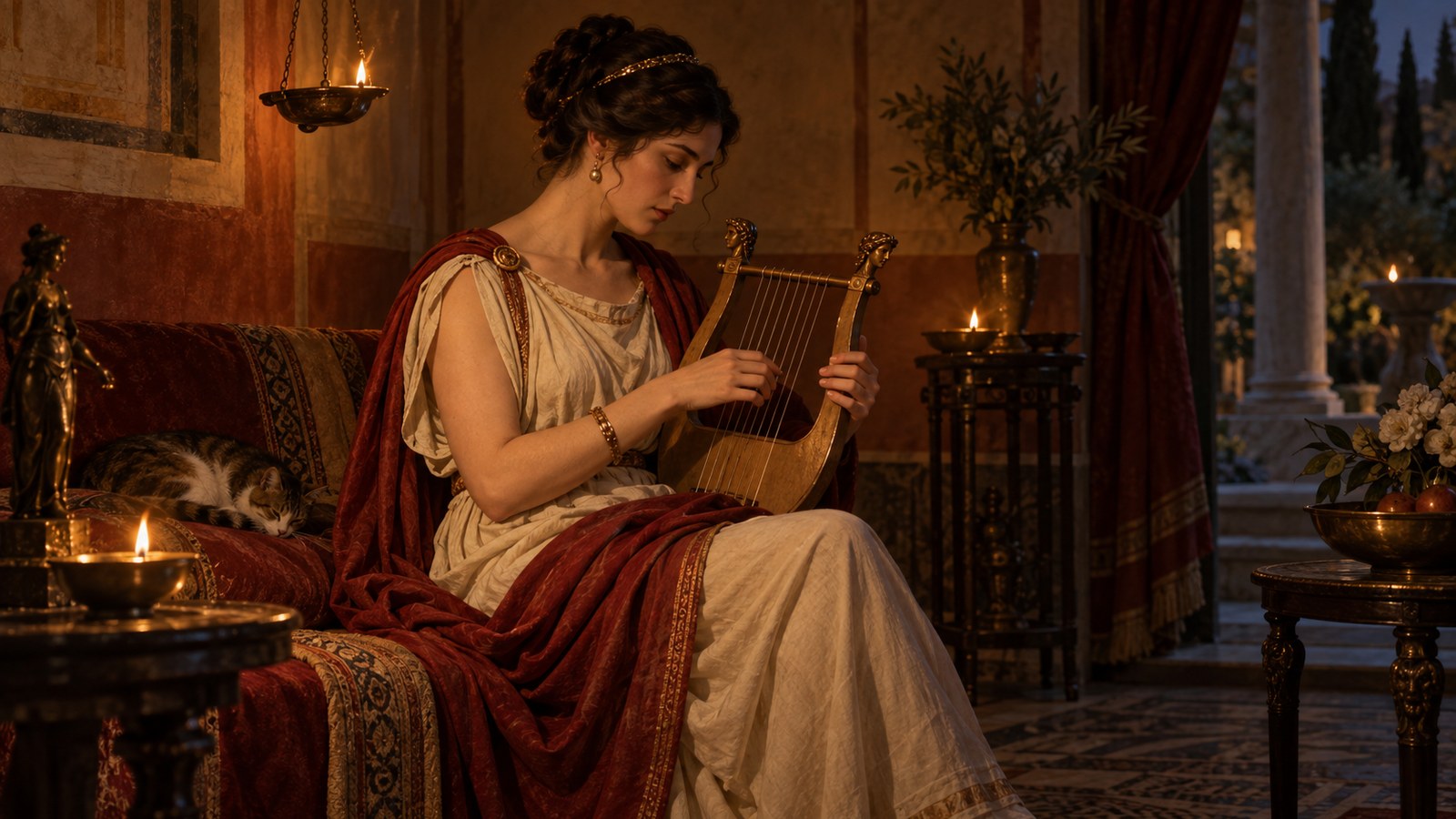
The most distinctive act happens away from the audience. Pliny says his works were continually in Calpurnia’s hands and that she learned them by heart. Reading became repetition; repetition made the words portable even when the physical roll was closed.
She then sang his verses, adapting them to the lyre. Pliny adds that love was her only teacher. That flourish praises feeling over formal instruction, but it also credits Calpurnia with transformation. A written poem became a private musical arrangement through her voice, memory and instrument.
The act differs from the shorthand writers who tried to preserve a public speech as it happened. They moved spoken words toward text. Calpurnia moved a finished text back into sound and melody. Both depended on disciplined attention, but one served rapid record and the other intimate reinterpretation.
We do not possess her tune. We cannot tell how far the adaptation altered rhythm, repeated phrases or selected among poems. The missing music is a useful boundary. The letter proves that Pliny wanted Hispulla to imagine Calpurnia singing; it does not let us reconstruct the performance.
Nor does the letter tell us whether every work received equal enthusiasm. Pliny gathers reading, memorization and music into a compact portrait of devotion. That compression serves his argument beautifully, but it removes the ordinary negotiations of taste: disagreement, boredom, preference and criticism. Calpurnia appears as the ideal audience because the husband-author controls the frame.
Separation Made Text Stand in for a Spouse
Other letters complicate the polished household portrait by introducing illness and absence. Calpurnia went to Campania for her health, while business kept Pliny from accompanying her or following immediately. He asked her to write daily and even twice a day because reading temporarily eased his anxiety.
Calpurnia, as quoted by Pliny, found a parallel substitute. She turned to his works in his absence and treated them as a form of conversation with him. He repeatedly picked up her letters as if they had just arrived. Written objects moved between spouses and were reread because one reading could not exhaust the need created by distance.
In another letter Pliny says that at the hours when he usually visited Calpurnia, his feet carried him toward her chamber. Finding her absent, he returned unhappy. The small bodily habit balances his grander language about honor. Reputation may organize the marriage in the letter to Hispulla, but ordinary time and familiar rooms reveal attachment differently.
Calpurnia remains partly screened from us, much as she stood behind the curtain. Her own letters do not survive here as independent documents; Pliny reports their sweetness and their effect on him. Her songs are silent, and her runners speak only through his summary. Any portrait must therefore distinguish her documented actions from his interpretation of them.
Still, those actions resist reducing her to decoration. She read, memorized, arranged music, sought live reports and used literature during separation. Pliny turned each act into evidence of a wife devoted to his glory. A modern reader can see both things at once: an intelligent participant in a literary household and a woman whose surviving image was composed by the husband whose applause she followed.
Sources
Pliny the Younger, Letters, 4.19 and letters to Calpurnia.