
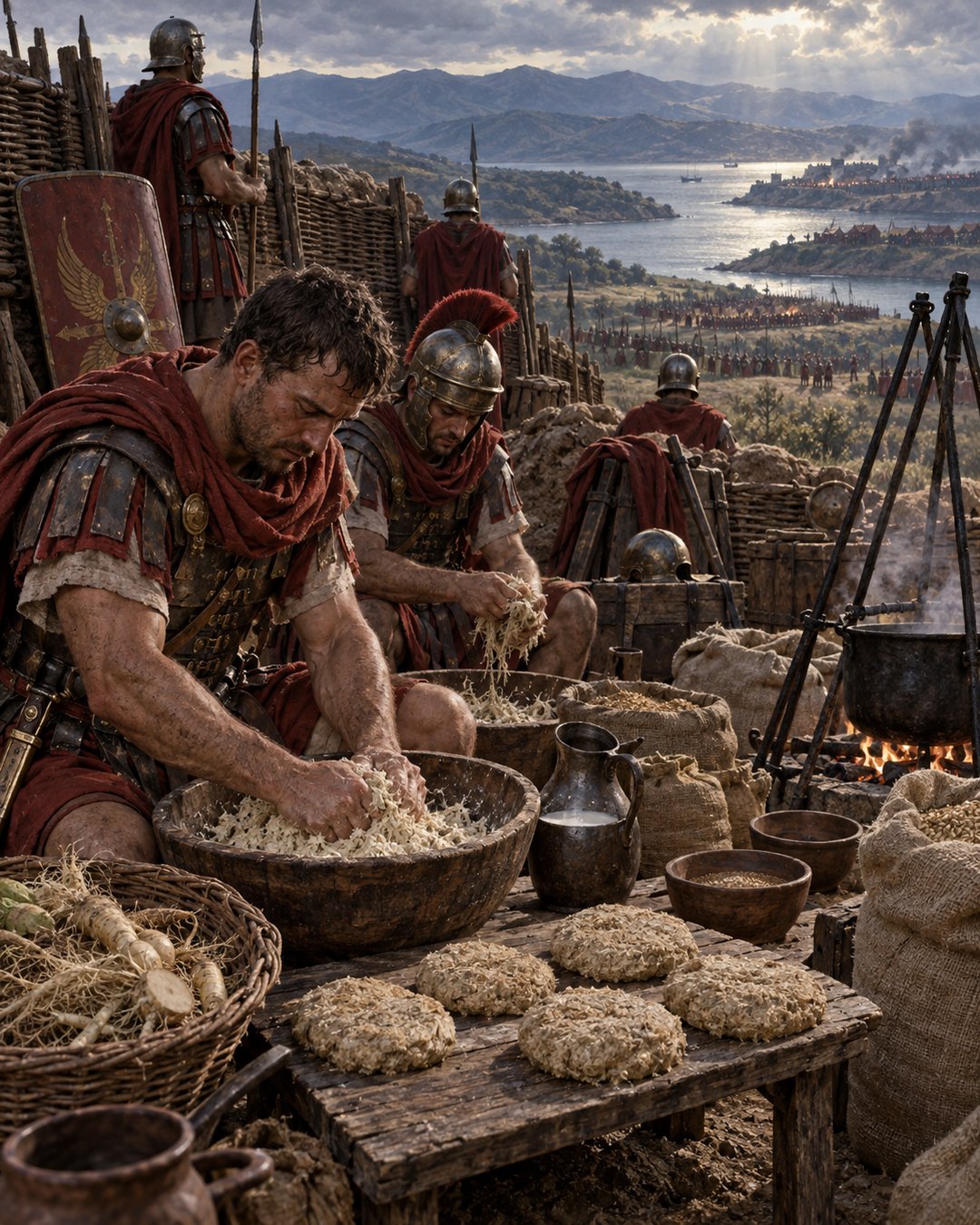
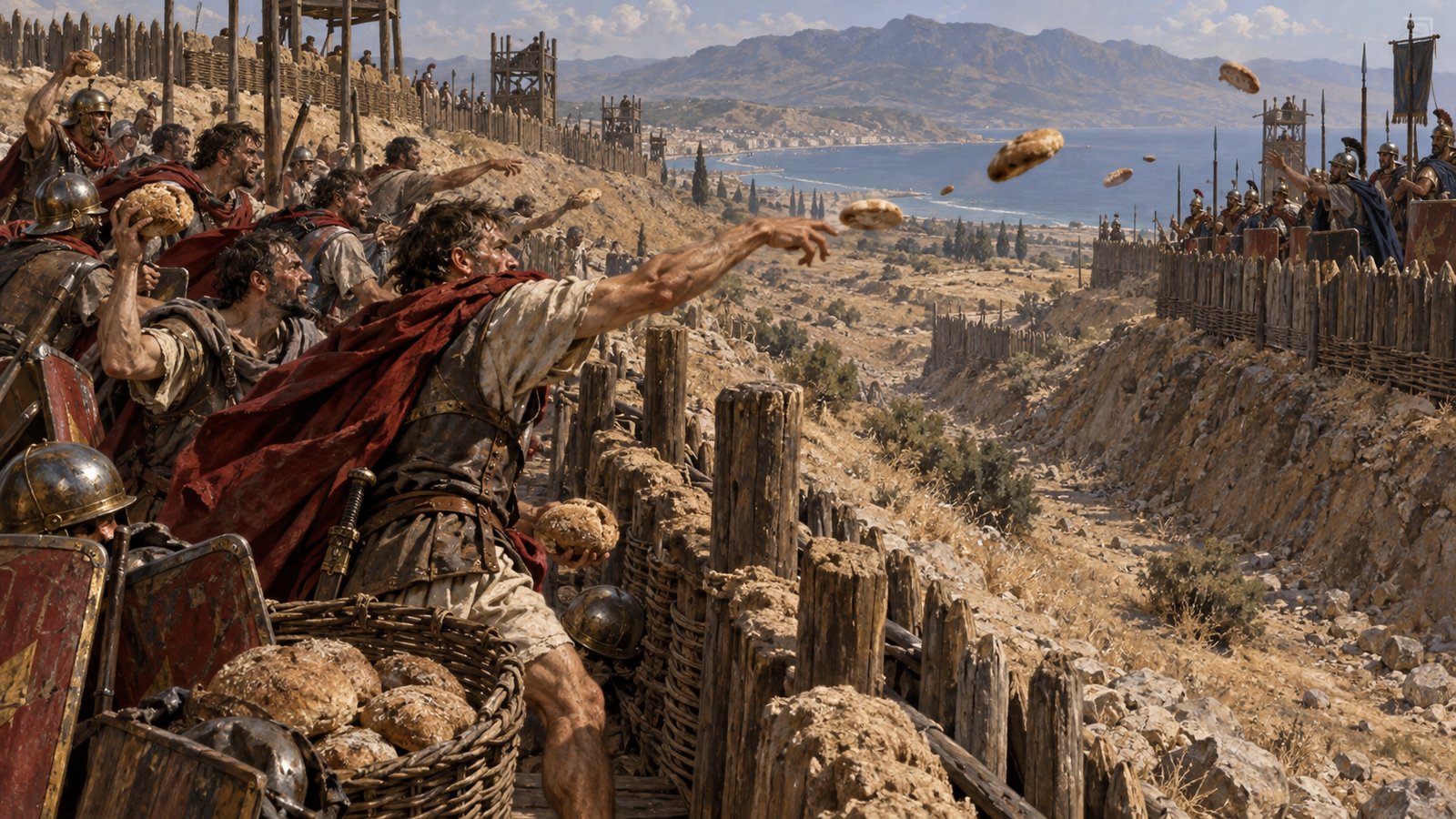
The loaf crossed the ditch instead of reaching a hungry soldier’s mouth. Near Dyrrhachium, Caesar’s men had mixed a local root called chara with milk and shaped the result into something resembling bread. When Pompeian troops mocked their hunger, the legionaries threw the rough loaves toward the opposing works.
The gesture carried two messages at once. It admitted that Caesar’s army was short of grain; no one mistook root paste for a normal ration. Yet it also denied the conclusion Pompey wanted hunger to produce. The improvised food showed that the besiegers had found another thing to eat and intended to keep the blockade closed.
Caesar tells the episode in the third book of the Civil Wars, where logistics, memory and morale crowd together. His account is interested in more than calories. Root-bread becomes evidence in an argument conducted across fortifications: one side points to scarcity, while the other turns scarcity into proof of endurance.
The Besieger Had Less Grain Than the Besieged
The position around Dyrrhachium reversed the usual picture of blockade. Caesar says his smaller army was trying to contain Pompey’s fresh and uninjured forces through a wide system of redoubts and connecting earthworks. The perimeter was extensive, and neither side occupied a simple enclosed city.
Pompey’s access to the sea complicated everything. Ships gathered from different directions with supplies, and Caesar remarks that almost any wind could favor a vessel arriving from somewhere. The army doing the enclosing could not seal every maritime route, while its own access to the grain of the surrounding countryside had been exhausted.
Caesar therefore describes his soldiers as being in severe straits even though the enemy was nominally enclosed. This was not total starvation. Barley and vegetables were accepted, and meat was plentiful from Epirus. Water also remained abundant on Caesar’s side. The acute shortage concerned grain, the ingredient that made the army’s familiar bread ration possible.
That distinction is important. An army can possess food and still suffer a logistical crisis when the expected staple disappears. Grain stored, measured, transported and issued predictably. Meat and gathered plants could sustain bodies, but they did not fit the same daily system or carry the same psychological reassurance.
The episode complements the marching camp routines that made Roman movement repeatable. Earthworks could organize a night and defend a position. They could not create grain after the district had been stripped. Fortification and food remained separate problems, and at Dyrrhachium the stronger line belonged to men eating the weaker ration.
Idle Hands Found a Root and Changed Its Form
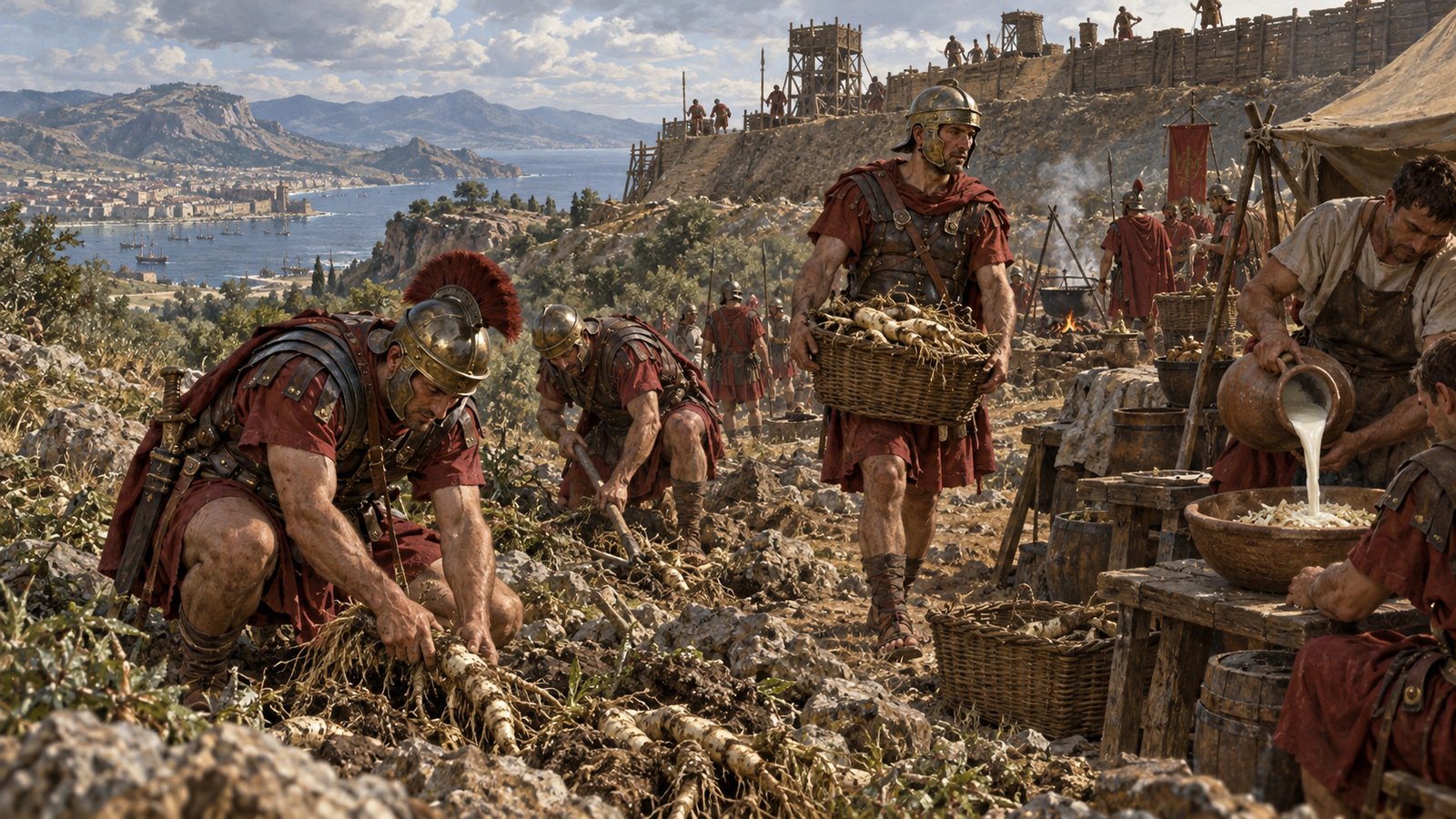
Caesar credits men who were not otherwise occupied with finding the root called chara. The wording places discovery inside camp labor. Soldiers between assigned tasks searched the local landscape, identified a usable plant and brought it into the army’s food supply.
The root was not simply chewed raw. It was mixed with milk, a detail that turns foraging into processing. The combination substantially relieved need, Caesar says, and the men made it into an object that looked like bread. Shape mattered because it translated an unfamiliar ingredient into the army’s most recognizable food form.
We cannot safely identify the plant from this passage alone. Ancient names do not always map cleanly onto modern species, and Caesar was explaining an emergency expedient, not writing botany. The certain sequence is practical: find the root, combine it with milk, form bread-like loaves and distribute enough to matter.
There was a large supply. That detail separates the incident from a single lucky snack. The soldiers had located a resource abundant enough to answer a collective shortage for at least part of the crisis. Local knowledge—whether learned from inhabitants, recognized by soldiers or discovered through trial—is not explained, so it should not be invented.
The transformation also reveals the limits of the word “bread.” Caesar says the result resembled bread rather than claiming it was ordinary wheat bread. The soldiers manufactured familiarity from different material. A rough loaf could be carried, shown and thrown in a way that a bowl of root and milk could not.
A Ration Became a Weapon of Expectation
The Pompeians knew the opposing army lacked grain and used that knowledge in conversation across the lines. Siege earthworks were not silent barriers. Sentries could shout, taunt and listen. Each side tried to estimate how long the other would accept discomfort before strategy gave way to necessity.
Caesar’s men answered with the food itself. Throwing loaves sacrificed some of a scarce substitute, which strengthened the performance. A hungry army desperate for every bite would be expected to guard its ration. Men who could afford to hurl bread-like objects over a ditch appeared to possess more supply and more confidence than the taunt assumed.
The loaf did not need to injure anyone. Its target was Pompeian expectation. Caesar explicitly says the soldiers acted to reduce the enemy’s hope that hunger would force an end. Material evidence traveled farther than a shouted denial: the Pompeians could pick up, see and perhaps break apart the strange food.
This was improvised psychological pressure rather than a formal stratagem ordered by Caesar in the passage. The soldiers themselves controlled the answer. Their gesture joined camp humor, defiance and practical logistics, compressing a complicated supply situation into one thing thrown through the air.
The action differs from Hannibal’s burning bundles that opened an escape route. Those flames misdirected an enemy’s attention during movement. The chara loaves disclosed a real weakness but changed its meaning. Deception lay not in hiding the root food; power came from displaying it without shame.
Memory and Ripening Grain Kept the Line Closed
Caesar surrounds the root episode with memories of earlier hardship. The troops recalled privation in Spain, at Alesia and at Avaricum, followed in each remembered case by victory. Those comparisons served morale by giving hunger a familiar ending: deprivation had occurred before, and endurance had carried them beyond it.
Future supply was visible as well. Grain in the fields was beginning to ripen. Caesar says hope itself lightened the shortage because the men expected abundance soon. A green or yellowing field beyond the works turned time into a resource. They did not need chara forever if they could hold until harvest.
Sentry talk pushed that confidence to an extreme. Caesar reports men saying they would feed on bark before allowing Pompey to slip away. We should hear the boast as rhetoric, not a menu. It marks the point where endurance became identity: releasing the enemy would be more intolerable than consuming something even less like bread.
Caesar’s authorship demands caution. He had every reason to present his troops as patient, inventive and fiercely loyal during a difficult operation. The narrative makes their suffering praise the commander whose blockade had placed them there. Pompeian abundance is emphasized so Caesar’s smaller army can appear even more remarkable.
Yet the propagandistic frame does not make the logistical details useless. Barley, vegetables, Epirote meat, milk, gathered roots, water and ripening grain form an unusually textured inventory. The account works because readers can feel how uneven the supply was. The army had many edible things, but not enough of the staple around which normal expectations were built.
The root-bread episode captures warfare at the level of hands and stomachs. Men dug a plant from unfamiliar ground, altered it with milk, copied the shape of a missing ration and then surrendered several loaves to make a point. Caesar’s line remained closed not because hunger vanished, but because soldiers found a way to eat and a way to make the enemy watch them endure.
Sources
Julius Caesar, Civil Wars, 3.47–49.