
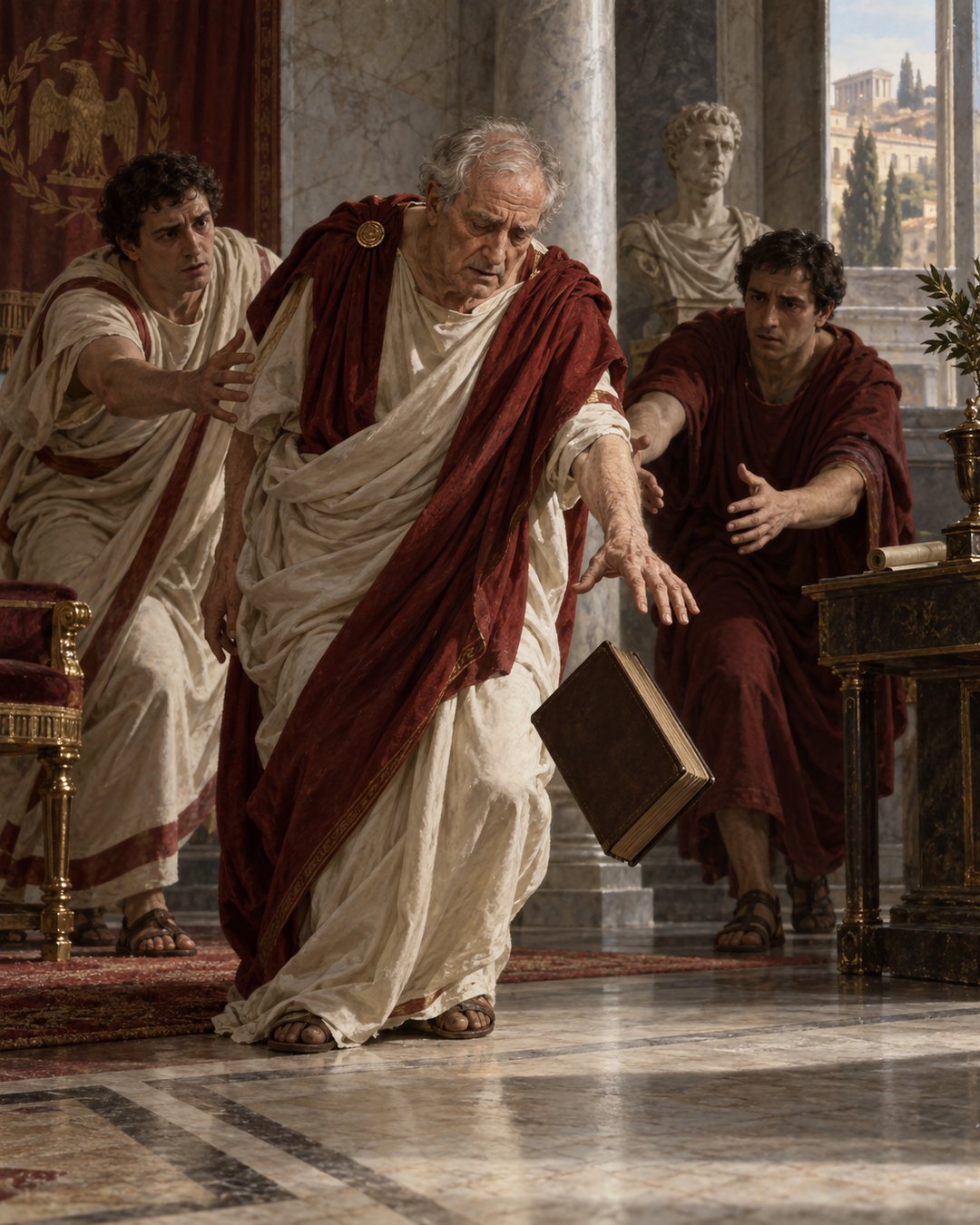
Verginius Rufus was standing with a heavy volume, practicing the speech in which he would thank Emperor Nerva for a third consulship. He was eighty-three. The book slipped from his hands; he moved quickly to catch it, lost his footing on smooth pavement and fell. The broken thigh never properly united.
Pliny the Younger tells the accident while praising a man whose public funeral, he says, surpassed anything Rome had seen for years. Cornelius Tacitus delivered the oration. The emperor, the Senate, the bar and the crowd could all participate in immediate honor.
Ten years later, Pliny visited Verginius’s old villa at Alsium and walked to his monument. It was still unfinished. The tomb was meant to be plain, with a short inscription linking Verginius to Vindex and his refusal of supreme power. It had neither name nor words. Rome had produced a magnificent day of remembrance but failed at the slower work of attaching memory to stone.
A Third Consulship Required One More Performance
Verginius had already lived decades beyond the crisis that made him famous. Pliny says he survived for thirty years after reaching the summit of his reputation. He read poems written in his honor and histories recounting his actions, an unusual experience of watching posterity begin while still alive.
His third consulship under Nerva crowned that long survival. Pliny frames the office with a political paradox: Verginius had refused to become the first of rulers, so he was repeatedly raised to the highest position available to a subject. The consulship honored restraint as much as achievement.
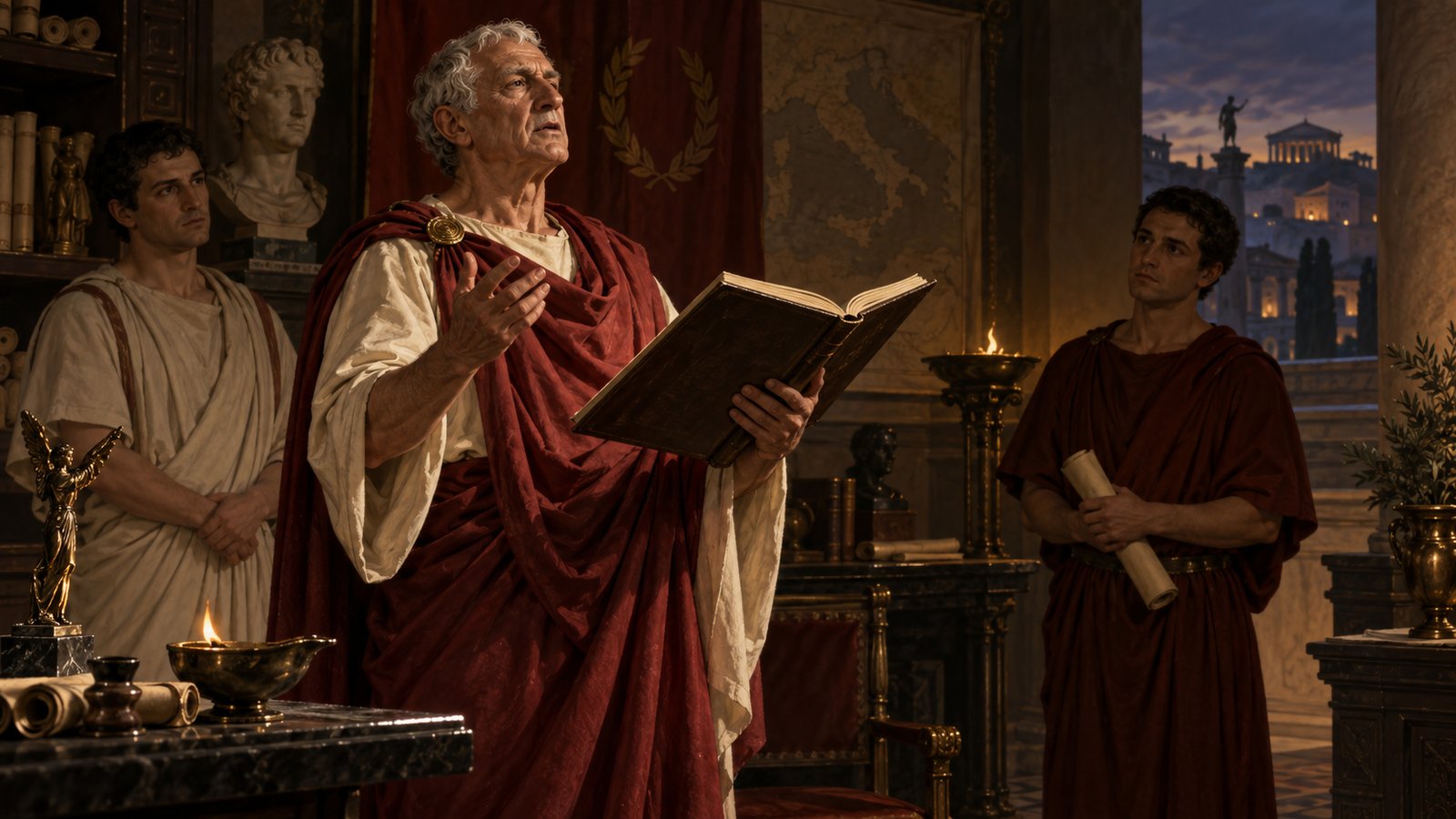
Office still demanded performance. Verginius prepared a public acknowledgement to the emperor who had promoted him. He practiced his voice rather than treating age and fame as excuses for improvisation. The large book in his hands was therefore part of disciplined preparation, not casual reading.
The scene belongs to the same Roman world as the shorthand writers who fixed a Senate speech while it was delivered. Public words required bodies, breath, memory and material supports. A statesman’s argument could depend on a reader standing securely enough to hold the text.
Verginius’s hands already trembled, though Pliny says the condition caused no pain. The detail makes the accident physical without turning the man into a symbol of helpless age. He could still rehearse and stand. Trouble began when the volume exceeded what that standing posture could safely manage.
The Heavy Book Turned Rehearsal into a Fatal Chain
Pliny arranges the fall as a sequence. The volume slipped. Verginius reacted quickly to recover it. His foot slid on the smooth floor. He struck the ground and fractured his thigh. The book was not a weapon, and the room was not a battlefield, yet ordinary weight and polished stone created a chain that an old body could not absorb.
The treatment failed as well. Pliny says the bone was badly set and that age worked against union. He does not name a practitioner or explain the procedure, so blame should not be expanded beyond the text. What survives is his judgment that poor setting and advanced age combined during a severe, prolonged final illness.
The accident has a bitter symmetry. Verginius was rehearsing gratitude for renewed public office when the physical apparatus of that speech brought him down. A document meant to support ceremonial language became too heavy to hold, while the smooth elite interior offered no grip when he lunged.
Pliny uses the illness to enhance reputation. Endurance under a long decline joins the virtues he wants readers to remember. That rhetoric deserves caution: the letter converts pain into moral evidence. Yet its details are specific enough to preserve the vulnerability behind the praise—trembling fingers, a sliding volume, polished pavement and a fracture that would not knit.
The mechanism differs from Spurinna’s carefully scheduled old age. Spurinna reduced risk through a measured routine of walking, carriage travel, conversation and exercise. Verginius was also following a routine, but civic expectation still asked him to stand and perform with a demanding object in hand.
Tacitus Gave the Dead Man a Public Voice
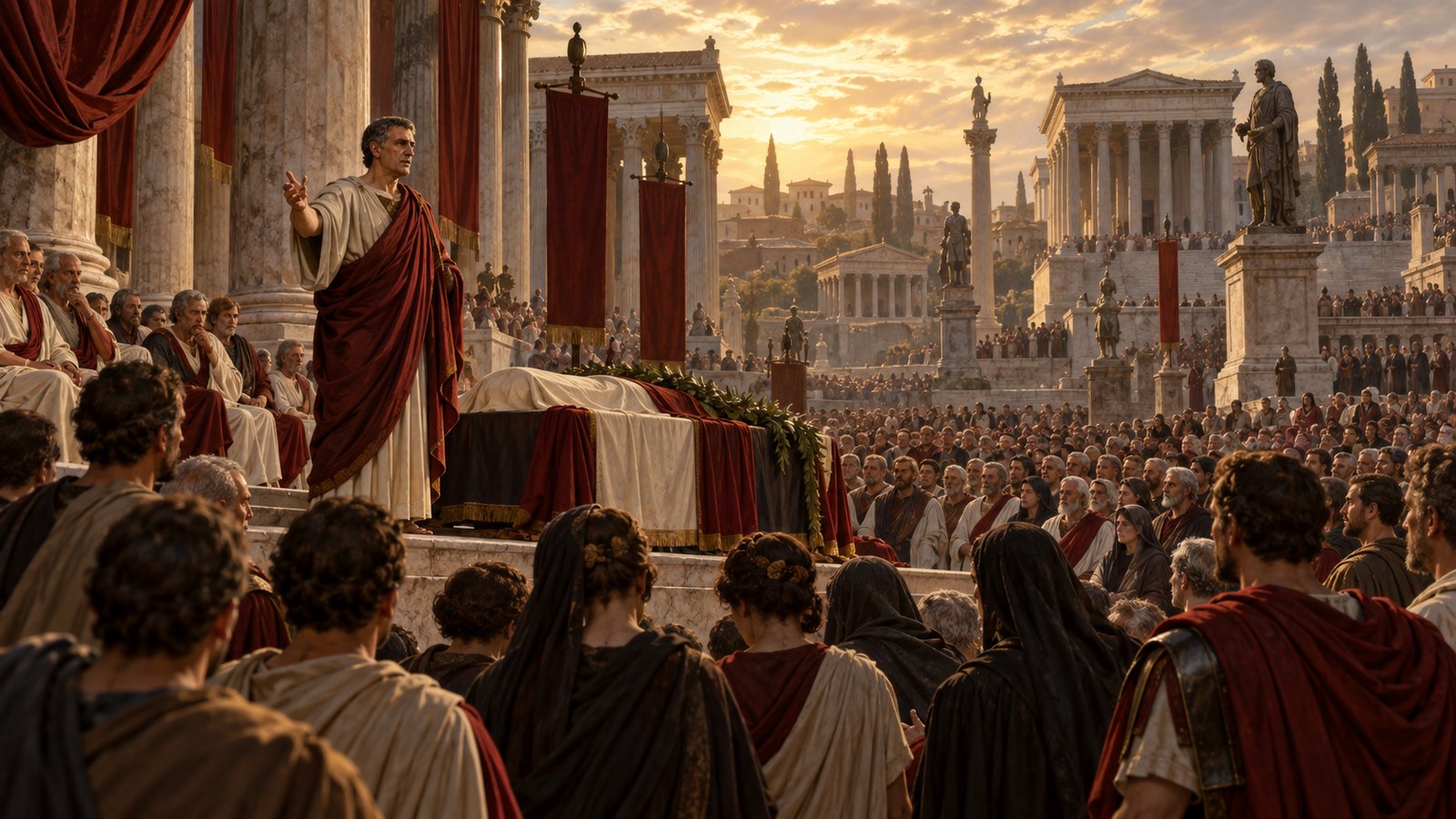
The funeral mobilized the resources that the fall had interrupted. Pliny calls it magnificent and memorable, and he presents the ceremony as an honor not only to Verginius but to Nerva’s reign and to the legal profession. Public mourning became proof that a better political age could celebrate a virtuous survivor.
Tacitus, serving as consul, pronounced the funeral oration. The pairing is remarkable even without imagining words Pliny does not preserve. One of Rome’s great historians publicly shaped the memory of a man who had crossed the dangerous politics of AD 68 and lived through later emperors.
Verginius’s refusals dominated Pliny’s assessment. Soldiers had wanted imperial power for him, but he did not accept it. Pliny says he was as illustrious for honors declined as for honors held. The funeral could therefore praise a political absence: the throne he had not occupied.
Pliny was not a detached reporter. He identifies Verginius as a patriot, model, neighbor and friend. Their estates and home communities connected them. Grief and political argument reinforce each other throughout the account, making Verginius’s death a personal loss and a judgment on Roman public life.
The oration completed one kind of memory. It gathered living listeners, matched office with eloquence and transformed biography into civic example. But speech disappears unless someone repeats or records it. The durable object was supposed to be the monument awaiting at Alsium.
Ten Years Left a Famous Name off a Plain Tomb
When Pliny returned to the villa, rooms and paths reminded him of Verginius. The older man had called the retreat the nest of his old age. That phrase gives the estate warmth before the monument introduces anger. Domestic memory remained vivid while formal commemoration stalled nearby.
The tomb was not unfinished because its design was technically difficult. Pliny calls it plain, even slight. Responsibility belonged to the person entrusted with the work. Ten years of delay therefore exposed neglect rather than engineering trouble, shortage or artistic ambition.
Verginius had supplied the intended message. In the translation preserved by Project Gutenberg, the couplet says that Rufus withstood Vindex’s arms not for himself but for his country. The wording compressed an entire political identity into refusal: victory had not become a private claim to rule.
Yet an inscription can speak only after someone cuts it. Without name or text, the stone failed at the modest task assigned to it. The public funeral had required extraordinary coordination for one day; the monument required a trustee to complete ordinary work after applause ended.
Pliny turns that failure into a general warning. Friends are rare, he says, and the dead are quickly forgotten. His conclusion is deliberately unsettling: people may need to build their own tombs in advance rather than trust heirs. Verginius’s fame made the neglect more shameful and more visible, but did not prevent it.
The contrast is sharper than a simple story of honor followed by oblivion. Verginius was not forgotten in literature. Pliny’s anger itself proves continued memory, and poems and histories had praised the man during his lifetime. What failed was the transfer from reputation to maintained place. A name filling books could still be absent from the stone above the remains.
That is the final force of the fallen volume. Written culture surrounded Verginius at both ends of the story. A book used to prepare public thanks slipped from his grasp; a planned inscription remained unwritten a decade later. Between them came Tacitus’s magnificent spoken tribute. Rome did not lack language for honor. It lacked the dependable hands needed to carry language from ceremony into durable care.
Sources
Pliny the Younger, Letters, 2.1 and 6.10.