
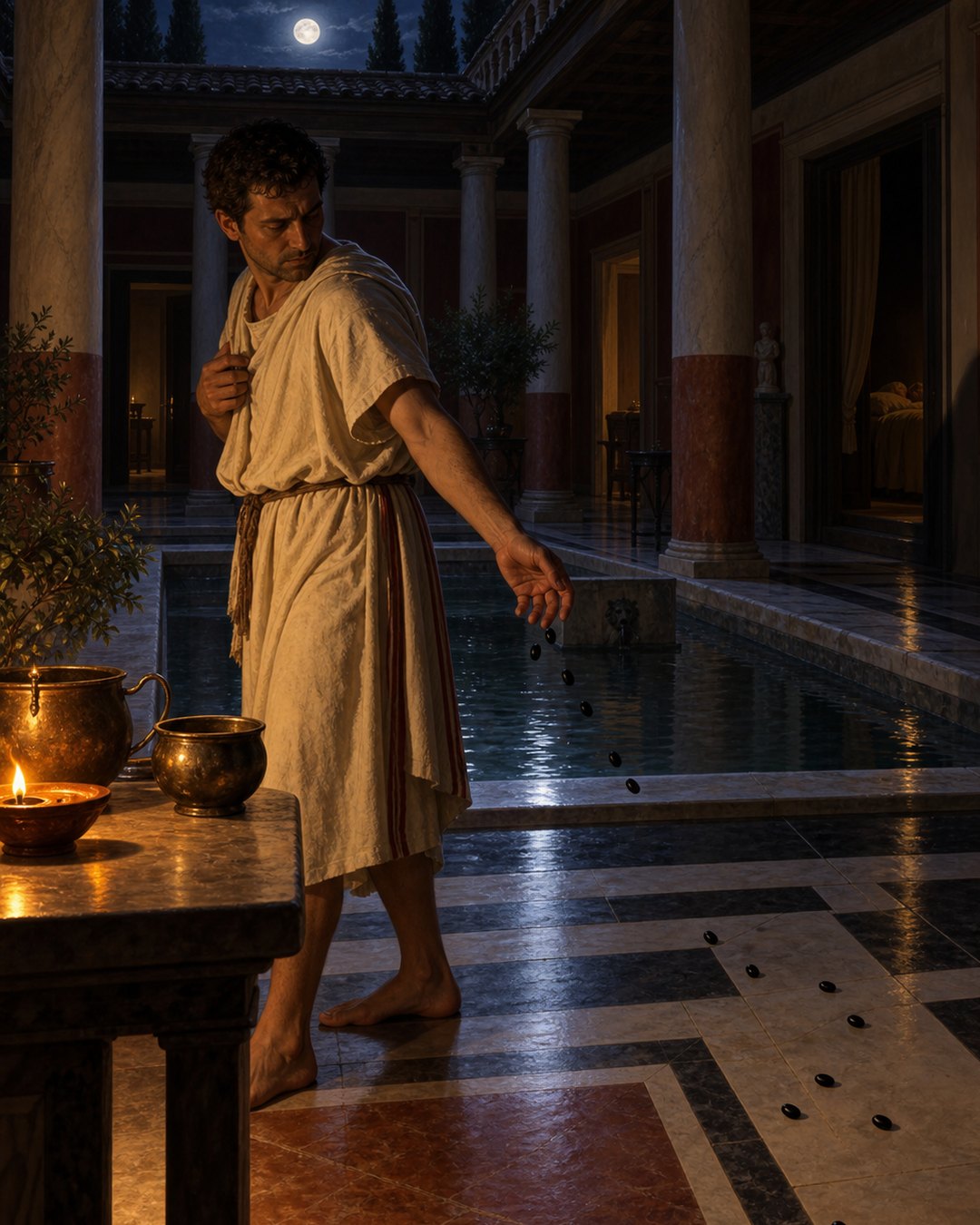
At midnight the householder rose barefoot while the rest of the Roman home slept. Dogs had stopped barking; birds were quiet. He washed his hands in spring water, took black beans, turned his face away and threw them behind him. The action carried the same spoken bargain: with these beans, he would redeem himself and those who belonged to his household.
He repeated the formula nine times without looking back. Ovid says the shade was thought to collect the beans and follow unseen behind him. Only then did the celebrant touch water again, clash Temesan bronze and order the ancestral ghosts to leave. That command also came nine times. At the end—and not before—he turned around.
This is Ovid’s most precise scene from the Lemuria, the old May observance for the restless dead. Its drama comes from restraint rather than spectacle. The living person does not chase an apparition or summon a priest. He controls his own feet, hands, gaze and voice until the household boundary has been restored.
Midnight Removed the House from Ordinary Time
Ovid places the nocturnal Lemuria after three appearances of the Evening Star following the sixth of May. The rite began on May 9 and returned on May 11 and 13. The broken sequence mattered: this was not a single night accidentally made strange, but a recurring interruption in the month.
His domestic description begins when midnight has brought silence to sleep. The dogs and varied birds are still. That acoustic pause empties the house of its daytime signals—conversation, work, street noise, service—and makes the smallest action distinct. Water can be touched. Bronze can be heard. Beans can strike the floor.
The hour also changes who acts. Ovid describes one person who remembers the old rite and fears the gods. He rises while the household remains offstage. The scene is private, but its aim is collective: the formula redeems both the speaker and “mine,” the people bound to him within the home.
This differs from the February days when Roman families made room for their dead. The Lemuria passage does not linger over visits to tombs or shared commemorative meals. Its movement runs through the interior of a house, with an unseen presence imagined immediately behind the living celebrant.
Bare Feet and a Closed Hand Prepared the Living Body
Before the beans appear, Ovid controls the celebrant’s body. No knots bind his feet. The detail is easy to pass over, yet it makes readiness physical: the performer meets the rite without an ordinary fastening around him.
He then forms a sign with his hand, joining his fingers with the thumb held in the middle. Ovid gives its purpose directly: it prevents a light or insubstantial shade from meeting him in the silence. The gesture does not destroy the dead. It creates a small defense at the point where an encounter might occur.
Spring water follows. The householder washes his hands clean before taking the beans. Later he touches water again, so purification brackets the central exchange. The sequence moves from protection, to cleansing, to offering, and back to cleansing before the final expulsion.
Nothing in the passage is casual. Bare feet, shaped fingers and clean hands turn the performer himself into part of the apparatus. Roman ritual could give extraordinary weight to exact conduct: another Roman prayer needed several people to guard words and conditions. Here a solitary householder carries the precision in his own posture and repetitions.
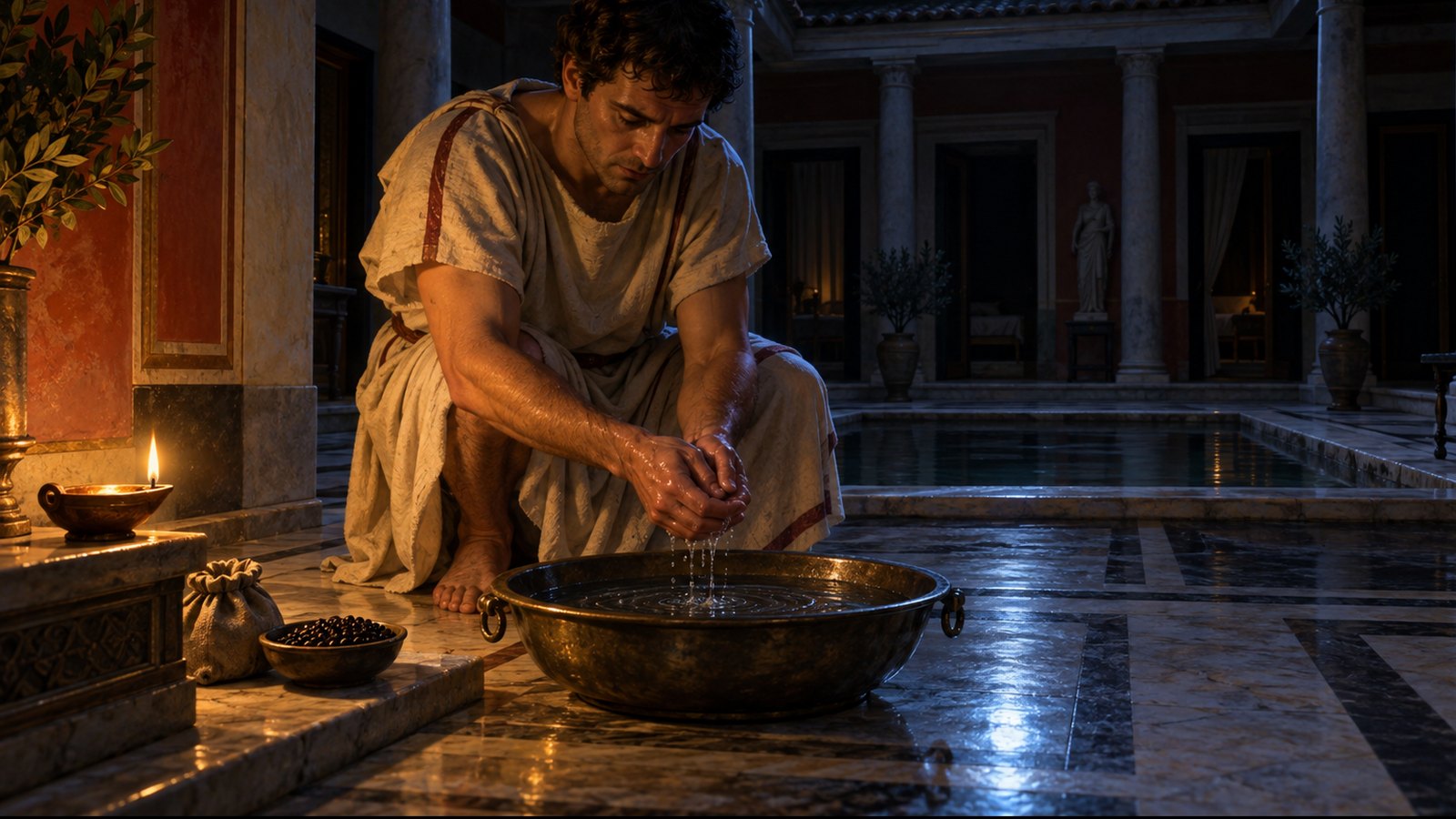
The Beans Bought Distance Without Requiring a Face-to-Face Meeting
The black beans enter only after the preparatory gestures. The celebrant receives them, turns away and throws them backward. His words identify an exchange: the beans redeem him and his household. Ovid does not explain a hidden theology of the bean. He shows what the object does inside this performance.
The bean can be cast without touch between living and dead. It falls behind the speaker, where the shade is thought to gather it. The unseen follower remains close enough to collect each offering yet never becomes a partner in direct conversation. The celebrant speaks forward while the imagined action occurs at his back.
Nine repetitions stretch that controlled vulnerability. A single throw might be a gift; a formula repeated nine times becomes a route, with the beans drawing the shade through a sequence the living person refuses to watch. The refusal to look back is therefore active. It keeps the exchange moving on the rite’s terms rather than satisfying curiosity.
Beans could carry very different meanings in ancient discussions. Gellius even disputed what Pythagoras had forbidden when later readers made beans mysterious. Ovid’s Lemuria scene should not be collapsed into every ancient story about the plant. Here the beans are black, countable offerings in a household act of redemption.
Bronze Changed the Rite from Payment to Expulsion
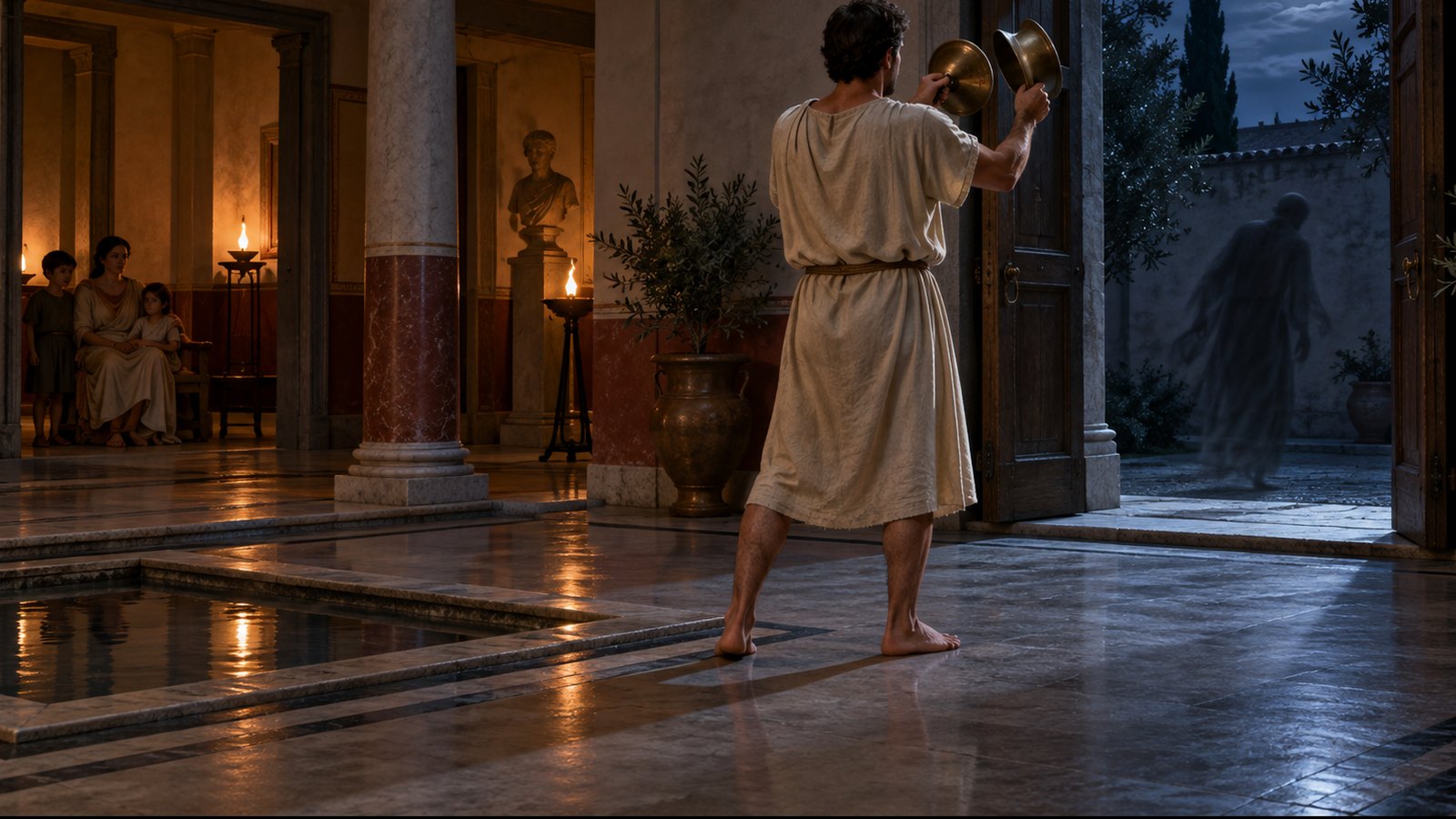
After the ninth repetition, the householder touches water once more. Then the soundscape breaks. Ovid says he clashes Temesan bronze and asks the shade to go out of his house. The earlier silence made this noise possible as a sharp boundary marker.
The material is geographically specific in the poem. Temesa was associated with bronze, so the phrase gives the sound both substance and place. Ovid does not describe an elaborate instrument. What matters in the action is the ringing metal and the request directed toward the interior boundary: leave these roofs.
The wording also changes. The beans were accompanied by a statement of redemption. The bronze prepares a command: “Ancestral ghosts, go forth.” That order is said nine times, matching the count of the earlier formula. Gift and dismissal have equal verbal weight, but they do different work.
Only after the second set of nine does the celebrant look behind him. Ovid marks that turn as the sign that the sacred acts have been performed correctly. The gaze is not permanently forbidden. It is delayed until the imagined follower has accepted the beans, heard the bronze and crossed out of the household.
Ovid Preserved the Procedure but Questioned the Name
After giving a remarkably confident sequence of movements, Ovid admits that the origin of “Lemuria” escapes him. He asks Mercury for an explanation and then tells a foundation story involving Romulus, Remus, their foster parents Faustulus and Acca, and a ghost at the bedside.
In that story, the bloody shade of Remus appears after his burial. He recalls the future the augural birds might have granted him, condemns the citizen’s hand that killed him, and asks Faustulus and Acca to carry a request to Romulus: let a day honor his memory. Ovid says Romulus complied and called it Remuria, a rough initial sound later softened into Lemuria.
The poet then connects lemures with the souls of the silent dead. This is an explanation within Ovid’s poem, not a license to treat every detail as recoverable institutional history. His own admission of uncertainty matters. He knows the ritual sequence more securely than he claims to know the word’s beginning.
That distinction protects the most vivid evidence. Whether or not the Remus tale explains the name, Ovid’s scene shows how a Roman writer imagined a household managing dangerous proximity to its dead. Midnight removes ordinary noise. The body is unknotted and washed. Black beans create an exchange that need not be watched. Bronze turns silence into departure. Only after two sets of nine may the living person face the space behind him again.
Sources
Ovid, Fasti, 5.419–492.