
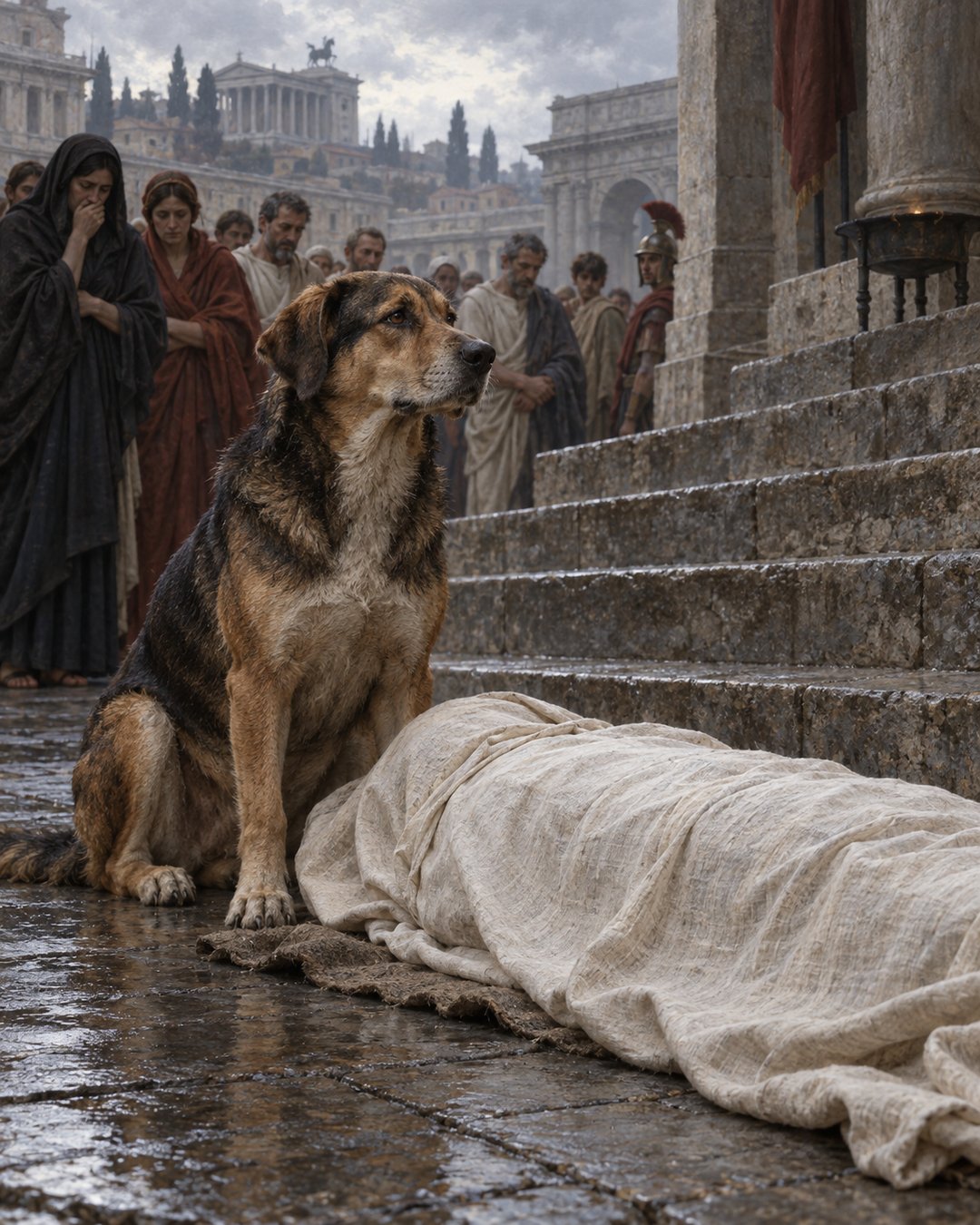
At the foot of Rome’s Gemonian stairs, a dog stayed beside a dead man whom the city had learned to avoid. The animal howled while a large circle watched. Someone in the crowd threw it food. Instead of eating, the dog carried the offering to the mouth of Titius Sabinus.
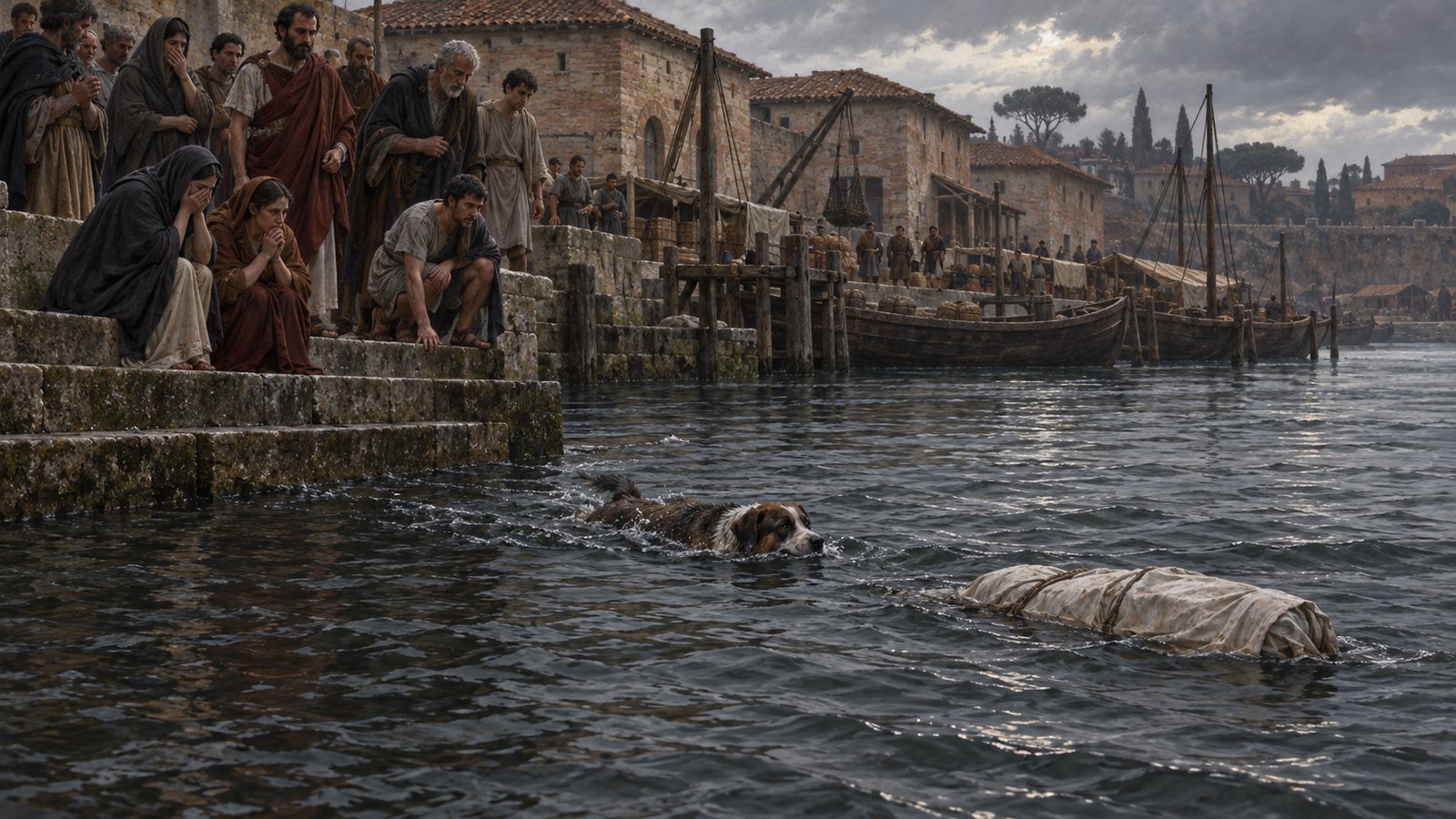
The gesture could not revive its master, alter a Senate decree or undo the political trap described by Tacitus. It did something narrower and stranger. It showed a form of attachment after human loyalty had become dangerous. When Sabinus’s corpse was later cast into the Tiber, the dog entered the water behind it and tried to keep the body afloat.
Pliny the Elder preserves the episode as evidence of canine fidelity. Read beside Tacitus’s account of Sabinus’s destruction in AD 28, it becomes more than an animal marvel. The state had turned friendship into incriminating evidence and public proximity into a risk. The dog kept closing the distances that frightened people opened.
Four Ambitious Men Built a Witness Box Above the Ceiling
Titius Sabinus was a Roman knight attached to Germanicus’s household. After Germanicus died, Sabinus did not abandon his widow Agrippina and their children. Tacitus says he remained a visitor in their home and a companion in public when the larger crowd of clients had fallen away.
That constancy made him conspicuous under Tiberius and Sejanus. Tacitus names four former praetors who wanted advancement: Latinius Latiaris, Porcius Cato, Petilius Rufus and Marcus Opsius. Their route toward office ran through Sejanus, and Sabinus offered them a victim with the wrong loyalties.
Latiaris used a slight acquaintance to approach him. He praised Sabinus for staying faithful to an afflicted house, spoke honorably of Germanicus and pitied Agrippina. Sabinus responded with tears and complaints. Apparent sympathy became the bait that made him return to what seemed a trustworthy listener.
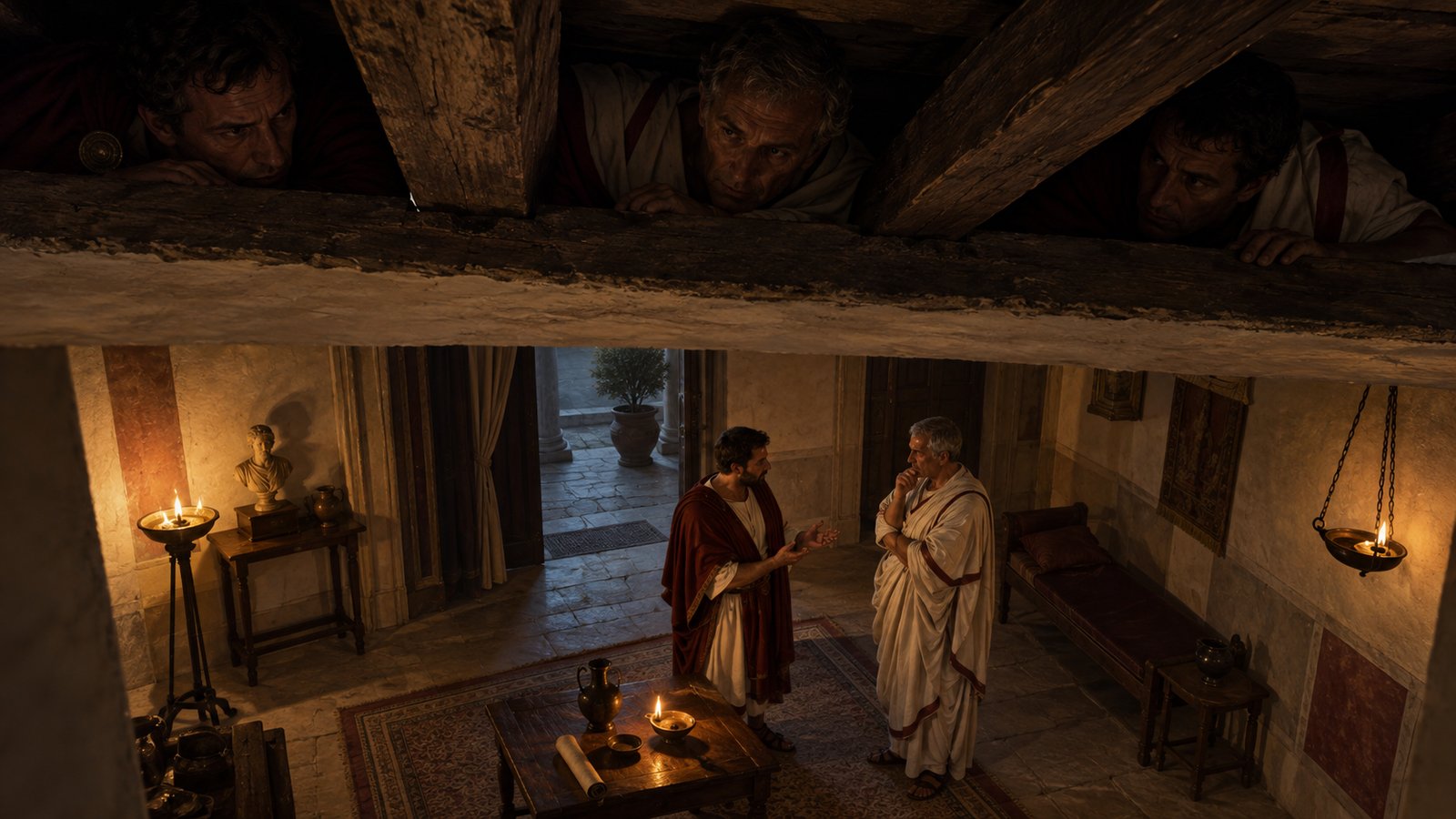
The final arrangement was architectural. Three senators squeezed into the space between roof and ceiling. From there they listened through chinks while Latiaris drew Sabinus into a bedroom conversation below. The hidden men were not overhearing by chance. Their cramped position manufactured the wider audience needed for accusation.
The physical setup separates this story from the Epirote dog that confronted a suspected murderer. In that account, animal recognition helped expose a hidden human act. Here humans conceal themselves to turn private grief into evidence, and the dog appears only after their scheme has succeeded.
New Year Prayers Opened Straight into an Execution
Tacitus places the official blow on 1 January. A letter from Tiberius began with the customary prayers for the new year, then accused Sabinus of corrupting freedmen and plotting against the emperor. The demand for vengeance was unmistakable. Punishment followed without delay.
Sabinus was dragged away with a cloak muffling his head and a noose around his neck. Tacitus gives him a final bitter cry: these were the ceremonies inaugurating the year, these the victims offered to Sejanus. The contrast between sacred calendar and political killing is the historian’s, but the date and sequence make the shock concrete.
The people around him responded through motion. Wherever Sabinus looked or could be heard, Tacitus says, streets and forum emptied. Some then retraced their steps, pale because even visible alarm might be dangerous. The condemned man’s isolation was not simply a lack of sympathy. It was produced by spectators calculating whether a glance, pause or gesture could attach them to his case.
That atmosphere had already entered private rooms. Meetings and conversations were avoided; friends and strangers seemed equally capable of listening. Tacitus says even walls and roofs were eyed with suspicion, an image made literal by the senators who had hidden above the ceiling.
Sabinus’s loyalty to Germanicus’s family had made him exceptional before his arrest. The public journey to death made everyone else practice disloyalty in real time. A related act of dangerous attachment appears when Agrippina carried Germanicus’s ashes through a silent Italy. Sabinus’s end shows the later political cost of remaining near that household.
The Dog Reversed the Crowd’s Logic on the Gemonian Stairs
Pliny begins his evidence in prison. One dog belonging to Sabinus’s household could not be driven away and would not leave the body after it was discarded. The account then moves to the Gemonian stairs, the place where condemned bodies could be exposed to public contempt.
There the dog produced mournful howls before a large circle of Romans. Its persistence changed the scene’s emotional center. The corpse was meant to display the state’s power over a disgraced enemy. Pliny asks his reader to look instead at the living animal that refused the required separation.
The food episode sharpens that refusal. A spectator tossed something for the dog to eat. The dog carried it to the dead man’s mouth. Pliny does not claim the animal understood death in human terms, nor does he give it a speech or invented motive. He records an action shaped by an old routine: food reached the dependent animal, and the animal redirected it toward its master.
That small movement implicated the crowd without making it brave. Someone offered food to the dog, not aid to Sabinus. The audience could pity an animal safely after fleeing the condemned man. Yet the dog used that safe gift to reconnect itself visibly to the politically dangerous body.
The scene also differs from the animals killed at Regulus’s son’s extravagant funeral. Those pets were drawn into a living patron’s display. Sabinus’s dog is not staged by an owner. Its repeated return frustrates the intended spectacle of abandonment.
A Swim into the Tiber Made Fidelity Impossible to Miss
The last movement carried the body away from the steps. After it was thrown into the Tiber, the dog swam after it. Pliny says the animal tried to support the corpse. The river should have ended the vigil by removing the object of loyalty; instead it forced the loyalty into greater physical effort.
Only then does Pliny describe the multitude pouring out to watch the animal’s fidelity. Tacitus’s people scattered when closeness to Sabinus threatened them. Pliny’s crowd assembled when the dog made closeness safe to admire. The two authors are pursuing different purposes, but their scenes meet around public distance.
The dog did not protest Tiberius, identify the informers or understand the Gemonian stairs as a political instrument. Calling its behavior resistance would give the animal a program the source does not provide. Its actions mattered because they were stubbornly practical: remain beside the body, carry food back, follow into water, push upward against the current.
Pliny includes the story in a catalogue of canine memory, recognition and devotion. The political history supplies what that catalogue leaves compressed. Sabinus had been punished in a system where companionship itself could be interpreted as conspiracy. The animal continued behaving as a companion after every human institution around the corpse had declared that bond unsafe.
This is why the story survived as more than a sad ornament. Tacitus shows roofs made treacherous by hidden listeners and streets emptied by fear. Pliny shows stone steps crowded around a dog, then a riverbank filling as it swims. One sequence demonstrates how repression breaks visible relationships. The other preserves a relationship that could not be cross-examined, promoted or frightened into denial.
The dog could not save Titius Sabinus. It could only refuse to behave as though he had become no one. On the stairs, food went back to the mouth that could not eat. In the Tiber, the animal put its body beneath a body Rome had thrown away. For the watching crowd, fidelity became visible precisely where human loyalty had been made most costly.
Sources
Tacitus, Annals 4.68–70; Pliny the Elder, Natural History 8.145.