
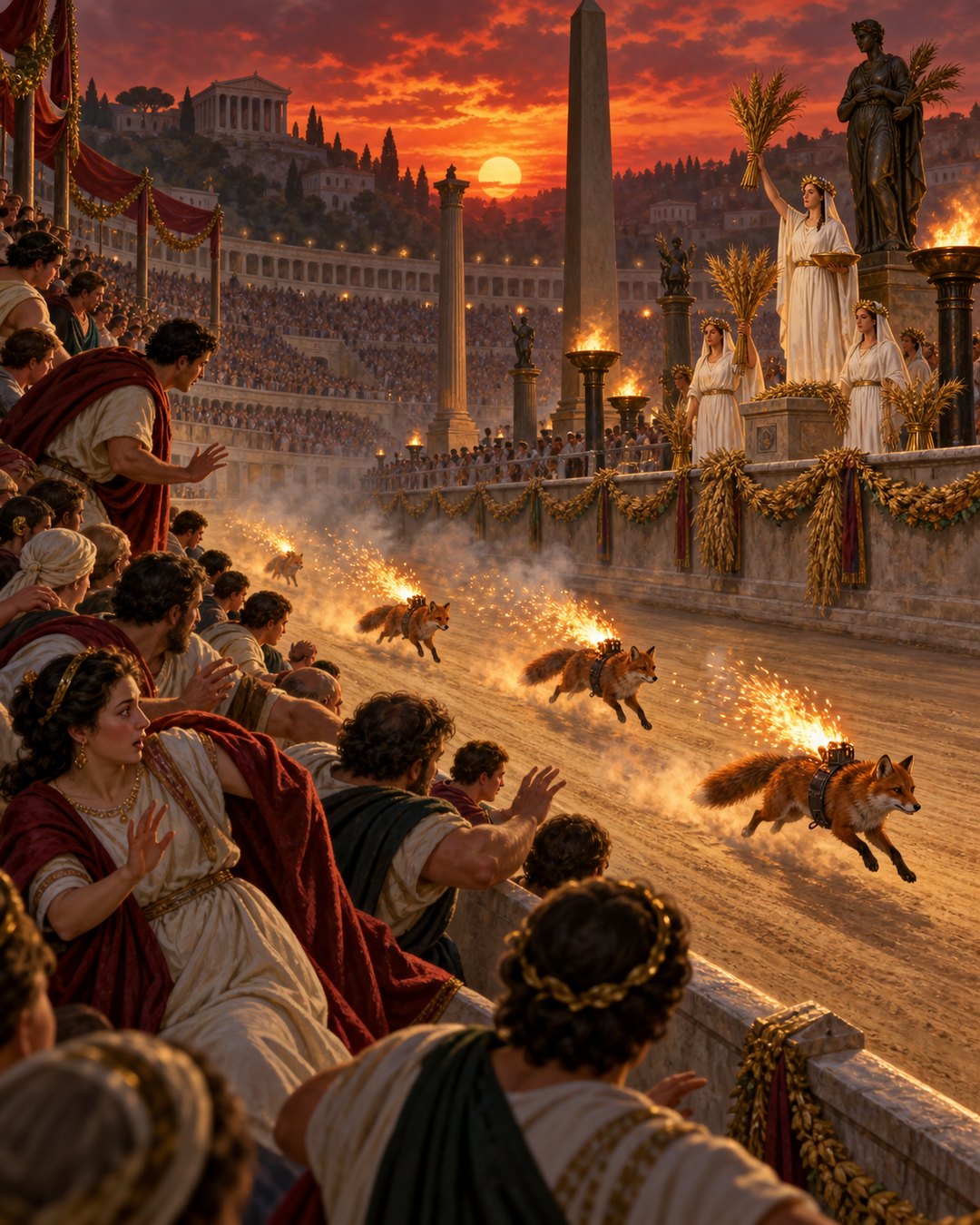
Foxes ran across the Circus carrying fire. Ovid does not let the image pass as ordinary festival color. In the fourth book of the Fasti, he stops at the games of Ceres and asks why living animals were released with torches fastened to their backs.
His answer does not begin in Rome. It begins beside a road near Carseoli, in a cold grain-growing district where Ovid says an old host told him a story about a small farm. A twelve-year-old boy caught a fox that had stolen a hen, wrapped it in tow and hay, and lit the bundle. The animal escaped into crops ready for harvest. The field burned.
That is the explanation Ovid offers for the annual punishment of foxes at the Cerealia. The passage joins an arena spectacle to a household mistake, then joins both to the vulnerability of grain. Its power lies in the route: public ritual is made legible through local memory.
A Calendar Question Opened into a Country Road
Ovid dates the episode through the sky and the racing calendar. On the third morning after the Hyades disappear, he says, horses will stand in the Circus in separate stalls. Instead of proceeding directly to the races, he asks why foxes are set loose with burning material attached to them.
The question signals that even a Roman spectator might need an explanation. Horses in stalls fit the Circus. Foxes and fire require a story. Ovid supplies one by leaving the arena in his narration and moving east toward Carseoli, a place he knew from journeys toward the Pelignian country of his birth.
The astronomical marker and the starting stalls place the reader inside a sequence already in motion. The Hyades have disappeared; another morning has arrived; teams wait for their race. Ovid then delays the expected action with an interpretive problem. Before the horses run, the poem has to account for a far stranger runner.
He characterizes the district through agriculture. It is cold and poor for olives, yet suitable for grain. That contrast places cereal cultivation at the center before the fox appears. Ceres is not attached to an abstract symbol alone; her festival is connected to land whose success depends on a standing crop surviving until harvest.
The method differs from the household expulsion preserved in the Lemuria rite of black beans and nine commands. There, repeated words and gestures drive dangerous presences from a home. Here, Ovid uses a remembered disaster to explain why danger itself is displayed before a crowd.
His authority is deliberately personal. An old host points toward the plain and tells the tale. Ovid presents neither an inscription nor a priestly decree. He shows a traveller receiving local knowledge and carrying it into a poem organized around Rome’s sacred year.
The Farm Is Built from Work before It Is Threatened
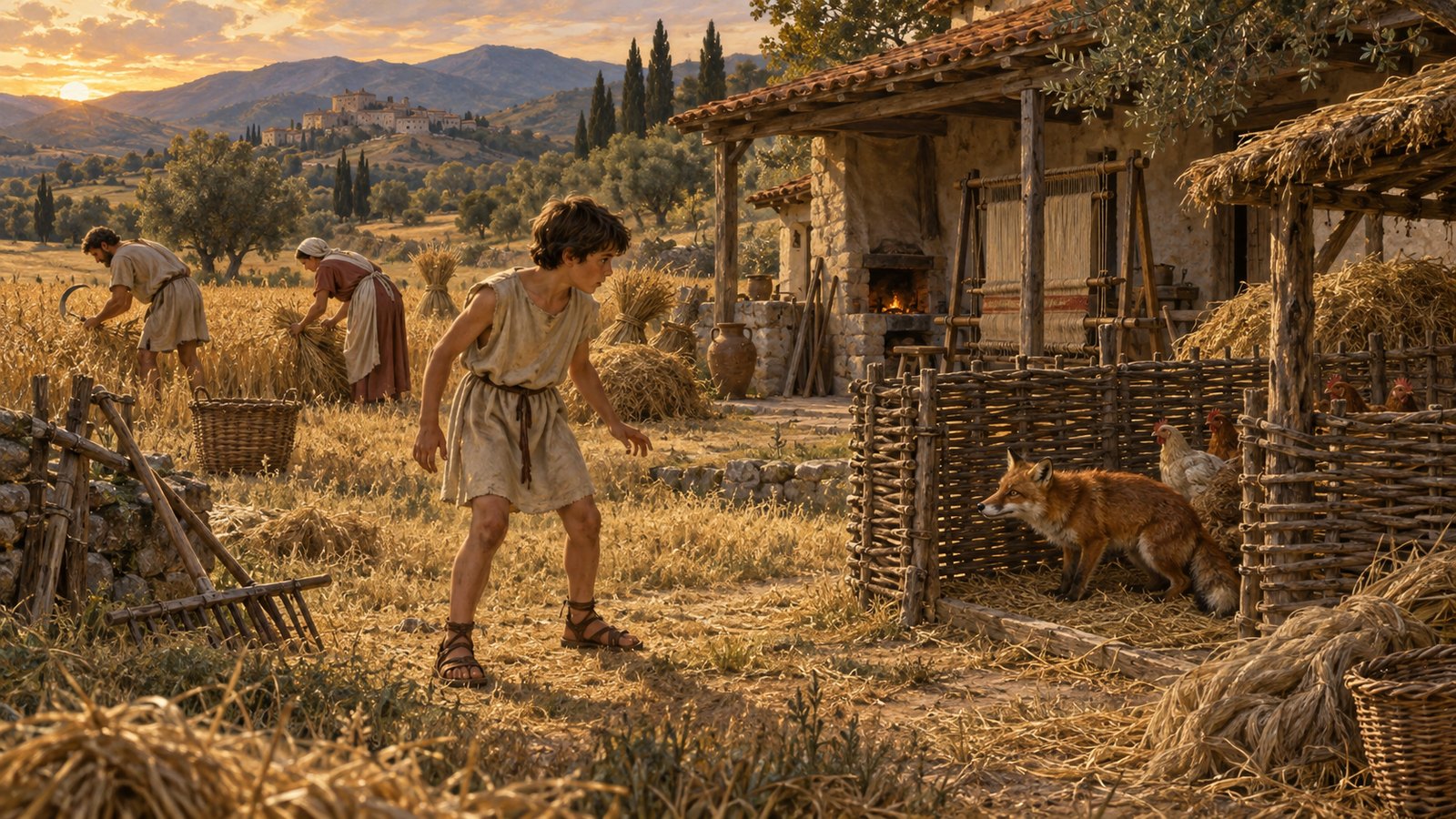
The host’s account lingers over a modest household. A thrifty woman and her sturdy husband hold a small plot. He handles plough, curved sickle, and hoe. She sweeps a propped cottage, tends eggs beneath a brooding hen, gathers mallows and mushrooms, warms the low hearth, and works at the loom against winter.
These details slow the approach to catastrophe. Grain does not appear as a faceless commodity. It belongs to a cycle of soil, tools, domestic labor, poultry, fuel, cloth, and weather. The family’s security depends on many small tasks being performed in the right season.
Their son has lived twice five years and two: twelve. Ovid labels him playful, which makes the act that follows look impulsive rather than administrative or sacrificial. A fox takes poultry, and the boy responds as someone defending a household resource without understanding how far his chosen punishment can travel.
The hen connects the threat to the mother’s work. She has set eggs under a bird; the fox reaches into that managed cycle. The child catches the predator, but the retaliation introduces a larger danger than the theft. Tow and hay are light, dry materials. Once burning, they can move wherever the frightened animal moves.
Rome’s grain supply depended on systems much larger than this field, including the storage and movement explored in Ostia’s warehouses and Rome’s hunger. Ovid’s little farm works at the opposite scale. One family watches a season’s labor become combustible.
The Punishment Escaped Its Intended Boundary
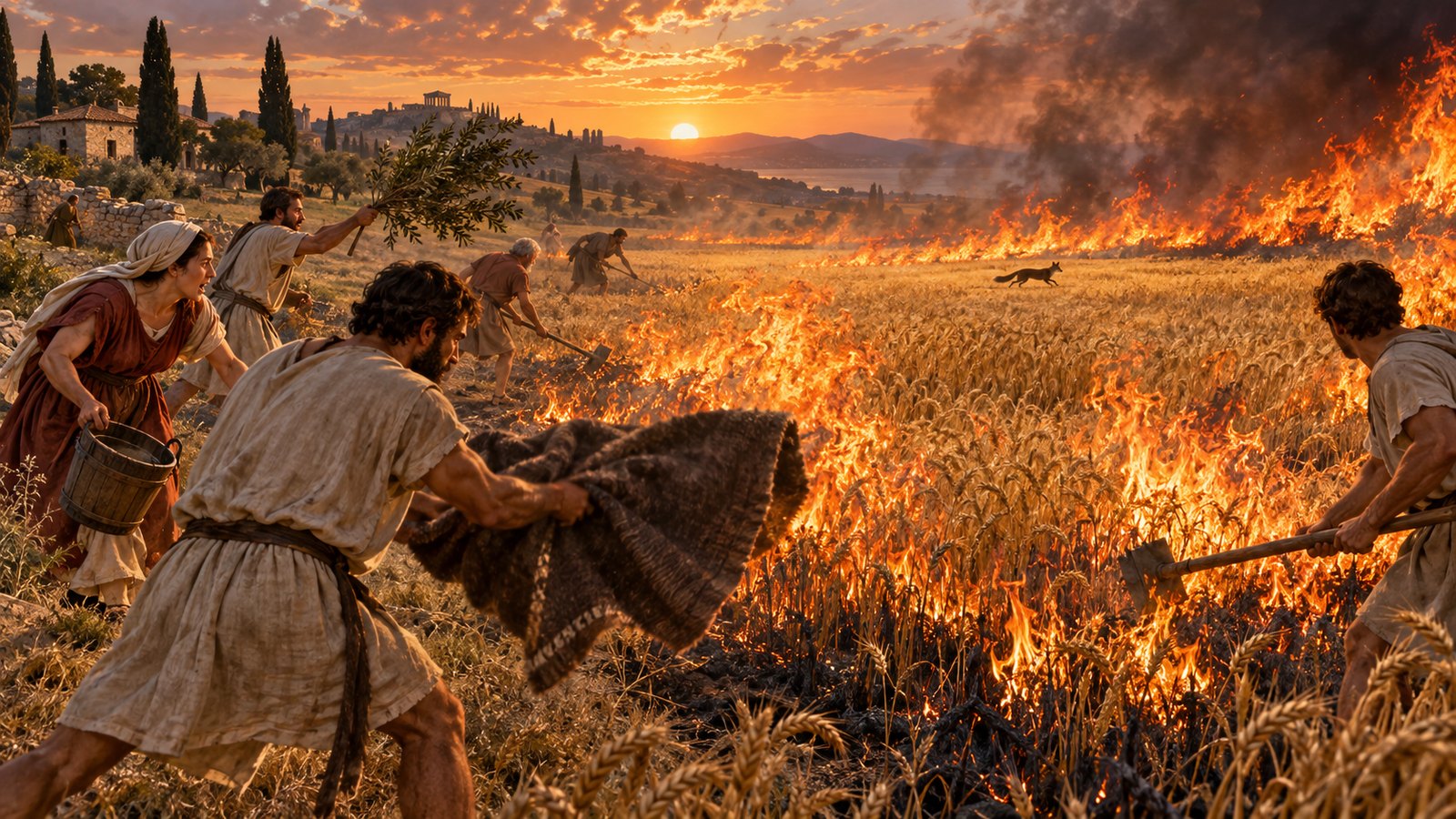
The fox does not remain where the boy caught it. Wrapped in tow and hay and set alight, it breaks free. The device meant to concentrate punishment on one animal becomes a means of transporting flame into the field.
Ovid says the crops were already ripe or near harvest. Timing makes the loss acute. The household has passed through ploughing and growth, and the grain now stands dry enough for fire to race. The moment closest to reward is also the moment when accumulated labor can disappear fastest.
This is the tale’s mechanical center. Fire is attached to movement. The running fox crosses boundaries that a stationary hearth flame would not. A farmyard act reaches the crop, and a private grievance becomes a communal agricultural warning.
The story does not provide an acreage, a count of animals, or the name of the family. It does not let us calculate the fire’s duration. Those absences matter because the poem is not a farm report. It compresses a chain of cause and consequence into memorable objects: hen, fox, tow, hay, standing grain.
The materials also reverse familiar household functions. Hay that can feed or bed an animal becomes fuel. Fibrous tow that can be handled in domestic work becomes a burning tether. The low hearth tended by the mother is controlled fire; the bundle carried into the field is fire without a boundary. Ovid’s objects make the difference visible without a technical discussion of combustion.
Ovid then says Carseoli had a rule that forbade naming the fox. The wording marks the animal as polluted by the story. Whether that local prohibition can be reconstructed beyond the poem is uncertain; within the poem, it carries the farm’s reaction forward.
The Circus Repeated a Warning under Ceres
The conclusion returns to annual time. The fox perishes at the Cerealia as punishment. A single escaped fire has become a recurring ritual explanation, and the urban spectacle repeats the rural danger before spectators who may never have seen the field at Carseoli.
Ceres governs the frame because grain is what the fire destroyed. Earlier in the same festival sequence, Ovid praises cultivation, yokes, and the transformation from rough foods to grain. The fox episode shows the gift’s fragility. Food must not only grow; it must survive misjudgment, flame, and the last days before cutting.
The contrast with the racing teams sharpens that lesson. Horses enter assigned stalls and move along a prepared course. The fox in the origin tale follows no course at all. Its unpredictable flight is precisely what carries the boy’s fire beyond the farmyard, while the ritual attempts to contain that memory inside a scheduled festival.
Other Roman commemorations also turned an old failure into repeated action. The annual treatment of Capitoline geese and watchdogs in the ritual memory of the Gallic attack distributed blame and honor among animals. Ovid’s foxes similarly make an animal body carry a lesson, but the danger here is agricultural rather than military.
The spectacle remains disturbing, and Ovid’s story does not make it harmless. What it reveals is how an explanation can domesticate strangeness. A viewer asks why foxes bear fire; a poet offers a child, a stolen hen, a material bundle, and a ruined crop. Each link makes the next one feel inevitable.
Yet the chain is literary as well as ritual. We know the host through Ovid, and Carseoli’s remembered farm through the host’s speech. The poem is transparent about that route. Instead of claiming timeless certainty, it lets us watch local story become Roman calendar knowledge.
The fox crossing the Circus therefore carries two fires: the flame staged in the arena and the remembered blaze in standing grain. The first repeats because the second, in the tale, should never have happened.
Sources
Ovid, Fasti 4.679–712.