
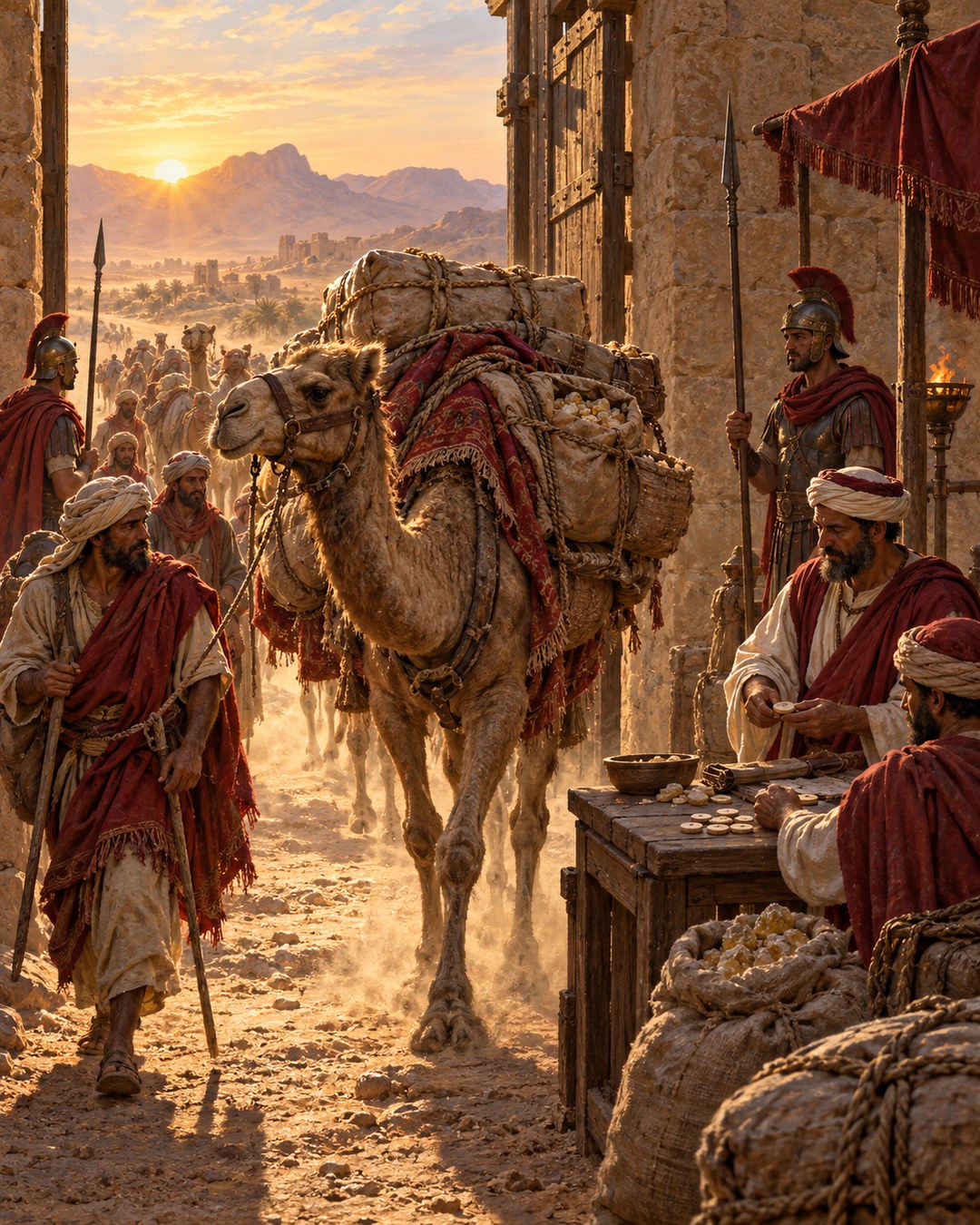
Before a camel carrying frankincense reached Mediterranean Gaza, Pliny says, it had accumulated 688 denarii in expenses. Roman customs charges still lay ahead. The number belonged not to the resin alone but to the route: water, fodder, lodging, tolls, guards, permissions and claims collected between tree and sea.
The journey began with restricted access. Pliny assigns harvesting rights to about three thousand families, passed down by inheritance. Gathered resin moved through a temple, surrendered a measured tenth to a god, and left by a guarded public gate.
Frankincense became valuable through more than rarity and distance. Every controlled transition added another party able to charge the load.
Three Thousand Families Controlled the First Cut
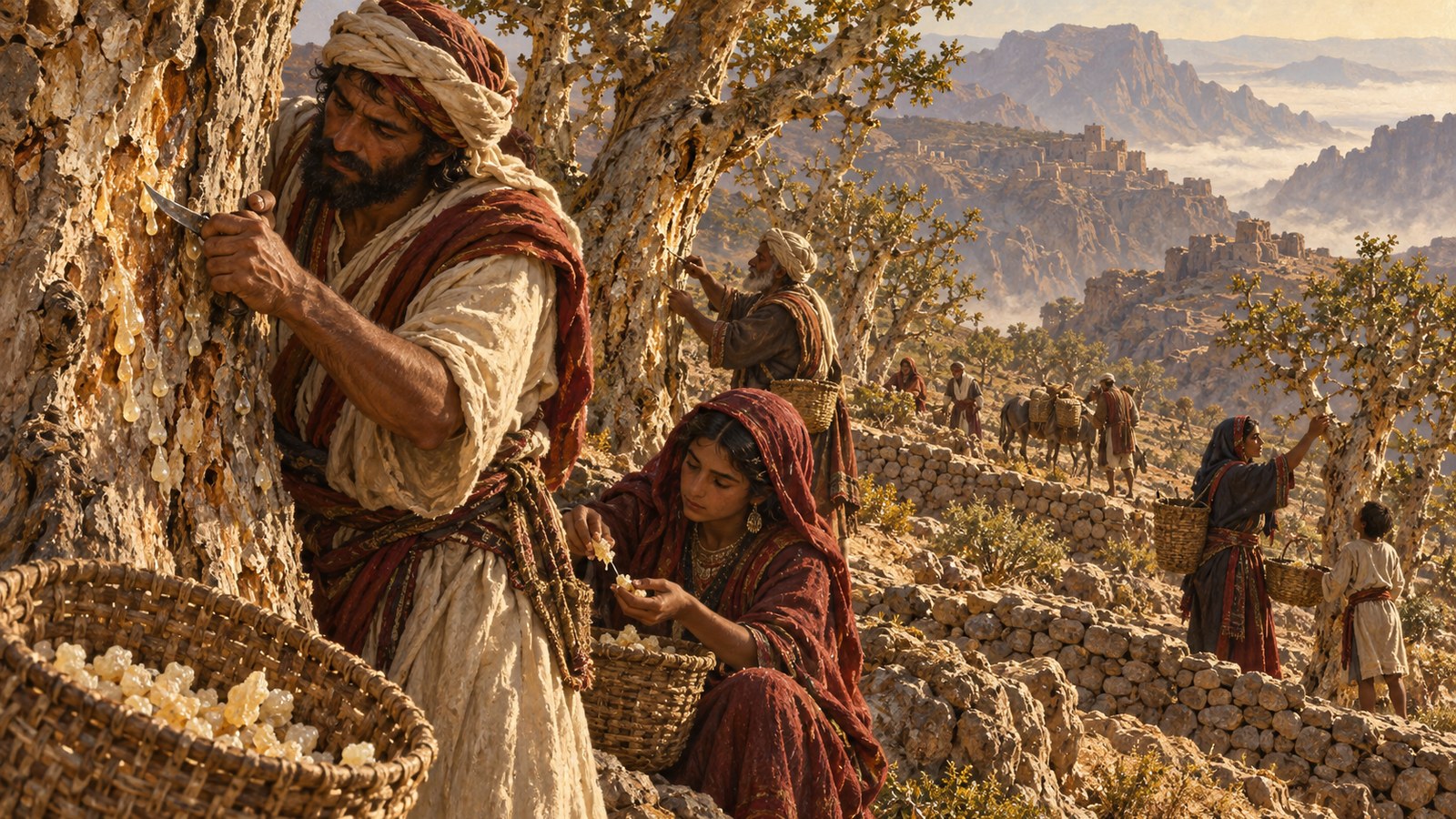
Pliny places the gathering of frankincense in the hands of the Minaei. He says about three thousand families possessed the right and transmitted it by hereditary succession. Access to the trees was therefore presented as a bounded privilege, not an open scramble across an aromatic landscape.
The family count makes labor visible while defining exclusion. Three thousand households are numerous enough to support a major trade, yet limited enough for the right to remain identifiable. The crop begins inside a social system before it enters a bale.
Pliny calls the harvesters sacred and reports purity restrictions around the work. Whatever gaps remain in his Roman account of Arabian practice, the structure he describes is clear: gathering is surrounded by rules that distinguish authorized hands and an authorized season.
The source does not tell us the annual yield of each household, the exact boundaries of every grove, or how disputes between families were settled. It should not be expanded into a complete labor code. What it preserves is a strong first constraint on supply. Resin could be commercial only after recognized people performed the cut.
That arrangement differs from the risk divided in Octavius’s grain contract. There, a written loan and cargo quantity expose how parties allocated the danger of transport. In Pliny’s frankincense account, control begins even earlier, with inherited eligibility to touch the crop.
Physical skill mattered as well. Aromatic resin had to be separated from a living tree, collected without losing it in dust, and prepared for movement. Pliny is more interested in marvel and trade than in a full technical manual, but his family system implies knowledge repeated across generations alongside rights.
A Temple and Public Gate Converted Resin into Accounted Cargo
After gathering, the frankincense did not move directly toward foreign buyers. Pliny says it was carried to the temple of a god he names Sabis. There, a tenth part was taken by measure. Trade could not proceed until the divine share had been paid.
The tithe transformed loose harvest into assessed quantity. Someone had to assemble it, measure it, remove the tenth and recognize the remainder as ready to continue. Ritual obligation and commercial accounting occupied the same moment.
Pliny then describes a public gate under guard. Frankincense had to leave through that controlled opening. Secret diversion faced penalties, while authorized cargo passed a point where movement could be observed. The gate turned geography into enforcement: a narrow exit made a dispersed crop legible to authority.
A measured tenth also scales automatically. A rich harvest gives more; a poor one gives less. The rule does not need a new flat charge for every household. By attaching obligation to volume, the temple participates directly in fluctuations of production.
Roman religious economies often made material offerings part of institutional order. The annual spectacle explained through Ovid’s burning foxes at the Cerealia tied grain danger to a calendar performance. The frankincense tenth works through measurement instead: aromatic substance becomes the god’s share before merchants can move it outward.
The source does not give a surviving receipt from this gate or name one individual guard. Its detail is systemic rather than biographical. Temple, measure and exit form a sequence that every legal load had to negotiate.
The Desert Route Charged for Survival as Well as Passage
Frankincense travelled on camels through the territory of the Gebbanitae toward Gaza. The animal was not simply a picturesque marker of distance. It was the unit around which Pliny totals expense: 688 denarii per camel before Roman customs collected their portion.
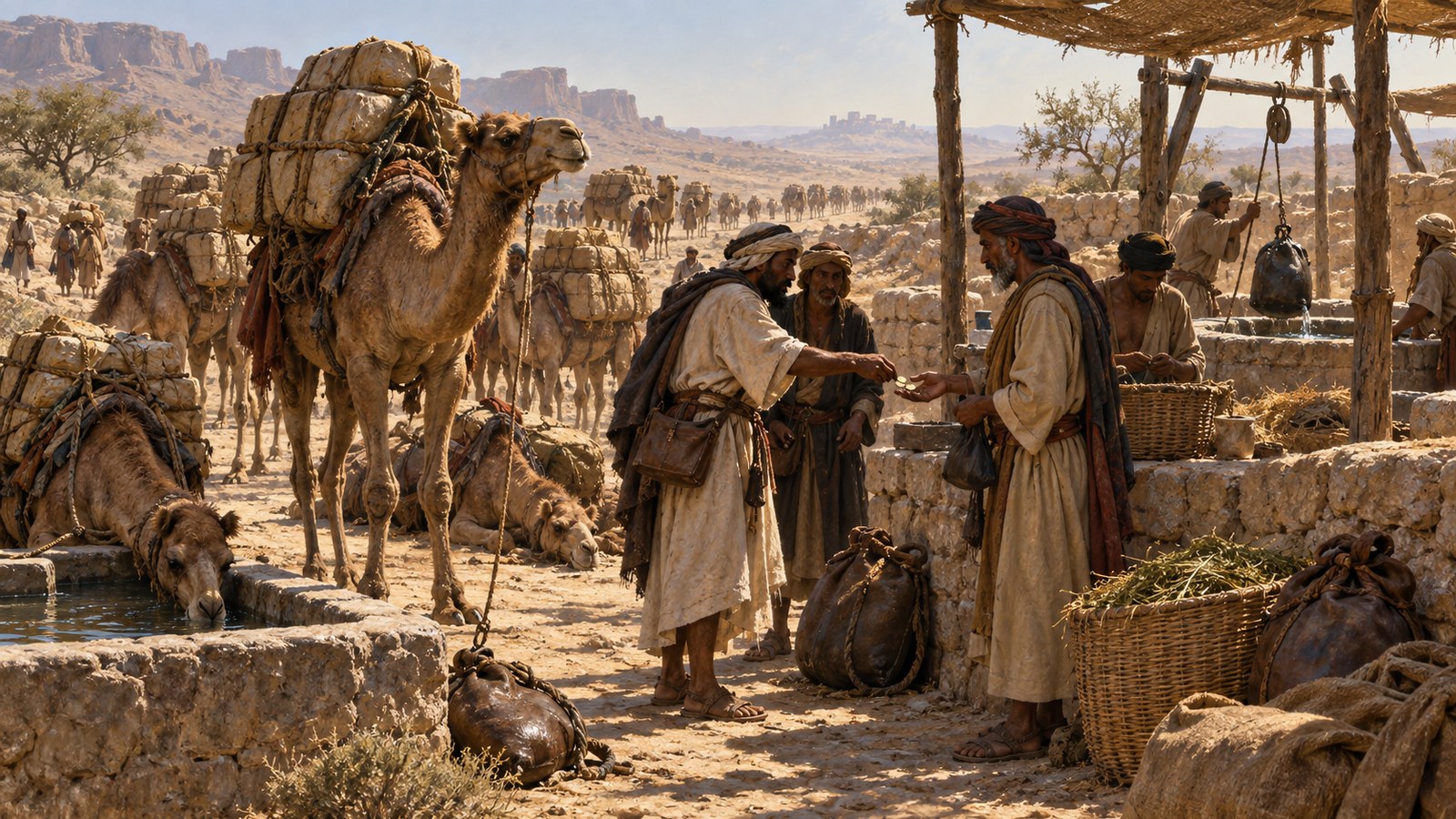
Along the road, carriers paid for water. In an arid crossing, water is not optional consumption that can be postponed indefinitely. Control of a well or station creates the power to charge because animal, driver and cargo cannot reach the coast without it.
Fodder created a parallel claim. A loaded camel consumes resources while carrying the commodity that will eventually repay them. The farther the journey, the more value must be spent keeping the transport mechanism alive.
Pliny adds lodging and various tolls. A caravan needs places to halt, secure bales and recover. Political authorities can also demand payment because the route crosses controlled territory. Survival costs and permission costs become difficult to separate; both attach themselves to forward movement.
The total should not be mistaken for the final retail price of a fixed weight of incense. Pliny’s figure belongs to one camel’s accumulated route charges in the system he describes. It precedes Roman customs and says nothing by itself about the load weight, merchant margin or price of a pinch burned in Rome.
Its importance lies in aggregation. A small payment at one station may look modest. Repeated across wells, stopping places and jurisdictions, charges become a figure large enough for Pliny to present as evidence of luxury’s hidden cost.
Gaza Was an Arrival Point, Not the End of the Price
Gaza put the caravan at the Mediterranean edge, but the account does not let the cargo escape institutional hands there. Roman customs officers still expected payment. The stated 688 denarii is explicitly incomplete, a subtotal reached before another authority added its claim.
This sequencing matters. The resin has already passed hereditary gatherers, sacred restrictions, a temple tenth, a public gate, camel transport, Gebbanite territory and service stations. Customs does not create the long-distance commodity from nothing. It encounters a load already shaped by every earlier checkpoint.
The trade therefore linked authorities that did not need one unified plan. Families defended harvesting privileges. Priests received the god’s portion. guards controlled an exit. Providers sold necessities. Local powers levied tolls. Roman officers taxed entry into their fiscal sphere. Their separate actions accumulated on the same bale.
Luxury at the consuming end can hide this chain. Smoke rises quickly from a brazier, while the route embedded in the resin disappears. Pliny reverses that perspective. He asks readers to see Arabia, inherited rights and camel expenses inside a substance used in small fragrant quantities.
The figure also explains why adulteration and quality distinctions mattered elsewhere in discussions of aromatics. When transport carries so many sunk costs, merchants and buyers have strong reasons to debate what a bale truly contains. A low-quality or false product can travel through the same expensive system as a valuable one.
Distance alone is an empty explanation. Miles do not collect coin. People and institutions situated along those miles do. Pliny’s camel reaches Gaza bearing resin, but it also bears a financial map of every place where movement could be measured, supplied, delayed or refused.
By the time the load approached the sea, the tree’s hardened sap had become a compound object: crop, sacred due, guarded export, caravan burden and taxable import. The 688 denarii recorded the route before Rome added its own line.
Sources
Pliny the Elder, Natural History 12.32.