
Uxellodunum still had grain. Its hill was steep enough to frustrate a direct assault, and a river curved around almost the whole base. Yet Caesar did not begin by trying to climb the walls. He looked for the routes by which water climbed toward them.
The river itself could not be turned aside. It pressed so closely against the foot of the hill that there was nowhere to lead a diversion trench. Roman archers, slingers and artillery could make the defenders’ descent dangerous, but danger did not erase the water below.
Then the siege narrowed to a spring beneath the town wall. What followed joined a conspicuous ramp and tower to a concealed excavation. One operation controlled what the defenders could see. The other reached the unseen channels feeding the source. When those channels were cut and diverted, the perennial spring suddenly stopped.
A River Almost Encircled the Hill Yet Could Not Save It
Hirtius, who completed the eighth book of the Gallic War, places Uxellodunum in the last hard season of resistance. Caesar arrived unexpectedly and found a town already enclosed by siege works. Deserters reported that the inhabitants possessed a large store of grain. Starving them quickly would not work, so he turned from food to water.
The site appeared generously supplied. A river ran through the valley and almost surrounded the hill on which the town stood. The slopes were precipitous on every side. Those features protected the settlement from assault, but they also concentrated movement into a small number of difficult paths.
Caesar first considered diverting the river. The ground rejected the plan. Because the channel ran directly along the hill’s base, trenches could not draw it away somewhere else. This is an important limit in the narrative: Roman engineering did not begin with an all-purpose power to reshape any landscape. The first proposed mechanism failed against the actual geometry of valley, hill and current.
The alternative was to govern access rather than flow. The descent from the town was difficult and steep. Archers and slingers were posted around it, while artillery covered the easiest lines down. Anyone carrying a vessel had to move slowly enough to descend, fill it and climb back under observation.
The result resembles neither a dramatic breach nor the layered obstacle field in the eight rows of concealed defenses outside Alesia. At Uxellodunum, the landscape was not filled with traps to stop an approaching relief army. Existing paths became exposed corridors, and an ordinary domestic action—fetching water—became the point at which the town’s height worked against its inhabitants.
Missiles could interrupt the river route, but they could not guarantee that every vessel remained empty. A second source therefore became decisive. The defenders’ water carriers assembled beneath the wall where a great spring emerged. In a roughly three-hundred-foot break in the river’s circuit, this outlet offered water close to the fortification without the full descent to the valley floor.
The Tower Made the Spring Approach Visible
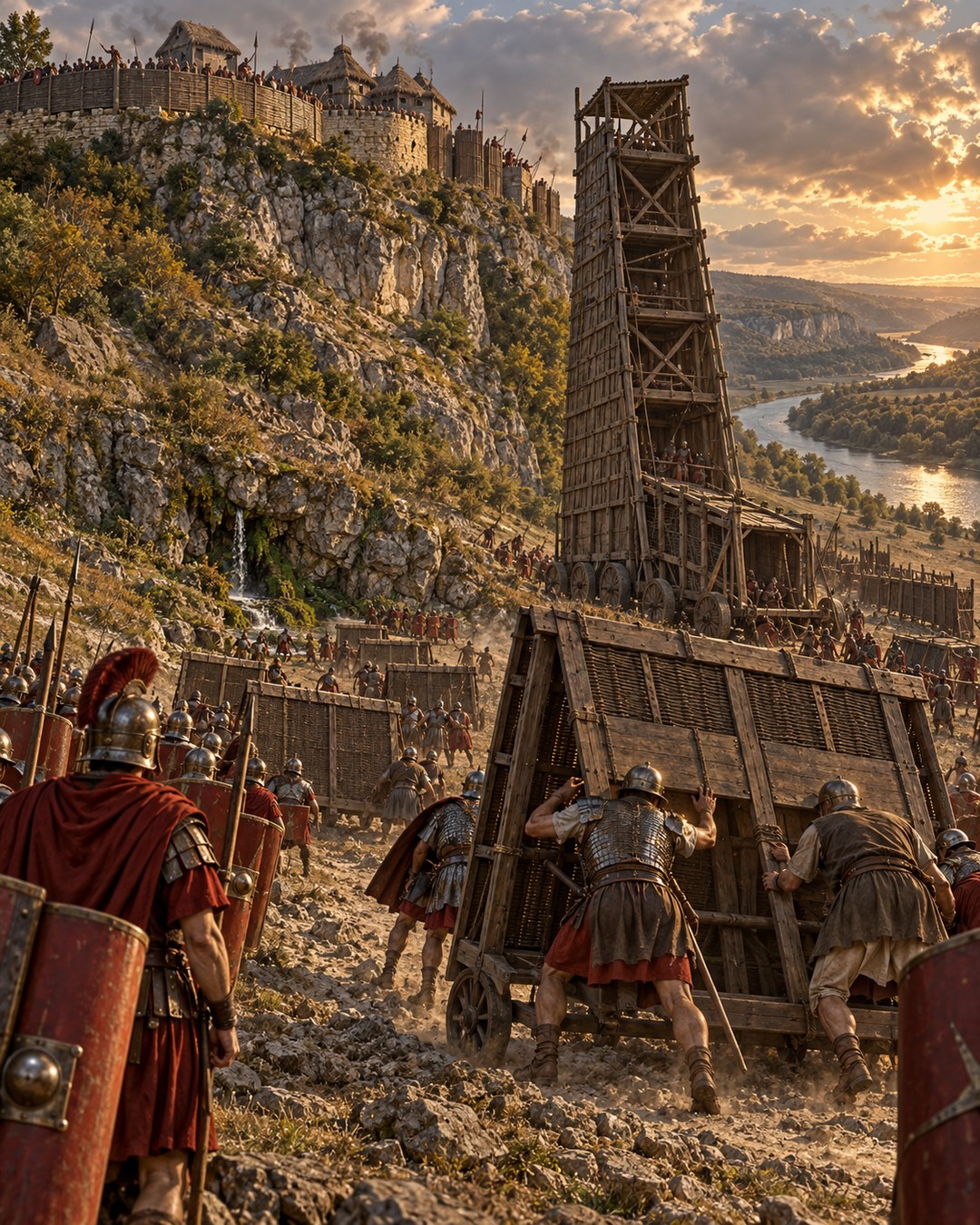
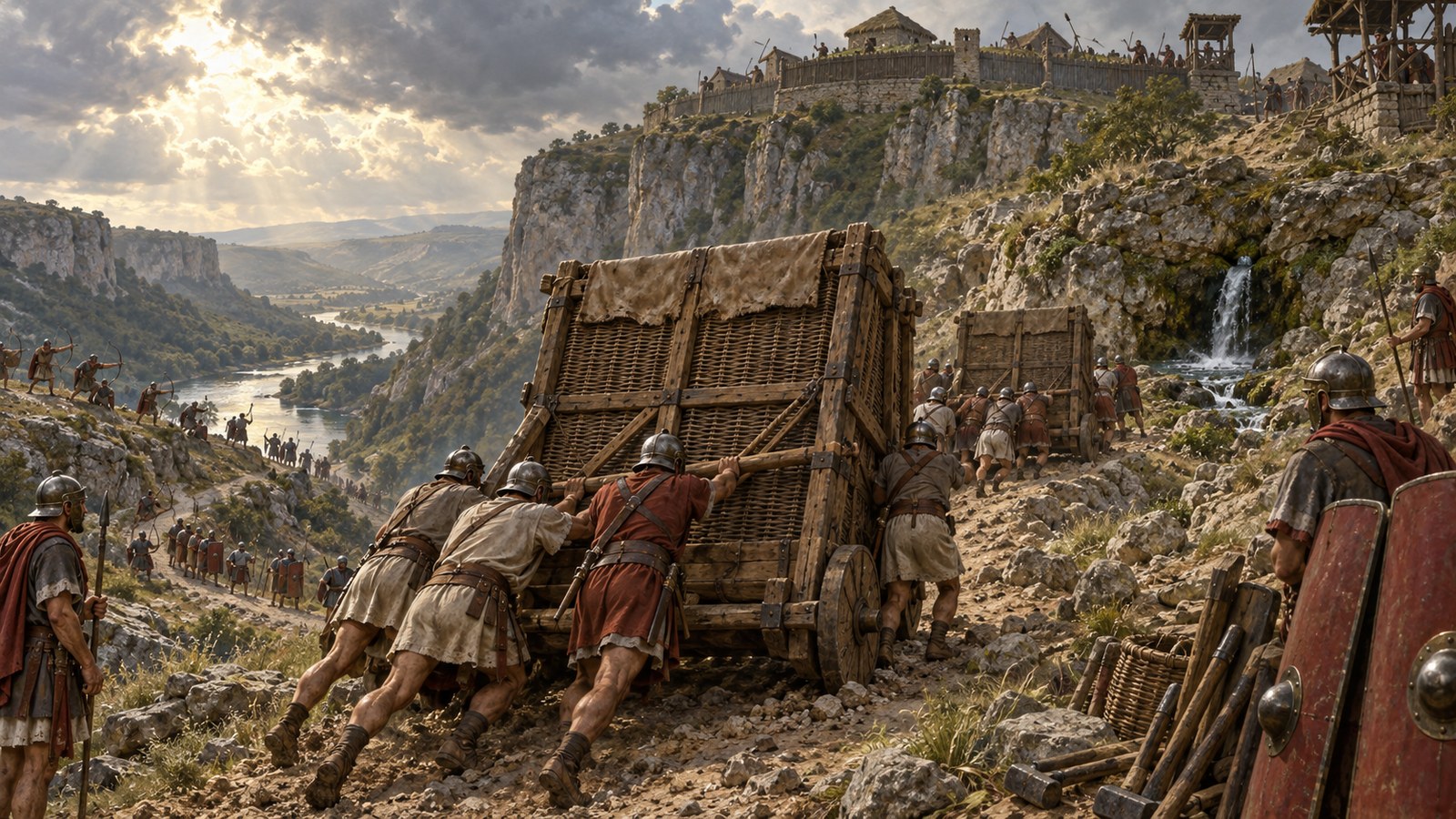
The Romans pushed mantlets toward the hill opposite the spring. These timber screens gave workers moving cover while they advanced against defenders firing from above. Progress remained difficult. Hirtius emphasizes continual fighting and the wounds taken by men forcing the construction uphill.
Behind that moving protection rose a ramp. It eventually reached sixty feet in height, and a turret of ten stories stood on top. The purpose was unusually specific. The tower could not reach the town wall; Hirtius says the terrain made that impossible. Instead, it overtopped the level of the spring.
From there, artillery could strike the route to the source. The structure transformed a low outlet beneath a high town into ground that Roman weapons could overlook. Height answered height, but only over the narrow zone where people and animals had to gather.
The scale of the work could mislead a modern reader into making the tower the entire explanation. It was huge, visible and contested. Cattle and beasts of burden, as well as the human population, faced thirst when collection became dangerous. Yet the source still flowed. The tower imposed risk on access; it did not remove the water itself.
The defenders understood the visible threat and attacked it directly. They packed tubs with grease, pitch and shingles, set them burning and rolled them onto the works. The mantlets and ramp caught the descending material, feeding a sudden fire. Fighting continued in full view of both armies, where individual bravery could be watched and judged.
Caesar answered with misdirection. Cohorts climbed around the town and shouted as if a general assault had begun. The defenders, uncertain about danger elsewhere, withdrew men from the burning works and spread them along the walls. Roman soldiers then extinguished the flames or cut away the burning sections.
Every part of that contest occupied attention above ground: tower, missiles, fire, shouting and men moving on the slopes. It created pressure in its own right. It also supplied a crowded foreground behind which a quieter route could continue.
Covered Mines Followed Water through the Hill
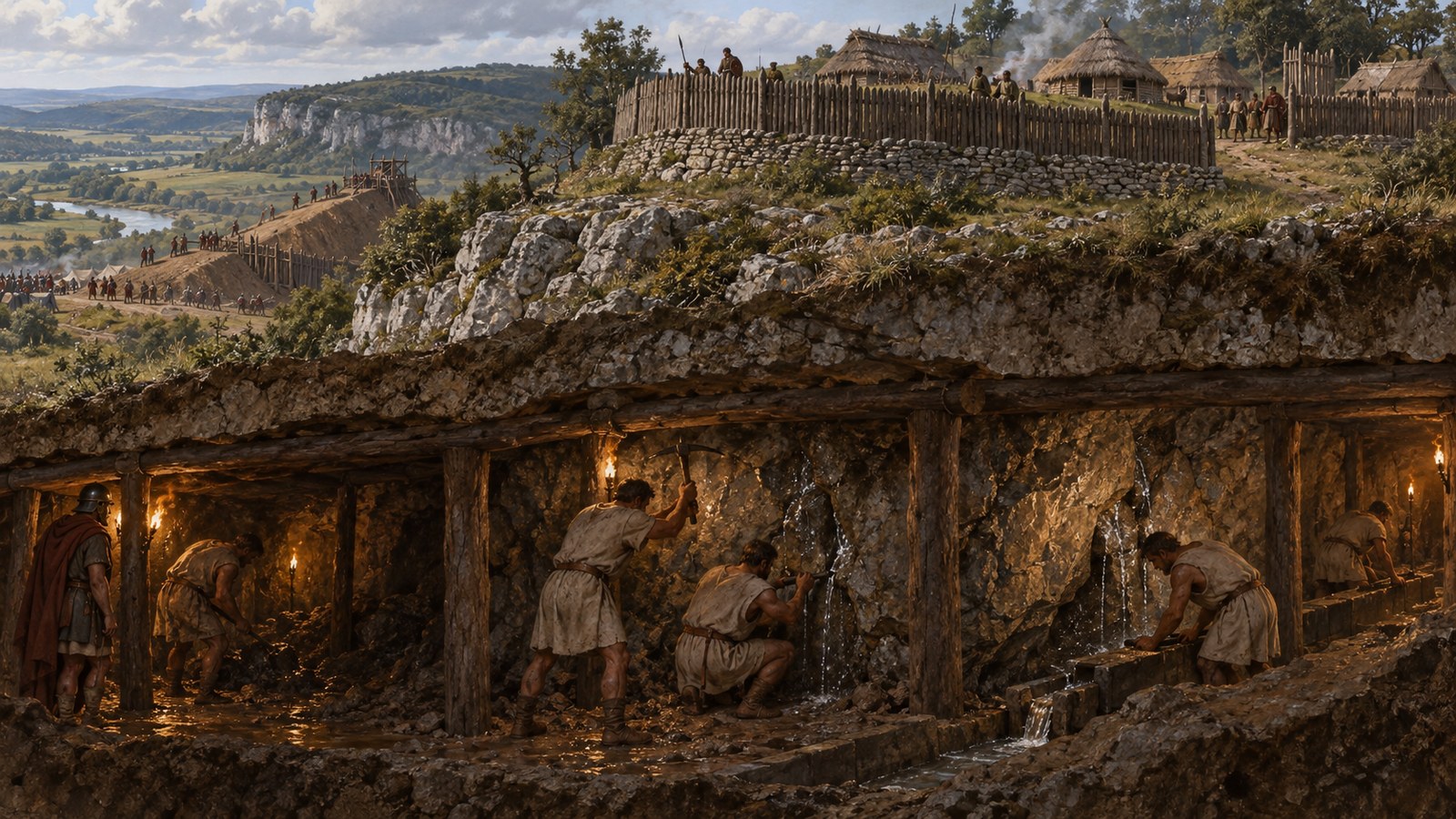
At the same time, workers drove covered mines from the mantlets toward the head of the spring. Hirtius distinguishes this excavation from the exposed labor on the ramp. It could be done without the same risk and, crucially, without arousing the defenders’ suspicion.
These were not mines in the modern sense of buried explosives. They were protected underground approaches. Timber cover and the hillside concealed men removing soil and rock as they sought the channels supplying the outlet. The target was not the pool visible at the surface but the water before it emerged.
The plan depended on reading a spring as the final point in a hidden system. Rain and groundwater move through cracks, porous layers and channels until local geology releases them. The ancient text does not provide a survey drawing or name the instruments used to trace those feeders, so a reconstruction should not invent precise shafts, pumps or measurements. It does state the achieved result: the mines reached the feeders, cut them off and diverted them.
This mechanism is the reverse of the controlled transport described in the Roman siphon that carried water down and across a valley before it rose again. A siphon preserves a route through pressure and sealed pipes. At Uxellodunum, excavation broke an existing route through the earth so that water no longer arrived where the defenders expected it.
The visible tower and hidden mines therefore performed different jobs. The tower reduced safe access and forced the spring to become the focus of the siege. The mines altered the source. One mechanism constrained bodies at the outlet; the other intercepted movement underground.
That division also explains why the construction could continue despite fire. Destroying part of the ramp threatened artillery positions and cover, but it did not reveal every tunnel beneath or behind the works. Caesar’s feigned assault bought time to save the exposed structure while the less visible excavation pursued the permanent result.
A Dry Spring Changed Engineering into an Omen
Hirtius says the defenders remained resolute even after many had suffered from thirst. Then the spring abruptly dried. A source described as perpetual had failed at the moment an enemy surrounded the town.
From inside Uxellodunum, the crucial labor was invisible. Defenders had seen the tower and fought the ramp. They knew how missiles could deny a path, because those weapons acted in the open. They had not watched miners intersect water-bearing channels inside the slope. When the outlet ceased, cause and effect were separated by earth.
The narrative says they attributed the event not to a human device but to divine action. That interpretation mattered operationally. A dangerous route might be reopened by a successful attack, and a burning ramp could be fought with more fire. A god’s removal of the spring offered no comparable countermeasure.
Necessity forced surrender. The engineering victory did not come from one miraculous machine. It came from matching several limited tools to successive constraints. The river could not be diverted, so missiles controlled its approaches. The spring remained close to the wall, so a ramp and tower overlooked it. The outlet continued to flow, so concealed mines went after its feeders.
The sequence also strips away a common romance of siege craft. Grandeur did not guarantee decisiveness. The ten-story turret was the most commanding object in the scene, but the final change occurred in channels too small and dark for the town to observe. The hill remained steep, the walls remained standing and the river stayed in its bed. Only the spring’s route changed.
There is a grim aftermath. Hirtius reports that Caesar spared the lives of those who had borne arms but ordered their hands cut off as exemplary punishment. That act should not be softened into a technical footnote or treated as part of the engineering achievement. It reveals the coercive purpose for which the entire system had been assembled: not merely to solve a hydraulic puzzle, but to end resistance and make its cost visible elsewhere in Gaul.
Uxellodunum fell when control moved from the surface to the source. Archers governed paths, a tower governed the outlet, and miners governed the water before anyone above could reach it. The largest construction drew the defenders’ eyes. The smallest hidden channels decided whether the town could continue to drink.
Sources
Hirtius, Bellum Gallicum 8.39–44.