
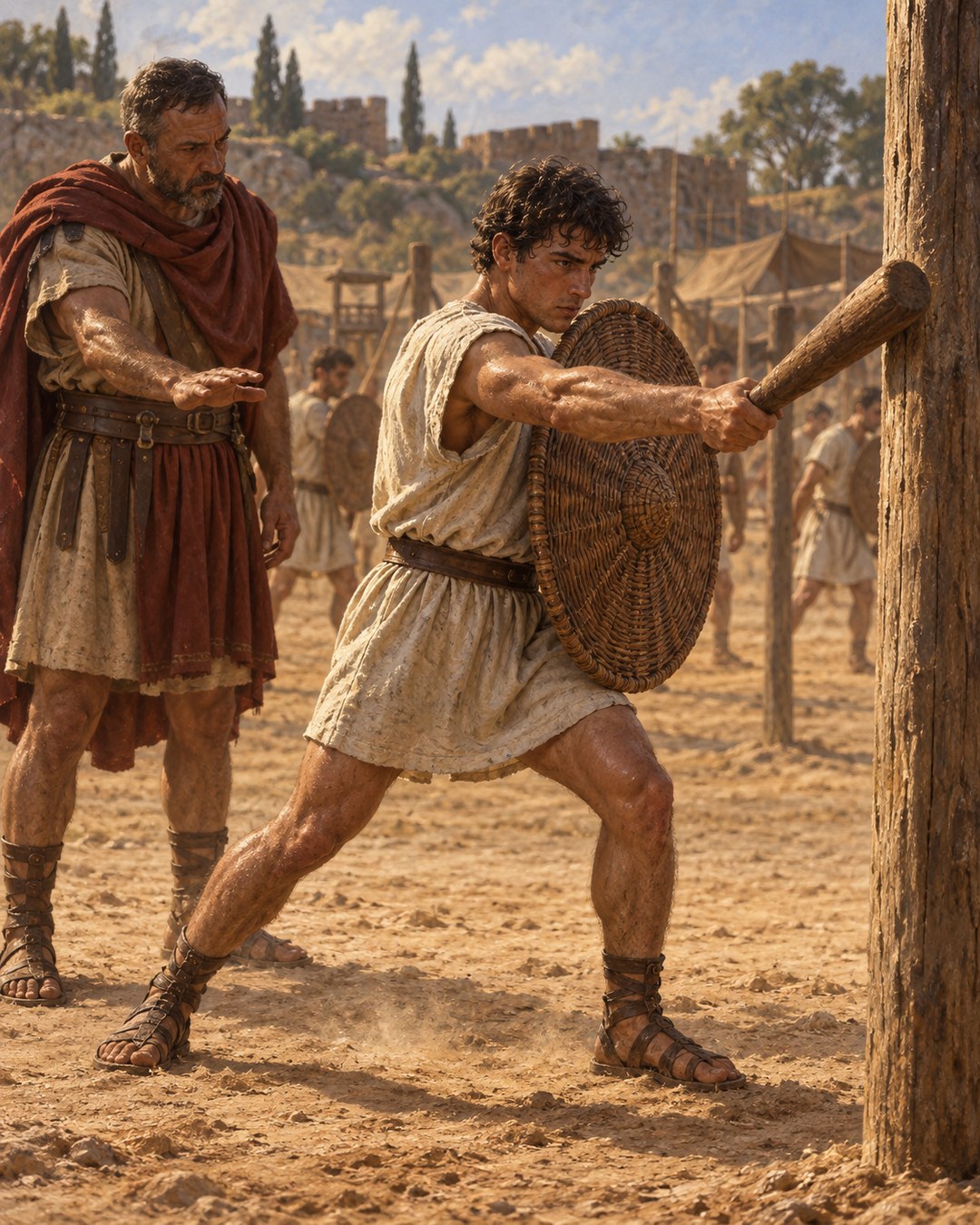
A Roman recruit walked onto the drill ground carrying equipment deliberately worse than the weapons he hoped to use. His round shield was woven from wicker and built to twice the weight of a service shield. In his other hand sat a wooden club, also twice the weight of the sword it represented.
In front of him was no sparring partner. It was a post driven so firmly into the earth that it could not wobble, with six feet of timber standing above the ground. Vegetius says every recruit had one.
The recruit treated that stake as a living adversary. He threatened its face, attacked its sides, dropped toward its knees and legs, retreated, advanced and leapt in. At every moment he had to preserve the same condition: strike without leaving his own body exposed.
This was not a wooden dummy designed to resemble a particular enemy. Its usefulness came from being plain, resistant and always available. Roman drill reduced a dangerous exchange to a sequence that could be repeated under weight until attack and protection belonged to the same movement.
Every Recruit Received One Opponent That Never Moved
Vegetius introduces stake practice as an old method found in military books. Each recruit’s post was fixed separately. It had to stand solidly rather than flex or rock under a blow, and it projected six feet above the soil.
That height gave the trainee a continuous vertical target. The upper portion could stand for head and face, the middle for flank, and the lower area for knees and legs. A single post therefore supported many imagined exchanges without needing hinges, painted anatomy or a cooperative partner.
The stake also returned honest physical information. A poorly planted recruit could feel his own club jar or slide. A wild swing did not persuade timber to fall down. To change the line of attack he had to change distance, angle, level and foot position around an object that remained where it had been driven.
Vegetius lists movement as part of the exercise. The recruit fell back, surged forward and jumped in as though the adversary were present. The fixed target did not make the body static. It provided the stable centre around which approach and withdrawal could be organized.
This individual station differs from the shared river crossing that tested recruits, riders, horses and camp workers. Swimming prepared a column for terrain. The stake narrowed attention to one body, one target and one guarded decision at a time.
Wicker and Wood Made Practice Deliberately Heavy
The practice shield was woven in the form of a round lattice. Vegetius says it carried twice the weight of the public, or regular, shield. The wooden club substituted for a sword on the same principle: it too weighed double.
Overweight equipment made fatigue part of instruction before the recruit handled sharper tools. Raising the wicker shield demanded more effort than raising the service shield. Recovering the wooden club after a blow required more control than allowing its mass to drag the arm away from protection.
The point was not to field soldiers with wicker screens and clubs. Vegetius explicitly supplies the reason for the excess weight. When the trainee finally took up real equipment, the lighter load made him feel released from a burden—more confident and more vigorous in movement.
That result depended on form surviving the heavier rehearsal. If the trainee merely learned to throw the club with his whole body, the light sword would magnify a bad opening. The exercise paired load with a rule: the shield and body had to remain arranged against the counterstroke.
Rome’s military age categories, explored in the census distinction between younger and older service groups, decided who could be called into different obligations. Stake practice addressed a later problem: how a selected body acquired motions dependable enough for battle.
The Target Changed While the Defensive Rule Stayed Fixed
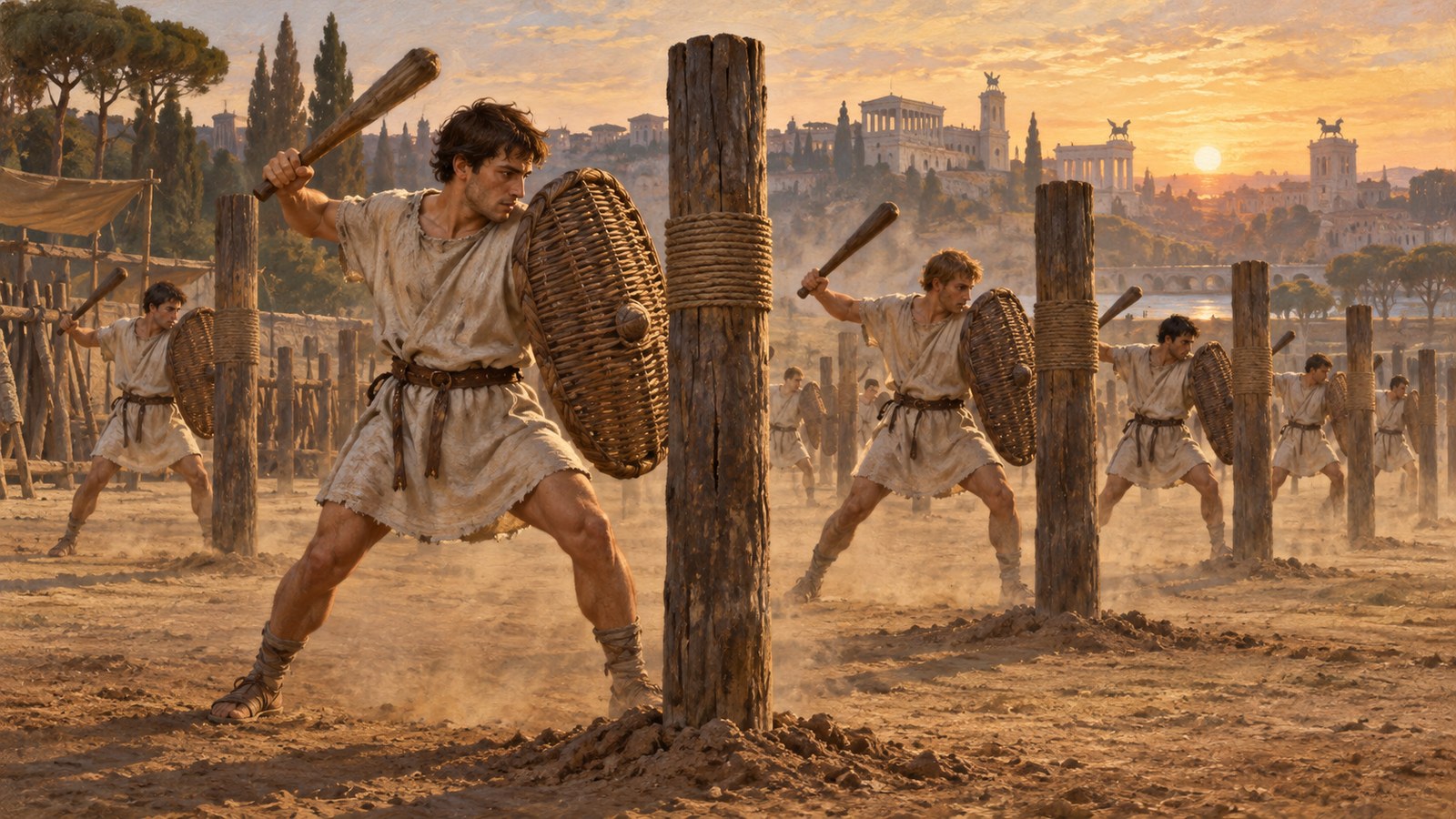
Vegetius does not describe recruits battering one spot until the post splintered. He gives a target sequence. The club rises toward head or face, shifts to threaten from the sides, then descends toward the backs of the knees and the legs.
Each zone changes the attacker’s posture. A high threat can pull the hand upward. A side attack invites rotation. A low blow tempts the trainee to dip his shield or look down. The wooden adversary cannot exploit those errors, so the instructor’s rule must supply the missing danger.
That rule is the most important sentence in the passage: the recruit should rise to inflict a wound without exposing any part of himself to a blow. Attack was not a separate phase followed later by defence. Protection had to exist during the attempt to hit.
Advancing and retreating tested the same coordination across distance. Leaping in added momentum, but the recruit still had to recover behind the shield. The post let him rehearse force without confusing force with success.
Vegetius says both soldiers and gladiators benefited from the stake. Their institutions and purposes were not identical, yet each demanded repeatable control around an opponent’s reach. The training ground and arena could share a tool because timber asked the same blunt question: what does your own body reveal when you attack?
The Thrust Kept the Soldier Behind His Protection
In the next chapter Vegetius turns from target practice to the direction of the blow. Recruits learned to use the point instead of relying on a cutting stroke. His explanation is anatomical and defensive rather than ornamental.
A cut, he argues, opens the right arm and side. A thrust can travel forward while the body remains covered, reaching the adversary before the motion is fully read. He also claims that a penetrating thrust could reach vital parts defended from slashing by armour and bone.
The stake was well suited to that lesson. It offered no edge to cut and no dramatic reaction to reward a sweeping arc. A direct extension, followed by recovery, could be repeated along different heights while the heavy shield stayed between trainee and imaginary reply.
Vegetius writes from a later Roman world and presents earlier practice as something worthy of recovery. His account should not be flattened into proof that every unit in every century trained identically. What it securely preserves is his model of disciplined instruction: old books, named exercises, specialist teachers and measurable consequences for poor performance.
Those consequences reached the ration. Vegetius says arms instructors could receive double provisions, while soldiers who failed to improve in the exercise might receive barley instead of wheat until they demonstrated the required skill before senior officers. Drill affected status at the food issue as well as performance on the field.
Repetition Turned Timber into a Combat System
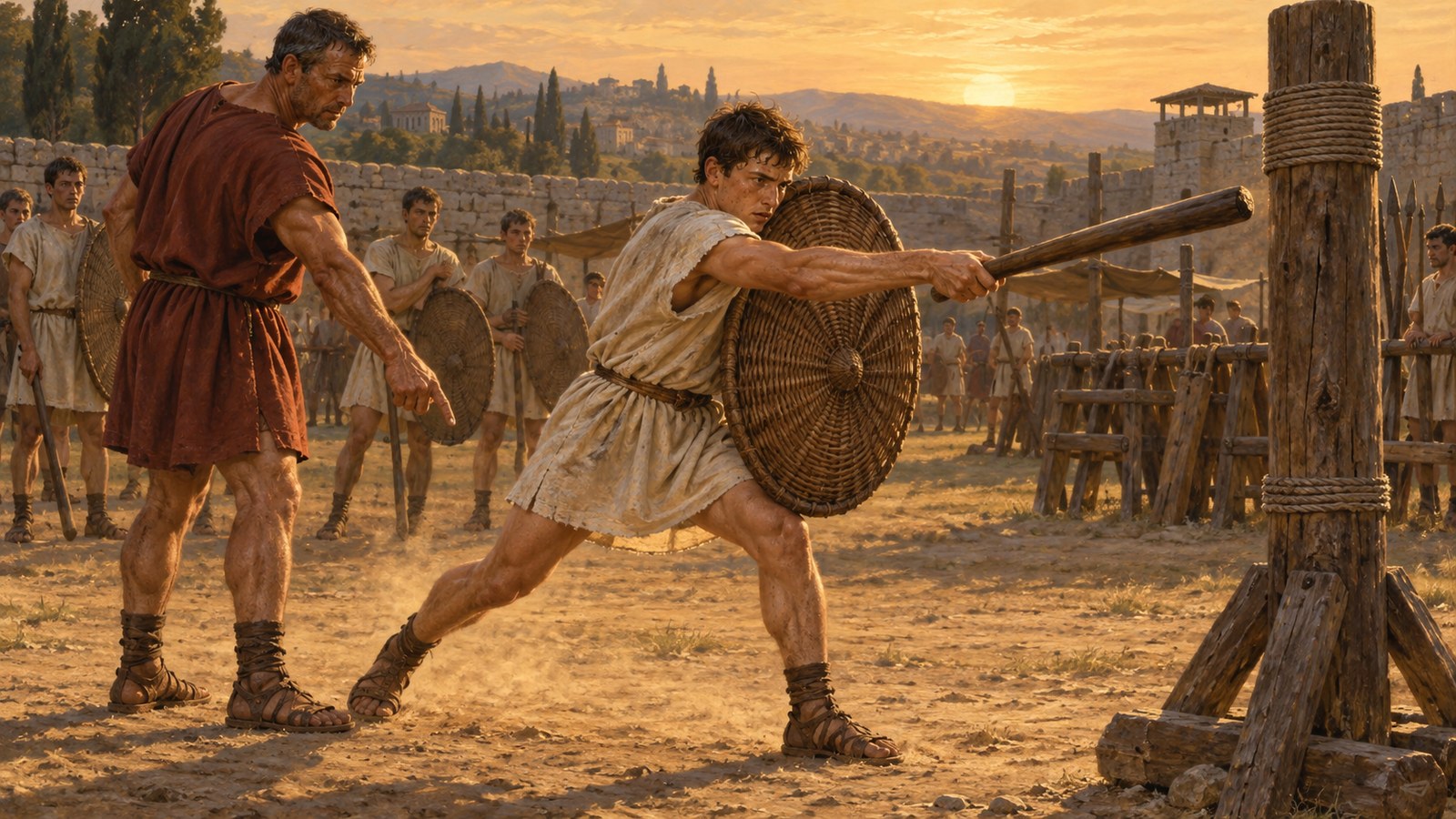
Morning and afternoon practice made the post more than an occasional test. The recruit returned to the same unyielding opponent after fatigue had accumulated. The equipment remained heavy, the target remained upright and the demand for cover did not relax.
No single movement explains the system. Weight strengthened control; the stake fixed distance; changing target zones disrupted habit; advances and retreats connected handwork to feet; the thrust shortened exposure; inspection and ration penalties made competence consequential.
The plainness of the equipment is part of its intelligence. Wicker could be woven into a burden shaped like a shield. Wood could imitate a sword without using a sharpened edge. A post required neither a skilled partner nor an elaborate machine, yet it endured enough repetitions to expose weak posture again and again.
Vegetius’s recruit was being taught more than aggression. He had to imagine danger where there was only timber and preserve defence when nothing could actually strike back. That disciplined imagination was the bridge from safe rehearsal to an opponent who would move.
The six-foot stake absorbed every blow without teaching flattery. It did not fall for enthusiasm, and it did not spare a careless opening. Roman training made that silence useful: repeat the attack, keep the shield, recover the body, and do it again when the arms were tired.
Sources
Vegetius, Epitoma rei militaris 1.11–13.