
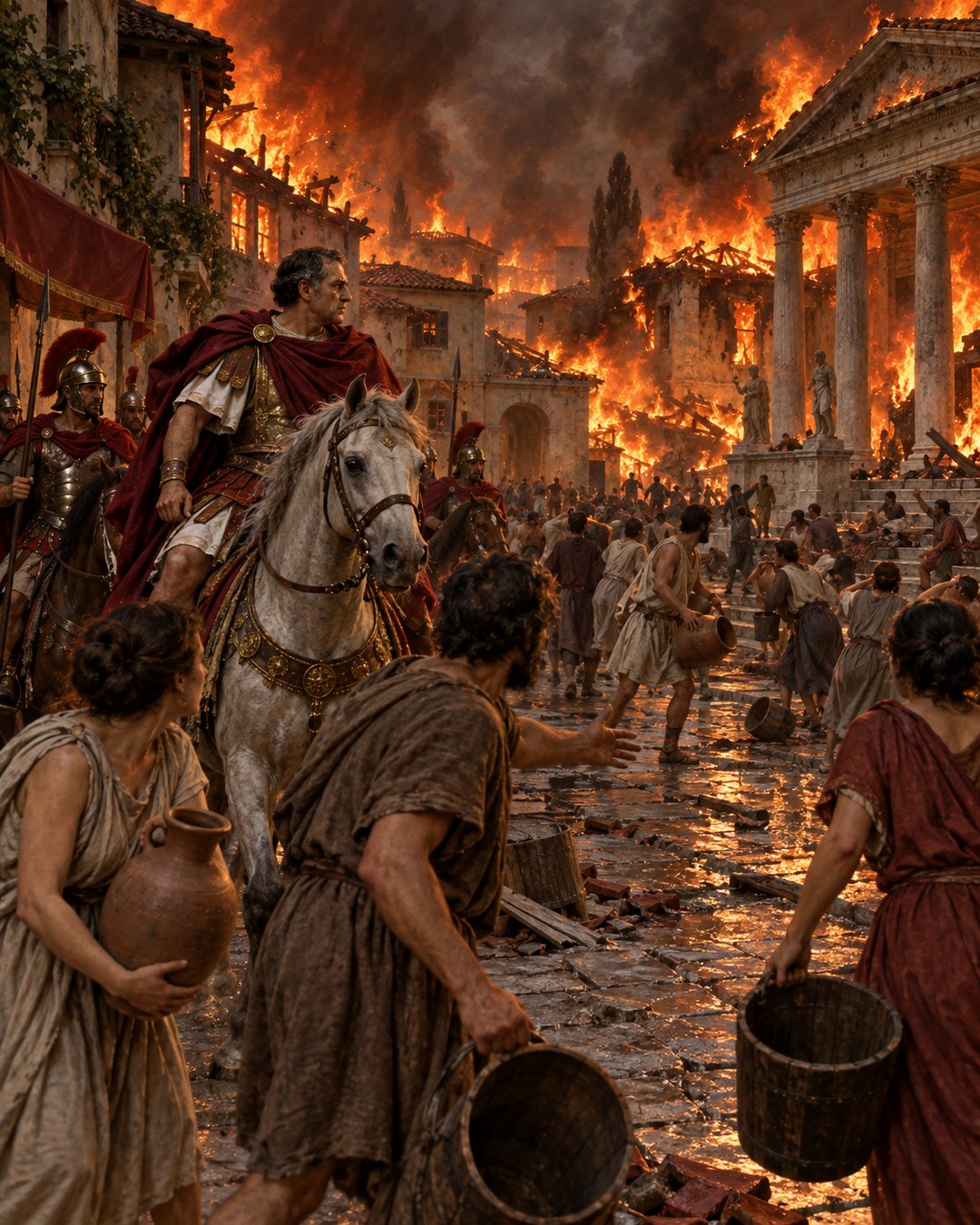
When fire ran through Nicomedia, the provincial governor was not there to direct the response. Pliny was visiting a distant part of his province. By the time he described the disaster to Trajan, private houses had been lost along with two public buildings: a facility associated with the city’s elders and a temple of Isis.
A road lay between those public buildings, yet both burned. Wind drove the flames. The people, Pliny complained, stood watching instead of acting. Worse still, the city possessed no public fire pump, no bucket and no other appliance for mastering an outbreak.
Pliny’s remedy had two parts. He had already ordered equipment. He also asked permission to create a guild of roughly 150 firemen, promising that only genuine firefighters would enter and that close supervision would prevent abuse. Trajan accepted the tools and rejected the team. In Bithynia, he replied, almost any association could become a faction or secret society.
The exchange in Letters 10.33–34 is not merely a story about primitive urban safety. It captures two competing models of coordination. Pliny wanted a small permanent body trained around one task. Trajan wanted equipment dispersed among owners and an unorganized crowd compelled to act when flames appeared. The emperor treated durable association as a political hazard even when its declared purpose was putting out fires.
Wind Found a City without Equipment
Pliny begins with absence. He was away, touring another part of the province, when what he called a devastating fire broke out at Nicomedia. That detail matters because Roman provincial government concentrated authority in a travelling official. A governor could inspect accounts, hear disputes and answer local petitions, but he could not be physically present in every city when an emergency began.
The damage crossed categories of property. An unspecified number of private houses burned. So did two civic or religious structures: the building Pliny calls the gerousia, often understood here as a facility for elderly citizens, and the temple of Isis. The road between them did not prevent both from being consumed.
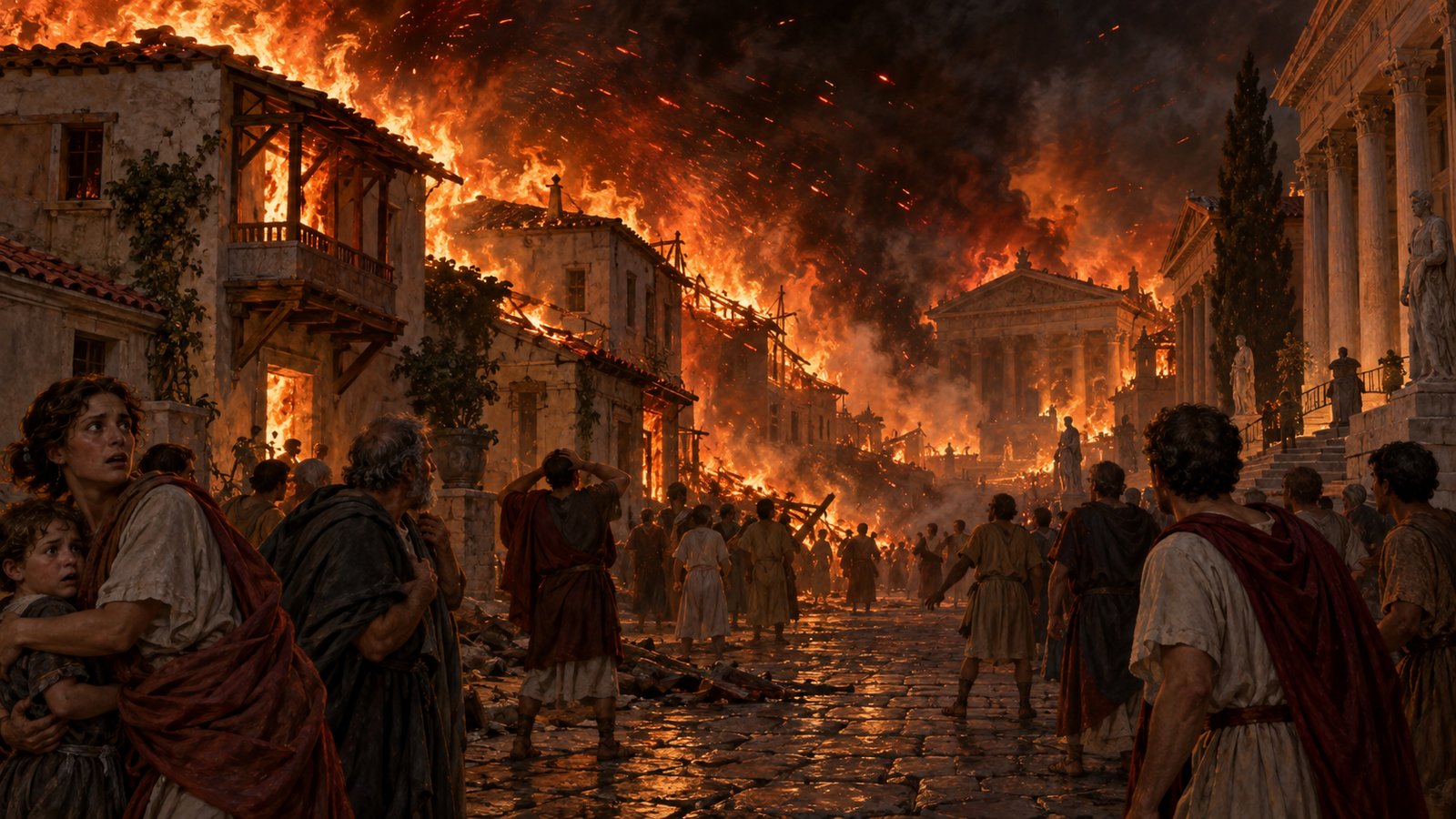
Pliny identified violent wind as the first reason the blaze spread farther than necessary. That explanation gives the disaster movement. Fire was not confined to one roof or courtyard; air carried heat and sparks through an urban fabric where neighboring structures offered more fuel.
His second explanation was human. The inhabitants, he wrote, remained idle and simply watched. It is impossible to recover every frightened person’s action from a governor’s accusation, and his wording conveniently shifts part of the failure onto the population. Still, the complaint reveals what he believed was missing: not only courage, but a method for turning bystanders into a coordinated response.
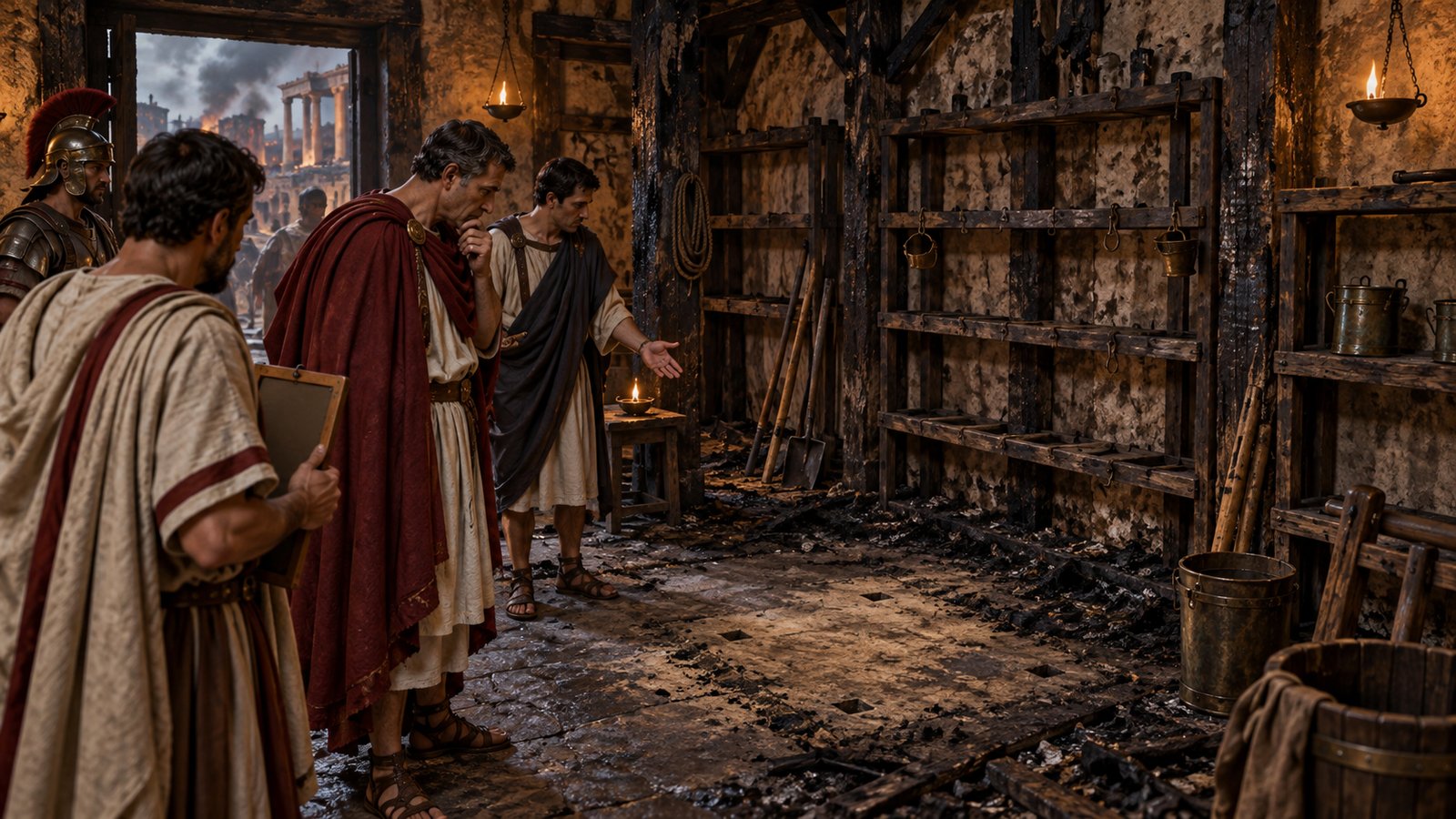
Nicomedia had no single public fire engine. The Latin term referred to a water pump of the sort used in ancient firefighting. Pliny went further. There was not one bucket and not one solitary appliance available for suppressing a fire. Whether every household literally lacked a vessel is less important than the administrative point: the city had no recognized public stock ready for the emergency.
The failure resembles the municipal neglect exposed by the foul channel Pliny found running through Amastris. In both letters, a visible urban problem prompted the governor to inventory what local government had failed to provide. At Nicomedia, however, pipes and tools were only half the issue. Someone had to gather, maintain and use them before wind converted delay into destruction.
Pliny Designed a Brigade and a Safeguard
Pliny did not wait for the emperor before addressing the obvious material deficiency. He told Trajan that firefighting appliances would be supplied under orders he had already given. The request concerned the more politically sensitive part of the remedy: people organized into a recognized body.
He proposed a guild of about 150 firemen. The number was large enough to divide labor across a serious blaze but small enough, in Pliny’s argument, to watch. His wording suggests that he anticipated the objection. He was not asking for a loose civic club with an ornamental title. Only genuine firemen would be admitted.
He also promised that the guild would not misuse the charter granted to it. Roman associations could possess rules, officers, common funds and a corporate identity. Those features made sustained cooperation possible. They also made a group capable of acting together for purposes beyond the one written into its authorization.
Pliny’s proposal therefore bundled the solution with its own guardrails. Selection would keep impostors out. Supervision would keep the group attached to firefighting. The body’s limited size would make oversight easy. He presented organization not as an uncontrolled concession but as a tool that provincial authority could define and monitor.
There was practical logic in permanence. Buckets stored without assigned keepers can disappear. Pumps without practice can fail at the moment they are needed. A crowd meeting for the first time beside a burning roof must discover leadership, sequence and responsibility while smoke is already thickening. A brigade preserves knowledge between emergencies.
The case also shows why labels alone were insufficient. Calling 150 men “firefighters” described their intended work, not the full range of relationships created when they met repeatedly, chose coordinators and recognized one another as members. Pliny believed rules could contain that additional social power. His emperor did not.
Trajan Feared the Organization behind the Name
Trajan’s reply did not dispute the fire, the missing tools or the need for action. He focused on Bithynia’s political environment. The province, and cities such as Nicomedia in particular, was vulnerable to factions. A formally constituted group could supply an existing rivalry with membership, routine and cover.
The emperor generalized his refusal. Whatever name people gave an association and whatever reason they offered for forming it, he warned, the members would soon become a secret society. “Fire brigade” could not make the structure politically innocent because the danger, in his analysis, lay in organized continuity rather than declared purpose.
This was a preventive judgment. Trajan did not accuse Pliny’s proposed recruits of an actual conspiracy. No brigade yet existed. He decided that the capacity to organize 150 men presented enough future risk to outweigh the coordination Pliny hoped they would provide.
The logic is visible elsewhere in the correspondence, where Trajan’s government repeatedly asks who is responsible, what status people hold and how local arrangements might create obligations. The problem of two enslaved men found among army recruits likewise produced a careful division of responsibility rather than a single automatic punishment. At Nicomedia, the categories were not recruit, officer and slaveholder, but governor, property owner, crowd and forbidden association.
Trajan’s fear should not be expanded into evidence for a particular Nicomedian plot. His letter names a provincial pattern of factionalism and predicts what organized groups may become. That is enough to explain the policy. It does not tell us which local enemies would have contested control of the pumps or whether any of the proposed firefighters already belonged to political networks.
The emperor’s refusal exposes a cost of rule through suspicion. The same features that make emergency teams effective—repeated practice, mutual recognition, internal command and collective resources—also make them politically legible as groups. Trajan removed the feared form, but the fire risk remained.
Tools, Owners and a Pressed Crowd Replaced the Guild
Trajan offered an alternative built from separate pieces. First, the city should obtain appliances for controlling fires. On this point he and Pliny agreed. A public failure so stark that the governor could report no pump or bucket demanded material correction.
Second, property owners should be encouraged to use the equipment. Responsibility moved toward people with an immediate stake in threatened buildings. The arrangement did not require them to become members of one permanent body. Ownership supplied motivation while the state supplied or required tools.
Third, if circumstances demanded it, the crowd gathering at a fire should be pressed into service. The same onlookers whom Pliny condemned for standing idle became Trajan’s reserve workforce. Instead of training together before the emergency, they would be converted into labor during it.
This answer solved the political problem more cleanly than the operational one. It denied 150 people the continuity from which a faction might grow. Yet it relied on coordination appearing at the worst possible moment. Someone still had to assign the pump, arrange the buckets, move people toward water, protect escape routes and decide which walls or roofs could be saved.
Perhaps local officials, owners and imperial authority could impose that order. The letter does not report a later test, so we should not invent either success or another disaster. What survives is the chosen design: equipment without a chartered crew, private initiative without corporate membership, emergency coercion without peacetime association.
Pliny had read the fire as proof that Nicomedia needed both hardware and an organized human mechanism. Trajan split those elements apart. He permitted objects to remain assembled and ready but refused the same permanence to people.
That distinction is the sharpest lesson in the exchange. Rome’s imperial government could recognize a practical danger and still subordinate the best-looking practical remedy to political control. The emperor did not tell Nicomedia to tolerate flames. He told it to fight them with owners, tools and temporarily commanded strangers rather than a brigade whose members might learn to act together after the smoke cleared.
Sources
Pliny the Younger, Letters 10.33–34.