
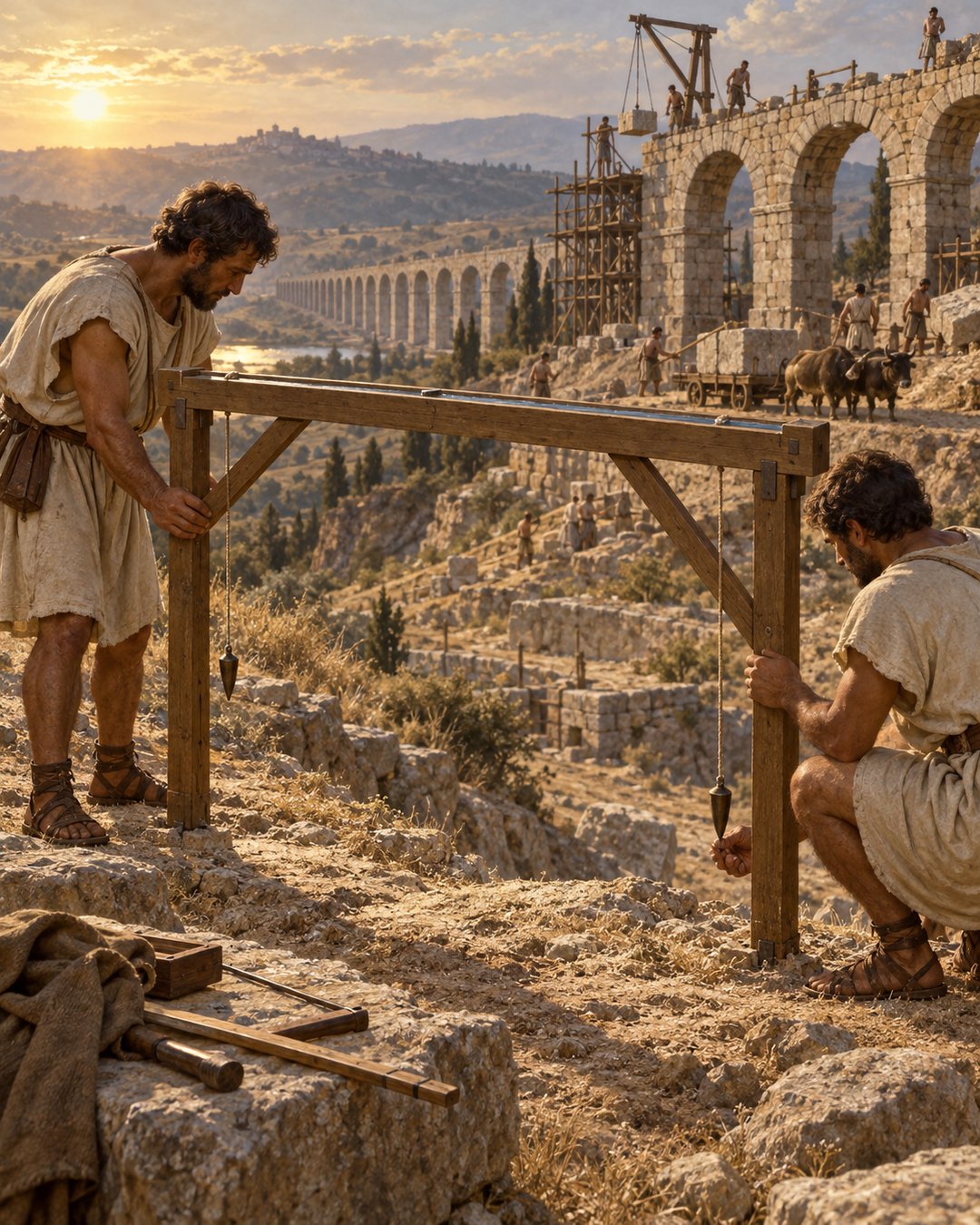
Aqueduct surveyors needed a horizontal reference before they could measure a slope. Vitruvius offered three instruments for that work: the dioptra, water levels and the chorobates. He preferred the last. It was not a pocket tool but a timber straightedge about twenty feet long, standing on equal legs and stiffened by tenoned crosspieces.
In calm air, plumb cords hanging from the beam were compared with vertical lines on the braces. Equal alignment showed that the frame stood level. Wind could ruin the reading, however, by keeping those cords in motion. Vitruvius’s answer was built into the same beam: cut a groove five feet long along its top and pour in water.
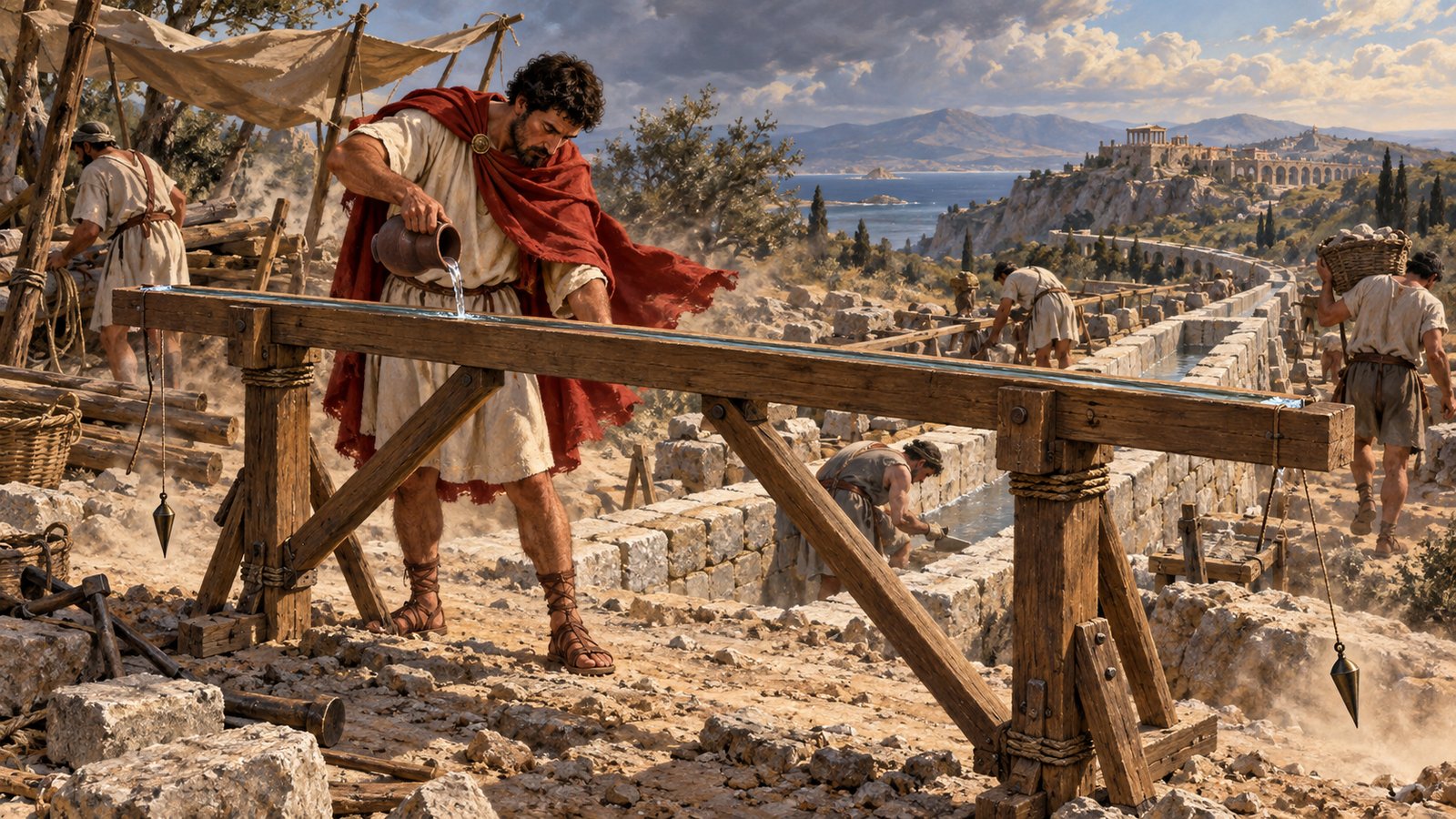
If the water reached both end rims equally, the frame was level. The surveyor could then establish the fall required to move water across the landscape. One large wooden instrument therefore joined two tests. Gravity pulled the cords; water compared the height of two nearby points. When moving air defeated one indicator, the second remained usable.
The description in De architectura 8.5 is a compact lesson in resilient measurement. Accuracy did not come from pretending conditions were perfect. It came from giving one stable geometry more than one way to reveal its position.
A Twenty-Foot Beam Made Error Visible
Vitruvius begins by comparing instruments. A route could be leveled with a dioptra, with water levels or with the chorobates. He nevertheless calls the chorobates the most accurate because, in his judgment, the other devices could be deceptive.
Its size was part of the method. A straightedge roughly twenty feet long stretched the comparison across a substantial baseline. A small change in height between the ends could be observed against that span rather than compressed into a short handheld surface. The instrument translated landscape slope into the position of one long rigid member.
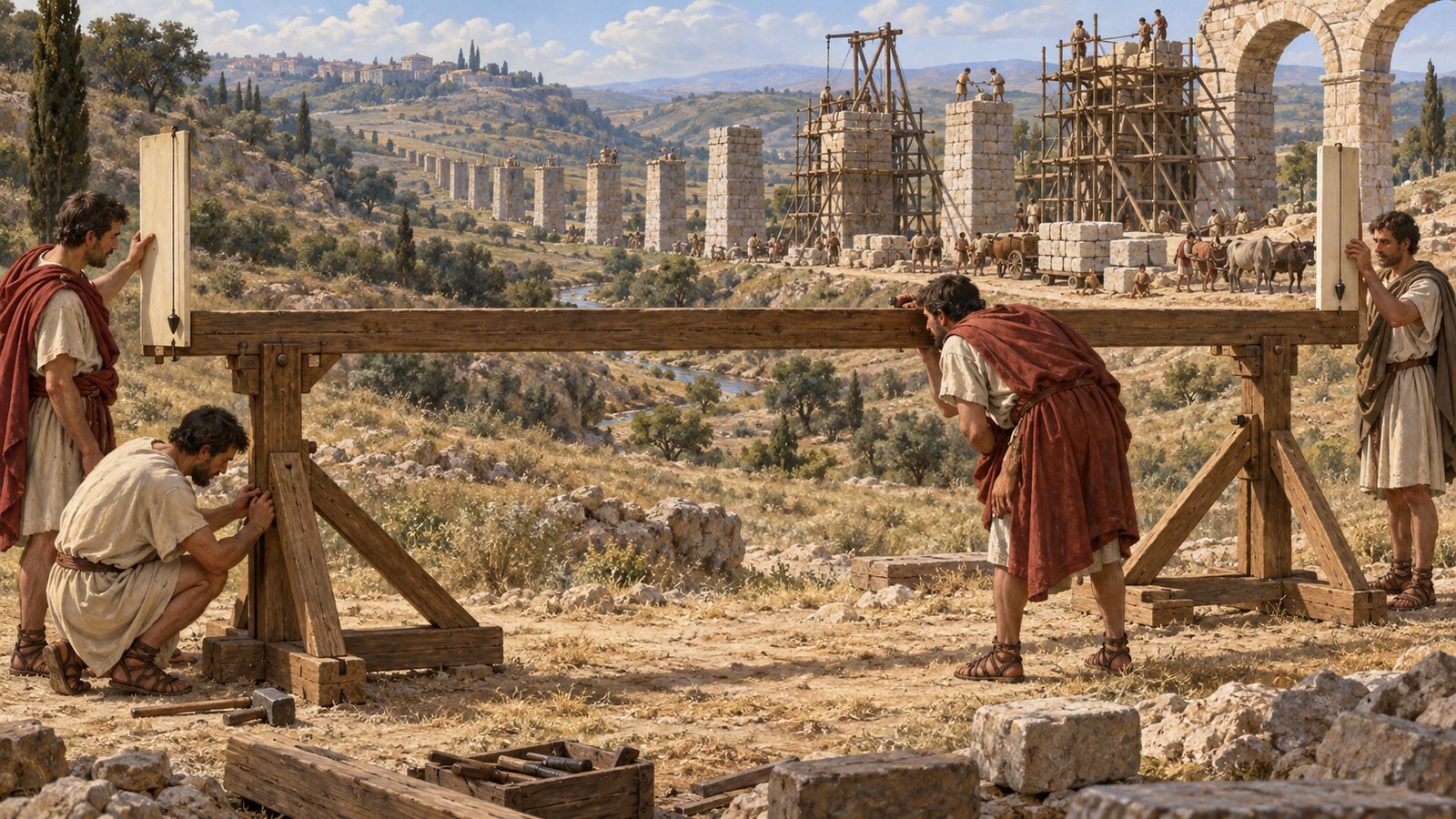
Two legs of equal length stood at right angles to the beam’s ends. Equality mattered because mismatched supports would introduce a false tilt before any reading began. The legs and beam had to form one controlled frame rather than a convenient arrangement of separate pieces.
Crosspieces joined beam and legs. Vitruvius specifies tenoned fastenings, a carpentry detail that reveals the demand placed on the instrument. The braces did not merely stop the frame from falling. They held its geometry while it was moved, set down and adjusted repeatedly over a survey route.
The crosspieces also carried vertical reference lines. Plumb cords descended from the straightedge over those marks. When both cords met their corresponding lines alike and at the same moment, the surveyor could judge the beam level.
This was a comparison rather than a mysterious reading hidden inside a box. Beam, legs, braces, marks and cords exposed the whole chain. A warped timber, unequal support or displaced reference could in principle be inspected. Like Vitruvius’s wheel-driven distance counter, the device made a quantity legible by turning physical relationships into a repeatable indication.
Wind Defeated the First Indicator
A plumb line depends on gravity, but it also hangs freely in air. That freedom lets the cord seek the vertical. It also leaves the cord available to every gust. Vitruvius does not hide the contradiction. He names wind as a condition that can keep the lines in motion and prevent a definite judgment.
The problem was not that gravity had stopped acting. The problem was observational. A restless cord might pass its mark again and again without settling long enough for the surveyor to compare both sides confidently. Waiting could help, but an exposed route offered no promise that the air would become still on command.
That matters because leveling was only the beginning. The team still had to carry observations over distance and determine whether water could follow the intended route. Uncertainty at one station could propagate into decisions about excavation, channel walls or raised construction farther ahead.
Vitruvius did not respond by shrinking the device or enclosing the cords in a construction he never describes. Nor did he ask the user to estimate the midpoint of their swing. He preserved the twenty-foot frame and changed the physical indicator.
A groove cut into the top accepted water. In the surviving description it was five feet long, one digit wide and a digit and a half deep. Those dimensions created a narrow reservoir within the beam rather than a separate bowl balanced on it.
The choice kept the alternate reading attached to the object whose orientation mattered. There was no need to transfer level from another stand. Surveyors could adjust the chorobates, ignore the dancing cords for the moment and watch what the water did at the two ends of its channel.
Two Wet Rims Replaced Two Moving Cords
Water was poured into the groove. If it came evenly to the rims at left and right, the straightedge was level. If the frame inclined, the water could not reach the higher end in the same way. The test reduced the question to equality at two fixed boundaries.
Vitruvius anticipates a learned objection. A reader of Archimedes might say that water does not form a truly flat plane because its surface belongs to a sphere centered on the earth. His response is practical and local. Whatever curvature belongs to the wider surface, water in this short groove will stand at equal heights at the nearby ends when the supporting beam is level.
He does not need to deny the earth-scale argument. He separates the geometry relevant to a five-foot comparison from the geometry of the globe. If one end rises, the water there fails to touch its rim as it does at the lower side. That difference is enough for the instrument’s task.
The water test was not merely a second opinion after calm-weather cords had already agreed. Vitruvius introduces it specifically for the moment when wind obstructs the plumb-line operation. The two systems answered the same question under different conditions.
This redundancy makes the chorobates more interesting than a long spirit level before spirit levels. Its resilience came from unlike vulnerabilities. Air motion disturbed the cords; water contained inside the rigid groove could still compare the beam’s endpoints. A crack or leak in the groove would pose another problem, but it would not be the same problem as swinging lines.
After equality had been established, the amount of fall could be determined. The level was thus a reference from which slope became measurable. In the nearby case of the proposed canal from Lake Sophon, a claimed forty-cubit difference demanded specialist verification. The chorobates shows the kind of disciplined comparison behind such decisions without proving that this exact instrument was the one sent to that lake.
A Level Reference Became a Water Route
Vitruvius moves directly from the instrument to the terrain. If there was plenty of fall, he says, conducting water was comparatively easy. Gravity supplied the direction. The survey still had to show that the decline was controlled rather than merely obvious to the eye.
Broken ground created the harder case. Depressions required substructures, lifting a channel across low points so the route could preserve its designed descent. That decision could consume masonry and labor. A reliable level therefore shaped costs as well as hydraulic performance.
The next chapter identifies three broad ways to carry the water: masonry channels, lead pipes or pipes of baked clay. Those were construction choices after the route had been understood. The chorobates belonged to the earlier moment when builders converted hills and hollows into elevations that could govern design.
The order is important. A grand arcade or buried pipe can dominate what survives archaeologically, but neither begins with the first stone or tube. It begins with repeated references carried over ground, each one establishing how the next stretch relates to horizontal and therefore to the intended fall.
Vitruvius’s instrument was made from familiar components: timber, joints, cords, marked lines and water. Their arrangement produced more than the sum of the materials. Equal legs supported a braced beam; the beam carried two indicators; the indicators established level; level made the route’s decline available for judgment.
The wind clause reveals the practical intelligence of that arrangement. The designer expected the world to interfere. Instead of treating a moving plumb line as user failure, he described a second test already integrated into the frame. The chorobates could remain where it stood while the surveyor changed what counted as evidence.
A twenty-foot beam crossed only a tiny fraction of an aqueduct’s path, and the water groove occupied only five feet of that beam. Yet the equality seen at those two wet rims could guide channels, pipes and substructures far beyond the instrument. Roman water began to move downhill only after the builders had made still water tell them where level was.
Sources
Vitruvius, De architectura 8.5–6.