
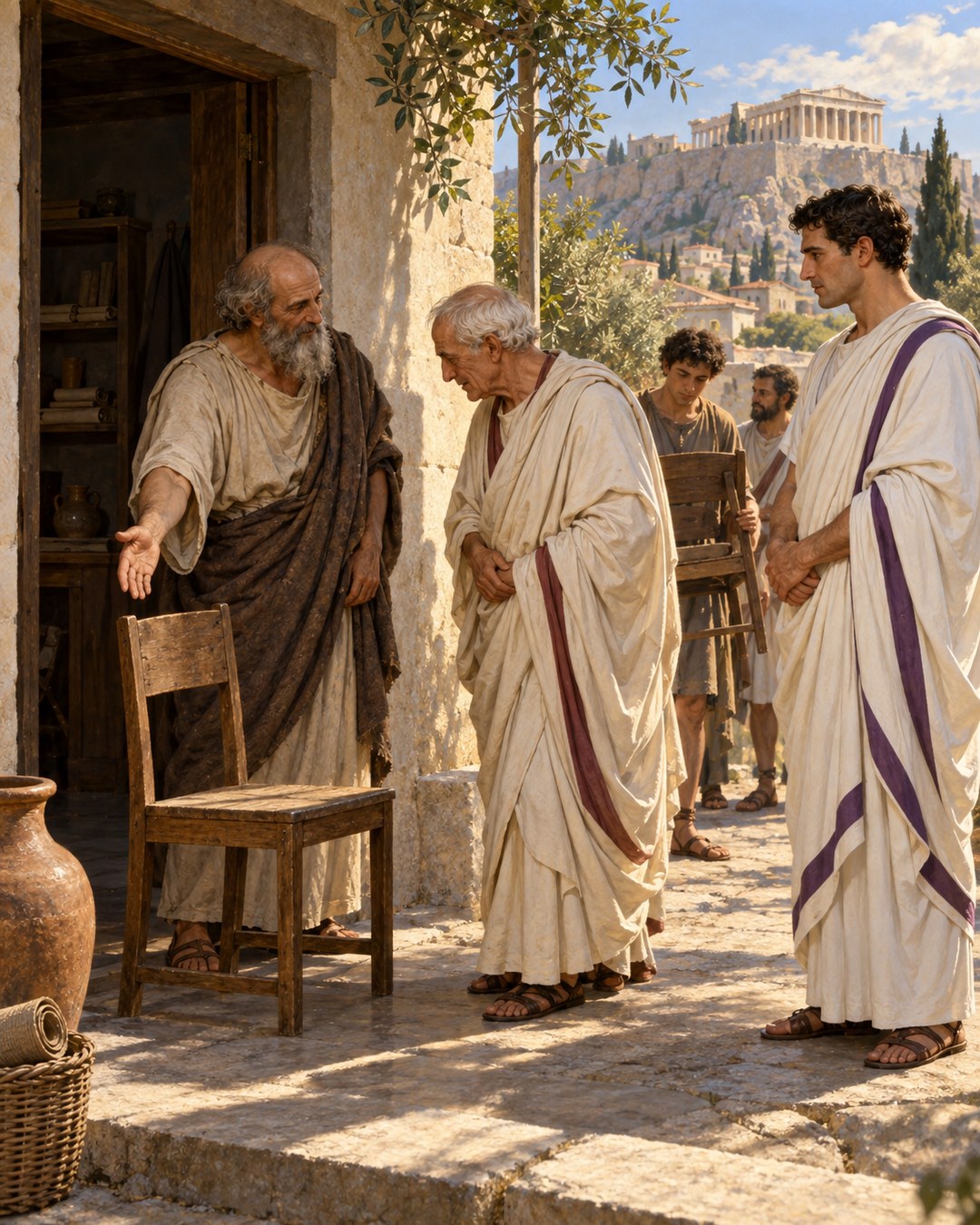
There was one chair and two claims to it. The governor of Crete had come to Athens with his father to meet the philosopher Taurus. The son held senatorial rank and Roman magistracy. The father held no office in the scene, but he was still the father and the older man.
Taurus offered him the seat. The father refused and directed it toward his son: the younger man was a magistrate of the Roman people. Taurus did not dismiss that fact. He asked the father to sit for the moment while they examined whether office or parenthood ought to control the room.
Aulus Gellius records what followed as a lesson in context rather than a victory of one rank over every other. Public places and acts gave the magistrate son precedence. Private company restored the honours attached to fatherhood and age. Taurus’s doorway was private, so the father sat first.
Gellius then places a harder Roman scene beside it. A consul met his own father, who was serving as proconsul and remained mounted. This time the younger man’s lictor ordered the father to dismount. The father obeyed and praised his son for defending authority bestowed by the people. One relationship produced two correct answers because the setting changed.
The Governor Arrived After Taurus Dismissed His Pupils
Gellius builds the first scene with careful social details. Taurus had just dismissed his students. He was seated before the door of his room, while Gellius and others stood near him in conversation. The encounter did not begin in a provincial headquarters, a court or a formal civic ceremony.
The visitor was governor of Crete and a senator. He arrived with his father because he wanted to visit and become acquainted with Taurus. The purpose was philosophical and personal, even though one guest carried a public title.
Taurus rose quietly when they entered. Greetings were exchanged, and he sat again. That modest sequence keeps the philosopher courteous without converting the visit into an official reception.
Then the furniture created the problem. Only one chair was immediately available. Other seats were being fetched, but somebody had to receive the first one. Taurus invited the father.
The shortage was temporary, yet it exposed a real uncertainty. If the son’s office controlled every encounter, the magistrate should sit. If the household-like courtesy of an older father controlled this room, the father should. No written placard resolved it; posture had to express the answer.
The Father Deferred to an Office of the Roman People
The father did not grasp the honour offered to him. He told Taurus to let his son take the chair because the son was a magistrate of the Roman people. His response recognized that Roman office was not merely a private decoration attached to a family member.
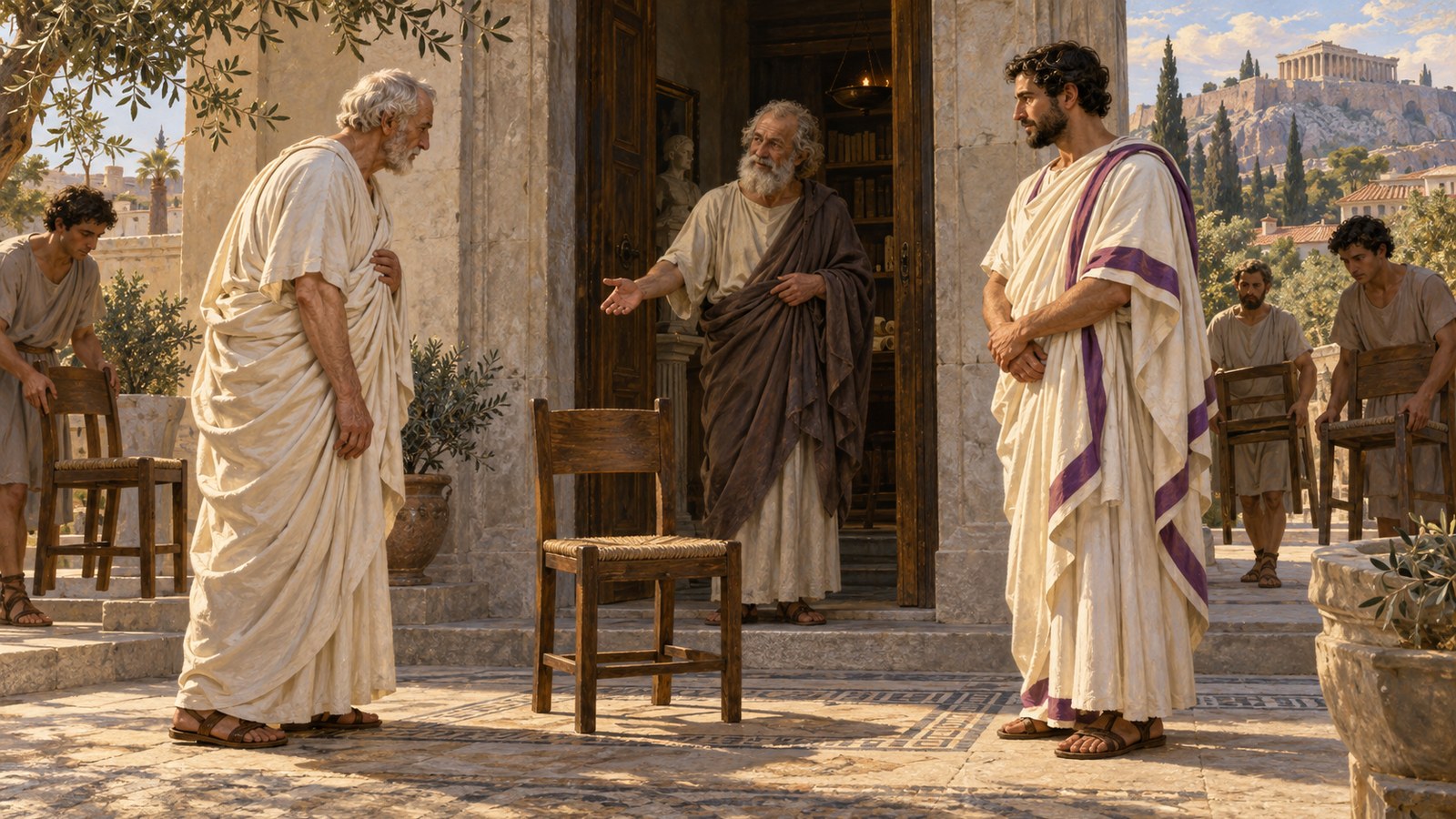
Taurus answered without prejudging the case. The father should sit while they investigated which status properly applied: father or magistrate. When another chair arrived for the son, the physical urgency disappeared, but the argument remained.
Gellius praises Taurus’s discussion as an excellent weighing of honours and duties. That balance matters. Taurus did not say office was unreal, nor did he say paternal authority automatically defeated civic power. He separated occasions on which each claim operated.
The object at the center was plain, not necessarily the formal folding seat that advertised Roman office. Yet even an ordinary chair could make precedence visible. Sitting placed one person before another while witnesses watched.
The father’s first instinct and Taurus’s correction were both forms of respect. The father respected a magistracy derived from the Roman people. Taurus respected the older man within a private visit. Their disagreement concerned jurisdiction over the moment, not whether either honour existed.
Public Acts Made the Father’s Rights Recede
Taurus’s rule begins with public life. In public places, official functions and official acts, a father’s rights yield somewhat and are eclipsed by the authority of a son who is a magistrate. Gellius’s wording preserves a comparison, not a permanent erasure of family.
Public authority had to remain legible to people beyond the household. A magistrate could not perform an office if every older relative rearranged its order according to private seniority. The office was a gift of the people, as the second scene later makes explicit.
This helps explain why Roman insignia and attendants mattered. A curule chair could stop noble visitors at a doorway because furniture, access and posture communicated jurisdiction. Gellius’s story focuses less on the prestige of an official seat than on deciding when an official identity should govern behaviour.
Taurus says the father’s rights “yield somewhat,” language that avoids making him socially invisible. The son does not cease to be a son in public. The point is that the magistrate’s duty takes priority while an act belongs to the office.
Rank therefore operated through a change of frame. Ask only who the two men are, and the answer remains father and son. Ask what they are doing in public, and one is also the magistrate who must exercise power on behalf of Rome.
Private Company Restored Age and Fatherhood
Taurus then names settings where official distinctions end: father and son sitting together unofficially in the intimacy of home, walking about, or reclining at a dinner among intimate friends. In these circumstances, natural and inherent distinctions return.
The visit to a philosopher belongs on this side of the boundary. Taurus describes the call itself, their present conversation and the discussion of duties as private actions. His house does not become a government chamber simply because a governor crosses the threshold.
He therefore tells the father to enjoy the priority in Taurus’s house that the older man properly receives at home. Age joins parenthood in the decision. The father takes the first chair; the son’s magistracy waits without being insulted.
Gellius remembers that Taurus spoke both seriously and pleasantly. The tone suits a correction offered among guests. A harsh rebuke would have distorted a scene meant to clarify courtesy. Taurus can preserve the rule while letting both men keep dignity.
The result is not modern informality. Private life has its own order, and Gellius treats that order as binding enough to determine who sits. What disappears is not hierarchy but the official hierarchy appropriate to public action.
A Lictor Reversed the Answer on a Public Road
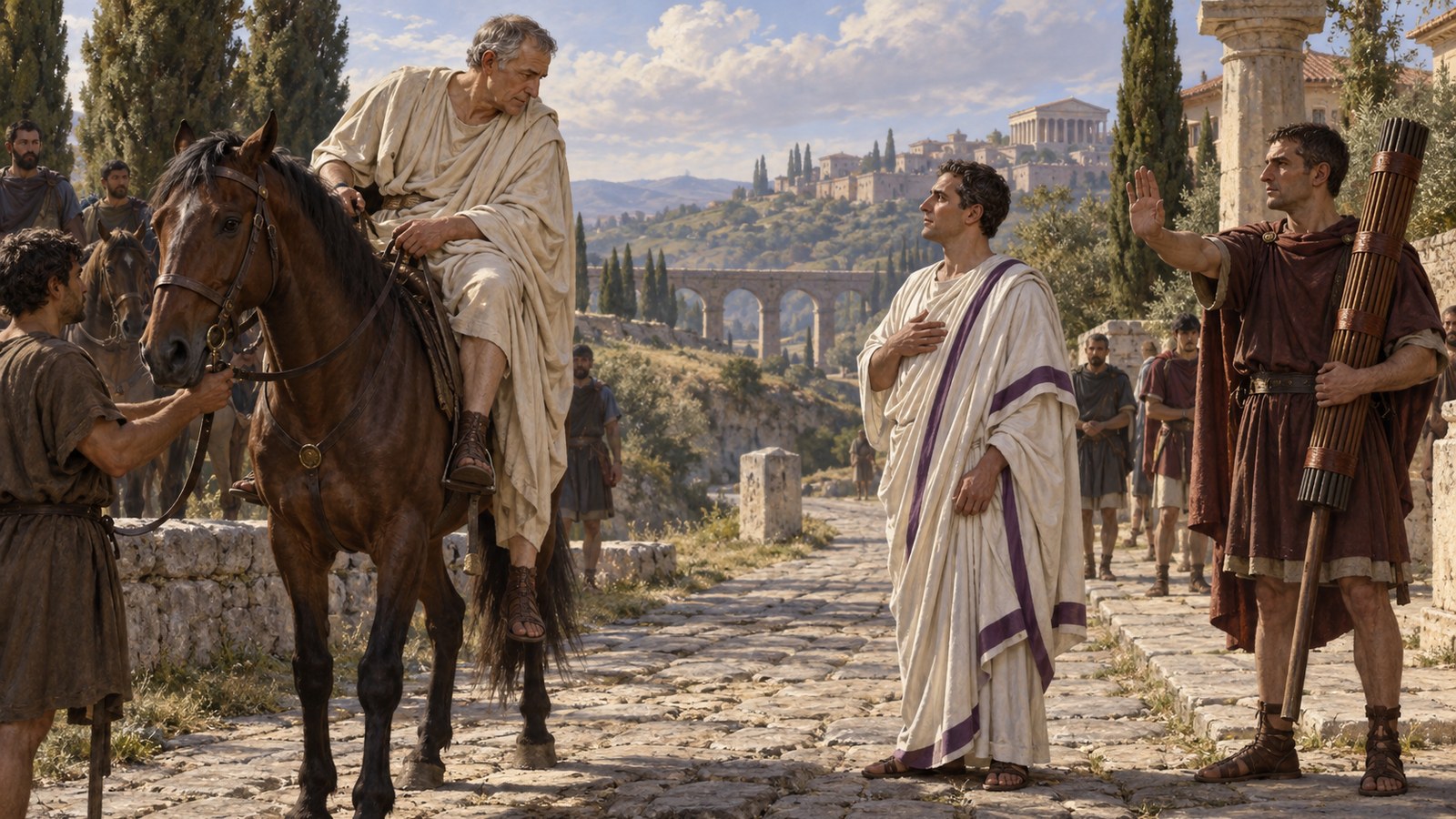
To test the distinction, Gellius quotes an older historical example from Quadrigarius. Quintus Fabius Maximus had been elected consul. His father, himself the Maximus who had been consul the previous year, was now a proconsul. The older man met his son while mounted on a horse.
Because he was the consul’s father, he did not dismount. The lictors knew father and son lived in complete harmony and at first did not presume to command him. Personal knowledge made them hesitate at exactly the boundary Taurus had described.
The consul then asked, “What next?” The attending lictor understood and ordered the proconsul to dismount. In a public encounter, the insignia and command of the current consul could not be suspended by family affection.
The father obeyed. More than that, he warmly praised his son for asserting authority received as a gift from the people. Dismounting did not announce a broken family. It confirmed that both men recognized when public duty displaced private precedence.
Placed together, the scenes prevent a simple slogan. At Taurus’s room, the magistrate son waits while his father sits. On the public road, the father comes down from his horse before the consul. Roman courtesy depended on reading the setting correctly. The chair and the lictor made that reading visible before a wordy rule ever could.
Sources
Aulus Gellius, Attic Nights 2.2.