
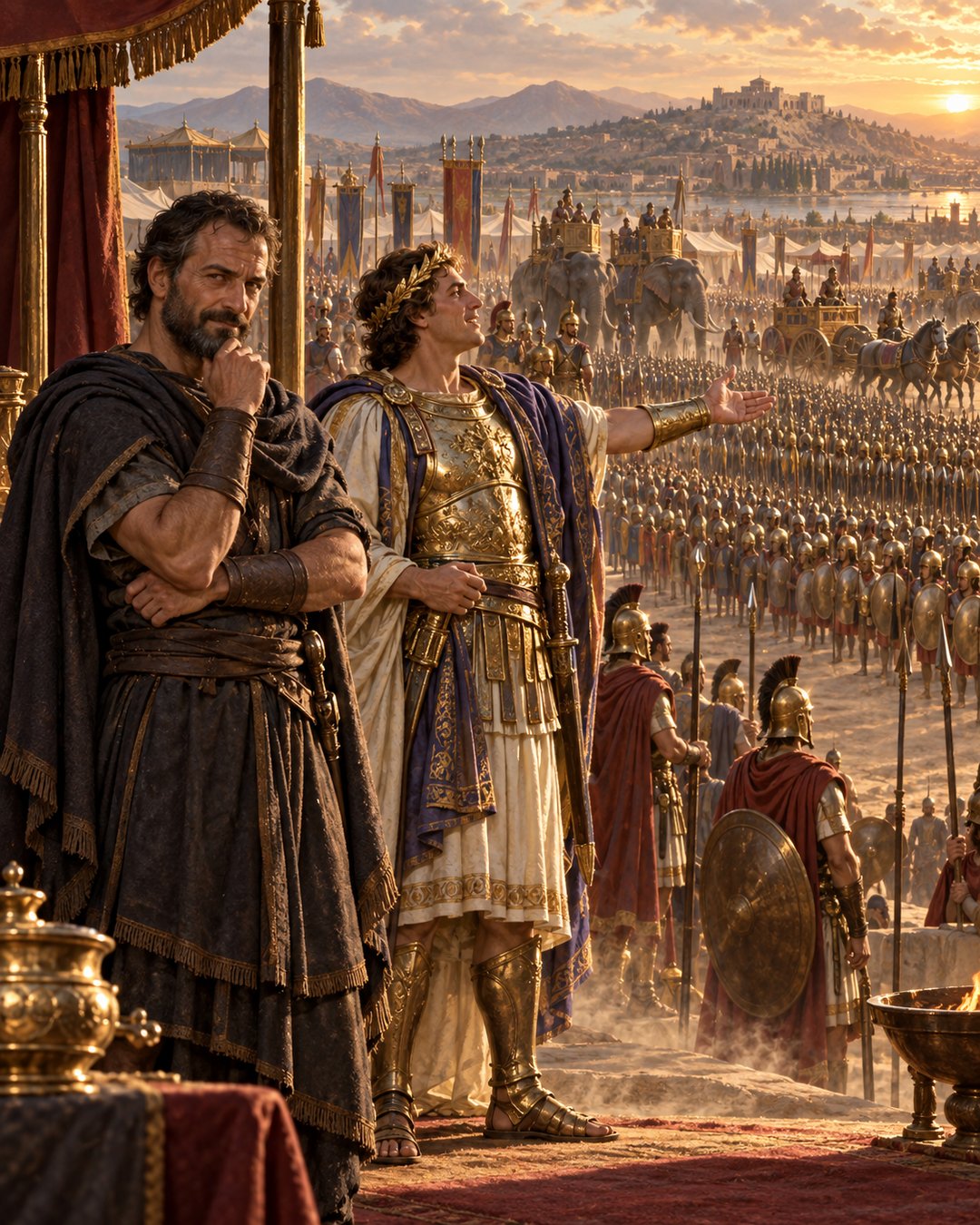
King Antiochus had assembled his answer to Rome on an open plain. Troops manoeuvred in gold and silver ornaments. Scythed chariots stood among them. Elephants carried towers, while cavalry horses flashed with brilliant bridles, saddle-cloths, neck-chains and other trappings.
The king showed the spectacle to Hannibal and asked for a comparison. Could all this be equalled? Was it enough for the Romans? The question invited a military estimate of size, equipment and power.
Hannibal gave him an estimate, but not of the kind Antiochus expected. Yes, he said, it was quite enough for the Romans—even though they were the most avaricious of people. The army’s costly display would satisfy Roman appetite because it could become Roman booty.
Aulus Gellius preserves the exchange as a model of wit and sarcasm. Its force does not depend on adding a new object to the scene. Hannibal simply renames what both men can already see. To Antiochus, the precious metal proves abundance. To Hannibal, the same abundance makes defeat more profitable for the enemy.
The King Put His Answer to Rome on a Plain
Gellius locates Hannibal at the court of Antiochus and says the king had mustered enormous forces for war against the Roman people. The review was therefore not an abstract parade detached from a named opponent. Rome supplied the measure against which Antiochus wanted the army judged.
The setting mattered. On a plain, large formations could be brought forward and manoeuvred. The king did not ask Hannibal to evaluate a written inventory. He arranged a visible comparison whose scale and surface were designed to supply their own argument.
Gellius describes Antiochus as filled with vainglory at the sight. That word fixes attention on the king’s response to his own display. Before Hannibal speaks, Antiochus has already accepted the spectacle as evidence of adequacy.
His question contains two parts. He asks whether all this can be equalled and whether it is enough for the Romans. Equality concerns comparison; sufficiency concerns result. The glittering plain encourages him to treat those questions as if magnificence had answered both.
Hannibal refuses the invitation without refusing its language. He will say whether the army is enough. He will merely change what “enough” is enough to provide.
Gold and Silver Made Strength Visible—and Vulnerable
The first quality Gellius gives the manoeuvring army is its glitter. Gold and silver ornaments catch the eye before he names any weapon, animal or formation. Cost has become part of military presentation.
Antiochus can read that expense as capacity. A ruler able to equip so many men and animals so richly can make resources visible across an entire plain. Precious metal turns wealth into a surface the king can point toward.
Yet ornament does not answer how troops will move under pressure, how commanders will coordinate them or how costly equipment will affect a campaign. Gellius does not provide a tactical report of the army in action. He gives the review and Hannibal’s verdict on what its appearance means.
That limitation is exactly where the joke enters. If the scene can establish wealth more securely than effectiveness, then the wealth is the part Hannibal can assess. Every flash that pleased Antiochus supplies evidence for a different conclusion.
Gellius calls the troops worthless and inefficient in costly armour while explaining the sarcasm. The contrast is not between an undecorated army and a decorated one as a universal rule. It is between the king’s confidence in display and Hannibal’s refusal to mistake display for proven force.
Chariots, Elephants and Horses Filled the Catalogue
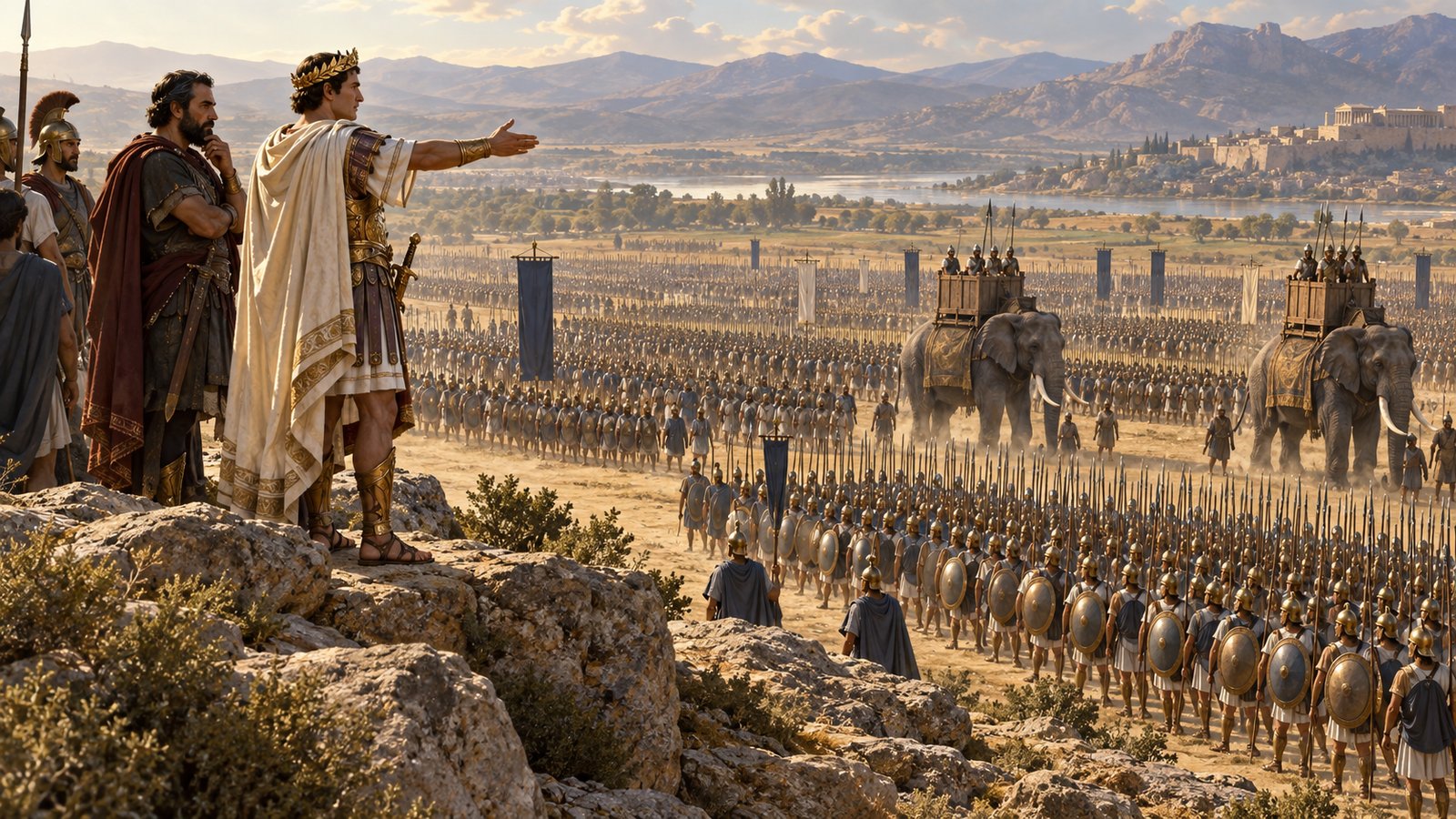
Gellius next gives the spectacle its machinery. There are chariots fitted with scythes and elephants carrying towers. These are not vague references to “many weapons.” Each creates a recognizable silhouette on the plain and enlarges the scale of the review.
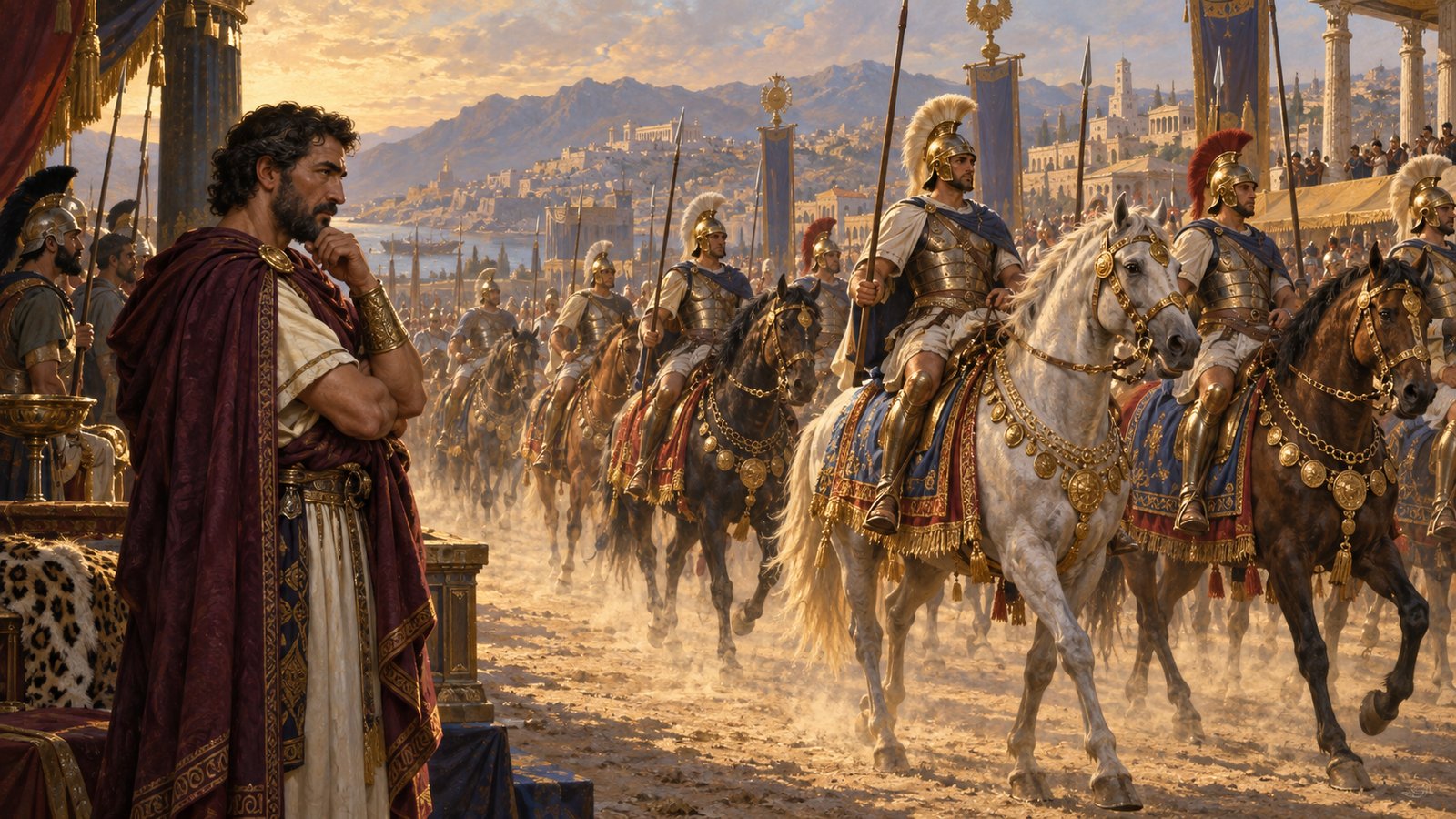
The cavalry receives even finer detail. Its bridles are brilliant. Gellius adds saddle-cloths, neck-chains and trappings. Horse and rider become part of a coordinated surface of expense.
This catalogue helps the reader see why Antiochus expected assent. The review contains numbers, unusual equipment, large animals and worked ornament. It offers variety as well as size. Each new component seems to add another reason that the total must be sufficient.
But the catalogue can also be read as a list of transferable objects. Metal, cloth, harness, armour and vehicles belong to a victorious owner only while victory holds. Hannibal’s answer converts Antiochus’s visual inventory into an imagined inventory for somebody else.
That conversion separates this display from the specific achievements behind Rome’s military crowns. In the next chapter, Gellius sorts crowns by acts such as relieving a siege, saving a citizen or first crossing a wall. Antiochus is showing equipment before Gellius has shown it earning anything.
Hannibal Changed the Meaning of “Enough”
The king expects “enough for the Romans” to mean enough troops and equipment to meet or overcome Roman power. Hannibal repeats the idea of sufficiency while attaching it to Roman avarice. Enough becomes a quantity of desirable spoil.
Gellius explains the verbal mechanism directly. Antiochus asked about the size of the army and wanted a comparative estimate. Hannibal referred to it as booty. The wit lies in answering the words while rejecting the intended category.
That is why a plain yes would not have worked. Hannibal’s “yes” initially appears to satisfy the king, but the phrase about avarice immediately withdraws reassurance. The Romans can be satisfied by this army for a reason opposite to the one Antiochus proposed.
The reply also makes the king’s ornament do two jobs in quick succession. Before Hannibal speaks, gold proves royal resources. Afterward, it proves the potential value of capture. The objects do not change; ownership becomes the hidden variable.
That verbal turn reaches every item Gellius has just named. A chariot can be counted as a weapon while Antiochus commands it or as captured equipment after he loses it. A gold fitting can signify the king’s expenditure or the victor’s gain. Hannibal does not dispute the scale of the catalogue. He makes scale increase the value of the answer the king least wanted.
Another confrontation with the same king would later compress Roman pressure into a circle drawn with a vine stick. Gellius’s anecdote works through the opposite visual excess: Antiochus fills a plain, and Hannibal empties the display of reassurance with one change of meaning.
The Joke Left the Army Standing but Defeated the Review
Nothing in Gellius’s scene makes the troops vanish. The chariots keep their scythes, the elephants their towers and the horses their rich fittings. Hannibal does not need to dismantle the formation to defeat the purpose of the review.
Antiochus wanted the spectacle to force a favourable comparison with Rome. Hannibal shows that spectacle cannot control its own interpretation. A viewer experienced in war may ask not how expensive an army looks, but whether its appearance has outrun its usefulness.
Gellius calls the remark unmatched in wit and sarcasm. His explanation keeps the praise precise. The king asked one kind of comparative question; Hannibal’s reply supplied another comparison under the cover of agreement.
The anecdote survives as more than an insult to decorated troops. It is a lesson in how display creates risk. The more Antiochus invests in making abundance visible, the easier it becomes for Hannibal to describe exactly what Rome might acquire.
On the plain, the king sees proof that he possesses enough. Hannibal sees property whose future possessor has not yet been decided. The Roman army never appears in the scene, yet the joke lets it take ownership in advance. Gold, silver, bridles and towers remain where Antiochus placed them, while one sentence moves them to the other side.
Sources
Aulus Gellius, Attic Nights 5.5–6.