
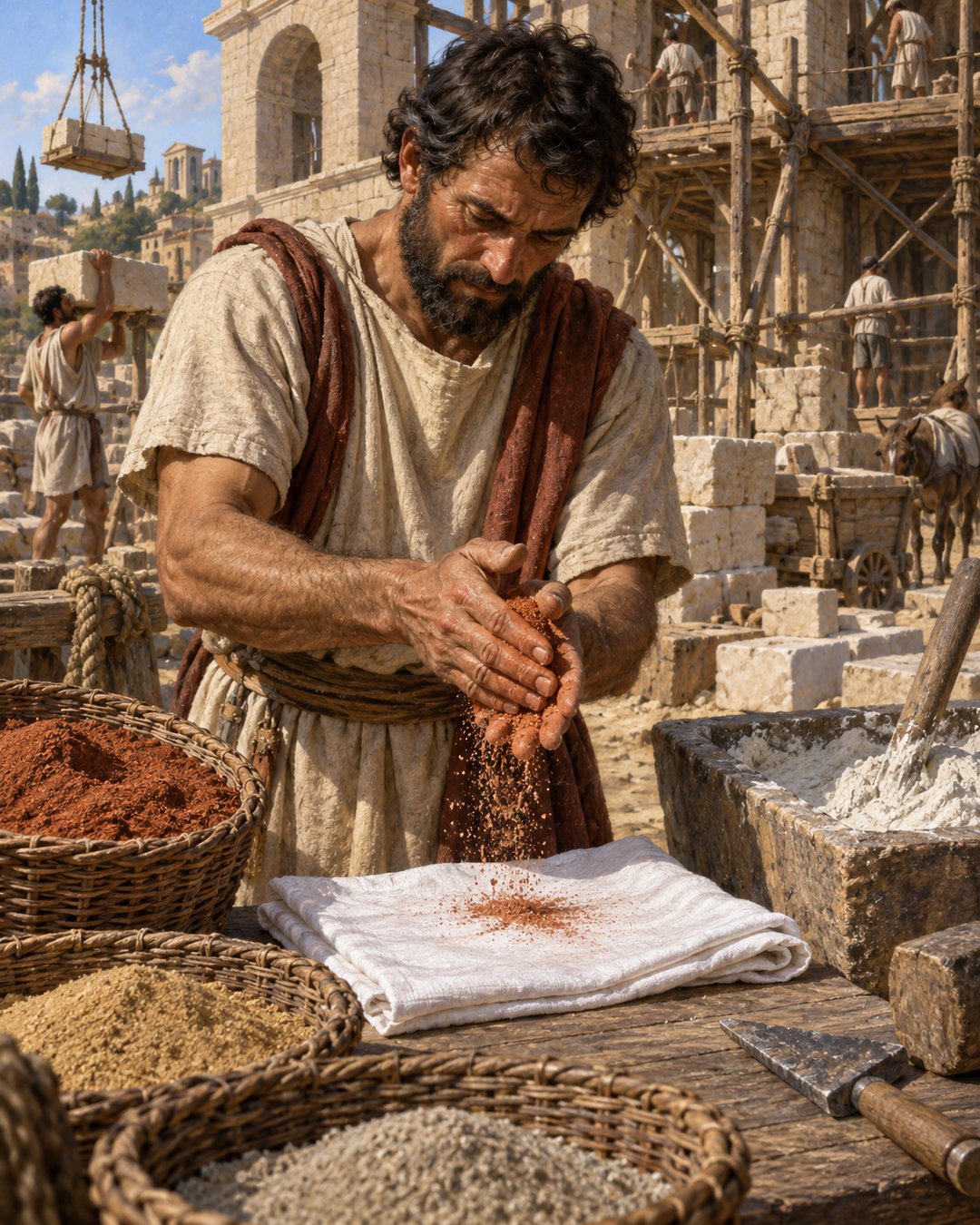
The sand looked dry enough. That did not make it fit for a wall.
Vitruvius gives a builder two tests that required no furnace, scale or specialist instrument. Rub the grains in the hand and listen. Then pour them over a white garment, shake them off and inspect what remains. Good material should rasp rather than collapse like soil, and it should leave neither an earthy stain nor particles clinging to the cloth.
The white surface turned invisible contamination into evidence. Yet it was only the beginning. A builder also had to know where the sand came from, how long it had lain exposed and whether it would bind rubble or receive plaster. Vitruvius could praise one material for a wall and reject the same rich mixture for a finish coat.
Roman mortar, in his account, began before lime touched water. It began with choosing grains whose history and behavior matched the work ahead.
The Hand Test Listened for Grain against Grain
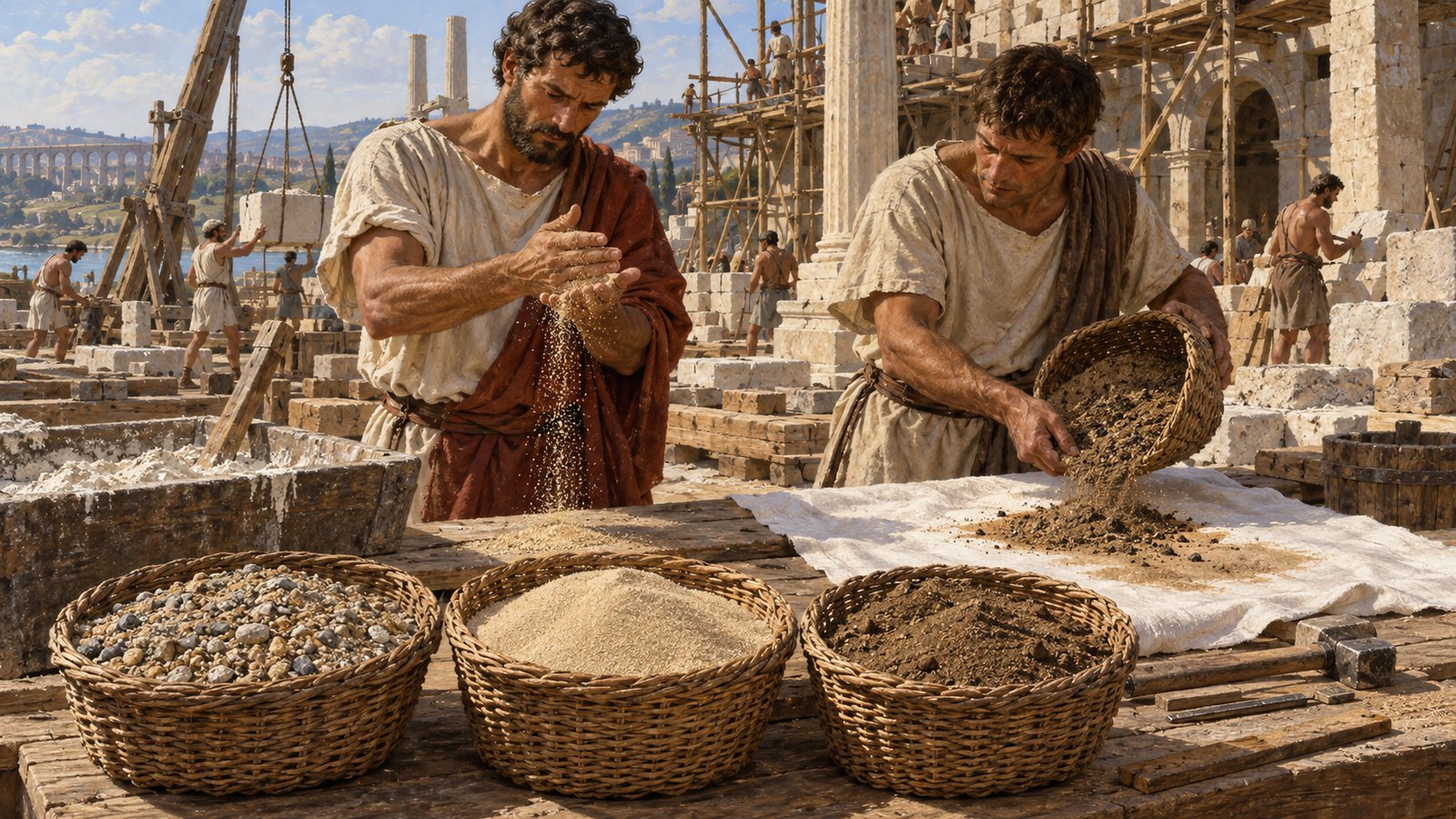
Vitruvius divides sand by source. Some came from pits, with black, pale, red and carbonaceous varieties. Other supplies came from rivers or the sea. The labels mattered because extraction environment affected cleanliness, salt, shape and the way a batch behaved with lime.
His first field test is tactile and audible. A builder rubbed sand between the fingers or palms. A good sample made a sound. The instruction is brief, but the contrast is clear: grains that scrape one another announce a different material from a handful softened by abundant earth.
This was not a demand for one color. Black, pale and red pit sands might all serve. The important question was whether the sample behaved as granular aggregate instead of disguising soil inside a sandy appearance.
The test also suited a working yard. Sand arrived in bulk, and a mason could not examine every grain. A handful converted a cartload into a quick judgment. Texture and sound were proxies for the boundaries between particles that mortar needed.
The related account of stone becoming quicklime inside a Roman kiln begins at the other side of the mixture. Lime supplied the reactive binder. Vitruvius’s hand test asks whether the aggregate deserved to meet it.
White Linen Made Earthy Contamination Visible
The second test used contrast. Vitruvius tells the builder to cast sand onto a white garment and then shake it off. If the fabric remained clean and no earth adhered, the sample passed this part of the inspection.
White linen performed two jobs at once. Its color exposed brown or grey smearing, while its weave caught fine material that did not fall with the heavier grains. The method separated a merely pale-looking sample from one that actually released little earth.
There is practical economy in the instruction. The test consumed almost nothing. Sand could return to the pile, the cloth could be shaken, and the judgment arrived before labor was committed to slaking, measuring and mixing.
The cloth did not calculate compressive strength. It screened for a cause of failure that a builder could recognize early. Excess earthy matter interrupted the granular skeleton that lime paste had to bind. What looked like extra fine material could become weakness rather than helpful body.
Vitruvius therefore places observation ahead of recipe. A ratio copied perfectly could still fail if its “sand” carried too much soil. Numbers mattered only after the ingredients were honestly identified.
Source and Exposure Changed the Same Material over Time
Fresh pit sand receives Vitruvius’s strongest approval for masonry, but that approval had an expiry. If the excavated material lay for a long period under sun, moon and rain, he says it lost binding power and became earthy.
Weathering altered the batch after extraction. The name of the pit could remain the same while exposure changed what arrived at the trough. Vitruvius warns that such sand would no longer hold rubble stones securely on their beds, especially where a wall carried great weight.
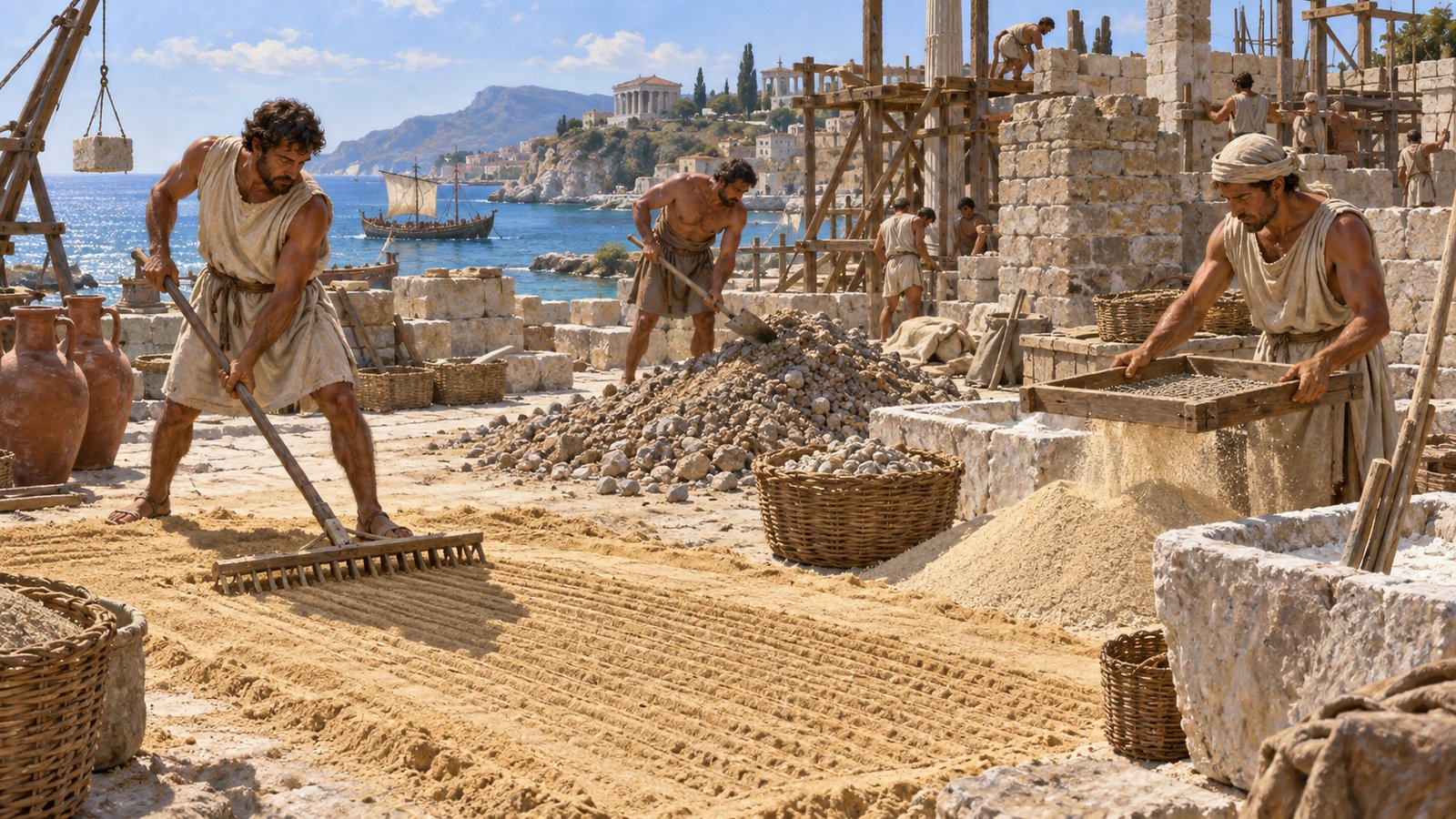
River and marine sands posed different questions. Water had already sorted and worked them. Sea sand also carried salt. Vitruvius required washing it in fresh water and drying it before construction, a preparation that added time but addressed what its source had introduced.
He connects the salt directly to finishes: material exuding from a marine batch could spoil plaster. A wall might stand while its surface announced that the sand had not been properly prepared.
This concern with waiting resembles the logic behind Utica’s five-year test for building bricks. In both cases, time is not empty delay. Exposure reveals whether a material will keep the qualities it seemed to possess on the first day.
Wall Mortar and Plaster Asked Opposite Things of Sand
The richest pit sand did not win every assignment. Vitruvius says it was excellent for mortar yet unfit for plastering. Mixed with lime and straw, its strength could prevent an even drying and produce cracks.
River sand, which he considered poorer in another context, could be advantageous for a finish. Worked thoroughly with beaters, it made plaster as hard as cement. The judgment changed because the task changed.
A rubble wall needed aggregate and binder to grip irregular stones and resist load. Plaster needed adhesion, workability and controlled drying across a broad, thin surface. “Strong” was not one universal property. A mixture could be too forceful or too rich for the geometry in which it was used.
This is the most useful part of the chapter. The white-cloth test did not sort all sand into good and bad forever. It established cleanliness. Source, age and intended layer then refined the decision.
Material knowledge meant preserving distinctions. Pit, river and sea sand were not interchangeable labels; neither were wall core and finish coat. A Roman builder who ignored those distinctions could produce a crack with ingredients that sounded impressive on their own.
Ratios Followed the Diagnosis
Only after discussing sand does Vitruvius give proportions. With pit sand, he specifies three parts sand to one part lime. With river or sea sand, the proportion becomes two to one.
The changed ratio confirms that there was no context-free mortar formula. Aggregate source altered how much lime the batch required. The recipe responds to the material judgment rather than replacing it.
Vitruvius adds another adjustment for river or marine supplies: sifted, ground potsherd equal to one third of the sand could improve the mortar. Broken fired clay entered a new building not as decorative reuse but as a controlled ingredient.
The complete sequence is diagnostic. Identify the source. Rub a sample. Shake it from white cloth. Account for washing, salt and weathering. Decide whether the batch belongs in masonry or plaster. Then choose a ratio and, where useful, add crushed ceramic.
That sequence also divided responsibility across a crew. A laborer unloading baskets could notice mud or stale stock; a mason could compare the rasp of two samples; the person supervising plaster could reject a batch that a wall builder welcomed. Knowledge did not have to remain inside a written treatise to shape the yard. Each test translated a principle into a repeatable action that could be shown by hand. The cloth was especially useful because disagreement left a visible result on a shared surface. Instead of arguing over whether the pile looked clean, workers could inspect the smear together and keep suspect aggregate away from expensive lime.
A finished Roman wall can make construction seem monumental and distant. Vitruvius returns it to a hand, a sound and a faint mark on linen. Failure might begin with earth too fine to notice in a pile. The builder’s first defense was to make that trace visible before the mortar set around it.
Sources
Vitruvius, On Architecture 2.4–5.