
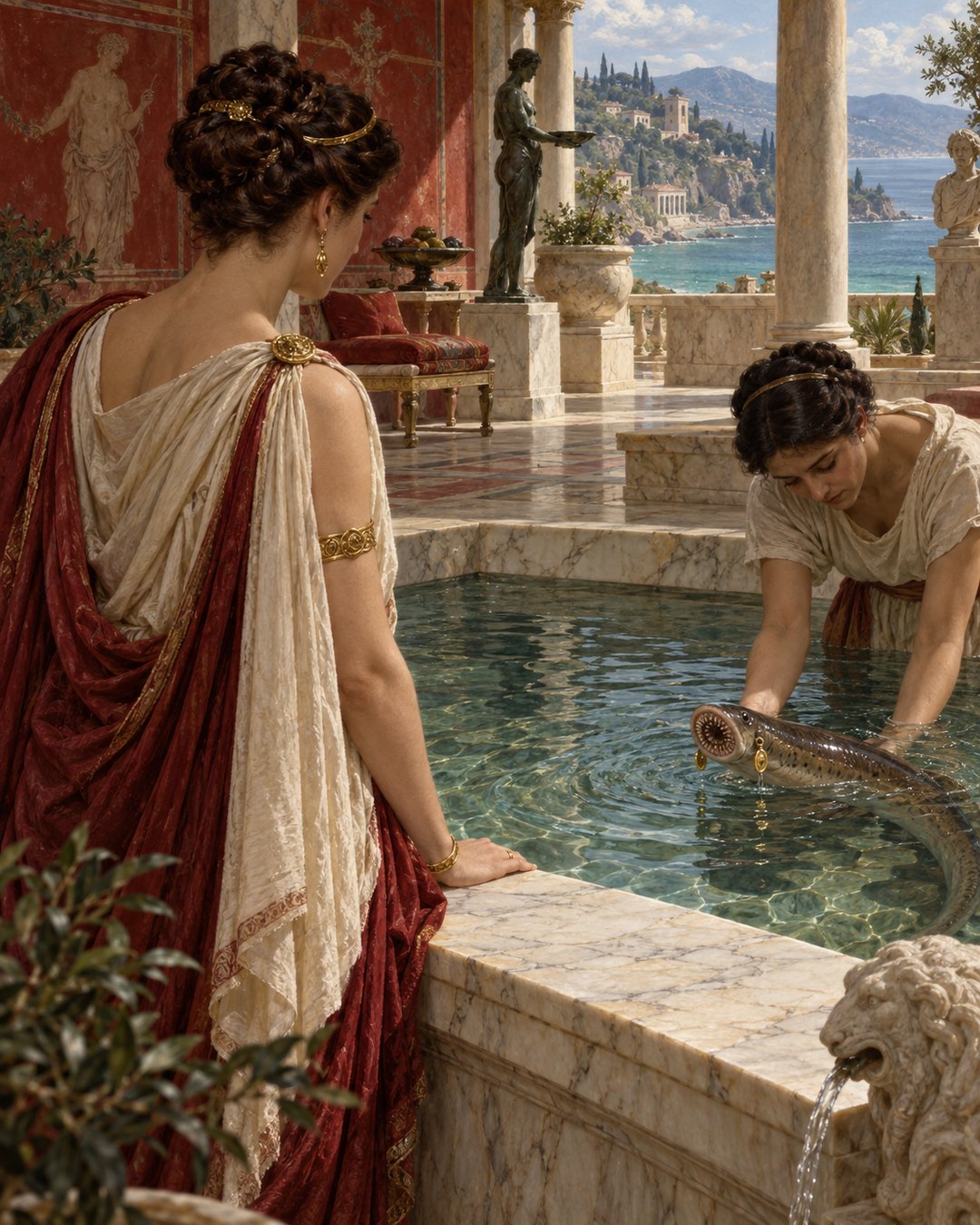
The visitor did not come for a statue. The attraction moved beneath the water.
At a villa in Baculo, near Baiae, Antonia kept a favorite lamprey and decorated it with earrings. Pliny says the fish acquired such a reputation that people became eager to visit. A creature normally counted among pond stock had become an individual sight.
The ornament can look like an isolated extravagance, but Pliny carefully prepares it. His account passes through oyster preserves, seawater channels cut through hills, fish sold for millions and six thousand lampreys loaned for Caesar’s triumphal banquets. Elite ponds had become expensive systems and public boasts before one animal wore jewelry.
Antonia’s fish marks the final turn. Wealth was no longer displayed only through the quantity consumed or the engineering that kept it alive. The owner made one lamprey recognizable, attached a story to it and let curiosity carry that story beyond the villa.
The Bay Turned Fresh Fish into Managed Property
Pliny begins the sequence with Sergius Orata, whom he credits with making the first oyster preserves at Baiae. Orata’s operation attached fame to oysters from the Lucrine Lake, converting a coastal product into a named delicacy.
Preserves and ponds changed the timing of luxury. A host did not have to depend entirely on the morning’s catch. Living animals could be retained, sorted and presented when required. Water, walls and channels became part of the household’s provision.
A related article on Sergius Orata and the Lucrine oyster trade follows this commercial mechanism. Pliny’s next examples move from branding toward spectacle. The elder Licinius Murena receives credit for ponds holding other fish, and imitators made the coastal villa itself a kind of curated sea.
Freshness remained useful, but usefulness alone cannot explain the scale Pliny emphasizes. The pond allowed wealth to stay visible between meals. Guests could see the costly stock still swimming, and the owner could delay its conversion into food.
This living inventory made a new kind of competition possible. One villa could boast a species, another an engineered channel, and another an animal whose identity mattered more than its market destination.
Channels and Prices Made the Water an Elite Monument
Lucullus turned circulation into architecture. Pliny says he cut through a hill near Naples to bring seawater into his ponds. The work cost more than a country house and provoked Pompey’s joke that Lucullus was Xerxes in a Roman toga.
The comparison mocked a private man for reshaping land and sea with royal ambition. A channel serving fish became a monument to command over geography. Its current kept valuable animals alive while advertising the money spent to create that current.
Pliny supplies a financial afterlife. When Lucullus died, the fish from his pond sold for four million sesterces. The figure compresses infrastructure and biology into property: waterworks had accumulated a living stock that could be priced separately from the villa.
A broader article on Roman fishponds as stores of freshness and wealth explains why managed water appealed to owners. Antonia’s lamprey belongs inside that system, but its earrings reveal how far ownership could exceed storage.
The pond was simultaneously pantry, investment and viewing space. Once guests learned to read its size and inhabitants as signs of status, an especially strange or beloved fish could become part of the architecture’s meaning.
Six Thousand Lampreys Could Be Lent without Being Sold
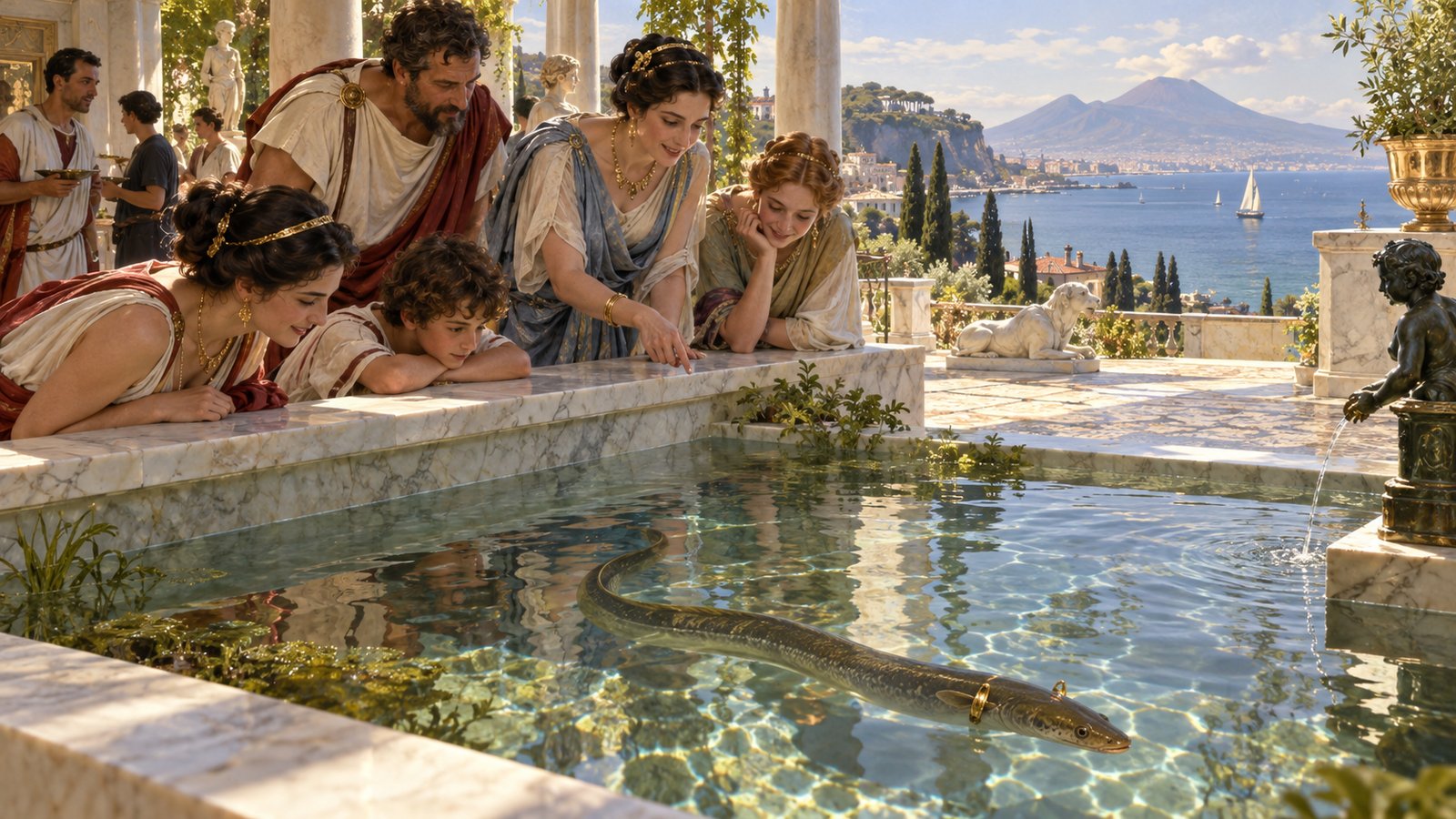
Gaius Hirrius receives another “first” from Pliny: a separate pond made specifically for lampreys. Specialization distinguished these fish from a mixed stock and let their number become a boast in its own right.
For Caesar’s triumphal banquets Hirrius supplied six thousand lampreys. Pliny insists that they were a loan. Hirrius would not trade them for money or for another commodity.
The arrangement sounds paradoxical only if the fish are treated as ordinary ingredients. Their temporary use at a triumph increased the owner’s reputation, while outright sale would dissolve the collection that made him notable. The value lay partly in retaining command over a mass of living animals.
Loaning also preserved the social message. Caesar could serve an extraordinary quantity, and Hirrius could remain the man capable of supplying it. The same fish generated prestige for both banquet and pond without passing permanently into a simple market exchange.
Pliny gives Hirrius’s estate the same four-million-sesterce valuation through its ponds. Whether the repeated figure is exact accounting or literary emphasis, it shows what the author wants readers to see: fish husbandry had become legible as enormous private wealth.
Grief Changed a Species into an Individual
After quantity and price, Pliny changes scale. Affection for individual fish, he says, came into fashion. The orator Hortensius kept a lamprey at Baculo and loved it so deeply that he was believed to have wept when it died.
The sentence makes the fish biographical. It had a place, an owner, a relationship and a death that produced reported grief. The pond no longer contains interchangeable units waiting for a feast.
Pliny’s tone is not neutral admiration. The progression lets extravagance expose itself: Romans who built costly habitats for food animals now mourned one of them. Yet mockery does not erase attachment. The anecdote works because the behavior was memorable enough to circulate.
Hortensius also prepares the reader for Antonia. A beloved lamprey could receive emotion; the next could receive adornment. Both gestures singled one body out from thousands of similar fish.
The villa made that distinction sustainable. Controlled water kept the animal near the household, where repeated encounters could produce familiarity. A wild catch disappears into a meal. A pond resident can acquire habits, recognition and a story.
Earrings Turned Affection into a Public Attraction
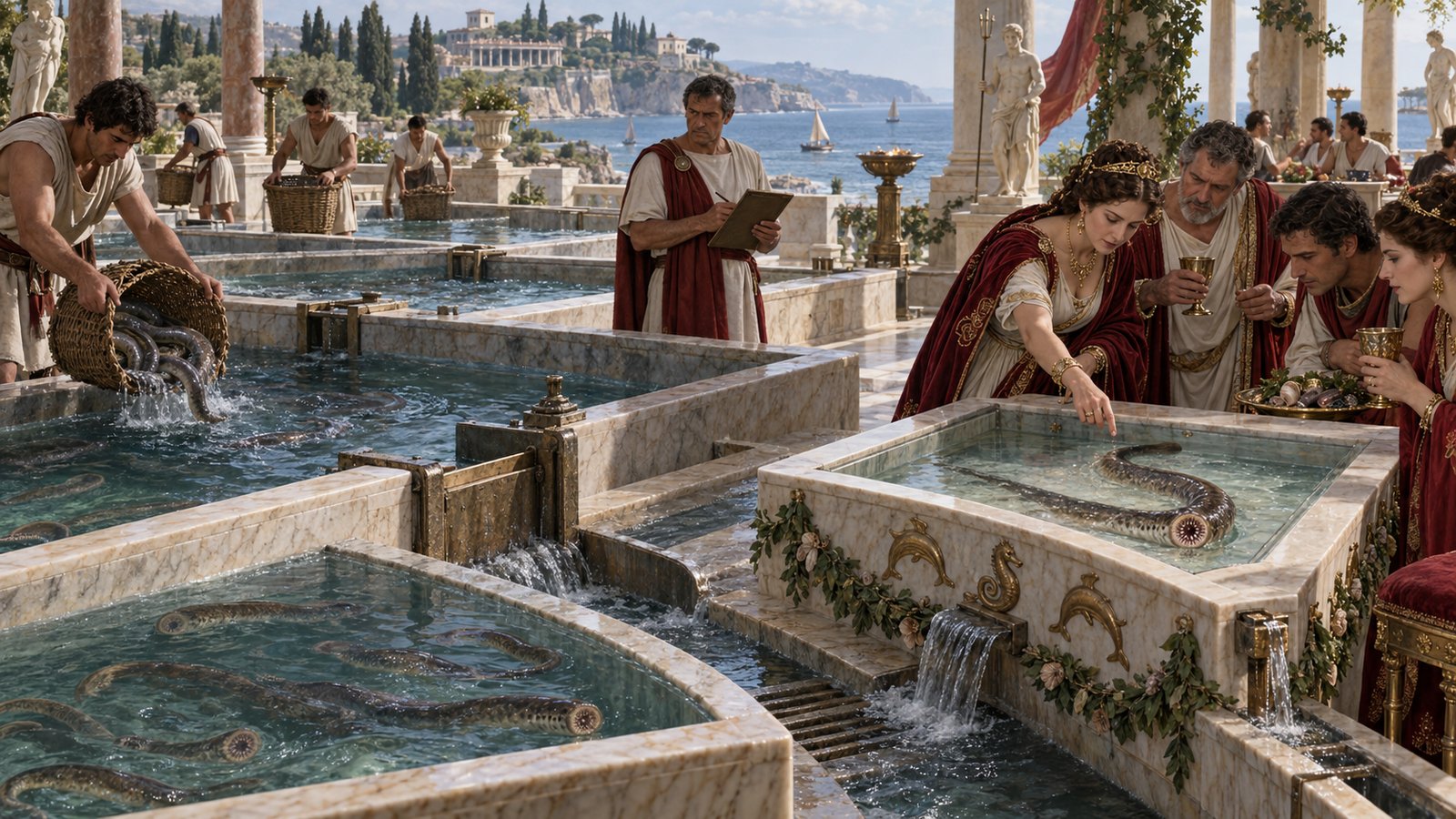
At the same Baculo estate, Drusus’s wife Antonia adorned her favorite lamprey with earrings. Pliny does not explain the attachment method or invite reconstruction beyond his sentence. The secure details are the owner, the favorite animal, the ornament and the attention it drew.
Jewelry made affection visible. A guest did not need to accept a private claim that this fish was special. Gold marked the individual body as it moved through the pool, separating it from stock by sight.
The result was reputation. People wanted to visit Baculo, Pliny says, because of the lamprey. The pond had become a destination, and access to a private villa became part of the animal’s celebrity.
Visitors also completed the display. Jewelry could mark the fish, but an audience converted that mark into social currency. Every person who repeated the story beyond Baculo extended the villa’s fame without consuming its attraction. Pliny’s sentence captures an early form of destination curiosity: the journey was justified by an object that could be seen nowhere else, even though that object was alive, submerged and owned by a private household. The lamprey’s continued presence made repeat telling possible in a way that a single extravagant dish could not.
That outcome differs from serving six thousand fish. Consumption proves abundance at one banquet. A famous living lamprey keeps producing curiosity over time. Its value lies in remaining unavailable for the ordinary end of a food animal.
Pliny’s sequence moves from coast to preserve, preserve to engineered pond, pond to fortune, fortune to collection, collection to pet and pet to spectacle. Antonia’s earrings are memorable because they close that escalation with something tiny. Two ornaments on one fish made an entire system of water, money and social access visible at a glance.
Sources
Pliny the Elder, Natural History 9.79–82.