
Before the grain arrived, the ground had to be built.
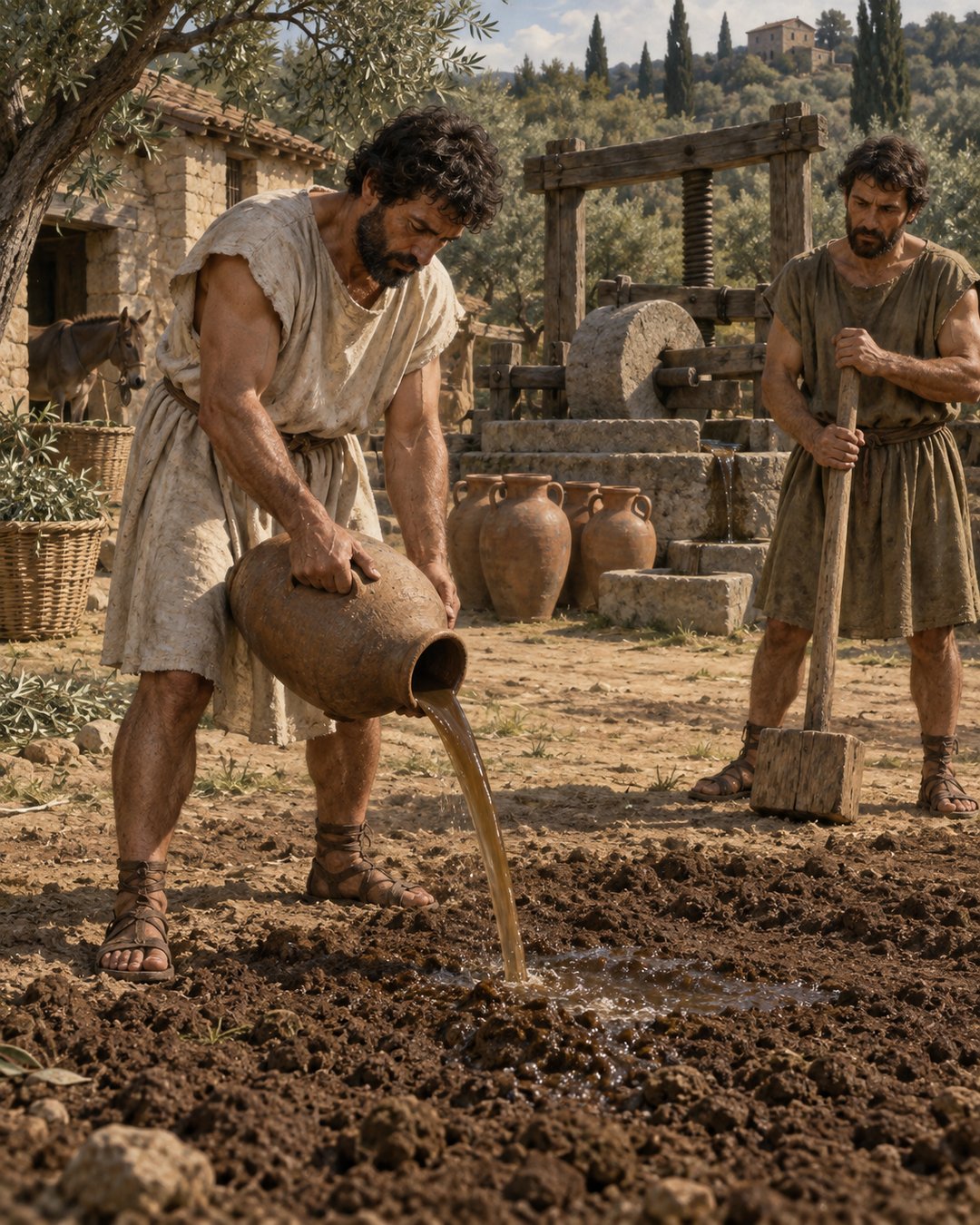
Cato’s recipe for a threshing floor begins by turning soil and flooding it with amurca, the dark watery lees left from olive-oil production. The liquid soaked in. Workers then broke every clod, leveled the area and beat it hard with rammers. A second layer of lees went over the packed earth and dried there.
The result was supposed to resist two quiet enemies. Ants would not injure the floor, Cato says, and weeds would not grow through it. Pliny adds another concern when he compares alternative preparations: dust.
This was not decorative paving. It was a controlled working surface designed to carry grain, hooves, sledges and flails without becoming part of the harvest. A farm by-product from the olive press helped turn ordinary soil into seasonal infrastructure.
The Harvest Needed a Surface That Would Not Join the Crop
Threshing separates kernels from ears and straw by impact, pressure and repeated movement. It also places food directly against the ground. If that ground loosens under work, soil and dust enter the same moving mass that workers are trying to clean.
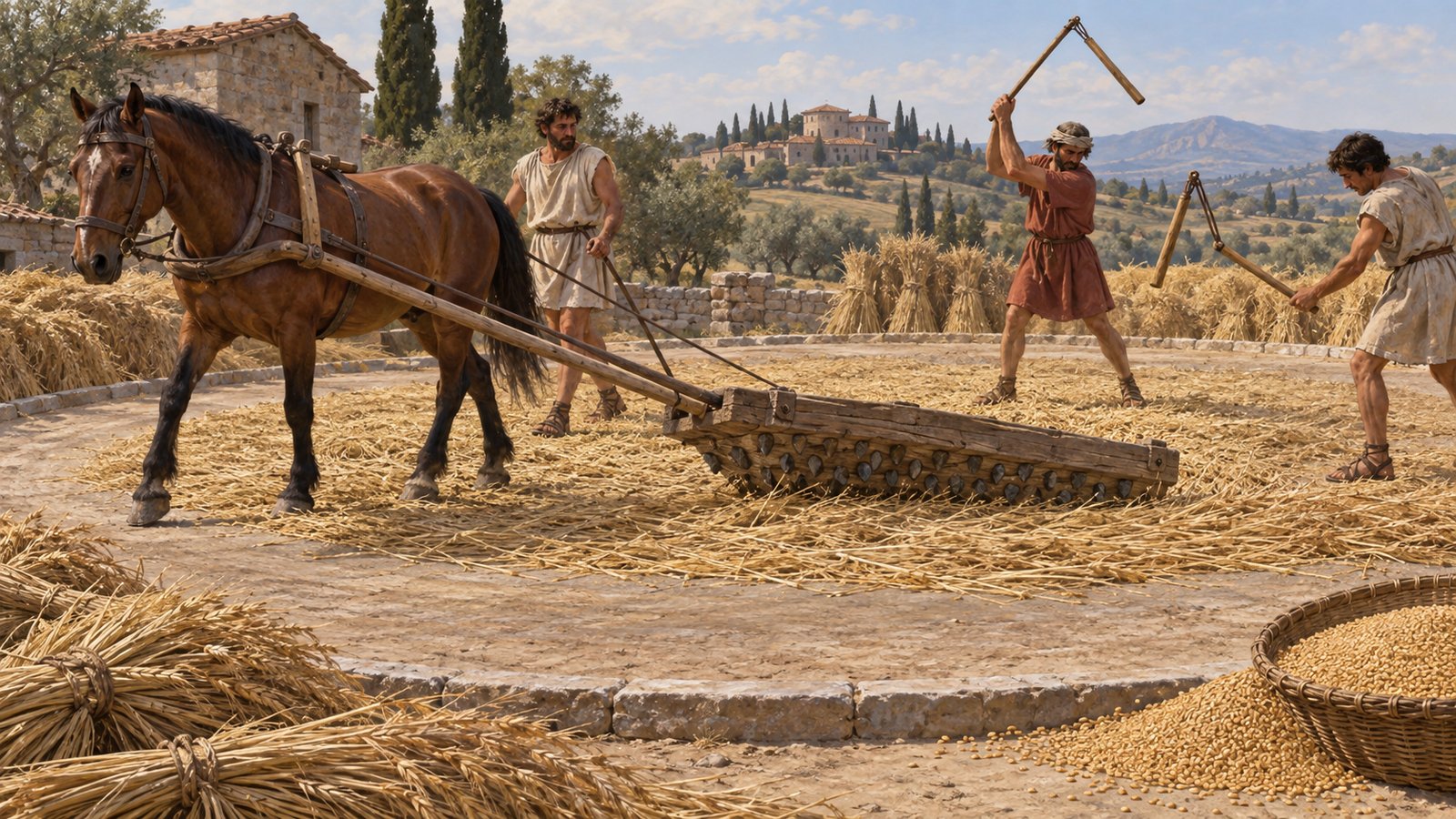
Pliny lists several methods. In some regions a sledge with flints beat the crop across a floor. Elsewhere mares trod it. Other workers used flails. Each method transferred force through grain into the surface below.
The companion article on hooves, flint and wind in Roman threshing follows the active separation. Cato’s instruction concerns the condition that made those actions possible. A floor had to remain flatter and harder than the field around it.
A soft patch would absorb effort. A cracked patch would trap kernels. Loose earth would rise with every hoof or sledge pass and make later winnowing carry mineral dust along with chaff.
Preparing the floor before harvest therefore protected both labor and crop. The work did not begin when the sickle entered standing grain. It began when farmers manufactured a place where grain could be struck, trodden and gathered cleanly.
Olive Lees Entered the Soil before the Rammers
Cato starts with turned earth rather than a finished slab. The farmer was to pour amurca thickly over it and allow the liquid to soak in.
Amurca was not olive oil. It was the watery, bitter residue that separated during processing. An olive farm produced it as an abundant secondary material, and agricultural writers assigned it uses far beyond the press.
The order matters. Wetting came before final compaction. Liquid reached between disturbed particles while the soil was still open, rather than merely darkening an already hardened crust.
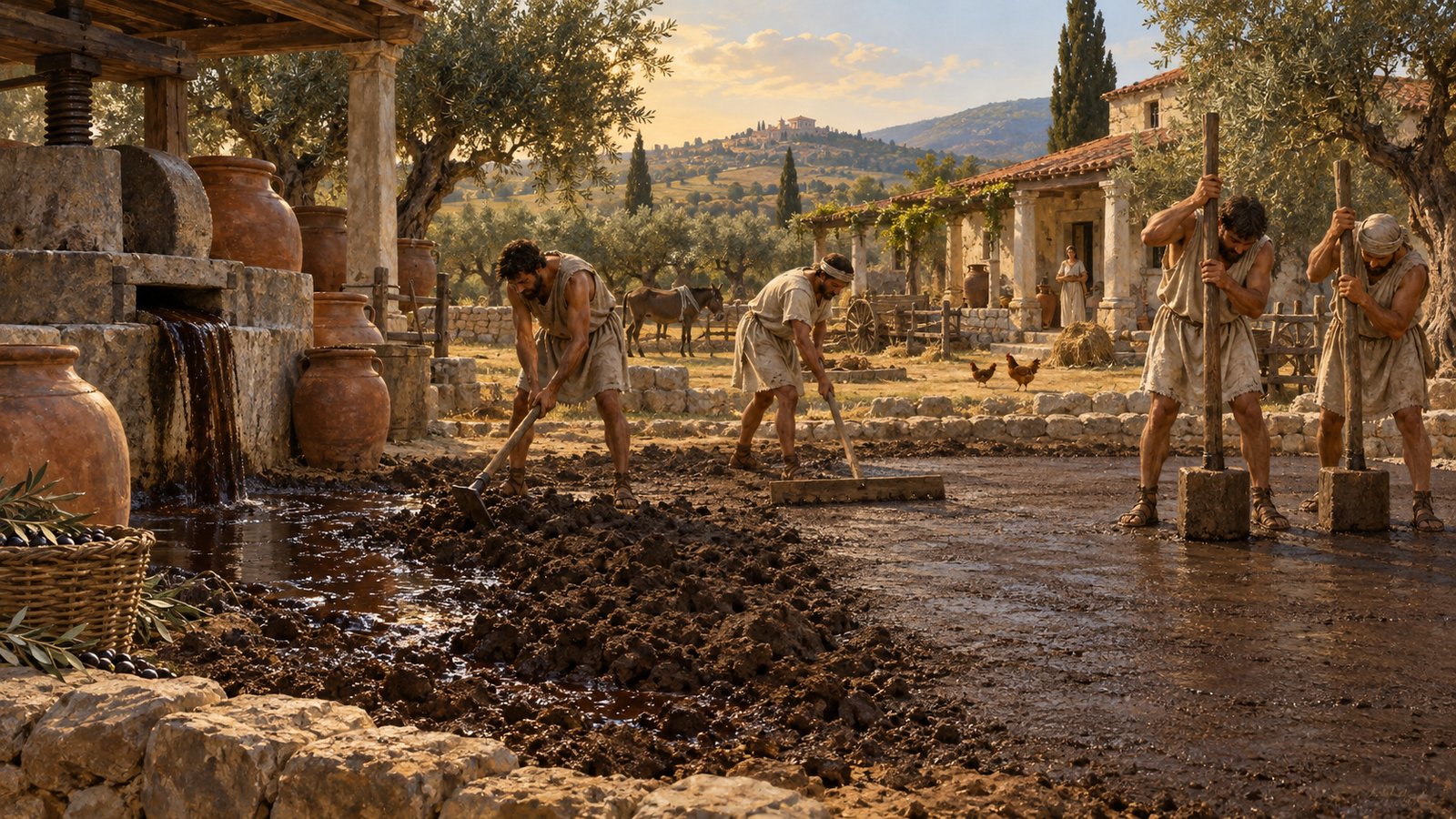
Workers then broke up the clods carefully. Large lumps would create voids and uneven resistance. Reducing them allowed the floor to be leveled as one continuous surface.
Only after that correction did the rammers pack it. Broad wooden heads and repeated downward blows forced loosened particles together. The method built hardness from many small impacts, the same kind of patient process seen inside Cato’s precisely adjusted olive mill, where a finger’s breadth determined whether stones crushed flesh without breaking pits.
A Second Coating Closed the Packed Surface
Cato orders another application of amurca after leveling and ramming. The first dose penetrated turned soil; the second met a compacted face.
That repetition suggests different functions within the same treatment. One application conditioned the body of the floor during construction. The next covered and dried over the finished surface where harvest work would occur.
Drying completed the sequence. The floor was not ready while saturated. Moisture had helped distribute the lees and shape the earth, but the working surface needed to become firm before grain and animals crossed it.
Cato promises that ants would not harm a floor built this way and weeds would not grow. Both claims concern persistence. Ants could excavate small passages and loosen particles from below. Roots could pierce and divide what ramming had made continuous.
The treatment therefore guarded the floor between moments of visible labor. Its most important work happened while no one was threshing: suppressing the biological activity that might undo compaction before or during harvest.
Pliny Preserved Three Competing Finishes
Centuries later, Pliny remembered Cato’s olive-lees dressing but did not present it as the only answer. He contrasts it with a chalk method attributed to Virgil, which he calls more laborious.
He also records an economical common practice. Many farmers simply leveled the area and smeared it with a fairly weak solution of cow dung. Pliny says that appeared sufficient to prevent dust.
The three options expose a shared problem through different materials. Olive lees reused liquid from one harvest process. Chalk supplied mineral matter at greater labor. Diluted dung offered a widely available farm input.
None of them turned the floor into elaborate masonry. Each modified compacted earth so its upper layer behaved better under abrasion. The desired surface was hard enough to work yet practical to prepare at agricultural scale.
Pliny also says Cato praised olive lees for keeping threshing floors from cracking. That addition connects the treatment to the wetting, packing and drying sequence. A crack was not merely ugly; it was a trap for grain and a starting point for erosion.
Press Waste Linked the Olive and Grain Calendars
Amurca moved between branches of farm work. The olive press produced a residue. The threshing floor consumed it. Pliny lists still more applications: granary plaster and floors, seed grain, leather gear, wooden tools and earthenware vessels.
The list should not be treated as modern chemical proof for every promised effect. It is evidence for how Roman agricultural writers imagined a useful by-product: bitter, penetrating and valuable enough to store and apply rather than discard.
On the threshing floor, its role was especially visible. Dark liquid soaked pale earth, rammers compressed the treated layer, and drying turned a messy preparation into a clean stage for cereal processing.
The geometry of the floor made maintenance equally important. Grain and animals moved repeatedly over the same bounded area, concentrating wear that an open field would disperse. A shallow depression could collect kernels; a raised clod could catch a sledge; a loose edge could crumble inward under hooves. Leveling was therefore not cosmetic. It created predictable contact across every circuit, while the rammed and treated face reduced the number of places where food or tools could snag. The investment paid back during the short harvest interval, when delays mattered and a damaged surface could contaminate many loads in succession.
The sequence also joined two harvests separated in time. Residue from olives could help prepare infrastructure for grain. A substance left after extracting one food protected the surface on which another food was released from straw. Storage and planning connected those seasons: the lees had to remain available when the floor was repaired, before cut cereal crowded the farmyard and demanded immediate processing.
Cato’s recipe is only a few sentences long because the labor was familiar. Yet those sentences preserve an entire physical chain: turn, soak, break, level, ram, coat and dry. Ants and weeds defined success between seasons; low dust defined it during work.
A threshing floor could look like empty ground when the harvest was elsewhere. Cato shows that emptiness was constructed. Beneath the next pile of grain lay compacted soil, two applications of olive lees and the memory of many blows from wooden rammers.
Sources
Cato, On Agriculture 91; Pliny the Elder, Natural History 15.8 and 18.71–72.