
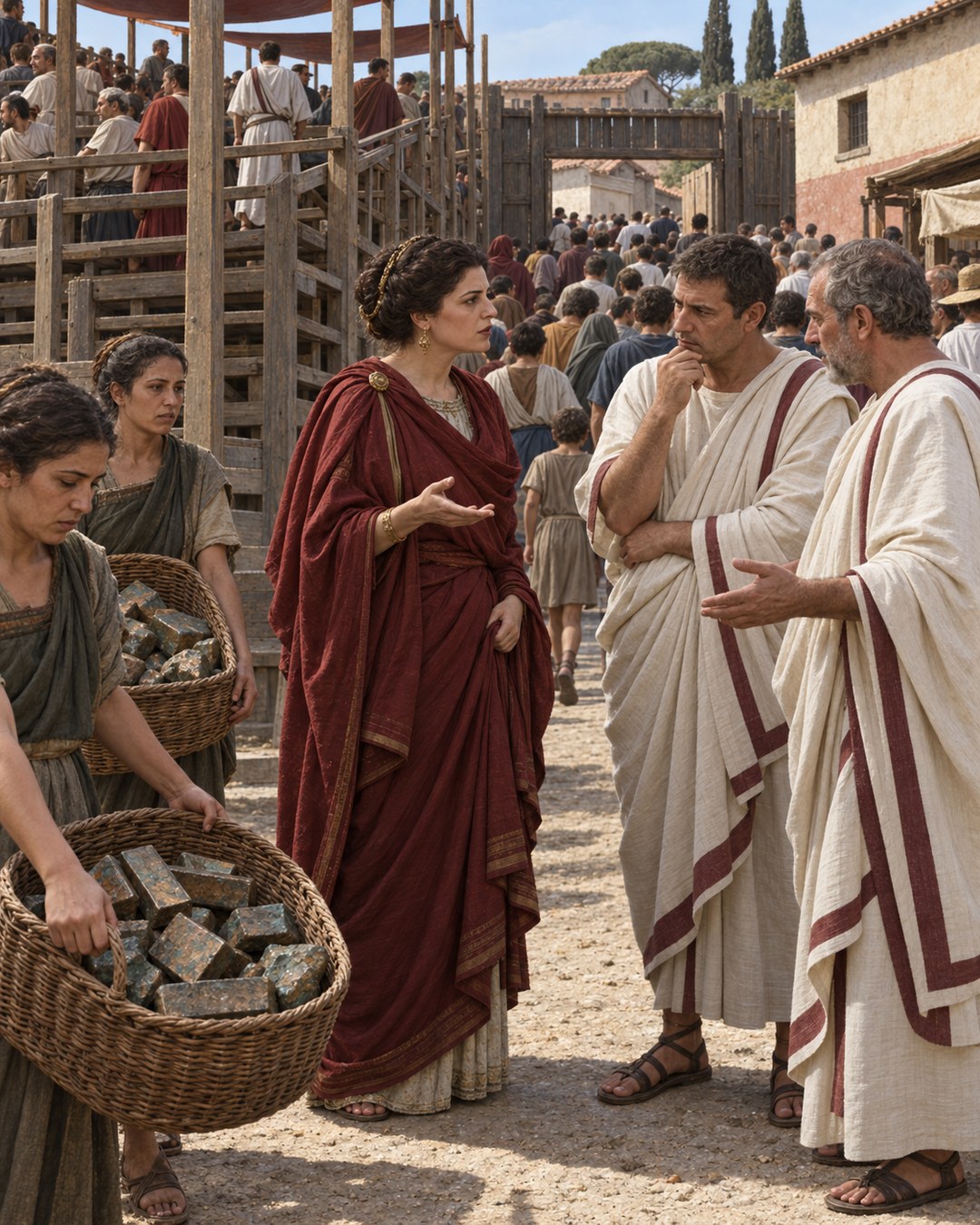
The crowd closed around her as the games emptied into the street.
The daughter of Appius Caecus had rank, family memory and no room to move. After she fought clear of the press, she complained that she had been roughly handled. Then irritation became something Rome’s magistrates could punish. She wished that her brother might return to life, take another fleet to Sicily and destroy the people who had just crowded her.
Her brother was Publius Claudius, remembered for the naval disaster bound to the story of the sacred chickens. His lost fleet had already carried many Roman citizens to their deaths. To use that catastrophe as an answer to an inconvenient audience was more than an aristocratic sneer.
Gaius Fundanius and Tiberius Sempronius, the plebeian aediles, imposed a fine of 25,000 pounds of full-weight bronze. Gellius turns the episode into a lesson about arrogant language, but the mechanics matter too: crowd, sentence, named officials and a penalty whose weight almost overwhelms the imagination.
The Offense Began in the Crush after the Games
Gellius does not place the remark in a private dining room or inside a family quarrel. The woman had been a spectator at public games. When the entertainment ended, people converged from different directions, and she was jostled as she tried to leave.
The physical setting explains the flash of anger without excusing it. Anyone who has moved through a narrow exit understands the loss of control: bodies press from behind, pace belongs to the crowd, and status cannot open empty space. For a member of one of Rome’s most celebrated houses, that temporary equality of elbows may have felt like an insult.
Gellius says she first complained about rough handling. Had the episode stopped there, it would have been ordinary bad temper. The decisive movement was verbal. She imagined the crowd smaller because her brother’s defeat had killed citizens, then wished for another expedition to remove still more of them.
The line converted those around her from fellow spectators into disposable bodies. The people who heard it did not need a long argument about intent. The speaker had reached for a national calamity as a fantasy of personal relief.
That public setting also meant witnesses. The crowd was not merely the object of the remark; it was the audience that made the remark politically legible. Rome’s civic life depended on speech before others, and the same visibility that could build reputation could expose contempt.
Her Brother’s Defeat Made the Wish More Than an Insult
Publius Claudius Pulcher’s fleet belonged to the First Punic War. The familiar account of the sacred chickens and the naval defeat explains why his name carried more than a family association. The disaster had become a warning about command, religious procedure and reckless confidence.
His sister’s remark pulled that collective memory back into a street-level conflict. She did not simply tell strangers to disappear. She referred to a military loss in which Roman citizens had died, then pictured a repetition as the solution to being jostled.
That is why the anecdote has endured. A family connection gave her sentence its edge. The dead were not distant abstractions; they belonged to the very catastrophe attached to her own brother. Instead of treating that association as a burden, she momentarily used it as leverage against the crowd.
Gellius writes centuries later, and his polished moral frame should not be mistaken for a transcript. The exact wording reaches us through literary memory. Yet his named actors, magistrates, sum and chronological attribution show that he presents the affair as a remembered public case, not a free-floating joke.
The source of his date was Ateius Capito’s commentary On Public Trials. Capito placed the incident in the consulship of Fabius Licinus and Otacilius Crassus, conventionally 246 BCE. By preserving that chain, Gellius anchors the lesson in legal and antiquarian record.

Two Plebeian Aediles Turned Outrage into Procedure
The response came from Gaius Fundanius and Tiberius Sempronius. Gellius identifies them as plebeian aediles, officials whose responsibilities joined public order, markets, streets and games to the political life of the plebs.
Their presence suits the location. A crowd leaving spectacles occupied precisely the shared urban space where an aedile’s authority was visible. The insult had also set elite privilege against ordinary citizens gathered in public. Named plebeian magistrates could answer it in the name of civic conduct.
Gellius opens the chapter with a broad claim: earlier Romans punished not only crimes but arrogant language because they considered dignified behavior worth guarding. His formulation is moralizing, but the case gives it a mechanism. Officials heard or received an actionable complaint, attached responsibility to the speaker and imposed a quantified fine.
This was not a modern system of free-speech doctrine, and the surviving passage does not supply a statute or trial transcript. It shows something narrower and more concrete. Public rank did not guarantee that a person could voice contempt for the citizen body without an official cost.
The contrast with the later demonstrations over the Oppian law is useful. Roman women could appear in public space as organized political actors, petitioners and pressure groups. Here an elite woman’s public visibility worked against her because the words attributed to her attacked the crowd itself.
The Fine Was Expressed as a Crushing Physical Weight
Gellius states the penalty as 25,000 pounds of full-weight bronze. The accompanying explanation connects the phrase with aes grave, the old heavy coinage in which the as was reckoned as a pound of copper or bronze.
The figure should not be pictured automatically as 25,000 neat modern coins stacked on a table. The language belongs to a world in which metal and money remained closely connected and in which an amount could be imagined through weight. Whether settlement involved weighed bronze, counted heavy units or later accounting, Gellius makes mass part of the story.
That mass reverses the scene outside the games. The woman had complained about bodies pressing on her. The magistrates answered with a penalty expressed as thousands upon thousands of pounds. Her momentary discomfort became a burden attached to her household and name.
The number also made the case repeatable. A vague reprimand would fade into gossip. A fine this large supplied a hard detail that antiquarians could preserve. It told later readers that the reaction was not ceremonial disapproval but an act intended to hurt.
Bronze gave moral language a physical edge. “Arrogance” could sound subjective; 25,000 pounds did not. The officials translated an assessment of conduct into a measurable demand, and the measurement carried the story across centuries.

The Crowd Became the Political Subject of the Case
The woman’s words began from the assumption that the crowd existed as an obstacle to her movement. The fine treated that crowd differently. Its members were citizens whose deaths could not be wished away as a private convenience without consequence.
Gellius therefore preserves more than a tale about a sharp-tongued aristocrat. He shows public reputation being tested at the point where rank met density. A famous father and notorious brother made the speaker visible; they did not make everyone else negligible.
The aediles’ intervention did not erase hierarchy. The very survival of the anecdote depends on the woman’s family. An unnamed person making a cruel remark after the games would probably have vanished from the record. Elite identity magnified both offense and memory.
Yet magnification worked in two directions. Her pedigree made the wish sound more dangerous because the naval dead were tied to her house. It also gave plebeian officials an opportunity to demonstrate that civic dignity could be defended against someone prominent.
A few seconds in a theatre exit became a sequence Rome could retell: pressure, anger, historical allusion, public contempt, magistrates and bronze. The crowd that seemed like an inconvenience at the start became the citizen body whose value the punishment asserted at the end.
Sources
Aulus Gellius, Attic Nights 10.6.