
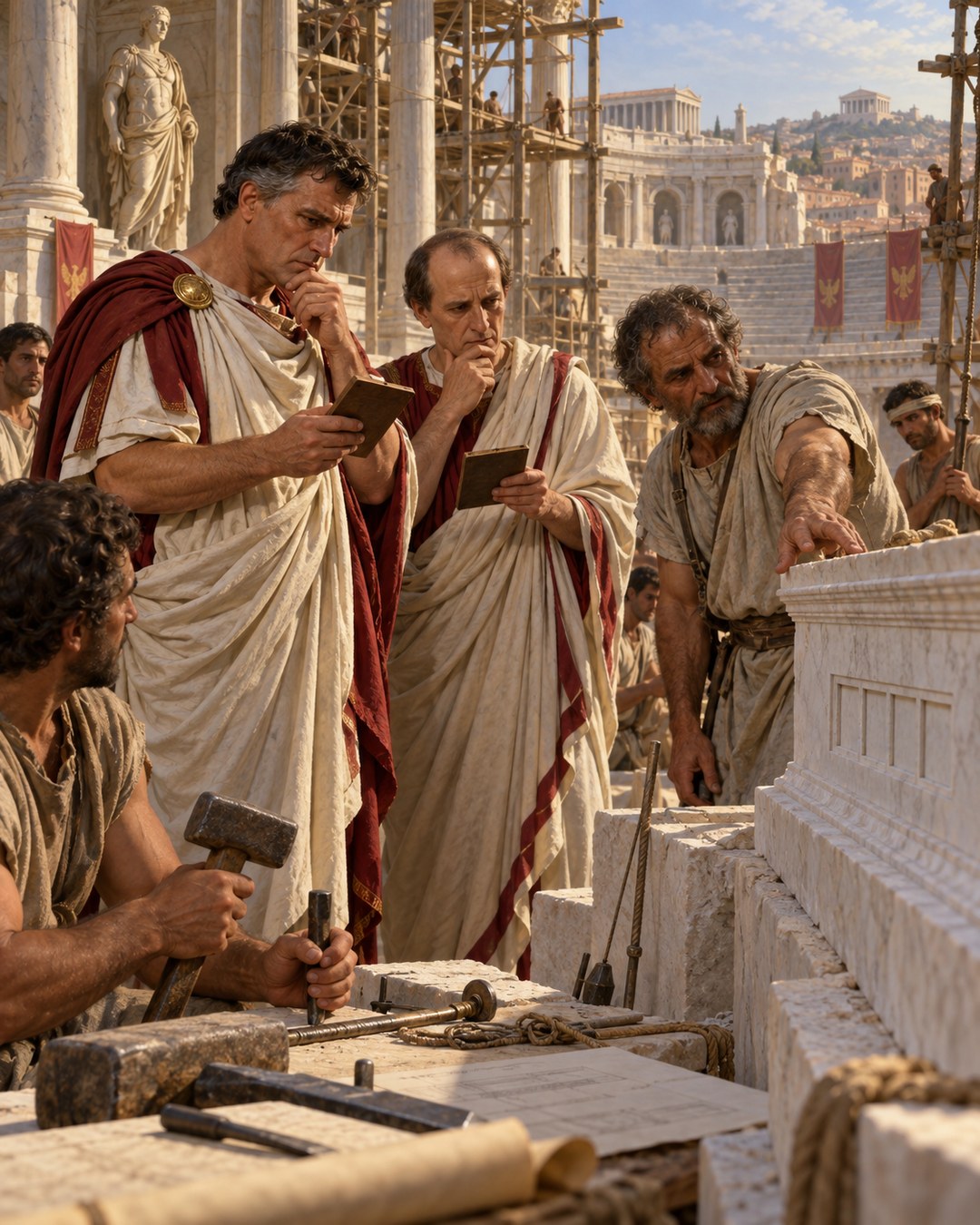
The stone waited for a final vowel.
Pompey wanted his third consulship recorded on the great theatre complex he was preparing to dedicate. The honor itself was clear. The grammar was not. Should the inscription call him consul tertium or consul tertio?
He consulted learned Romans and received two confident answers. Pompey then asked Cicero to judge between them. Cicero saw that a grammatical verdict would also become a public rebuke to whichever scholars lost, so he proposed a solution suited to stone: stop after the letters TERT. The office and number could be understood; the disputed ending would never be carved.
Aulus Gellius preserves the anecdote because it shows language becoming material. Spoken uncertainty can pass. An inscription fixes a choice above a monument, where every reader can see it and every rival can remember who was declared wrong.
The four-letter compromise let architecture carry honor without turning Pompey’s theatre into a permanent grammar lesson. It was abbreviation as political engineering.
A Friend’s Question Opened a Much Larger Dispute
Gellius begins far from the theatre. Writing from Athens to a friend in Rome, he said that he had now written for the third time, using tertium. His correspondent asked why he had not written tertio.
The question expanded immediately. If one form described a third letter, which should describe a man serving as consul for the third time? Gellius’s friend had heard learned authority behind tertio, and he could cite historians who used related forms for repeated consulships.
Gellius answered with Marcus Varro, whom he considered weightier than the alternatives. Varro distinguished sequence from repetition. A form such as quarto could indicate that someone stood fourth in an order of election, while quartum could indicate that he had held an office three times before and now held it for a fourth.
This was not grammar as decoration. The ending determined what kind of number the inscription expressed. Was it a place in a sequence, or the count of recurring tenures? On a monument listing a career, that distinction belonged to the public identity of the honorand.
The archive’s story of one Latin word sending a grammarian running for his books shows how seriously Roman intellectuals could treat a tiny verbal uncertainty. Pompey’s problem raised the stakes by moving such an uncertainty from conversation into monumental stone.
Pompey Made Grammar Part of the Dedication
Tullius Tiro, Cicero’s freedman and literary associate, gave the fuller version that Gellius reports. Pompey was preparing to consecrate the temple whose steps formed the seating of his theatre and to add his name and honors.
The theatre was a daring permanent complex in Rome. Its sacred crown helped frame the seating as an approach to a temple, conventionally identified with Venus Victrix. An inscription there did not sit on an obscure object. It participated in the building’s claim about Pompey, victory and public generosity.
That visibility explains his caution. The phrase for the third consulship would be short, but a wrong or ridiculed ending would sit beside his name. The more splendid the architecture, the less easily a disputed letter could hide.
Pompey therefore referred the question to Rome’s most learned men. They did not converge. Some maintained that tertio should be used; others defended tertium. Expertise multiplied the problem instead of dissolving it.
Varro mocked Pompey as timid for avoiding the full word. The joke has force because a commander associated with armies and triumphs hesitated before grammar. Yet hesitation was rational. A stonecutter’s chisel would transform one scholarly preference into an official statement endorsed by the monument.
Cicero Solved the Politics without Solving the Grammar
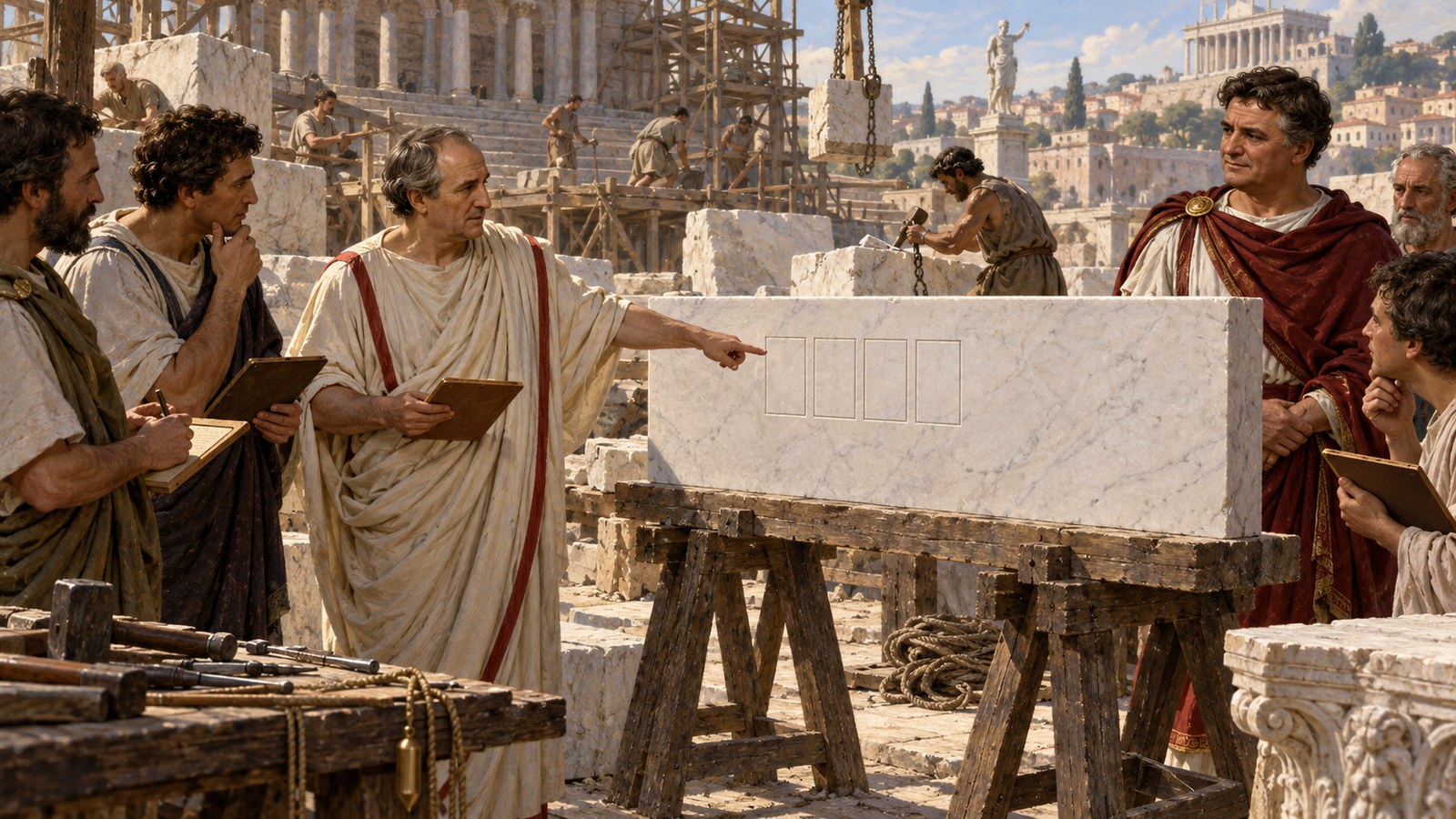
Pompey asked Cicero to choose. According to Tiro’s account, Cicero resisted because a verdict on the form would look like a verdict on the learned men who supported it. Correcting an opinion could seem like censuring its holders.
His recommendation was neither a new grammatical theory nor a declaration that both forms were equal. He told Pompey to write only the first four letters. TERT carried enough information for the reader, but it stopped before the contested ending.
The elegance lies in separating communication from completion. Readers did not need the final letters to understand that Pompey’s third consulship was being advertised. The monument could therefore perform its essential work while remaining silent at the point of conflict.
This was not a vague abbreviation forced by lack of space. The space was monumental. The shortening was deliberate and diagnostic: identify the common ground, cut that much, and leave the disagreement unmaterialized.
Cicero’s position also protected relationships. Pompey received a usable inscription. Each scholarly faction could retain its preferred full form. Cicero avoided making an enemy through a ruling that the building would repeat every day.
Four Letters Controlled What the Monument Could Say
Roman public lettering was slow, skilled work. Layout had to be measured, guides established and strokes cut into stone. Once mounted high on architecture, a title became part of the urban scene rather than a sentence that could be casually revised.
The related article on large red rental letters at Pompeii follows a different medium, but it reveals the same basic power: oversized writing turned a wall into a public voice. Pompey’s inscription would make his career legible at the scale of the city.
TERT was useful because abbreviation invited the reader to complete meaning without requiring the stone to complete morphology. The eye supplied “third”; the surface never chose between the rival endings.
There is a broader lesson in that economy. Public language does not have to state everything its audience understands. Sometimes omission is not a failure of clarity but the condition that allows clarity and coalition to coexist.
The compromise also shows that a monument had multiple audiences. Ordinary spectators needed to recognize Pompey’s honor. Scholars might inspect the exact form. Political associates watched how Cicero handled their reputations. Stonecutters needed a final layout. Four letters satisfied all of them well enough.
A Later Repair Replaced the Compromise with Three Strokes
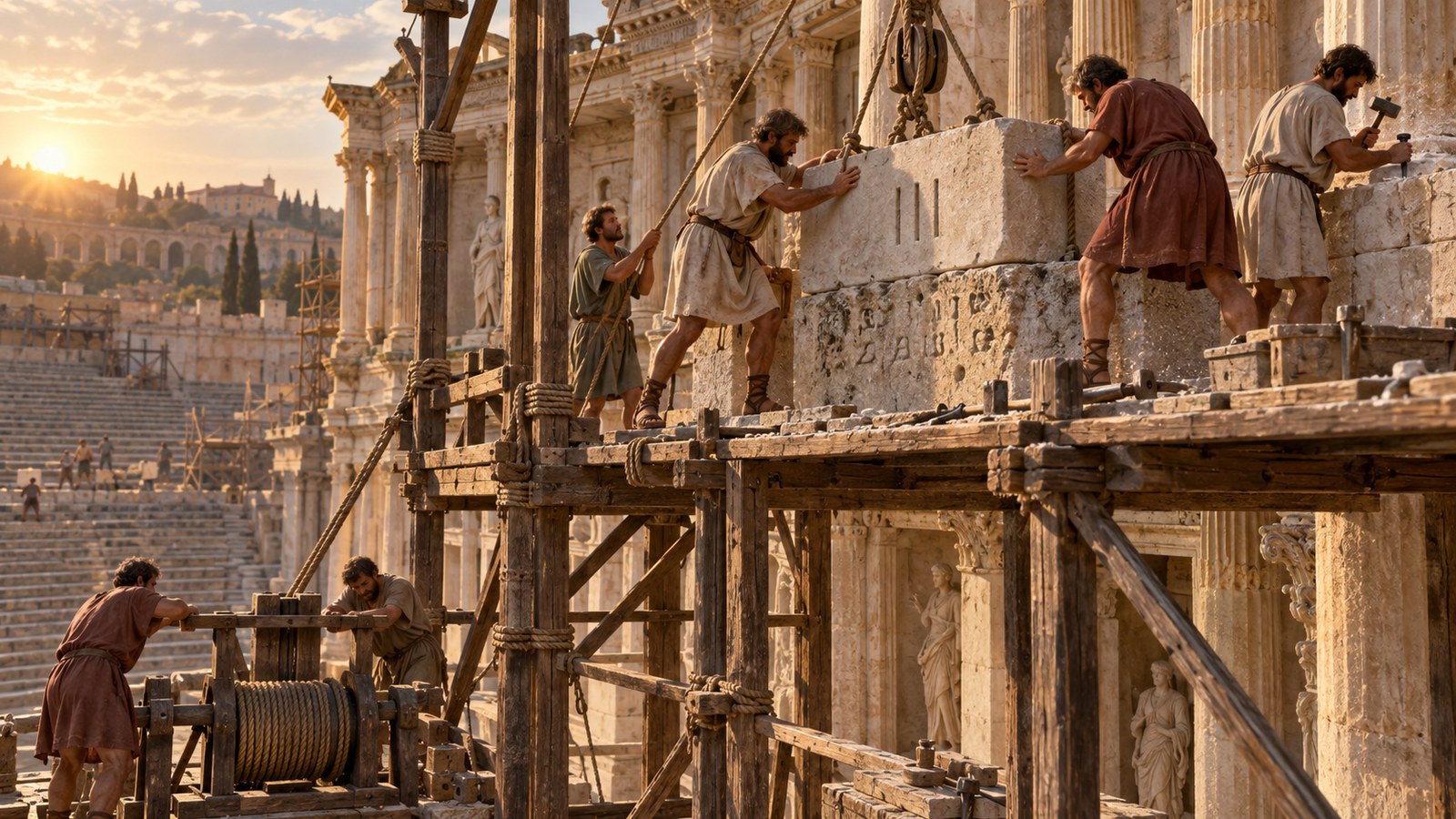
Gellius adds a physical afterlife. By his day, the theatre no longer displayed the device in the form described by Varro and Tiro. The back wall of the stage had fallen and was restored years later.
During that restoration, the third consulship was represented not by the old four-letter opening but by three incised lines. The contested word disappeared completely. Number replaced abbreviation.
The change is revealing because restoration is also interpretation. Masons and patrons do not merely return fallen stone to position; they decide what to reproduce, simplify or update. The later inscription preserved the fact of the third consulship while discarding the exact strategy once used to protect learned opinion.
Three strokes made the title still leaner. They also turned a famous act of linguistic diplomacy into an antiquarian puzzle. Gellius needed written testimony to recover what the restored wall no longer showed.
The sequence is unusually complete. Varro supplied the grammatical distinction and mocked Pompey’s caution; Tiro preserved the consultation with Cicero; Gellius compared their accounts with the theatre visible in his own time. Each witness saw a different layer of the object. One explained the disputed forms, another remembered the decision, and the last noticed that the masonry had changed. The inscription’s history survives because a reader checked words against a building rather than treating either as sufficient alone.
Without his chapter, the viewer might see only a numeral. With it, the missing letters become the story. Pompey’s theatre had once encoded disagreement by refusing to finish one word, and Cicero’s most successful contribution to the inscription was precisely the part no chisel touched.
Sources
Aulus Gellius, Attic Nights 10.1.