
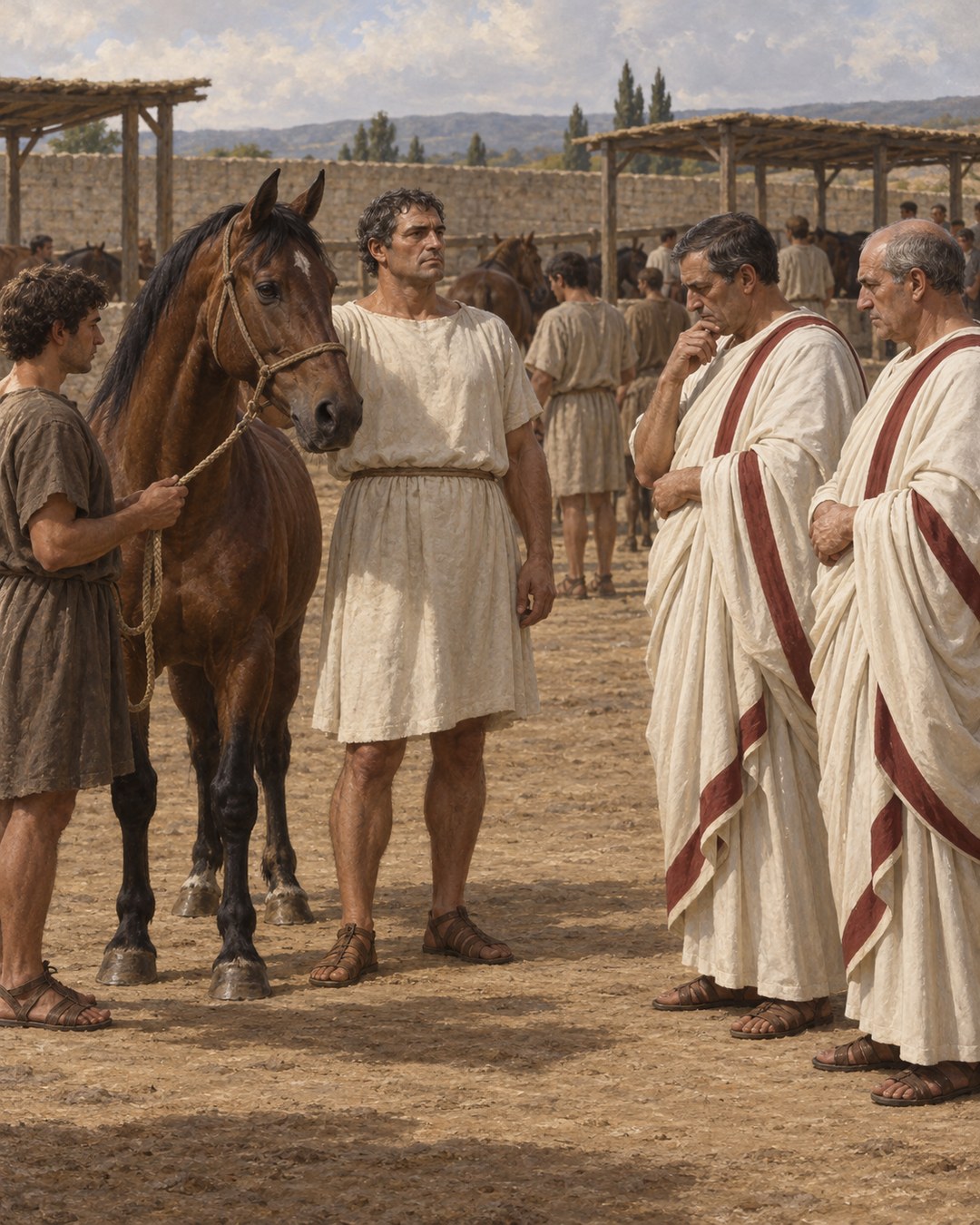
The horse left the review without its rider.
Roman censors, Aulus Gellius says, used to remove a knight’s horse when the man had become too fat and corpulent. Their immediate reasoning was practical: someone so heavy was no longer considered fit for the duties expected of a mounted equestrian. Yet the physical decision opened a harder civic question. Had the censors punished the man, or merely reassigned equipment?
Gellius records the distinction with care. One interpretation held that the knight was relieved from duty without losing his rank. Cato, however, had spoken of such an incident as a serious charge. If Cato’s tone was right, the horse could be removed administratively while the removal still marked the rider as idle and disgraced.
The episode is only a few sentences long, but it exposes how Roman status worked through visible objects. A place in the equestrian order might survive in law and memory. The public horse, reins and mounted appearance could disappear in front of everyone.
The Review Matched a Body to a Mounted Obligation
Gellius begins not with appearance for its own sake but with fitness for duty. The censors saw a bodily condition and connected it to the work of a knight. Mounted service required balance, endurance and a workable partnership between rider, tack and animal. In his compressed account, excessive weight made that partnership unsuitable.
This was not a general Roman rule about every large body. Gellius describes a specific institutional setting and a specific consequence: the horse was taken from a knight. The action mattered because horse and rider formed a public assignment. The censors were not merely commenting at dinner; they were deciding whether a man still matched an obligation represented by state-supported equipment.
The horse therefore made physical capacity legible. A reviewer did not need an abstract theory of readiness when the man had to mount, ride and be carried by a living animal. The pairing itself was the test. Once officials concluded that it no longer worked, leaving the horse in place would turn the review into empty ceremony.
Roman military preparation often reduced broad virtues to concrete performance. A related reconstruction of a recruit drilling against a six-foot stake shows a different scale of the same logic: equipment, repeated movement and bodily control made readiness observable. Here, by contrast, the censorial decision arrived at the end of a career or period of service, where public suitability had to be reconsidered.
Removing the Horse Did Not Necessarily Remove the Knight
The most important sentence in the chapter separates duty from rank. Gellius says some interpreters denied that the action was punishment at all. On their reading, the man was relieved of mounted service but remained an eques.
That distinction prevents a simple story of expulsion. Roman orders and honors were not identical with the objects through which they appeared. A person could retain social classification even when a particular public resource was withdrawn. The horse answered the practical question of service; rank answered a broader question about civic position.
Gellius’s phrasing also suggests why later readers debated the case. If removal had automatically meant degradation, there would be little to discuss. The chapter exists because an official act could have a narrow technical explanation and a much wider social meaning at the same time.
The rider did not need to be formally erased for the scene to alter how others saw him. The line of horsemen would continue while he stood apart. An attendant could lead away the animal. Neighbors would know that the censors had intervened. Retained rank was real, but so was the empty space where mounted performance had been.
This tension made the horse more than transport. It was a working badge: expensive, animate and impossible to hide. A ring could remain on a finger and a family name could still be spoken, yet the loss of the mount changed the body’s position inside the civic display.
Cato Made an Administrative Act Sound Like a Charge
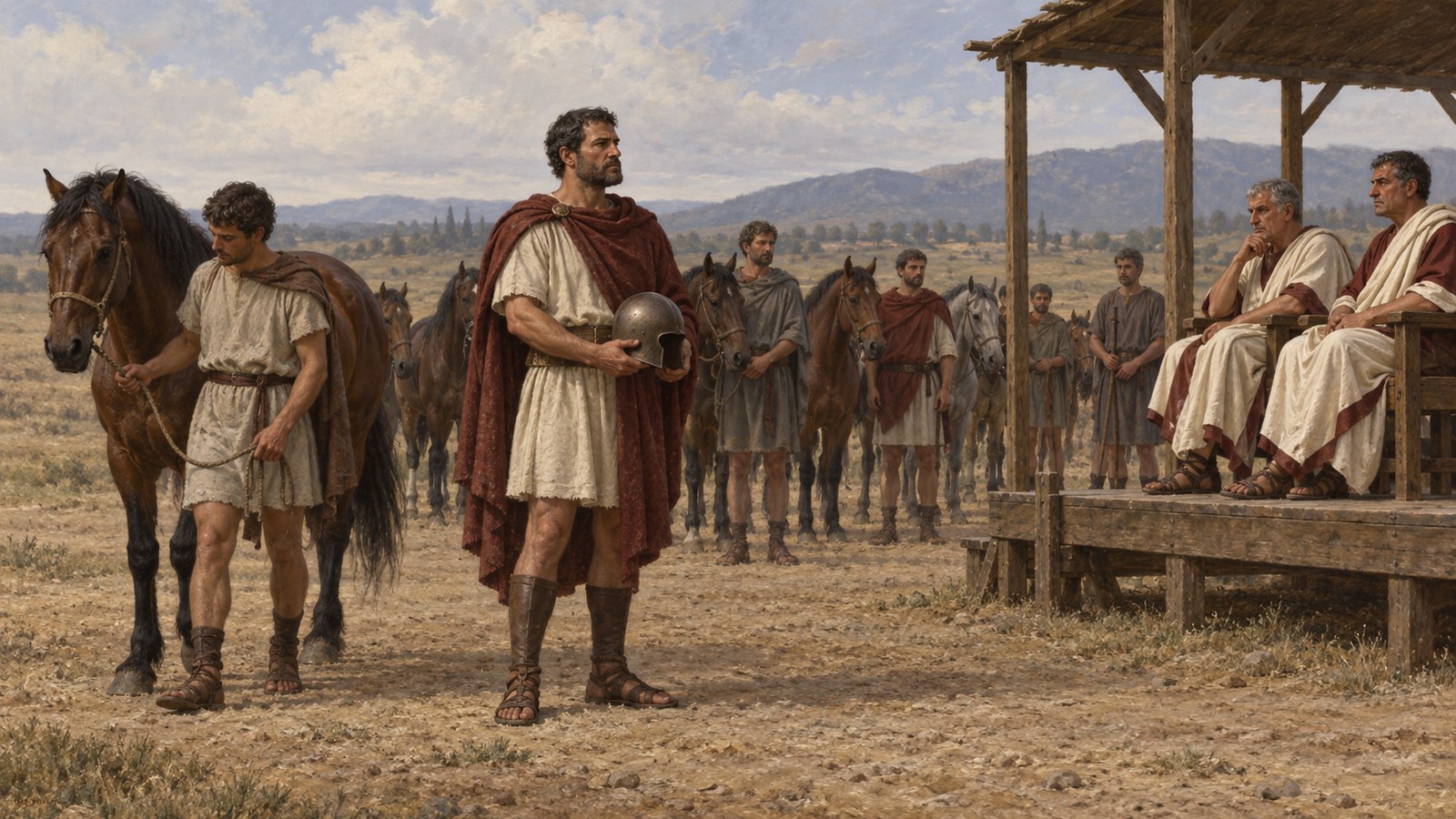
Gellius does not let the non-punitive explanation stand uncontested. He turns to Cato’s speech On Neglecting Sacrifice, where such an occurrence apparently appeared as a somewhat serious accusation. The surviving fragment does not supply a complete case, but its tone matters.
If Cato used horse removal as evidence against a man, then contemporaries or later readers could hear moral judgment in it. The censors may have solved a question of mounted capacity, yet political speech could convert their decision into proof of defective character.
Gellius identifies the implied vice as slothfulness. He does not present measurements, a physician’s assessment or a narrative of illness. He reports a cultural inference: a body swollen to unwieldy dimensions could be blamed on inactivity. That inference may have been unjust in any individual case, but it explains how practical unfitness became reproach.
The distinction is essential. The source tells us what a Roman argument attached to a body, not what caused that body. Illness, age, injury, diet and constitution remain outside the chapter. Gellius preserves the judgment because he is investigating the meaning of censorial action, not diagnosing the knight.
Cato’s intervention also made the loss reusable. An administrative decision might end when the horse was reassigned. A charge repeated in oratory could follow the man into later disputes, detached from the exact circumstances of the review.
The Censors Worked through Public, Ambiguous Signals
Censorial authority often depended on converting ordinary conduct into evidence of civic quality. The case of a yawn that drew censorial suspicion shows how a small bodily act could invite a large interpretation. In that case, context could rescue the accused. In the equestrian review, the horse made the judgment harder to explain away.
The censors did not need to publish a philosophical essay on fitness. They could act on the public arrangement before them. Keep the mount, remove it, or attach some further mark of degradation: each option communicated through procedure.
Ambiguity was not a failure of the system; it was one of its powers. The official act could be defended as practical while spectators supplied moral conclusions. That allowed institutions to regulate service and reputation together without always declaring where one ended and the other began.
For the knight, this meant that preserving formal status could offer only partial protection. He might truthfully say he remained within the order. Others might truthfully answer that the censors had judged him unable to perform its most visible mounted function.
The chapter’s title question—degradation or retained rank—never receives a perfectly clean answer because Roman public life did not produce one. The legal-social category and the reputational event pulled apart.
One Missing Horse Carried the Whole Verdict
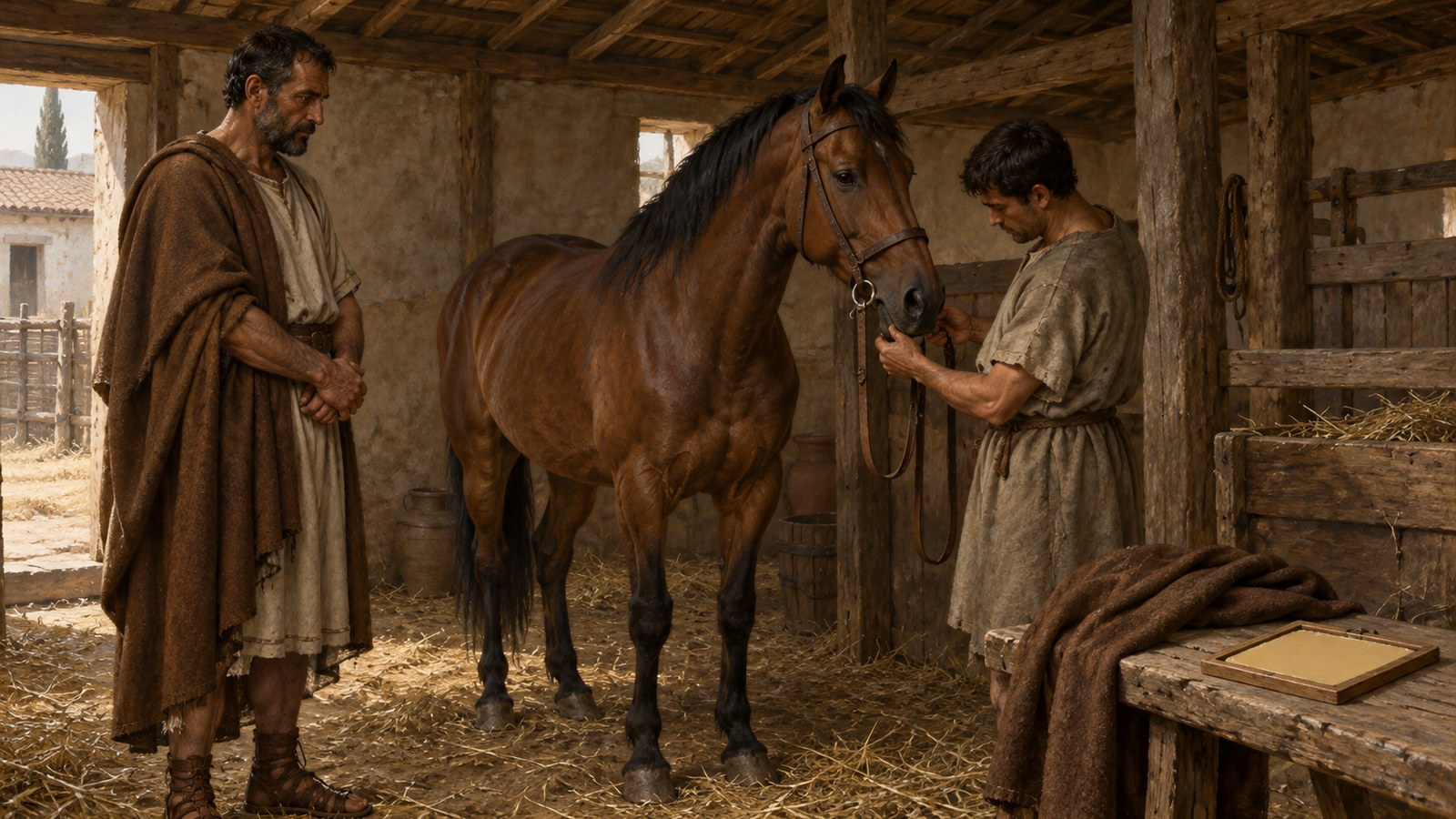
Gellius’s brief report survives because it concentrates a complicated hierarchy into one scene. There is a body, an animal, a pair of officials and a disagreement over what their decision means.
The horse solved the censors’ immediate problem. If the rider was unfit for mounted duty, another arrangement could be made. But the animal also externalized judgment. The knight’s changed status in practice could be seen before anyone settled his status in theory.
That is why the claim that he lost no rank does not cancel Cato’s language of disgrace. Both could operate at once. A formal boundary protected the man from total expulsion; a public removal exposed him to a character story about indolence.
Modern readers should resist turning the passage into a joke about weight. Its sharper subject is institutional classification. Rome could separate a man from an obligation without wholly separating him from an order, then let public memory argue over whether that mercy was also shame.
The knight remained a knight. The horse went elsewhere. Between those two facts stood the censorial power to make one practical reassignment feel like a verdict on a life.
Sources
Aulus Gellius, Attic Nights 6.22.