
Lightning hit the bronze hero, and the experts told Rome to hide him from the sun.
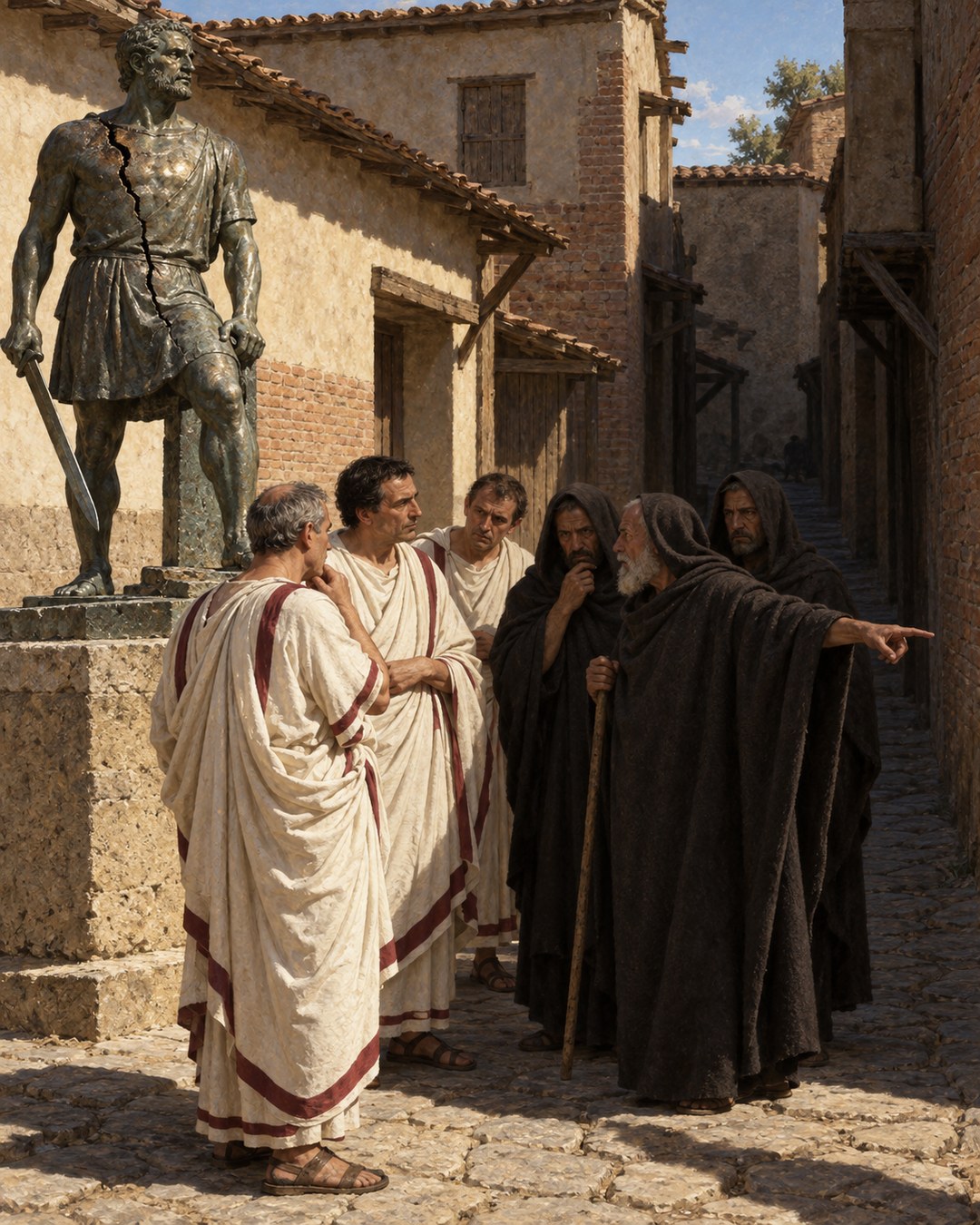
The statue of Horatius Cocles stood in the Comitium, a dense center of political memory. After the strike, Romans summoned diviners from Etruria to direct the expiation. According to Aulus Gellius, those advisers carried old hostility into their technical answer. They ordered the damaged monument moved down into a place hemmed by buildings, where sunlight never reached it.
The deceit did not remain hidden. The diviners were exposed, tried before the people and made to confess. Rome then followed the opposite spatial logic: Horatius rose to an elevated, commanding position in the Area of Vulcan. The story’s final monument was not bronze but a sentence. Boys across the city supposedly chanted that bad counsel ruins its giver most of all.
What began as storm damage became a contest over expertise, visibility and public memory.
A Lightning Strike Turned a Statue into a Ritual Problem
Gellius introduces the object precisely. It was a statue of Horatius Cocles, the one-eyed defender whose stand at the bridge belonged to Rome’s repertoire of exemplary courage. It stood in the Comitium, where assemblies, speeches, trials and monuments crowded together.
Lightning did not leave the community with an ordinary repair job. A strike on a public monument demanded interpretation and expiation. The physical mark mattered, but so did the possibility that the event signaled a damaged relationship between city and gods.
That need created room for specialists. The Romans summoned diviners from Etruria because Etruscan expertise carried authority in reading unusual celestial events and prescribing ritual responses. Their foreign origin did not make them marginal. It was the reason they were asked.
The episode resembles other Roman stories in which sacred objects seem to test the people handling them. The story of Juno’s statue leaving conquered Veii also turns movement into a judgment about legitimacy. Here the statue does not speak. Its destination reveals the quality of the advice.
Once the experts entered the scene, ropes, labor and ritual all depended on words that most citizens were not equipped to verify. The diviners controlled the bridge between an alarming event and the correct public action.
The False Instruction Worked by Controlling Light
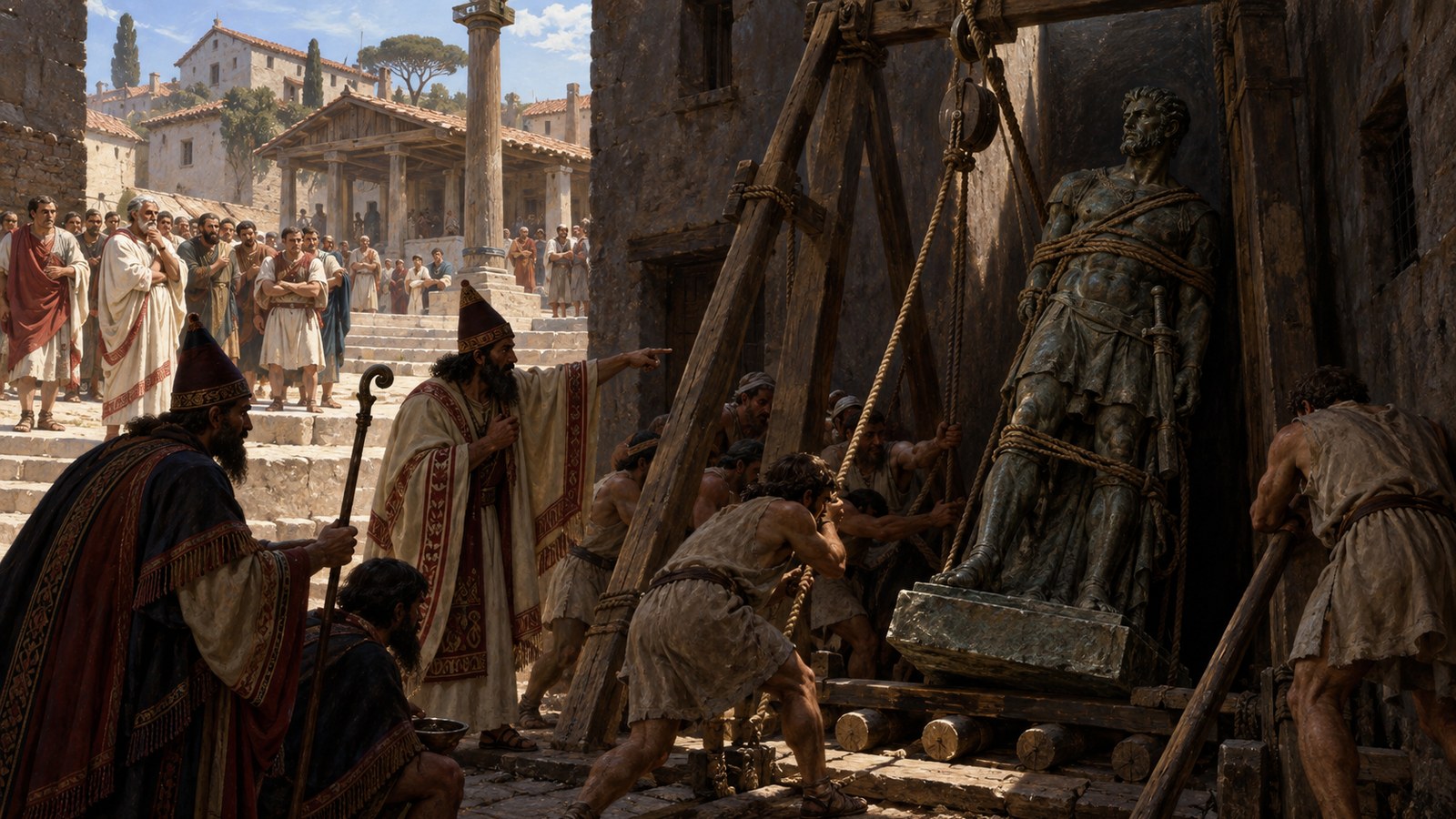
Gellius says the advisers recommended a lower position enclosed by high buildings on every side. The crucial detail is sunlight: none reached the proposed location.
This was not simple storage. A public statue derived force from placement. Height opened sightlines; light modeled the figure; surrounding movement renewed attention. A low, dark recess could preserve the metal while stripping away the monument’s daily audience.
The supposed ritual solution therefore changed civic memory through urban design. Horatius would remain present in a literal sense, yet his visibility would collapse. The hero famous for holding a public passage would be pushed into a blocked visual corner.
Gellius attributes motive bluntly. Personal and national hatred led the diviners to give false directions. Whether that motivation reflects early history or a later Roman moral frame, the structure of the tale is clear: technical authority can conceal hostility because outsiders cannot easily distinguish a difficult prescription from a malicious one.
The Romans accepted the instruction at first. That detail prevents the story from becoming a simple celebration of immediate wisdom. Officials and citizens acted on expertise, moved the monument wrongly and only later discovered that the ritual remedy had injured the honor it claimed to protect.
Exposure Reversed Both Direction and Authority
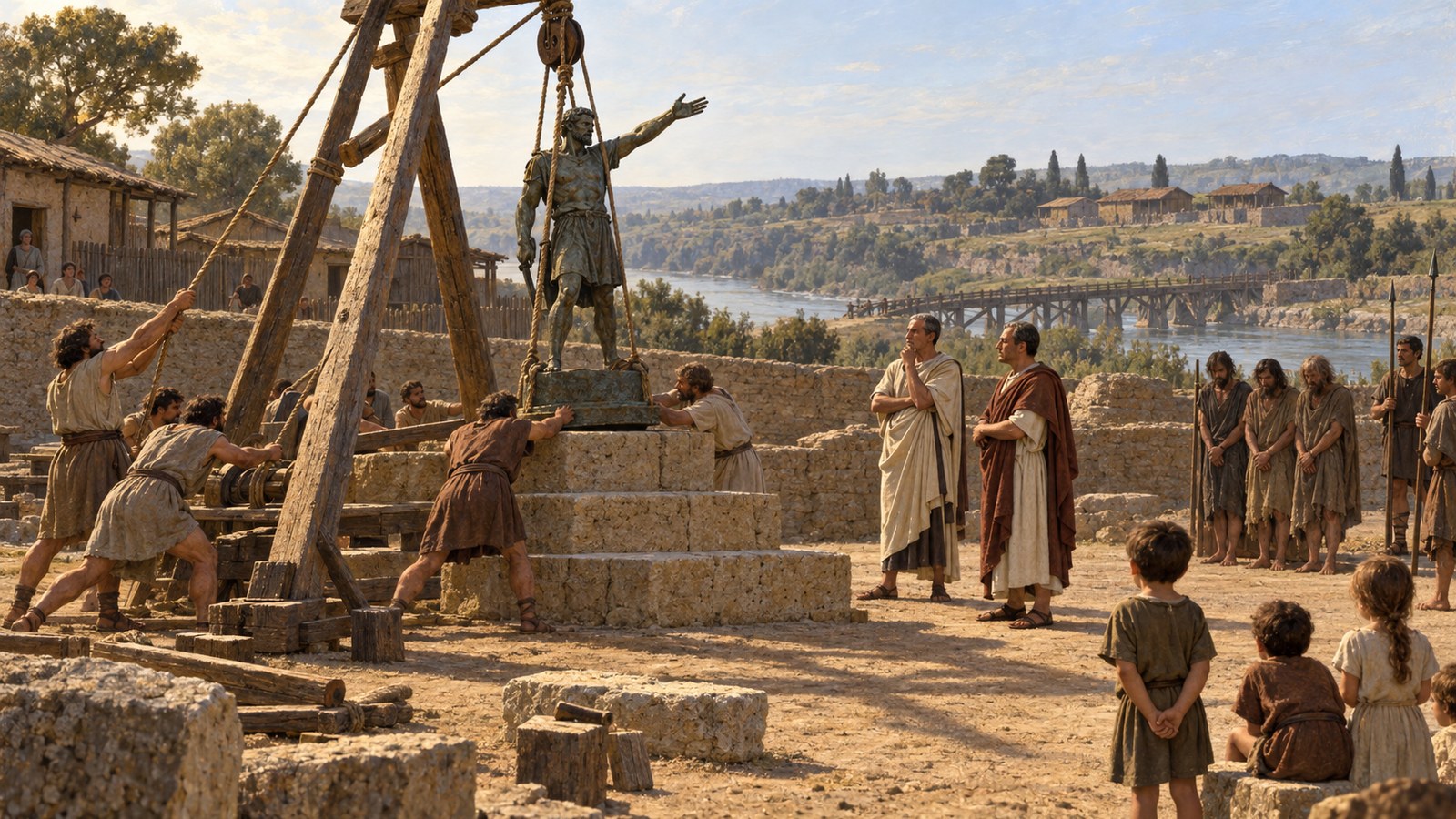
The diviners were betrayed, brought to trial before the people and confessed their duplicity. Gellius then states the proper arrangement as the geometric opposite of their advice. Horatius belonged in an elevated place, set more commandingly in the Area of Vulcan.
Low became high. Shadow became open light. A constricted recess became a civic area. The correction did not require a different hero or a new myth; it required Rome to reverse the spatial consequences of corrupted expertise.
The Area of Vulcan carried its own old religious and political associations near the Forum. Placing the statue there joined heroic memory to a visible sacred zone. The move restored not only sunlight but an audience.
Roman stories about divination often ask whether political power can test specialized knowledge. Tarquin’s challenge in the tale of the razor and whetstone uses an impossible feat to establish an augur’s authority. The Horatius episode runs in reverse. Authority exists first, then conduct destroys it.
Trial before the people widened the correction. The original consultation may have belonged to magistrates and experts. Public prosecution made the failed advice a civic offense rather than a quiet professional error.
Gellius says the advisers confessed and were put to death. The severity belongs to an exemplary narrative in which bad ritual counsel threatens the whole community. A mistaken private opinion could be revised; deliberate corruption of expiation placed Rome’s divine security and public memory at risk.
The trial also answered an information problem. Most citizens could not independently derive the correct ritual placement from a lightning strike. They could, however, understand deception once it was exposed and confessed. Judicial procedure translated obscure expertise into familiar categories of intention, evidence and punishment.
That translation protected the institution of consultation by isolating guilty consultants. Rome did not conclude that all Etruscan divination was useless. The story condemns advisers who weaponized their specialist position. Proper directions still existed and could still be followed.
Gellius reports that events turned out happily after the statue was moved. He does not supply a measurable outcome or a chronological list of benefits. The formula closes the ritual circuit: false placement brought danger; corrected placement restored alignment.
The account is therefore not evidence that sunlight itself mechanically produced success. It records a Roman explanation of why correct ritual and visible honor belonged together after a prodigy.
Children Carried the Verdict Farther Than the Court
The most unusual consequence is auditory. Boys throughout the city chanted a line meaning that bad counsel is most ruinous to the giver. The technical dispute became a compact moral rhythm that could travel without a statue, courtroom or written archive.
Gellius traces the story to the Annales Maximi and Verrius Flaccus, then recognizes the line as a version of Hesiod. His chain of transmission joins official record, antiquarian collection, Greek wisdom and street repetition.
The chant simplified a complicated event. It omitted lightning doctrine, urban topography and jurisdiction. What remained was reversal: the adviser designed harm for someone else and received the worst consequence himself.
That simplicity gave the affair a second public. Adults who had watched the monument move could remember the procedure. Children who knew only the line could still reproduce its verdict. The failed attempt to reduce Horatius’s visibility enlarged the visibility of the diviners’ failure.
The city thus answered hidden advice with open repetition. A specialist instruction had briefly pushed a heroic image into shadow. A proverb moved in the opposite direction, carried from mouth to mouth across Rome.
The Restored Monument Became Evidence against Secrecy
Horatius’s statue mattered because it occupied shared space. Lightning made that space uncertain; expert betrayal tried to exploit the uncertainty; public correction reclaimed it.
The episode’s moral does not require every detail to be accepted as a literal contemporary transcript. Gellius offers a Roman theory of civic memory. Heroes must be placed where citizens can see them, ritual authority must serve rather than hollow out public honor, and advice should be judged by the direction in which it moves the community.
The final arrangement did more than undo an error. A higher base in the Area of Vulcan embodied the exposure. Anyone who knew the tale could read elevation as proof that the malicious prescription had failed.
At the beginning, a thunderbolt appeared to diminish the statue. In the middle, experts nearly completed that diminishment by removing light and prominence. At the end, Rome made the monument more commanding and attached a portable warning to the men who had tried to hide it.
The bronze hero returned to the sun. The bad counsel did not disappear with its givers; it survived as the reason Romans remembered where the statue should stand.
Sources
Aulus Gellius, Attic Nights 4.5.