

Metellus asked Rome to accept a bargain he refused to decorate.
If people could live without wives, his surviving words suggest, they might gladly escape the trouble. Yet a life arranged around universal avoidance could not give the community lasting security. The censor therefore asked his audience to accept a limited private burden for a public future.
Aulus Gellius preserves the opening because its bluntness continued to provoke readers. A later teacher of rhetoric thought an exhortation to marriage should have sounded more inviting. Other hearers defended Metellus precisely because a censor was not an advertising advocate.
The disagreement opens a Roman question larger than marriage: when public policy asks people to bear costs, does persuasion work by hiding those costs or by naming them?
A Censor Spoke from an Office of Continuity
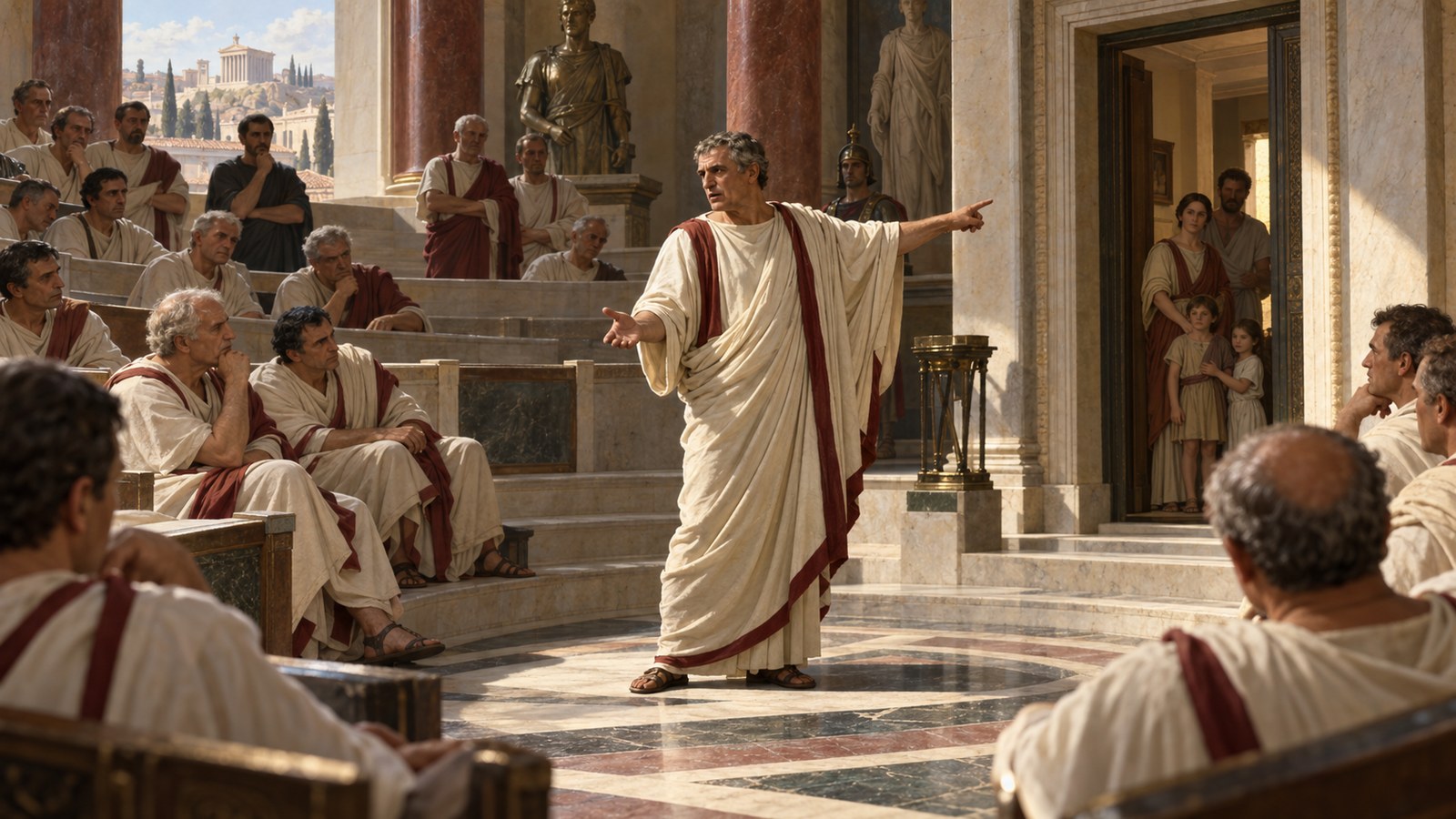
Gellius identifies the speaker as Quintus Metellus Numidicus and places the speech in his censorship. Metellus was not offering private advice across a dinner table. He was addressing the community with the public dignity that Gellius’s later defenders associated with a censor.
The subject made that long horizon unavoidable. Marriage joined households, but the speech’s civic pressure came from children and continuation. One person might decide that domestic obligations were not worth undertaking. If that decision became general, the political body would eventually run out of future citizens.
Metellus therefore moved between two scales. At the household scale stood daily friction, divided interests and obligations that could not be wished away. At the civic scale stood a community that expected to persist beyond the present audience. His premise allowed the first scale to remain real while insisting that the second changed the choice.
The office mattered because a censor could frame conduct as part of public order. The speaker did not need to claim that every marriage produced affection or peace. He needed to explain why Rome treated the formation of households as more than a sequence of unrelated private preferences.
The surviving fragment also reveals what the office could not command directly. A censor might rank citizens, review conduct and give public admonition, but households still had to be formed by people who would live inside them. Speech occupied the gap between institutional concern and personal decision. Metellus could define the choice as civic duty, yet he still had to make reluctant listeners accept it for themselves.
This is a different scene from the ritual mechanics of confarreatio, where witnesses and a spelt cake marked one marriage. Metellus’s problem came before any ceremony. He had to persuade people to enter an institution whose inconveniences were already familiar to them.
The Opening Conceded the Audience’s Objection
Metellus did not wait for a critic to say that marriage could be troublesome. He placed the objection at the front of the speech. Life with a wife, in the quoted passage, could not be free from annoyances.
That concession changed the relationship between speaker and audience. Anyone who had watched household disagreements could not dismiss him as naïve. He acknowledged what listeners might say among themselves and made it part of the official argument.
The strategy also narrowed the promise. Metellus did not offer constant delight as the reward for civic obedience. The reward was continuity: what he calls the preservation of the state and the security that life without wives could not provide indefinitely.
His bargain was asymmetrical in time. The trouble belonged to the immediate life of an individual. The benefit extended beyond that individual into a future population. A listener was being asked to weigh what he would feel now against what Rome would need later.
Such reasoning could sound severe because it converted intimacy into public arithmetic. Yet the speech does not erase personal cost to make the calculation cleaner. Its unsettling feature is that both sides stay visible. Marriage may burden; collective survival may still require it.
Public Survival Reframed a Private Refusal
An individual refusal does not end a state. Metellus’s argument only acquires force when imagined across many households. The censor turns a personal exit into a general rule and asks what happens if everyone takes it.
This movement from exception to pattern is the core mechanism. Avoiding one difficult obligation can appear harmless when measured only against one lifetime. Applied universally, the same choice removes the future generations on which Metellus’s argument for preserving the community depended.
Gellius does not preserve a demographic table, and the short quotation should not be inflated into one. The secure point is simpler: Metellus contrasts a temporary trouble with the preservation of the political community. The future gives the inconvenience a different weight.
That contrast also limits sentimental readings. The censor’s case is not that marriage always perfects the individual. It is that a society cannot treat the production and upbringing of its next generation as someone else’s problem forever.
Roman marriage had many legal and ritual forms, and a single speech cannot describe every household. The argument instead reveals what public rhetoric could demand from the category: private arrangements were asked to carry a collective future even when the speaker admitted they were not frictionless.
A Teacher Thought Persuasion Needed More Pleasure
Gellius then brings the old speech into a later room. Titus Castricius, identified as a teacher of rhetoric, objected to the way Metellus had made his case. Someone urging marriage, he thought, should praise it and describe its pleasures rather than foreground its irritations.
The criticism treats persuasion as a problem of appetite. If an audience is reluctant, a speaker should make the proposed action attractive. Admitting the strongest objection risks supplying listeners with a reason to refuse.
Castricius’s alternative was not necessarily to invent a perfect household. His reported view was that Metellus might have emphasized greater delights and lesser irritations. The balance could be tilted without pretending that inconvenience vanished.
This later debate resembles the story of a false marriage controversy that changed who entered the Senate: the household topic becomes a device for testing political speech and institutional boundaries. What matters is not only marriage, but who may speak, how an audience is managed and what consequences follow from a crafted argument.
Gellius lets the rhetorical complaint retain force. A message can be honest and still fail if its framing gives the audience no desire to move. The chapter would be flat if Metellus’s method carried no persuasive risk.

Censorial Candor Became the Defense
Other respected hearers answered Castricius by distinguishing a censor from an advocate. An advocate may arrange material to win a case for a client. A censor, in their defense, carried public dignity and should appear truthful and sincere.
On that reading, the concession was not a flaw but evidence of office. Metellus earned the right to demand sacrifice because he did not disguise it. He presented marriage as an obligation whose public rationale could survive contact with private experience.
The defense also recognizes that credibility is itself persuasive. Listeners who distrust praise may respond more strongly to a speaker who admits cost. The opening says, in effect, that the censor knows what his audience knows and still reaches a different conclusion about what should be done.
Gellius notes that the speech remained worth reading. Its survival inside his miscellany confirms the later debate’s point: the words lasted because they did not resolve easily into celebration or complaint.
Metellus offered no household without annoyance. He offered a reason not to let annoyance become the community’s only measure. The argument asks citizens to hold two truths together—private trouble and public necessity—then decide whether candor makes a duty less appealing or more believable.
Sources
Aulus Gellius, Attic Nights 1.6.