
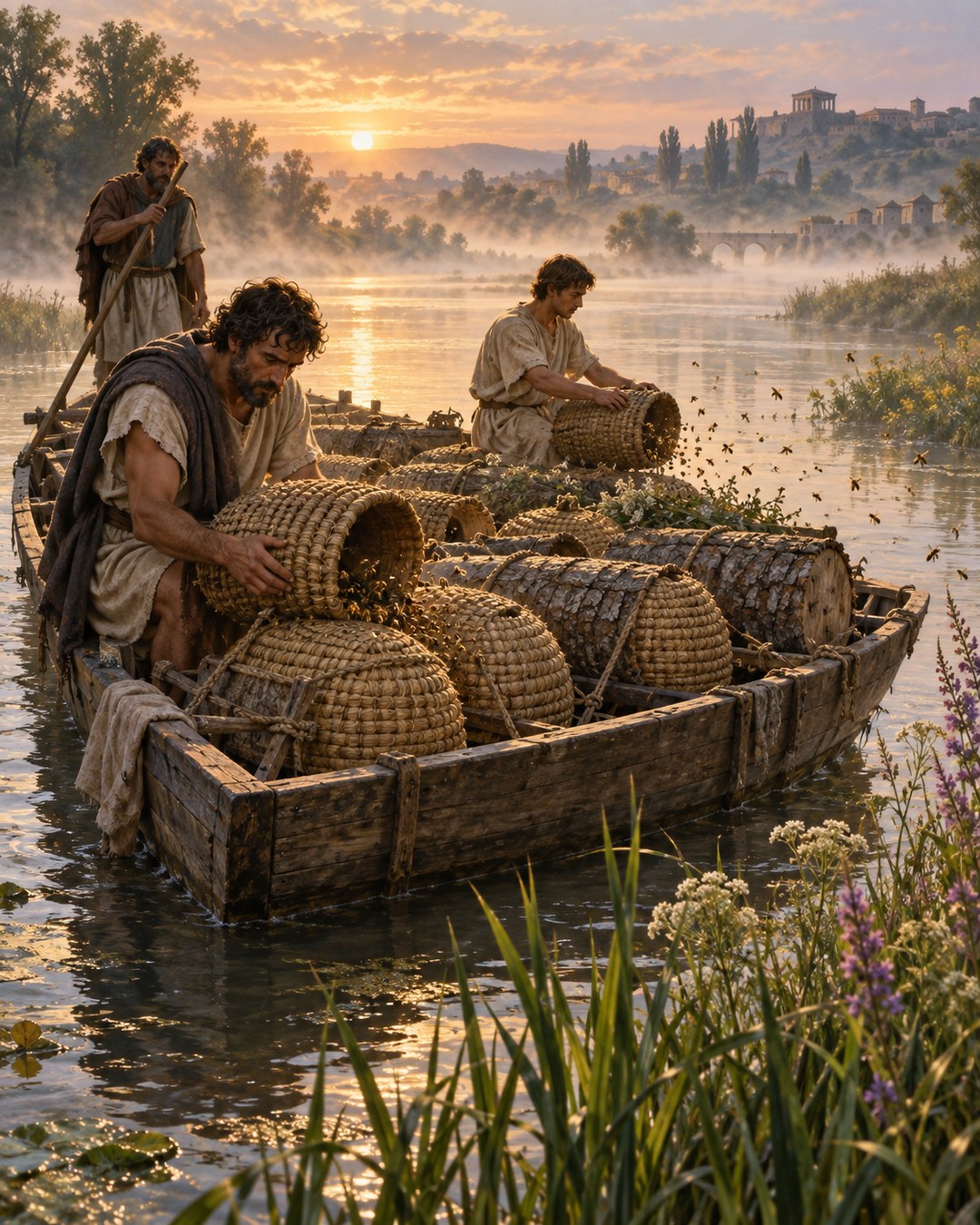
At night, Hostilia’s beehives went upriver.
Pliny describes villagers on the Padus placing colonies in boats when nearby food failed. They carried the hives about five miles upstream in darkness. Morning released the bees into a new feeding area, and evening brought them back to the same floating base.
The boat moved again from day to day. As honey accumulated, the vessel settled deeper in the water. That changing waterline told the keepers when the hives were full enough to return home.
The bees supplied flight. The river supplied range. The hull supplied a scale.
Scarce Flowers Turned the Hive into Cargo
A fixed hive asks bees to search outward and return across the same local landscape. Pliny’s Hostilia episode begins when that landscape no longer supplied enough food. Instead of waiting for another bloom or carrying harvested forage to the colony, keepers moved the colony toward forage.
The solution depended on treating hives as transportable units. Bees, comb, stored honey and the enclosing structure travelled together. A beekeeper did not have to separate the insects from their home or reconstruct the colony after every move.
This mobility fits the principle behind Roman ownership of bees that kept returning to a hive. The colony’s repeated departure did not dissolve its connection to a home. At Hostilia, the home itself changed coordinates, and the foragers still returned to it.
The account does not specify the hive material used on these boats. Pliny elsewhere discusses several hive forms, but importing one exact design into Hostilia would go beyond his short report. The secure mechanism is portability: whatever their construction, the hives could be loaded, secured, opened for forage and moved again.
A boat expanded that possibility. Many hives could travel as one cargo, and the river offered a continuous route through changing patches of vegetation.
The cargo was productive while it travelled. Grain or pottery merely occupied space until unloaded; the colonies left the vessel each morning and returned with new material. The boat carried both the means of production and the product that gradually accumulated inside it.
Night Travel Kept the Colony Together
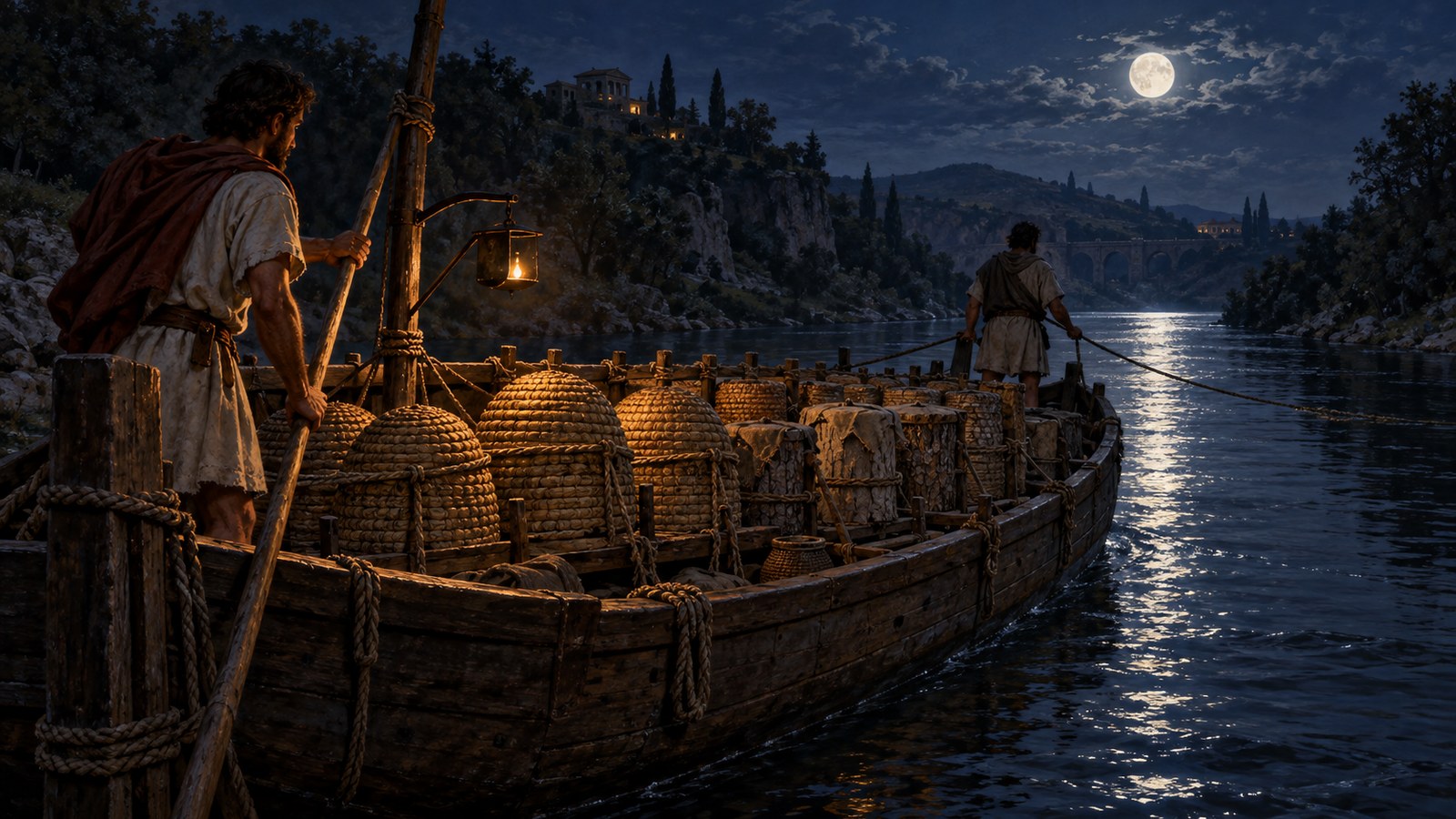
The timing was not incidental. Pliny says the hives went upstream at night. In darkness, foraging activity had ceased and the workers had returned. Moving then reduced the risk of leaving the active portion of the colony behind around the previous landing.
Night also separated transport from feeding. The boat’s task during the dark hours was relocation. At morning, the hives became bases for flights into the surrounding country. The cycle could then repeat after the bees came back.
Pliny does not describe every handling step, so modern details should not be projected backward as if they appeared in his text. We are not told exactly how entrances were closed, how hives were tied down or how far each later daily move went. His sequence nevertheless makes the operational rhythm clear: load or retain the hives aboard, travel by night, feed by day and change position repeatedly.
That rhythm coordinated human and insect movement. Boat crews could cover miles without trying to command bees in flight. Bees could forage without understanding the whole river route. Each species worked in the interval suited to it.
The approximately five-mile upstream journey established the first fresh zone. Daily relocation then kept the feeding base from remaining fixed after the local flowers had been worked.
Return behavior made the schedule possible. Keepers could not steer individual foragers back to a deck, but they could rely on the colony’s orientation to its hive. The boat had to remain available through the feeding period so that the familiar entrance, not the riverbank itself, remained the destination.
A Floating Base Extended the Foraging Map
The boat did more than carry hives from one permanent apiary to another. Pliny says the location changed from day to day. The vessel was a mobile platform whose surroundings could be refreshed repeatedly.
River travel made the sequence linear. A crew could follow the Padus and its banks rather than hauling each hive over rough ground. Meadows, gardens and uncultivated flowers along the route became successive feeding territories.
For the bees, each morning’s problem remained local: leave, find flowers and return. For the keepers, the larger problem was regional: decide where the colony should wake next. Mobility shifted part of the search burden from insect flight to human transport.
The story does not say that the bees ranged exactly five miles from a fixed hive. The five miles belong to the boat’s initial movement upstream. That distinction matters. The system gained reach because the home base moved, not because every forager was forced to fly the whole transport distance.
Pliny reinforces the portability by mentioning Spain, where hives were carried from place to place on mules. River and pack animal solved the same shortage with different infrastructure. One followed navigable water; the other used overland routes.
The comparison shows that mobile beekeeping was not inseparable from one unusual boat. The constant was the decision to relocate a whole working colony toward seasonal food. Hostilia’s river simply let that strategy operate at the scale and rhythm of a shared vessel.
The Hull Registered the Growing Load
Pliny gives the boat a second function. As the process continued, it sank deeper and deeper in the water. The villagers used that change to judge that the hives were full.
A vessel rides according to the total load it must support. Honey returning in many small foraging trips added mass inside the hives. No single bee transformed the boat’s position, but accumulation across colonies and days became visible at the hull.
The account does not provide a marked scale, a target depth or a calculation. The judgment was practical rather than numerical in the surviving text. Experienced crews could compare how the loaded boat sat against the water and recognize when the cargo had become sufficiently heavy.
This was a collective measurement. Individual combs did not have to be opened repeatedly merely to check progress. The boat integrated the load of all the hives it carried. Its displacement offered a coarse signal while the colonies continued working.
The hull could not tell keepers how honey was distributed between hives or whether every comb was ready. It answered a narrower operational question: had the travelling apiary gained enough weight to justify the homeward trip?

Homecoming Turned Mobility into Harvest
Once the hives were judged full, Pliny says they were taken home and the honey withdrawn. The journey therefore ended where the product could be processed within the household or farm economy.
Harvesting had its own limits. The process described in Roman honey and wax collection depended on taking produce without destroying the colony’s future. The Hostilia passage does not repeat those methods; it supplies the logistical stage that brought fuller combs back within reach.
Mobility connected shortages and surpluses. Flowers absent near the village did not mean all forage had disappeared. It meant forage and hives were in the wrong places relative to each other. Boats corrected that mismatch long enough for bees to convert distant bloom into portable honey.
The tale is remarkable without requiring a romantic image of uncontrolled nature. Every phase was managed: the decision to move, the night departure, the daily location, the observation of the hull and the return for extraction.
Pliny begins with failed food and ends with a heavier boat. Between those points, Hostilia’s keepers made the river part of the apiary. The hive remained the bees’ home, but for several nights home travelled upstream.
Sources
Pliny the Elder, Natural History 21.43.