
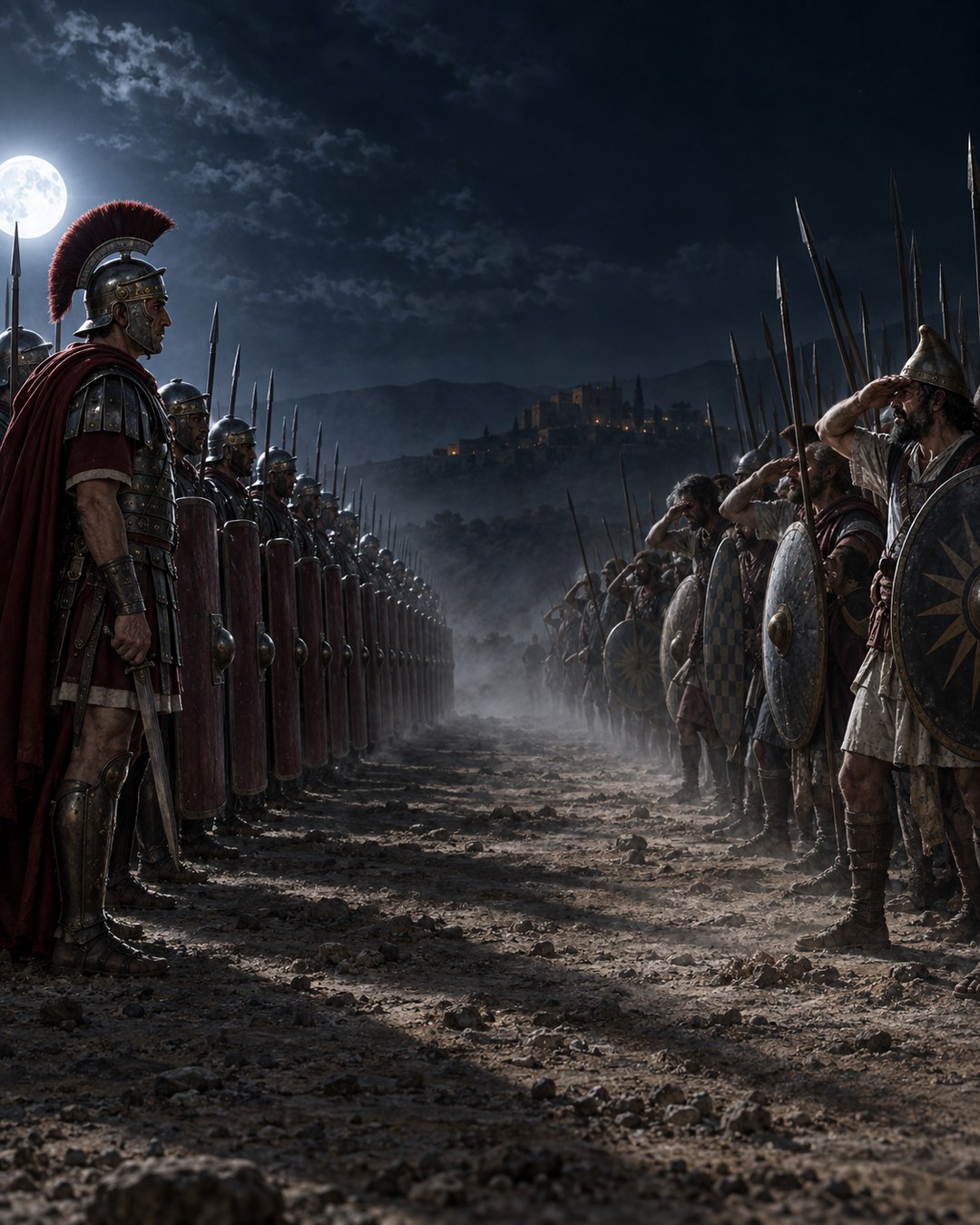
Pompey did not wait for daylight to make the battlefield visible.
He wanted to stop Mithridates from escaping and force an encounter during withdrawal. Frontinus says he chose night, blocked the march and arranged his force so moonlight fell into the faces of the Pontic soldiers.
The same light worked differently behind the Roman line. The enemy met glare. Pompey’s soldiers received a distinct view ahead.
Night concealed the field, but direction redistributed what could still be seen.
An Interception Had to Become a Battle
Frontinus begins with movement, not a static camp. Mithridates was withdrawing, and Pompey wanted both to check the flight and force him to fight. Those aims created a timing problem. Delay could let the column pass; a careless pursuit could produce confusion in darkness.
Pompey’s first act was therefore to block the march. An interception changes what retreating troops can choose. A route that promised distance from the pursuer becomes a place where formation, baggage and direction must be reconsidered under pressure.
The source does not give a detailed map, so it would be wrong to invent a named ridge or exact road. Its operational sequence is enough. Pompey anticipated the withdrawal, prepared a barrier to movement and then suddenly forced the encounter.
Surprise mattered because the enemy was not approaching at a mutually agreed hour with a settled line. Troops oriented toward escape had to become troops oriented toward combat. The shift cost attention, time and order.
Pompey was already experienced in commands that depended on movement across large spaces. The political machinery behind one of those commands appears in the vote that gave him the Mediterranean against piracy. Frontinus, however, narrows the lens to one encounter and one environmental advantage.
The roadblock alone could halt a march. To win the fight that followed, Pompey still had to decide how both lines would face.
Night Was Chosen, Not Merely Endured
Commanders often lose information after sunset. Distances become uncertain, units drift from alignment and familiar terrain turns ambiguous. Frontinus’s wording makes night an intentional part of Pompey’s plan rather than an accident accepted after pursuit ran late.
Choosing night meant choosing its constraints for both armies. The difference lay in preparation. Pompey knew an encounter was intended and could arrange his force beforehand. Mithridates’ men were being stopped as they withdrew and had to respond inside conditions selected by their opponent.
Darkness also narrowed the value of numbers. A soldier cannot respond to every threat he cannot locate. Lines depend on seeing neighbors, officers, ground and the force ahead. Even partial improvement in those tasks could matter when the alternative was a confused black field.
Frontinus does not claim the night was lightless. His whole mechanism depends on the moon. Nor does he say moonlight alone won the engagement. The secure claim is that Pompey included the available light in his deployment.
That distinction prevents the anecdote from becoming magic. The moon did not belong to Rome. It illuminated every exposed surface according to angle. Pompey’s advantage came from placing bodies so the shared source produced unequal effects.
Night was therefore a resource with a condition attached. It rewarded the commander who could predict where the light would fall when the two lines met.
The Moon Became Part of the Formation
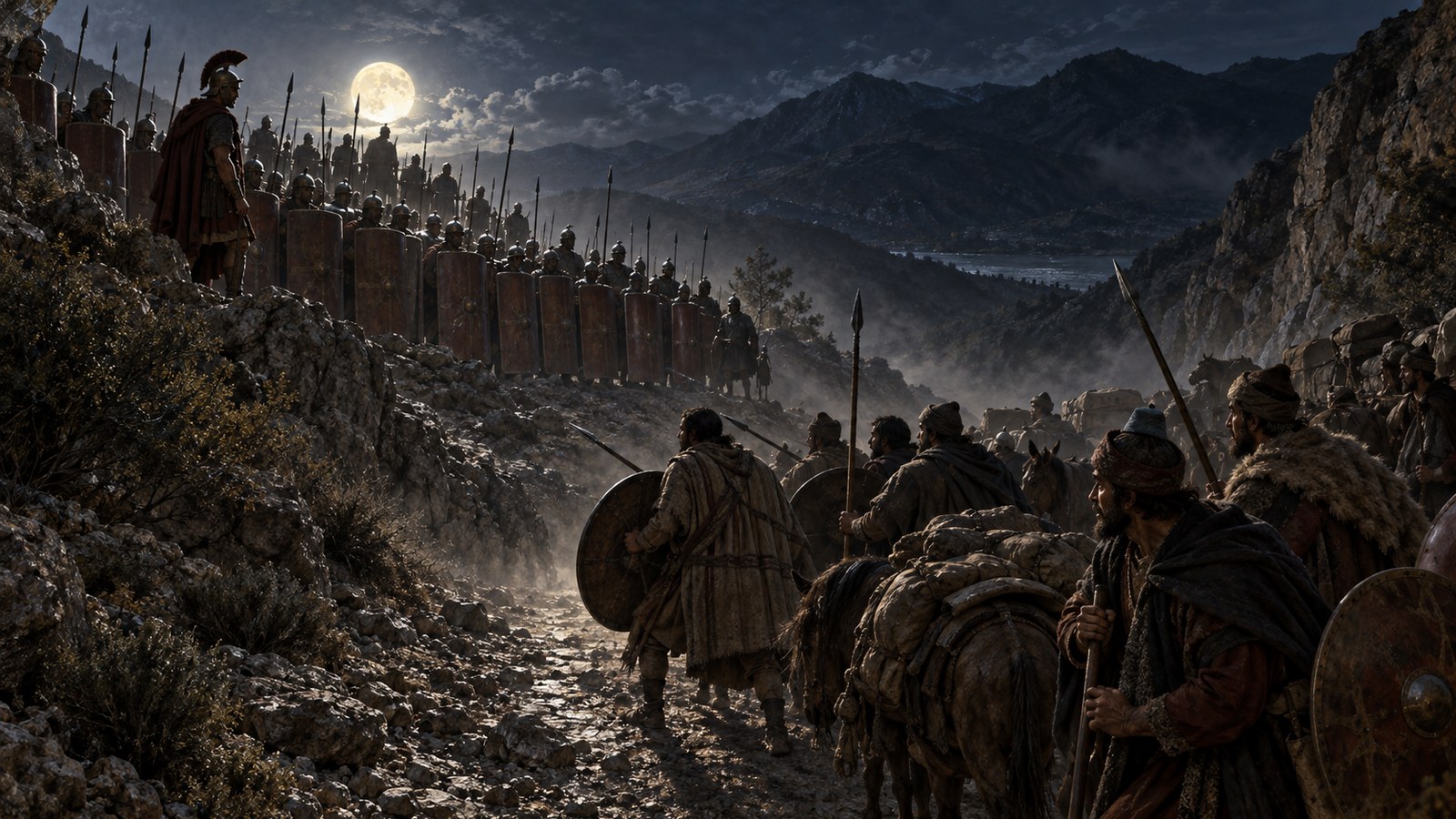
A battle line has a front and a rear. By drawing up his force in relation to the moon, Pompey added light direction to the usual considerations of terrain, route and enemy position.
Frontinus describes the result from both sides. Moonlight fell in the faces of the Pontic soldiers and blinded their eyes. For Pompey’s troops it supplied a distinct, clear view of the enemy.
The asymmetry is easiest to understand as orientation. Looking toward a bright low source makes the surrounding dark harder to read. Facing away from it lets the source illuminate objects ahead. One line confronted brightness near its targets; the other saw brightness reflected from those targets.
The passage does not tell us the moon’s precise phase, height or azimuth. It does not need to. The tactical lesson is geometric rather than astronomical: before fixing the line, notice which direction turns illumination into glare and which turns it into visibility.
Formation made that observation collective. One soldier could shade his eyes or change his stance. An army could not solve the problem independently man by man without disturbing alignment. Pompey’s preparation imposed one visual condition across the opposing front.
The image is the reverse of the poison lore surrounding Mithridates and a daily antidote. That tradition focuses on protection carried inside one body. Here the vulnerability came from where an entire force stood and looked.
Clear Sight Changed Ordinary Actions
Frontinus says Pompey’s troops had a distinct and clear view of the enemy. That benefit sounds simple because it improved almost every ordinary action without requiring a new weapon.
A visible silhouette helps a soldier judge approach and distance. Visible neighbors help a line retain relation to itself. Officers can read whether movement ahead is advance, hesitation or flight. None of these tasks becomes perfect in moonlight, but each can become less uncertain.
The Pontic disadvantage also compounded. Glare did not have to render every soldier literally incapable of sight. It only had to make the darker Roman line harder to distinguish while brightening faces and forward surfaces on the Pontic side.
Weapons and armor remained the same objects they had been before the lines turned. Their usefulness changed because perception changed. A shield raised against an unseen blow is late; a formation correcting against an indistinct threat may open gaps.
This is why Frontinus includes the episode among stratagems about choosing the time for battle. Time determined where the celestial light stood. Position determined who looked into it. Preparation joined the two.
The tactic also carried risk. If the enemy had changed direction, if the blocking position failed or if the encounter began after the light shifted, the planned alignment could lose force. Pompey had to coordinate interception and deployment closely enough that the geometry still existed at contact.
His preparation also had to remain intelligible to his own troops. A line placed with the moon behind it still needed officers, spacing and discipline; favorable light could support those arrangements but could not replace them. The stratagem amplified ordinary command rather than freeing Pompey from it.
A Shared Sky Produced an Unequal Field
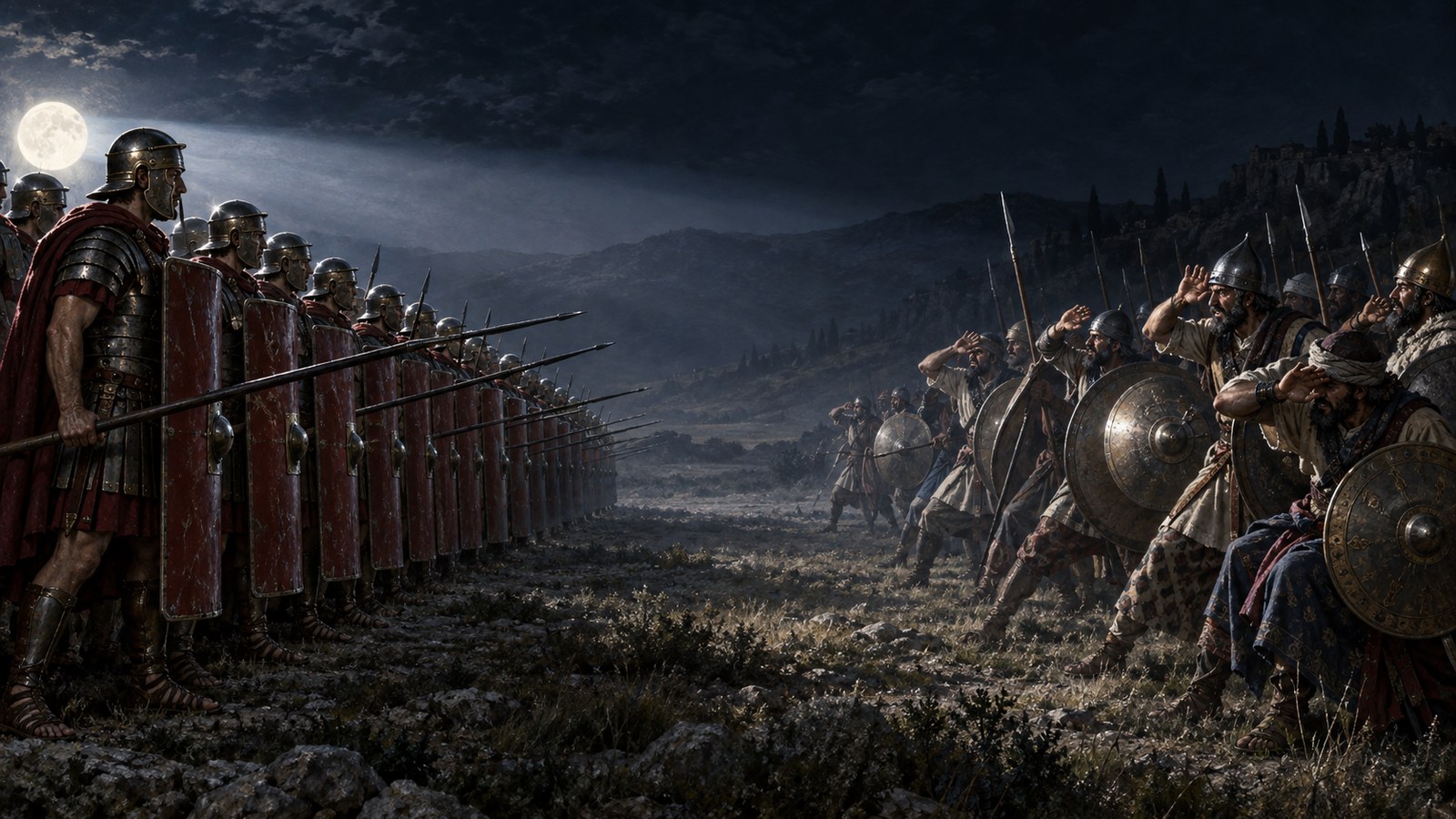
The moon could not be stockpiled, transported or denied to the enemy. It was a common condition. Pompey’s stratagem shows how a commander could still make a common condition unequal.
He did so without altering the source. He altered relationships: moon behind one line, moon before the other; visible enemy for one, glare for the other; prepared interception on one side, interrupted withdrawal on the other.
Frontinus compresses all this into a few sentences because the mechanism is legible. The plan has a before and after. Before formation, both armies share the same night. After formation, they occupy different visual worlds.
The anecdote should not be stretched into a complete account of the campaign against Mithridates. Frontinus offers no casualty figures, no detailed order of battle and no long narrative of what followed. His subject is the choice that made the encounter begin on tilted terms.
That narrow focus is precisely what makes the example useful. It isolates a command decision that might otherwise disappear beneath names and outcomes. Pompey first controlled the route, then the hour, then the direction of sight.
When fighting began, the Romans did not possess more moonlight. They possessed the side of it that revealed an enemy.
Sources
Frontinus, Stratagems 2.1.12.