
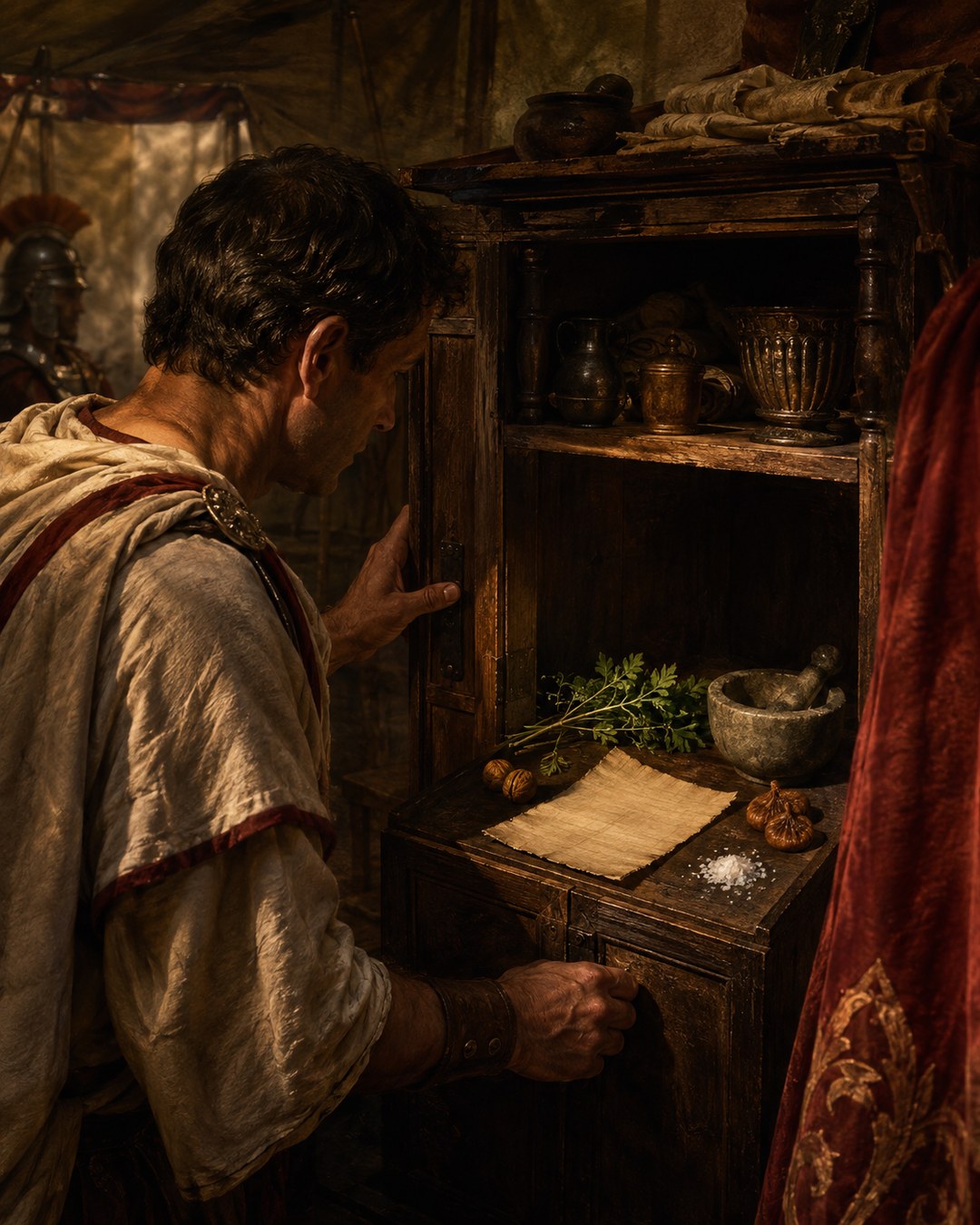
Inside the private cabinet of a defeated king, Pompey found a recipe. Pliny says it was written in Mithridates’s own hand: two dried walnuts, two figs, twenty leaves of rue and one grain of salt.
The ingredients were to be pounded together and swallowed fasting. The promise was immense but carefully bounded. The person who took the mixture would, according to the text, be safe from every poison for that day.
Modern readers should not treat that guarantee as medical advice. Its interest lies in how the story constructs credibility. A royal cabinet supplies secrecy, handwriting supplies identity, conquest supplies discovery, and exact counts make the formula feel reproducible.
The antidote moved through several kinds of power before reaching Pliny’s page. It began as the alleged possession of a king famous for poison lore, became captured knowledge under Pompey, and ended as a compact recipe in a Roman encyclopedia.
Conquest Opened a Cabinet, Not Merely a Kingdom
Pliny introduces the formula after Mithridates’s defeat. He names Cneius Pompeius as the man who found it and locates it in the king’s private cabinet. The setting turns military victory into access.
A cabinet is a small interior within a palace or command centre. Its contents are selected and enclosed. By putting the recipe there, the story distinguishes it from market remedies or common kitchen knowledge. This was supposed to be something a ruler kept close.
The claim of handwriting tightens the link. Pliny does not merely say that a servant attributed the mixture to Mithridates. He says the instructions stood in the king’s own hand. Authorship, possession and secrecy converge on one sheet.
That chain is rhetorically powerful even though it cannot now be verified. Readers encounter the defeated king through an object he allegedly touched. Pompey does not capture only territory and treasure; he captures a method associated with surviving the most private danger of monarchy.
The episode adds a quiet counterpart to the extraordinary command that gave Pompey authority across the Mediterranean. Large jurisdiction enabled conquest. Here conquest ends with a much smaller prize: counted leaves and fruit in a cupboard.
Exact Numbers Made a Vast Promise Look Usable
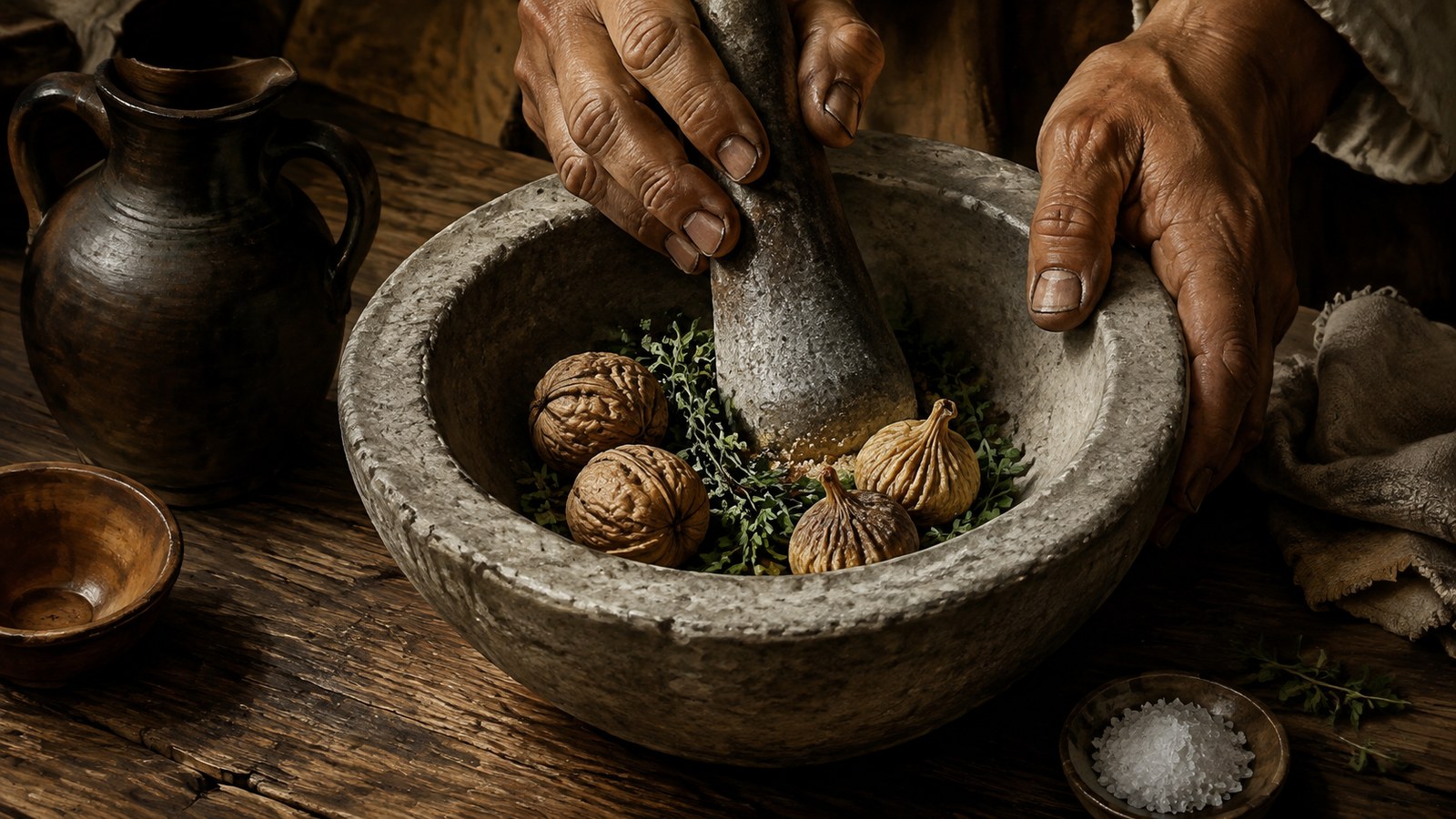
The recipe’s structure is strikingly precise. Begin with two dried walnuts. Add two figs. Count twenty leaves of rue. Pound them together, then add a grain of salt.
Each number reduces ambiguity. “Some nuts and herbs” would sound like an anecdote. Two, two and twenty sound like instructions that another person can execute. The final grain of salt makes the scale descend from handfuls and leaves to a tiny measured addition.
Pliny gives no weight for the walnuts or figs and no size for the rue leaves. Ancient measures were not modern laboratory controls. Yet the sequence creates operational confidence because it tells the hands what to collect and what to do next.
Pounding is the only transformation. There is no long boiling, aging or specialist apparatus. A mortar and pestle can break the ingredients down into one mixture. The royal secret is therefore portable: once the wording escapes the cabinet, an ordinary work surface can reproduce its form.
That accessibility is part of the paradox. The recipe gains authority from being hidden with Mithridates, but its actual procedure is simple enough to leave the palace. Captured text turns private protection into transmissible knowledge.
Fasting and a One-Day Limit Completed the Procedure
The formula also specifies when it must enter the body. It is to be taken fasting. That condition creates a clean beginning, before other food, and makes administration part of the recipe rather than an afterthought.
The promise expires with the day. Pliny’s wording does not offer permanent immunity from a single dose. It links one morning act to one period of protection.
This daily boundary makes the extraordinary claim feel disciplined. “Safe forever” would be shapeless. “Safe for that day” asks for repetition and gives failure an explanation: perhaps the dose was not taken fasting, the leaves were miscounted or the day had ended.
The structure resembles a ritual schedule even though Pliny presents a remedy. Ingredients, order, bodily condition and duration all matter. A claimant can follow the procedure correctly or incorrectly, and that distinction helps preserve belief when results are uncertain.
Roman stories about poison repeatedly turn survival into a test of character and preparation. In the warning Fabricius sent Pyrrhus before a plot could reach him, information prevents poisoning. In Pliny’s cabinet story, a repeatable mixture claims to prevent every poison for a measured span.
The King’s Name Became an Ingredient of Its Own
Walnuts, figs, rue and salt were not the only components carrying weight. Mithridates’s name did essential work. The king’s reputation for poison and antidote made the formula plausible to later audiences before anyone lifted a pestle.
The nineteenth-century notes accompanying the Bostock and Riley translation are openly sceptical. They observe that recipes for Mithridate differed widely and question whether the king knew the remedy later advertised under his name. They also label the story of acquired immunity fabulous.
That warning is useful because it separates historical transmission from pharmacological truth. Pliny genuinely preserves the recipe story. The story genuinely links Pompey, a cabinet, handwriting and exact ingredients. None of that proves the mixture could protect a person from all poisons.
Instead, it shows how names stabilize uncertain knowledge. “Mithridates’s antidote” carries a biography inside the label: royal danger, repeated suspicion, foreign expertise and resistance. The recipe arrives already framed as something tested by a life lived near poison.
Readers did not need to see the original sheet to imagine it. The more specific the location and handwriting became, the easier it was for a lost document to function as authority.
A Tiny Recipe Carried the Spoils of a Much Larger War
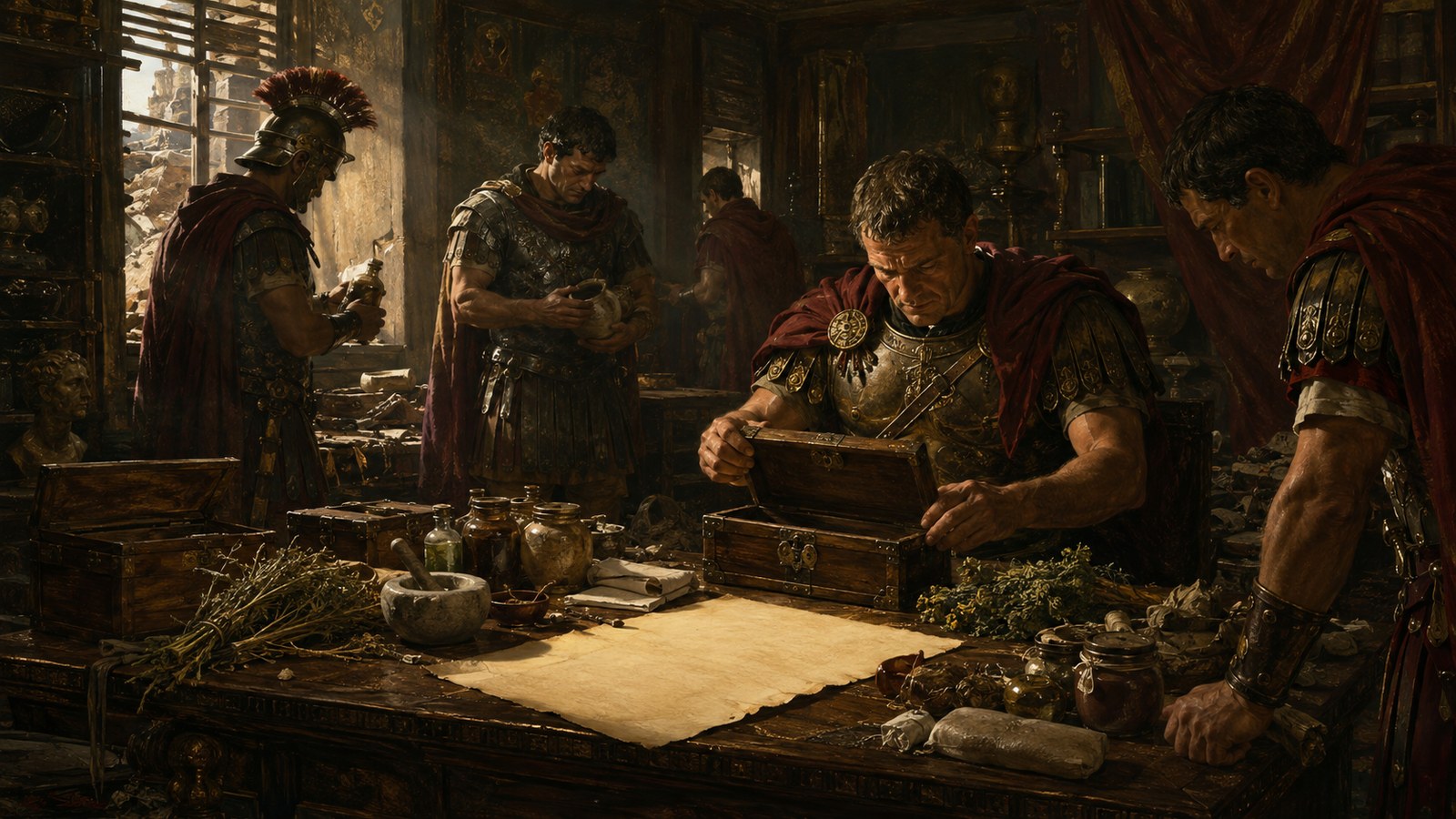
Pompey’s victory made the formula Roman in a new way. Its ingredients remained ordinary and its supposed author remained Mithridates, but the route of possession changed. Knowledge taken from a defeated enemy could be catalogued, translated and circulated by the victor’s culture.
This is why the cabinet matters as much as the mortar. The recipe is a spoil without the bulk of a statue or chest of coin. Its value lies in a claim that can be copied indefinitely.
The compactness also sharpened the tale for Pliny. A reader can remember two walnuts, two figs and twenty rue leaves. The ratio has rhythm. One grain of salt and one day of protection complete it.
Other poison stories in the archive end with a body, as in Hannibal’s use of a ring when escape closed around him. This one ends with instructions. Fear becomes a list, a list becomes a mixture, and a mixture claims to make the day manageable.
The medical promise should remain in antiquity. The historical mechanism is what survives scrutiny: exact language, royal attribution and conquest gave a handful of common materials an authority far larger than their bowl.
Sources
Pliny the Elder, Natural History 23.77. Bostock and Riley translation and notes.