
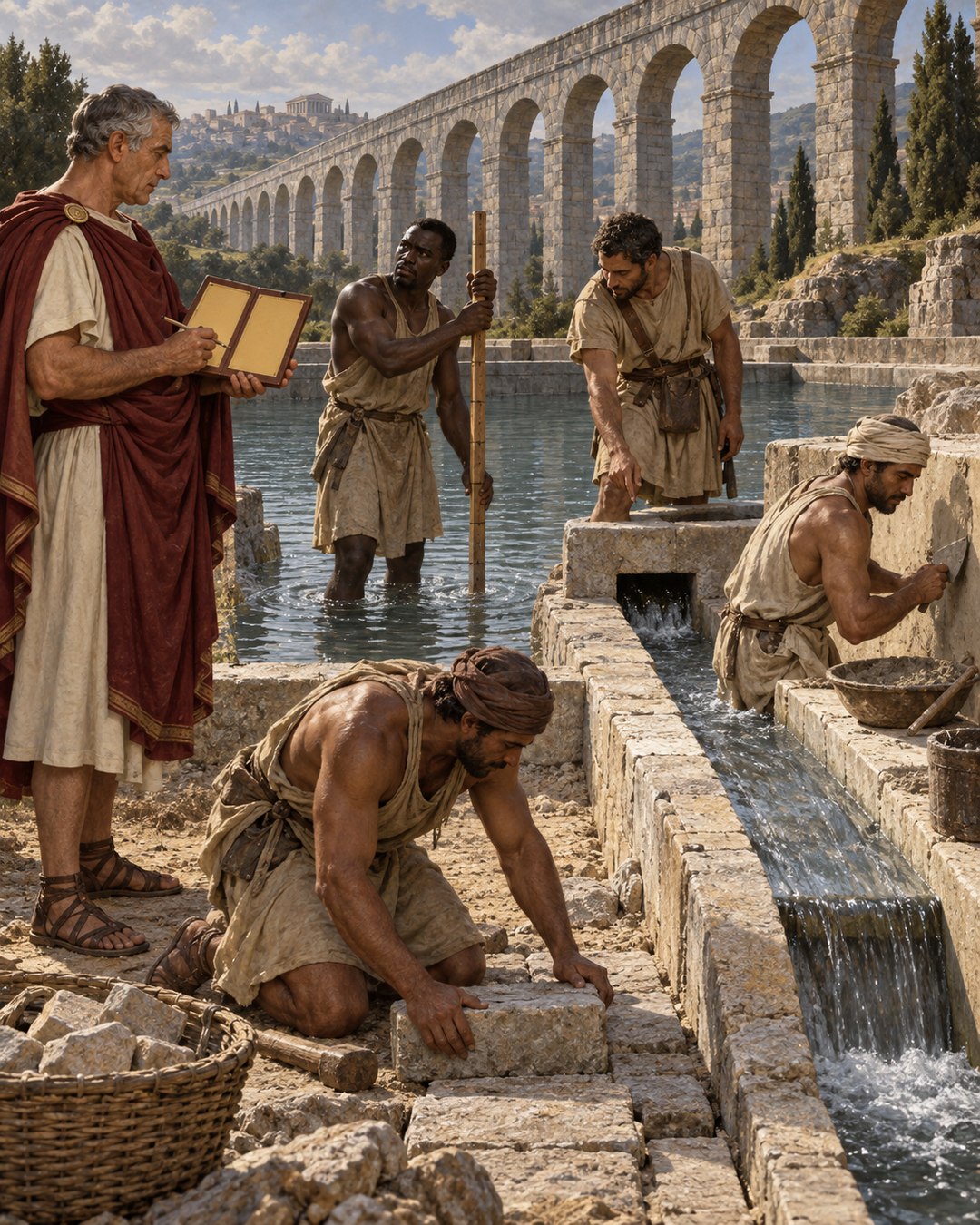
Frontinus wanted tomorrow’s aqueduct work written down before tomorrow began.
Rome maintained two large gangs for its water system. One belonged to the State and numbered about 240 workers. The other belonged to Caesar, numbered 460 and dated to Claudius’s new aqueduct. Their specialists watched reservoirs, inspected structures, laid paving and repaired plaster.
But a workforce on the books was not necessarily a workforce on the conduits. Frontinus says favor and negligent foremen had pulled both gangs into private jobs. His answer was a daily chain of accountability: record the assignment in advance, then record what the crew actually did.
Water reliability began with control of labor.
Two Gangs Carried Different Histories
Frontinus pauses before discussing repairs to explain the people available to make them. He identifies two gangs of enslaved workers, one attached to the State and one to Caesar. The older force had belonged to Agrippa, passed to Augustus and then been transferred to public ownership.
That State gang contained about 240 workers. The imperial gang was larger at 460. Claudius had organized it when he brought his aqueduct into the city.
The figures turn maintenance from an occasional response into a permanent institution. Rome did not wait for a collapsed arch and then search the market for anyone who could patch it. Hundreds of workers existed inside named organizations with inherited authority, payroll arrangements and assigned territory.
Their origins also reveal layers in the system. Agrippa’s works, Augustus’s settlement and Claudius’s additions did not dissolve into one timeless monument. Each expansion left an administrative legacy. New channels required people as surely as stone, gradient and spring water.
This is a different scale from the inverted siphon that carried water across a valley. A siphon solves one hydraulic obstacle through pressure and elevation. A maintenance organization solves recurring obstacles by keeping skills available across years.
Frontinus’s two totals therefore describe capacity, not proof of performance. The next question was what kinds of work those people could do and where they waited.
Specialists Stood Between Source and Fountain
The gangs were divided into classes. Frontinus names overseers, reservoir keepers, inspectors, pavers and plasterers before adding other workers. The list follows the aqueduct beyond its most famous arches.
Inspectors had to notice damage and irregular use. Plasterers maintained the water-resistant surfaces that kept flow inside channels. Pavers restored disturbed ground and working surfaces. Reservoir keepers watched distribution points where one supply became several urban deliveries. Overseers coordinated labor that no single craft could complete alone.
Some workers remained outside Rome. Frontinus says their tasks might not look extensive yet still demand immediate attention. A small obstruction, leak or damaged cover could become a much larger failure if a crew first had to be assembled and sent from the city.
Others occupied stations at urban reservoirs and fountains. Their location mattered because those structures were control points. The public saw water arrive at a basin, but the keeper worked where flow could be observed, apportioned and altered.
The workforce mirrored the physical network. Long rural channels needed dispersed readiness; dense urban distribution needed staffed nodes. The same water system joined remote masonry with crowded streets, so its people could not all gather in one central yard.
Monumental architecture attracts the eye because it survives at scale. Frontinus’s occupational list restores the smaller human functions without which an arch could remain impressive while a neighborhood fountain ran dry.
Emergency Water Required Workers Already in Place
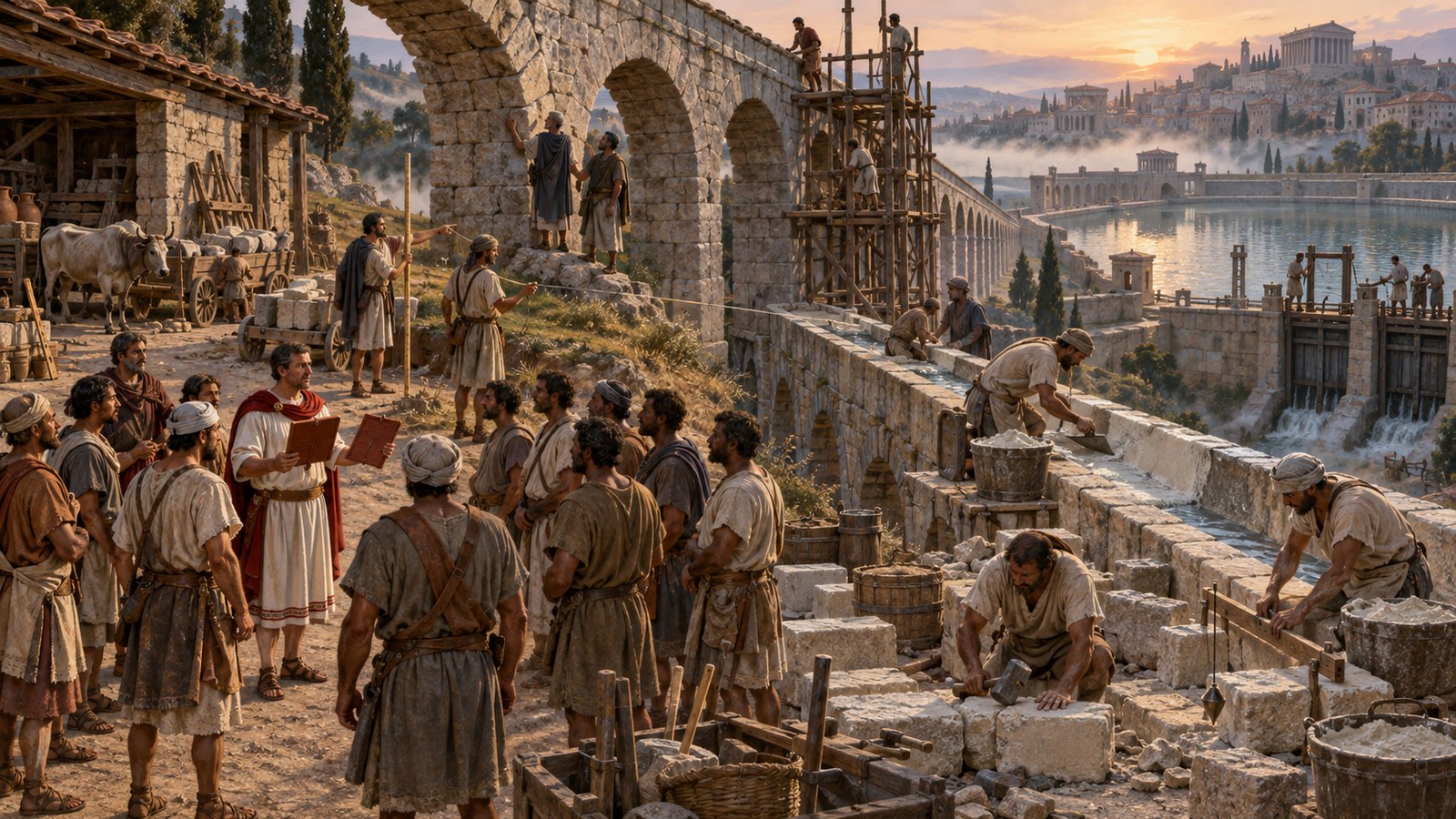
Frontinus gives urban stations an emergency purpose. If one district suffered a sudden problem, a plentiful reserve could be turned toward it from several other wards.
That response depended on more than spare water. Reservoir keepers had to know which points connected, which flows could be altered and how to make changes without creating a second crisis elsewhere. Inspectors had to identify the afflicted section quickly enough for redirection to matter.
Permanent stations shortened the distance between report and action. A worker already at a reservoir could move from routine attention to emergency routing. A gang outside the city could address an upstream fault before its effects propagated through urban branches.
Frontinus elsewhere describes how multiple aqueduct connections protected districts against interruption. Here he supplies the labor side of redundancy. A reserve is useful only if someone can release it, guide it and monitor the consequences.
The goal was not to pretend failures never happened. Age, storms, flawed original construction and interference by neighboring landowners all appear in his repair account. Reliability meant preventing ordinary damage from becoming an uncontrolled chain.
That principle also separated emergency work from expansion proposed for someone’s advantage. Frontinus warned that people urging construction or extension could not always be trusted. The commissioner needed practical judgment to decide what must begin now, what could wait, and whether contractors or regular workers should perform it.
Private Favors Stole Public Working Time
Frontinus found both large gangs repeatedly diverted to private employment. He blames favoritism and the negligence of foremen. The abuse did not remove workers from the rolls; it removed their effort from the water system while preserving the appearance of public capacity.
This was a different theft from the secret pipes that sold public water beneath Roman streets. An illegal branch diverted flow. A private work assignment diverted time, tools and specialist attention.
The damage could remain invisible until a fault needed immediate care. A roster might still show hundreds of available workers. In practice, a plasterer could be finishing a favored person’s wall while an aqueduct lining leaked. The discrepancy lived between nominal employment and actual location.
Frontinus’s reform made that gap recordable. He wrote down one day ahead what each gang was going to do. Then he entered what it had done each day.
The pairing is crucial. A completion record alone can rationalize whatever happened. A plan alone can be ignored after it is filed. Placing the advance assignment beside the completed work exposed substitutions, absence and delay.
Daily cadence also limited how long a diversion could hide. An annual summary might bury weeks of private labor inside broad totals. A next-day instruction gave the foreman and commissioner a specific expectation that could be checked almost immediately.
The wax tablet or register was therefore part of the aqueduct system. It did not carry water, but it helped keep the people who repaired channels from being carried elsewhere.
Repairs Followed Water, Weather and Sequence
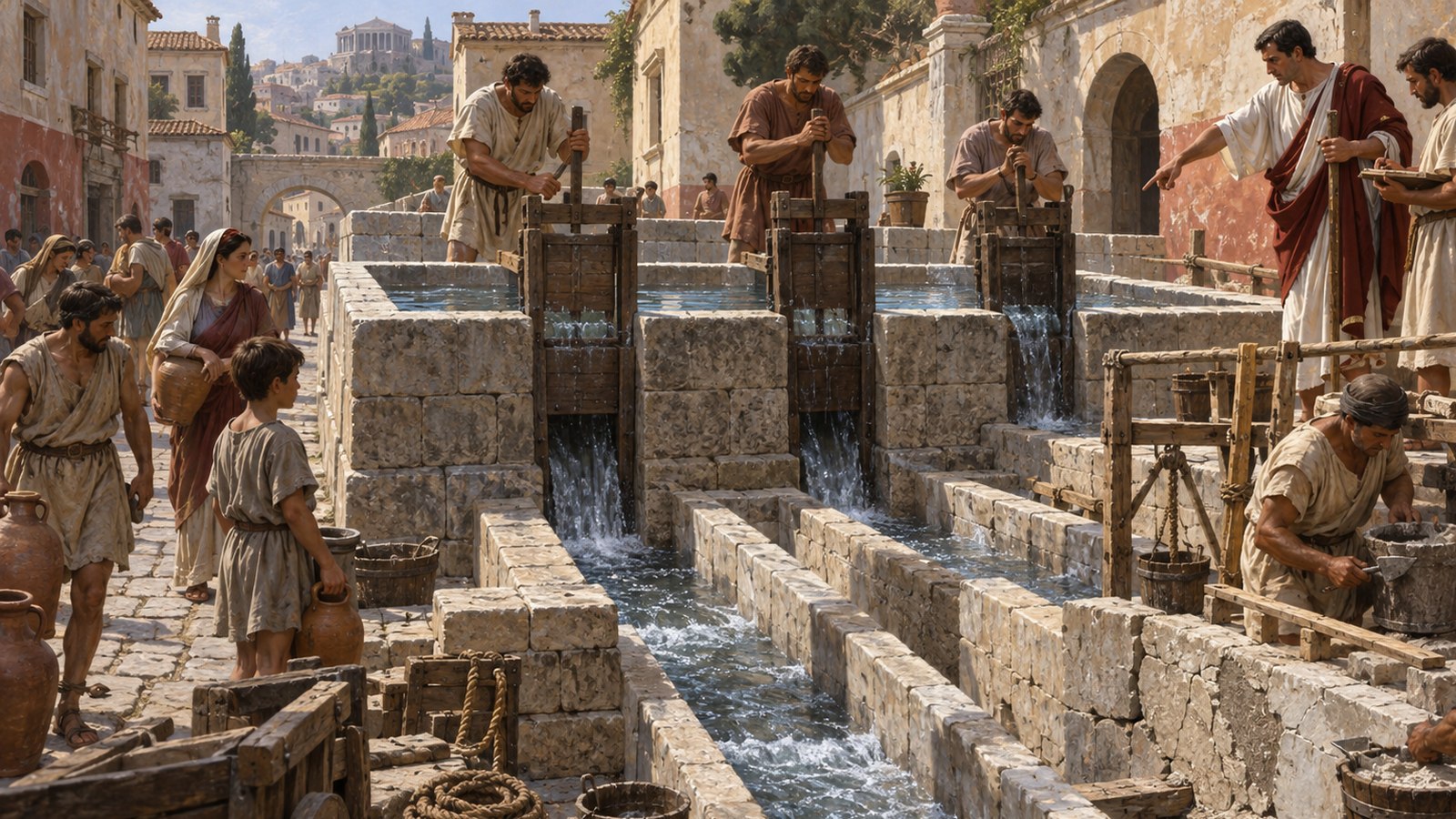
Once labor returned to public duty, timing still mattered. Frontinus says arches, hillside structures and river crossings suffered most from age and violent storms. Underground sections avoided heat and frost and were less vulnerable.
Some defects could be fixed while water continued to flow. Others required diversion because the channel itself had to be entered. Hardened deposit narrowed the passage; damaged concrete lining caused leaks that then harmed walls and substructures. Tufa piers could fail under heavy loads.
Channel work that stopped flow belonged in spring or autumn, not the season of greatest summer demand. Preparations had to be finished before shutdown so the conduit remained out of service for as few days as possible. Only one aqueduct should be stopped at a time, because closing several could leave Rome without enough water.
Ordinary masonry had its own calendar. Frontinus gives a working season from April 1 to November 1 but excludes the hottest period. Moderate weather allowed mortar to absorb and harden properly; extreme sun could damage the work as surely as frost.
The maintenance system thus coordinated several clocks. Daily records controlled crews. Emergency stations answered sudden failures. Seasonal rules protected supply and materials. One-at-a-time shutdowns kept a local repair from becoming a citywide shortage.
Rome’s aqueducts endured not because Roman concrete ignored decay. Frontinus begins from the opposite truth: extensive works were always falling toward it. Their survival depended on noticing small damage, assigning the right workers, preserving alternative supply and finishing before interruption spread.
The great visible achievement was flowing water. Behind it stood an administrative rhythm measured one crew, one record, one season and one aqueduct at a time.
Sources
Sextus Julius Frontinus, The Aqueducts of Rome 116–123.