
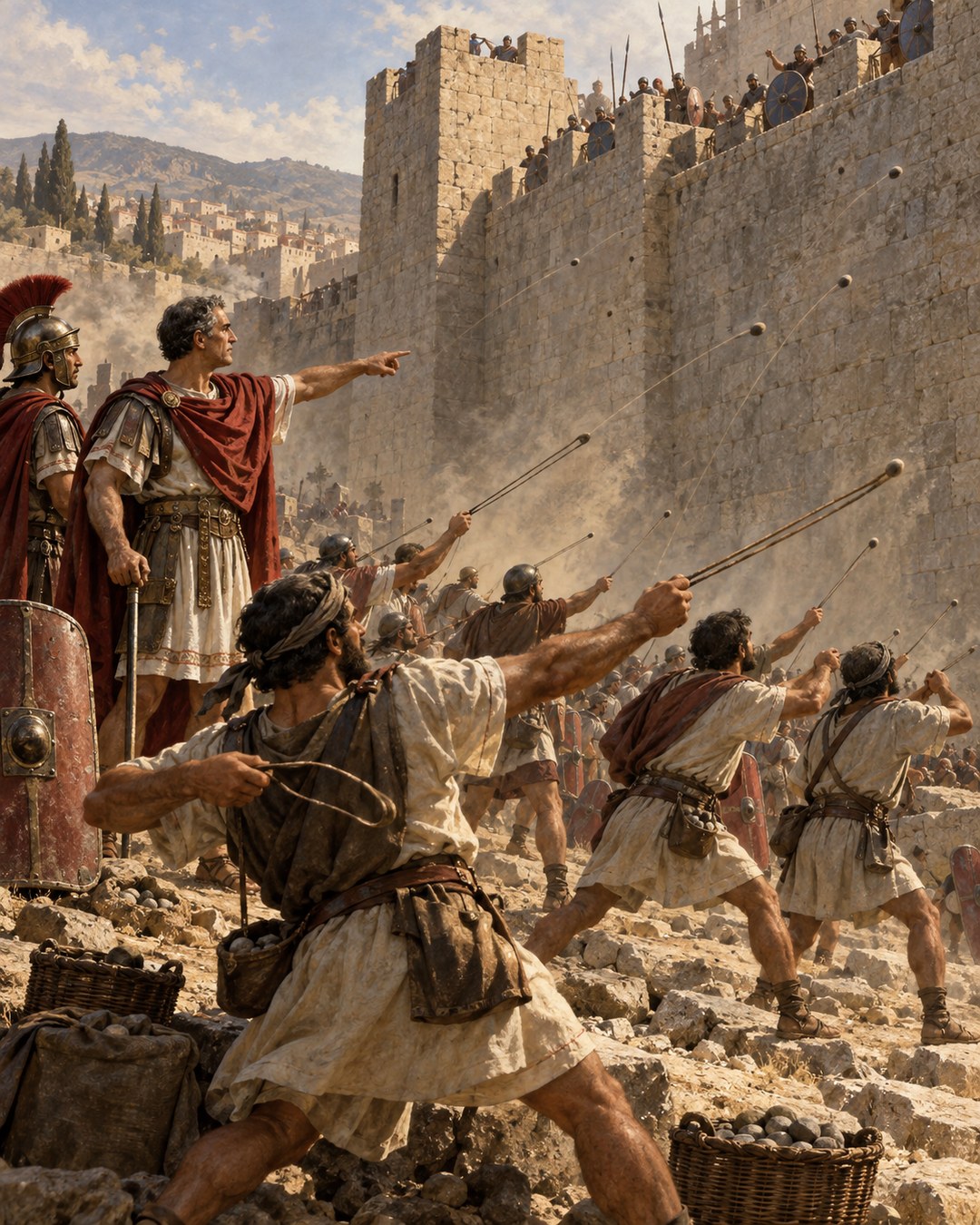
The defenders owned the height. Metellus’s slingers owned the better line.
That is how Quintus Claudius Quadrigarius framed a Roman assault on a fortified town. Archers and slingers worked furiously on both sides, yet the men below suffered fewer wounds and drove their opponents from the battlements.
His reason seems backward: arrows and stones were less accurate when sent downward than when thrown up.
Aulus Gellius did not let the paradox pass as a veteran’s proverb. He asked the rhetorician Antonius Julianus to explain why gravity, speed and ease might still lose to deliberate control.
The Wall Gave Force but Stole a Clean Angle
Quadrigarius placed the proconsul Metellus outside a town whose inhabitants defended the crest of their walls. The fragment does not linger over the town’s name, the length of the assault or the wider campaign. It fixes attention on two groups exchanging missiles across a steep difference in height.
Both sides used archers and slingers. The symmetry matters. This was not a contrast between a sophisticated Roman engine and defenders armed with improvised stones. Similar classes of weapon faced one another, but their bodies occupied opposite angles.
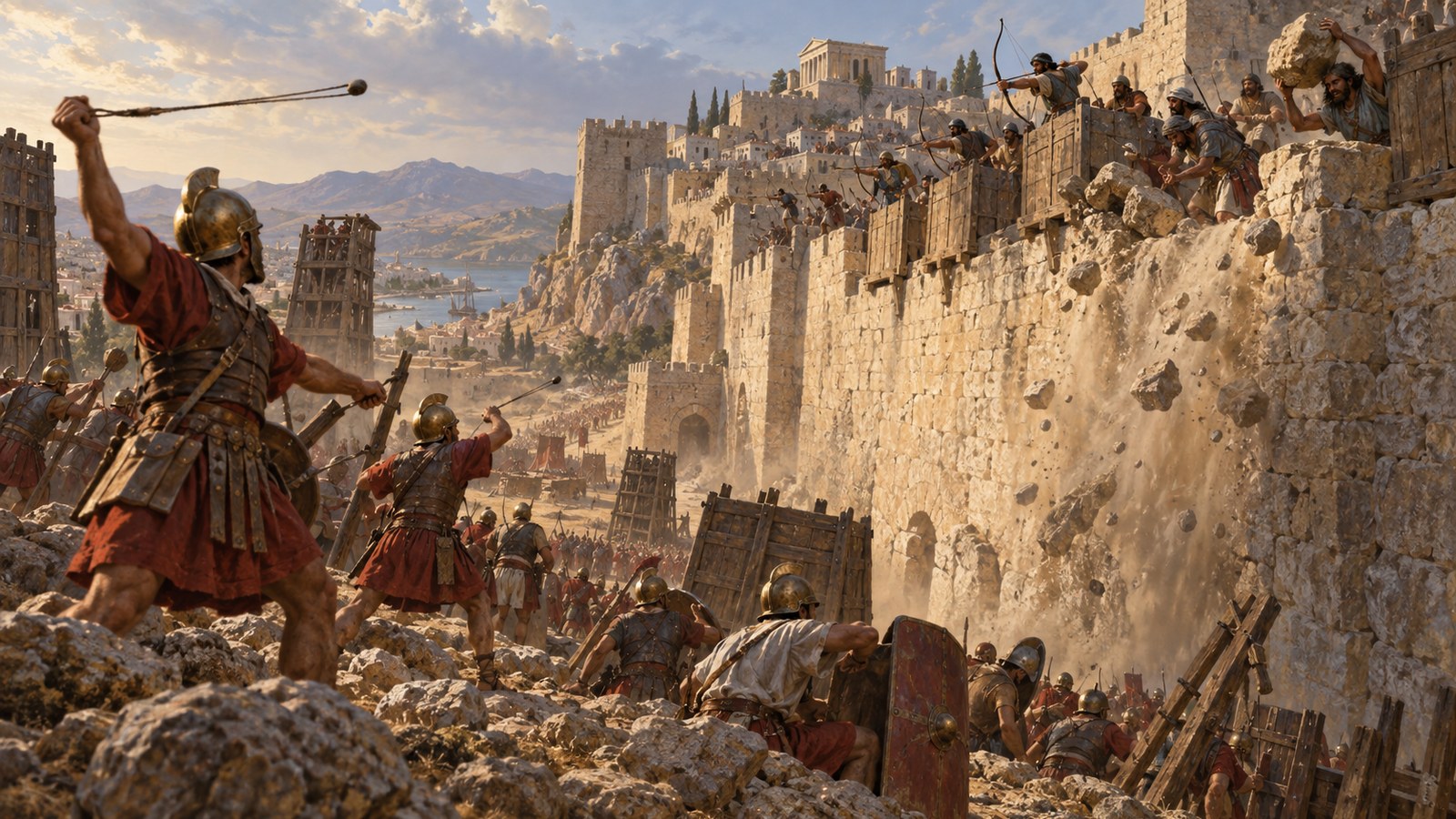
From the wall, a defender could release with gravity. The missile accelerated toward the ground, and throwing it required less effort than sending the same weight upward. That advantage is obvious if success means moving a projectile quickly from high to low.
A battlefield demanded something narrower. The missile had to cross the parapet without striking nearby masonry, preserve the intended direction through a steep descent and arrive where an individual soldier actually stood. Height increased force while compressing the useful window of aim.
The Roman troops below had the reverse problem. Their shots had to climb against weight, but the wall itself supplied a broad visible target line. A defender leaning above a parapet presented a location toward which hand, eye and release could be joined.
Quadrigarius Counted Wounds, Not Elegance
The historian’s test was practical. Metellus’s men suffered fewer wounds. His slingers also cleared defenders from the battlements with surprising ease. The claim measured results at both ends of the exchange: protection below and lost positions above.
A sling stone did not need to kill to alter the wall fight. A defender who ducked, withdrew behind a merlon or abandoned an exposed section ceased shooting effectively. Repeated accurate pressure could therefore open space for the rest of an assault even when the surviving fragment says nothing about a breach.
This kind of suppression appears elsewhere in Roman siege narratives. At Uxellodunum, followed in the fight over a spring beneath missile fire, archers and slingers shaped where people could work and move. Quadrigarius isolates the geometry that made such pressure possible.
His language also resists the assumption that the elevated side always dominates. Walls created security through stone, distance and restricted access. They did not erase the vulnerability of bodies that had to rise above cover in order to see and shoot.
The attackers could choose when to expose a slinger, distribute men along the base and concentrate on visible points. The defender had to use the top edge that made him observable. Terrain offered advantages, but practice decided how those advantages were converted.
Julianus Separated Throwing from Hitting
Gellius’s question began with common sense. A downward throw was faster and easier. Why should it be less accurate?
Antonius Julianus answered by changing the verb. If a person wished only to throw, downward was easier. If he wished to hit a mark, direction and force had to remain under regulation. Ease and accuracy described different achievements.
In a downward cast, Julianus said, the missile’s own weight and descending impulse weakened the command of the marksman. The object was eager to fall. Once released, it acquired motion that did not necessarily preserve the fine adjustment intended by the hand.
For the upward throw, hand and eye were directed together at something above. The projectile went toward the spot selected by the impulse given to it. The marksman had to supply enough force to climb, but that very requirement made the throw deliberate from stance through release.
The explanation is ancient mechanics expressed through bodily experience, not a modern ballistic calculation. Julianus offered no measured velocities or angles. He described what a practiced thrower feels: weight can assist movement while interfering with control.
A Sling Made Discipline Visible
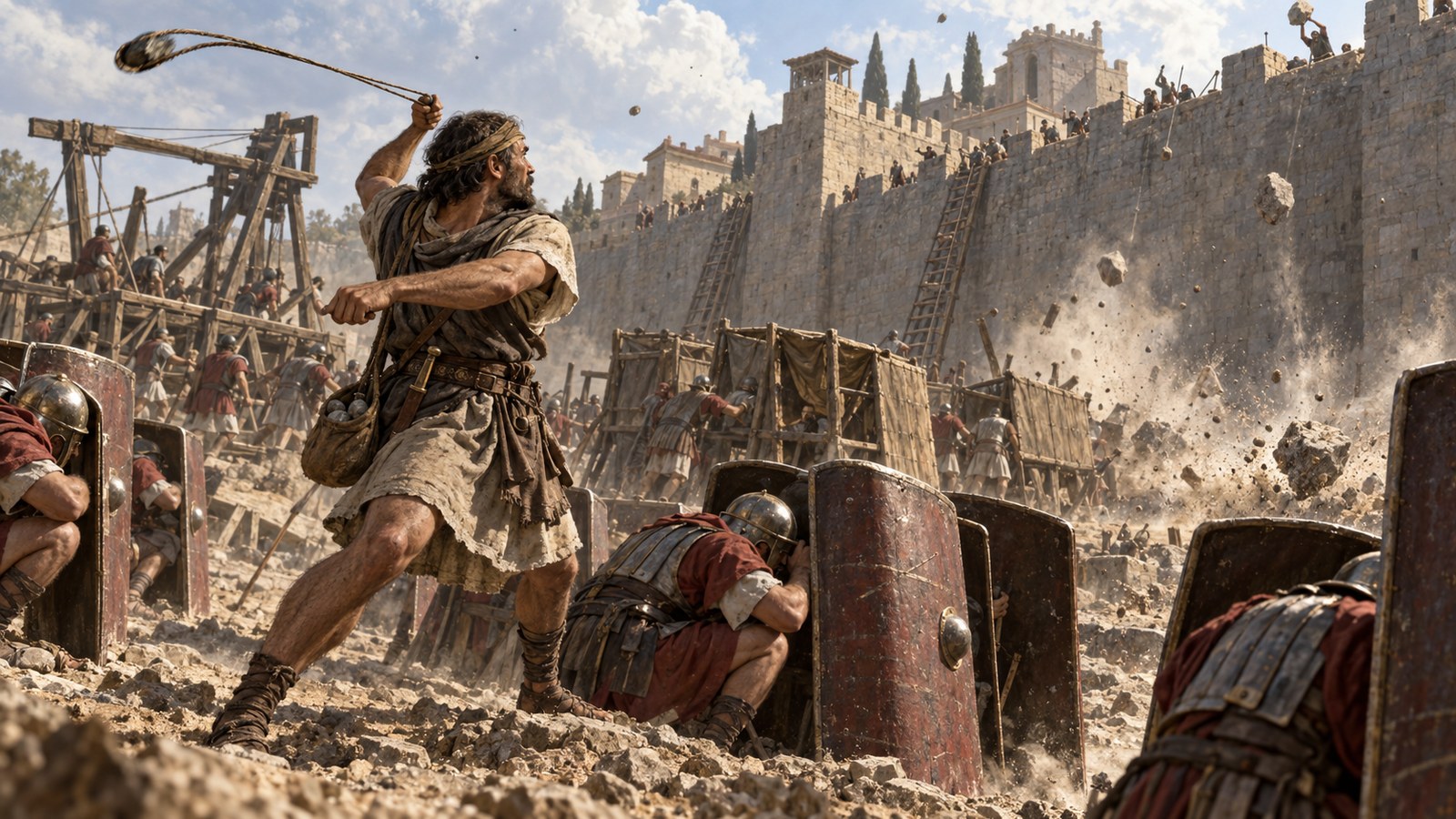
The sling sharpened this contrast because its stone left a rotating system at one chosen instant. The thrower built speed through motion, watched the target and released one cord. A small error in timing redirected the shot.
Throwing uphill forced the slinger to commit to an elevation and power suited to the wall. He could see the parapet as the point where the missile’s path needed to arrive. Men beside him could observe results and adjust successive casts.
Downward work from a battlement was physically awkward in another way. Space behind a parapet limited stance and swing. A slinger needed room for a safe rotation; an archer had to angle bow and body without exposing himself excessively. Quadrigarius does not spell out these details, so they should remain implications of the geometry rather than additions to his report.
The core distinction survives without them. Force delivered by terrain is not identical to force governed by a person. A soldier below who had trained his release could exploit a target above. A defender who trusted height still had to solve the problem of aim.
Roman military equipment repeatedly rewarded coordinated bodies rather than isolated objects. The wooden tablet that carried a camp password mattered because many sentries used it in sequence. Here, leather cords and stone mattered because eye, hand, posture and formation kept repeating the same controlled task.
One Old Verb Preserved the Result
Gellius closed with a linguistic detail from Quadrigarius. The historian used defendere for what the slingers did to the enemy on the battlements. In that passage it meant to avert, remove or drive away, rather than the familiar sense of defending a position.
The old verb catches the tactical outcome. Metellus’s troops did not merely survive fire from the wall. Their upward missiles displaced the people using the wall. Accuracy changed possession of the exposed edge before stonework itself changed hands.
That is why the fragment remains more than a curiosity about throwing. It asks what an advantage actually contains. Elevation contained speed, weight and easier descent. It did not contain a guaranteed hit.
Below the battlements, the attackers had to spend energy against gravity. In return, their gestures stayed organized around a visible mark. The defenders could let objects fall with greater violence, but gravity began making choices the moment the hand surrendered control.
Quadrigarius remembered the men who cleared the wall from beneath it. Julianus explained their success with a lesson every marksman could recognize: the easiest direction for a weapon is not always the surest route to its target.
The episode also preserves how technical knowledge moved through Roman literary culture. Quadrigarius recorded an outcome in an annalistic battle narrative. Gellius noticed that the outcome violated an intuitive rule about height. Julianus translated it into the language of bodily control, while Gellius added a note about the historian’s old verb. No surviving participant needs to have possessed a complete science of trajectories for the chain to matter. Observation began with fewer wounds and an emptied battlement; explanation began when one reader refused to treat those results as self-explanatory. The archive therefore keeps both the field report and the conversation it provoked. A small tactical puzzle became evidence that Romans could reason carefully from practiced motion without pretending that greater speed and greater precision were the same thing.
Sources
Aulus Gellius, Attic Nights 9.1, preserving Quintus Claudius Quadrigarius and Antonius Julianus.