
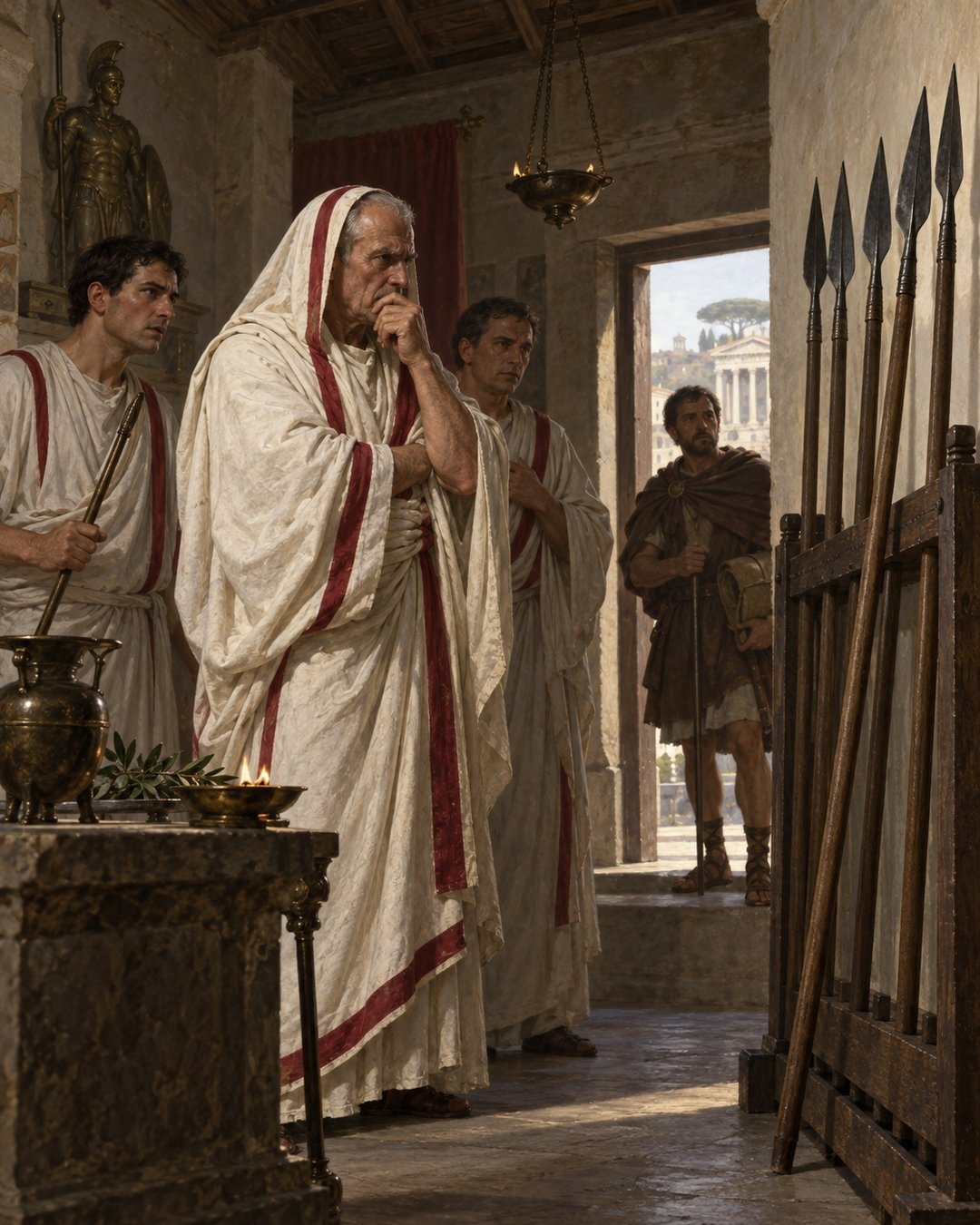
The spears were not on a battlefield. They stood inside the Regia, in a sanctuary tied to Mars.
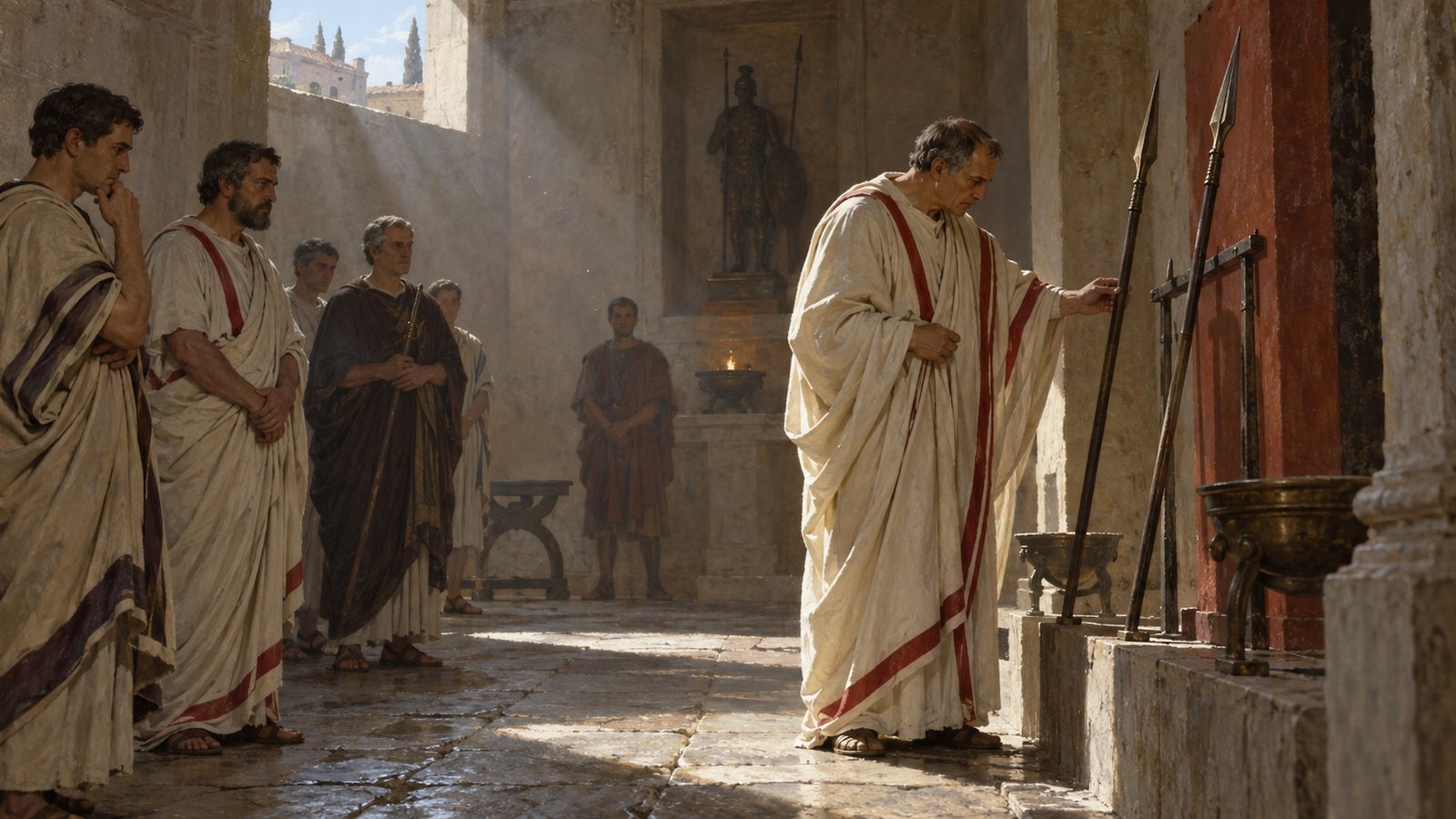
When they moved, a pontifex named Gaius Julius carried the observation into Rome’s machinery of government. The senate did not answer with a vague instruction to calm the gods. It named the consul responsible, distinguished which victims belonged to Jupiter and Mars, allowed another class for other gods and described what should happen if the first offering did not settle the matter.
The reserve victims were to be red.
Aulus Gellius preserved the decree because its ritual vocabulary interested him. In doing so, he also preserved a compact view of how Rome made uncertainty administratively manageable.
A Movement in the Regia Became Public Business
Gellius begins by placing the incident beside earthquakes. Such disturbances were reported, and expiatory rites followed. The movement of the spears belonged to the same family of events: an observable break in expected order that demanded more than private interpretation.
The location mattered. The Regia was not an ordinary storeroom where a rack might shift without consequence. It was a sacred and civic center, and these were the spears of Mars. Their movement could therefore be read as a disturbance in the relationship between Rome, war and divine order.
Gellius does not embellish the moment with thunder, voices or a visible god. The record begins with a material report. Something assigned to a fixed sacred place had moved. That limited observation was enough to activate a chain of offices.
The same preference for controlled ritual action appears in the stored ingredients used to cleanse the Parilia. Roman religion often joined extraordinary meaning to precisely handled objects. A spear, ash or stalk mattered because a recognized institution had assigned it a place in a rite.
Here the first institution was the priesthood. Gaius Julius, identified by his father and by the office of pontifex, made the report. The decree did not float free as anonymous fear. It recorded who had brought the matter forward.
The Senate Converted Alarm into Instructions
The senate received the report and issued a response during the consulship of Marcus Antonius and Aulus Postumius. Its wording made responsibility concrete. Marcus Antonius, as consul, was to perform the expiation.
This was not a division between a religious Rome and a political Rome. A priest observed and reported; senators authorized; a magistrate acted. The prodigy crossed institutions without ceasing to be sacred.
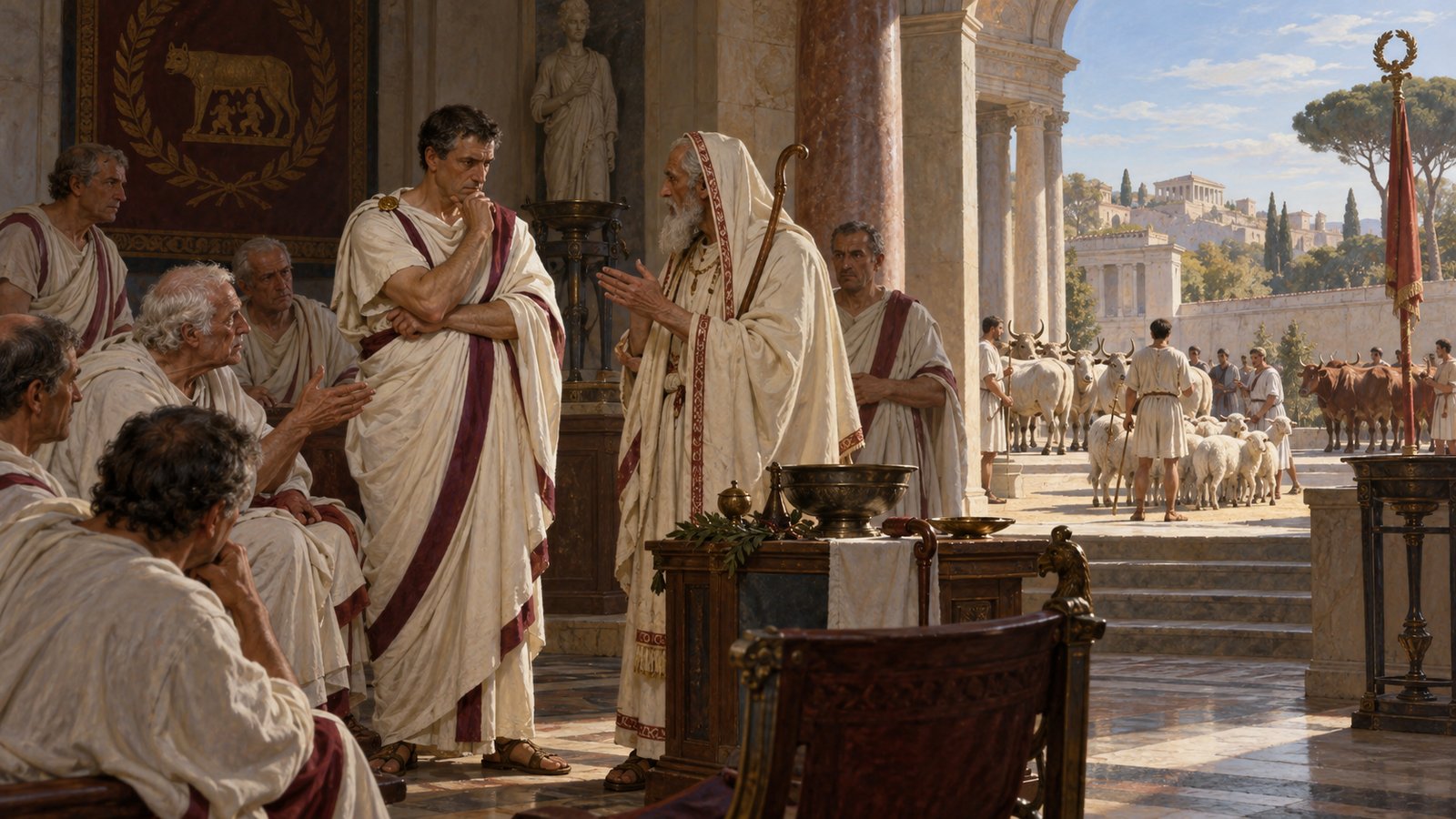
The first order named Jupiter and Mars for full-grown victims. Other gods could receive unweaned victims according to the consul’s judgment. Age therefore helped organize the offerings. The decree did not treat all animals as interchangeable ritual material.
That distinction also set a boundary around discretion. The consul had room to decide which other gods should be included, but the principal recipients and their mature victims were already fixed. Authority meant executing a framed response, not inventing one from nothing.
The senate then declared those sacrifices sufficient. That phrase is easy to overlook. It established what counted as an adequate first answer before anyone knew whether another would be demanded.
Roman ritual could be elaborate without being endless. Public action needed a point at which the responsible magistrate could say that the order had been fulfilled. The decree supplied that point while retaining a contingency beyond it.
Red Victims Waited behind the First Offering
If additional victims proved necessary, they were to be red. The color requirement belonged only to the reserve stage described by Gellius, not to every animal in the opening sacrifice.
The provision reveals a system expecting that ritual action might need correction or reinforcement. The possibility of insufficiency was not evidence that the senate doubted the rite. It was a condition for which the rite had language and procedure.
Preparation changed the meaning of repetition. A second offering made under the decree would not look like panic after an unforeseen failure. It would complete a path already authorized when the first response was designed.
Color made that path visible. Full-grown and unweaned animals separated recipients in the initial offering; red animals marked the additional stage. Anyone organizing the victims could tell which group belonged to which condition.
This practical sorting matters because public sacrifice involved bodies, handlers, time and space as well as words. An instruction had to become a procession of actual animals. Ritual categories were operational categories.
A related scene in the pig and prayer used before work in a sacred grove shows the same concern with sequence. Permission was not a mood. It was produced through an ordered act before axes or labor entered protected ground.
At the Regia, the sequence reached beyond the first act. Rome prepared not only to respond, but to respond again without losing formal control.
Substitute Victims Preserved a Failed Sequence
Gellius pauses over the word succidaneae. He explains it through succession: when the first victims did not achieve expiation, others were brought after them and slain in their place.
The replacement did not erase the first sacrifice. Its name depended on the first act having occurred. The later victims occupied a defined position in a sequence whose earlier stage remained visible as incomplete.
That is different from simply repeating the same gesture until anxiety fades. A substitute offering acknowledged both performance and insufficiency. The rite had been attempted correctly enough to count, yet its desired expiatory result had not been secured.
Gellius even cared about pronunciation, warning that the vowel in the term should be long. For him, exact ritual language and exact linguistic form belonged together. A corrupted word could hide the historical logic embedded in it.
The logic made contingency legible. Officials could distinguish an original victim from one supplied afterward, just as the senate distinguished the first groups from red additions. The vocabulary kept the repair attached to the failure it answered.
That attachment protected institutional memory. If additional animals appeared, observers did not need to treat them as a fresh omen or a separate political initiative. Their ritual name explained why they were there.
Preparatory Offerings Faced the Opposite Direction
Gellius then contrasts victims slain after a failed expiation with praecidanea, offerings made before a regular sacrifice. One category repaired backward. The other prepared forward.
His example is a sow customarily offered to Ceres before the new harvest. It addressed a household that had not been purified after defilement or whose purification had been performed improperly.
Agricultural time sharpened the need for advance repair. The harvest could not be treated as detached from the condition of the household approaching it. A preparatory offering created a ritual threshold before new produce entered the cycle.
The same adjective could describe a festival. Gellius quotes pontifical law in which Tiberius Coruncanius, serving as pontifex maximus, appointed a preparatory holiday on a day of ill omen. The pontiffs decided that observing it then created no religious obstacle.
That ruling shows expertise working through apparent contradiction. A bad day did not automatically cancel every sacred act. The college determined whether this particular preparatory observance could proceed without scruple.
Both examples treat timing as part of ritual identity. An animal offered before the principal event and one offered after an insufficient event might look similar in a courtyard. Their place in the sequence made them different acts.
The moving spears remain unexplained. Gellius offers no mechanical cause, and the senate did not need one before acting. Its task was to decide how Rome should answer an event already accepted as requiring expiation.
The response was neither spontaneous terror nor a single automatic formula. It distributed duties among priest, senate and consul. It classified victims by age and recipient. It established sufficiency, then preserved a route for additional red animals.
That design reveals why the vocabulary mattered. Rome’s ritual system had terms for an offering that came after failure and another that came before the principal rite. Each word located action relative to what had already happened or was about to happen.
The result was a form of resilience. If the first sacrifice proved enough, the consul had completed a bounded command. If more was needed, no new constitutional scramble had to begin. The reserve instruction was waiting.
Nothing in the account makes uncertainty disappear. The spears moved. The gods’ disposition could not be inspected like a ledger. Yet uncertainty was prevented from dissolving responsibility.
Gaius Julius reported. The senate specified. Marcus Antonius was to sacrifice. The pontifical tradition supplied names for preparation and repair.
Rome’s answer to an unstable sacred object was a stable sequence. Even the possibility that the first answer might fail had already been given its animals, its color and its place in the decree.
Sources
Aulus Gellius, Attic Nights 4.6.