
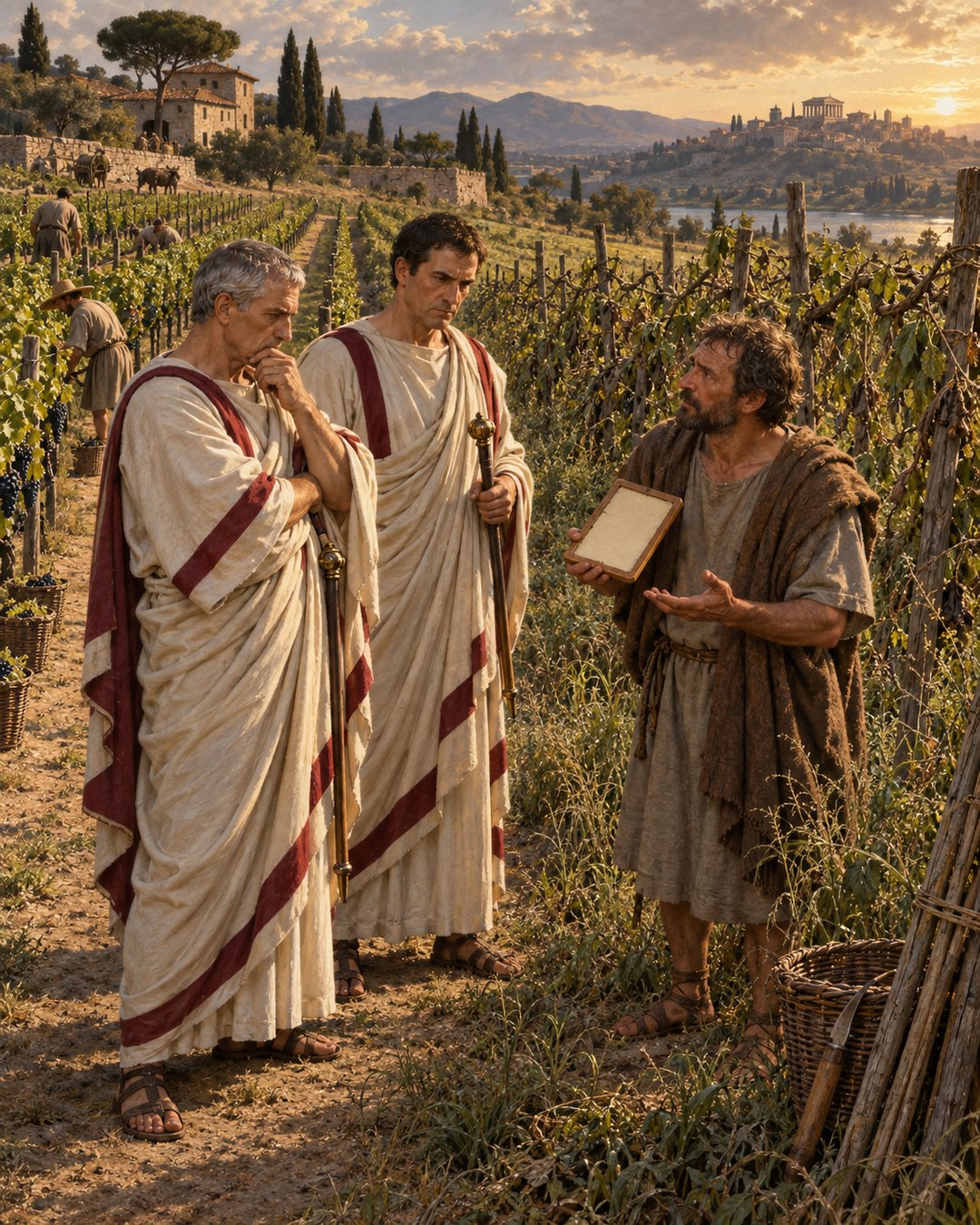
The vineyard did not need to collapse. It only needed to show that nobody had kept up the work.
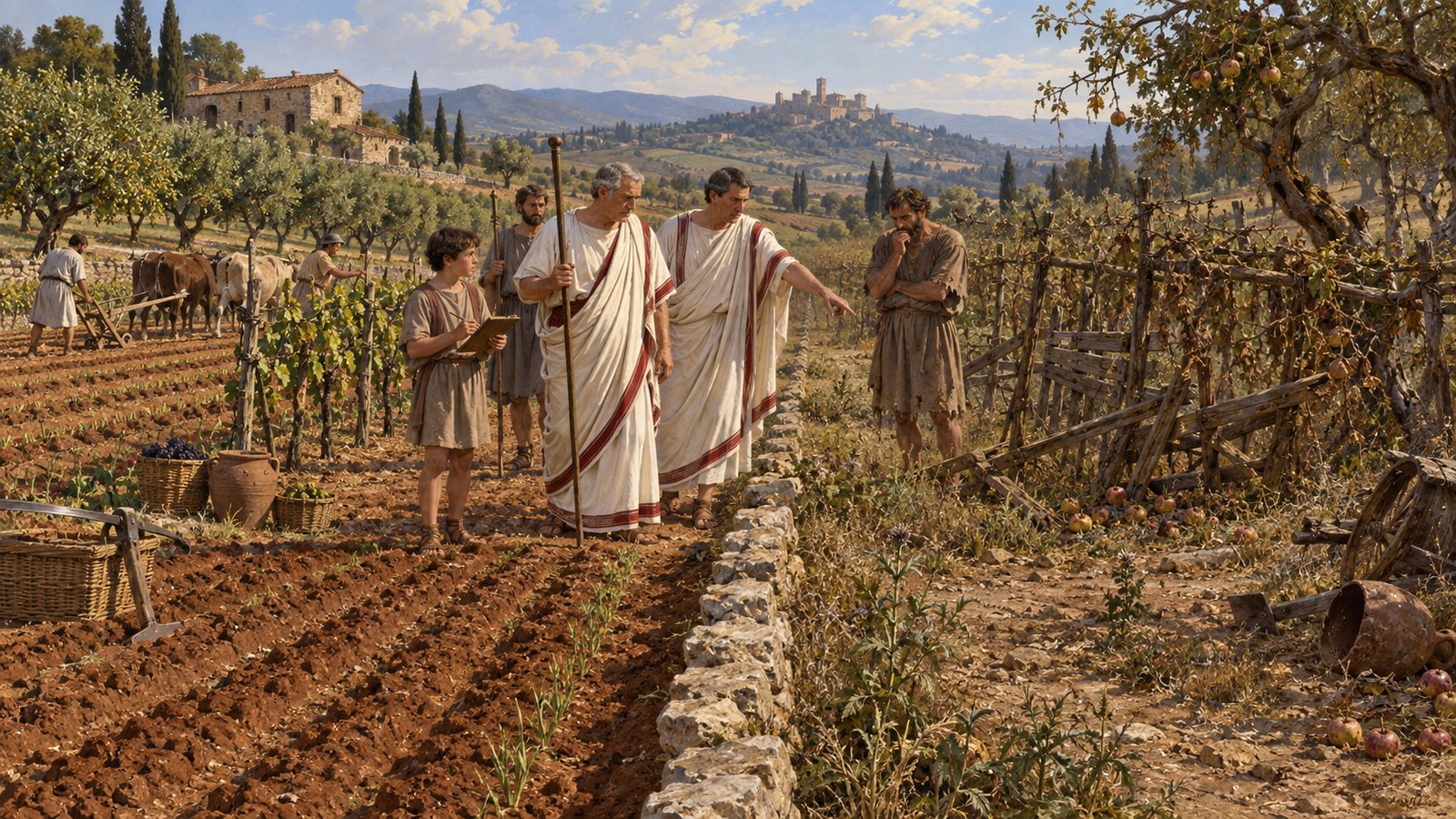
Unploughed soil, weeds, an untended orchard or vines left to decline could bring a Roman landholder before the censors. Aulus Gellius says the penalty could push that citizen into the lowest class.
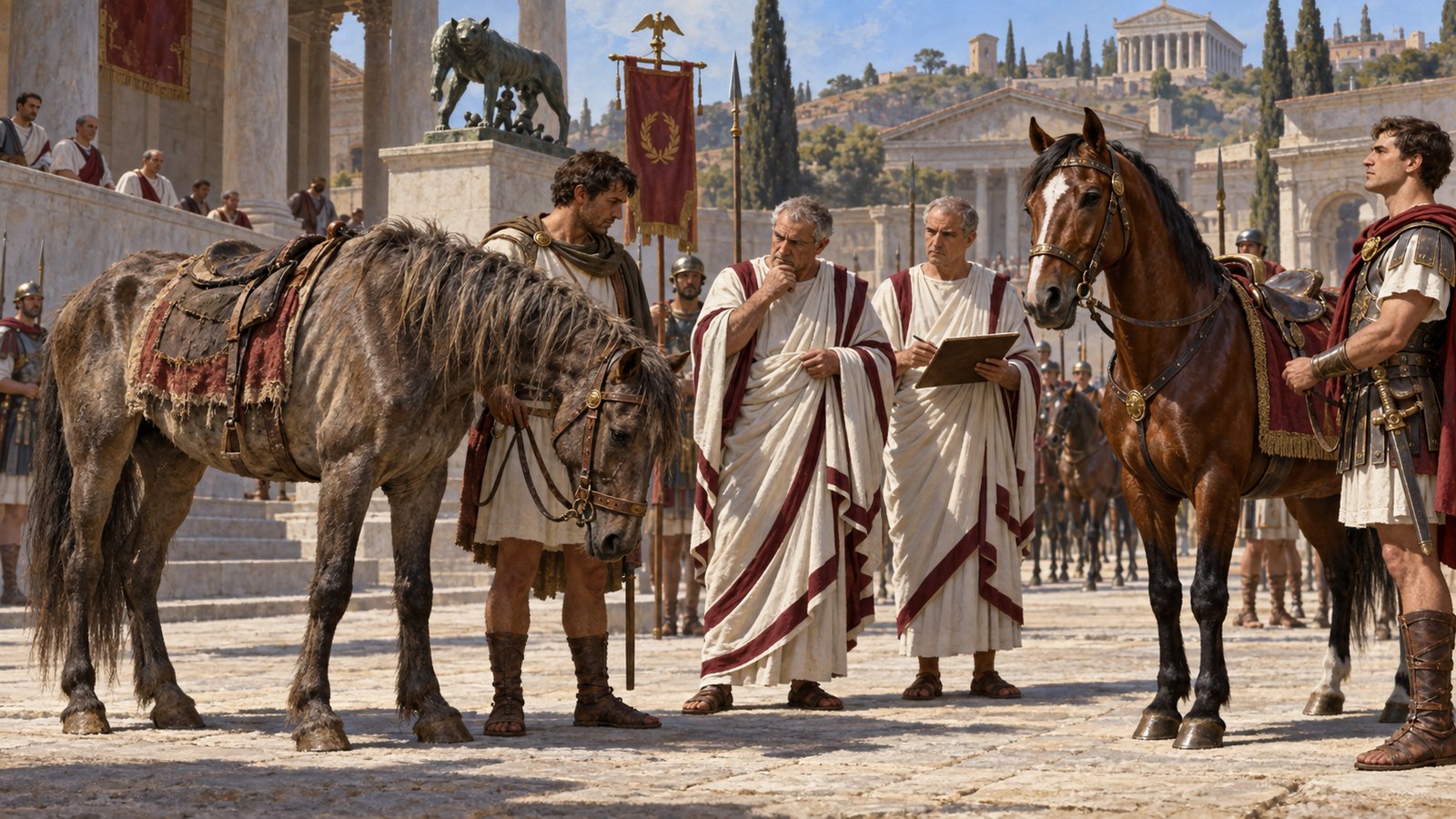
A knight faced a parallel test. If his horse looked thin or poorly groomed, the censors could charge him with inpolitia: negligence.
These were not hidden moral failures. They accumulated in soil, branches, coats and ribs until care—or its absence—became publicly readable.
A Field Recorded More Than a Bad Season
Gellius begins with land allowed to run to waste. His examples identify tasks whose absence persisted long enough to be seen: ploughing had not broken the ground, weeding had not cleared competition, and perennial plantings had not received attention.
A harvest can fail despite careful labor. Weather, pests and disease can defeat an experienced farmer. The censorial examples do not make yield the test. They focus on maintenance that an owner was expected to organize.
That distinction kept the judgment tied to conduct. Bare earth after drought might say little about character. Rows left unworked and vines left untended supplied a different kind of evidence, especially when the neglect extended across the property.
The field also preserved time. One missing morning of work was hard to reconstruct. A season of weeds or an orchard without pruning made repeated omission visible at once.
Roman agricultural management depended on such sequences. Cato’s overseer was expected to rise first and sleep last because the farm required supervision across many small operations. Gellius shows what the civic system could infer when that chain of attention failed.
The censor did not need to know every conversation between owner and worker. The land had retained the result.
Vines and Orchards Raised the Cost of Delay
Gellius names orchards and vineyards separately from general land. Both were long-lived investments. Their productivity depended on care that could not simply be recovered by one energetic day before inspection.
A neglected annual field might be ploughed again next cycle. A vine trained badly, left tangled or allowed to weaken carried the consequences forward. Fruit trees likewise joined present work to future yields.
That made perennial crops especially useful signs of stewardship. Their condition showed whether an owner had maintained value already planted rather than merely chasing the next immediate return.
The list also broadens what “property” meant in censorial judgment. Land was not an inert block held by title. It was soil under cultivation, trees under care and vines shaped by recurring labor.
Neglect could therefore damage more than private income. Productive ground and planted capital belonged to the material base from which households, markets and military obligations were supported. Gellius does not spell out a national economic theory, but the severity of demotion shows that the failure was read civically.
The owner remained responsible even when other hands performed the tasks. Roman estates distributed labor through overseers, tenants, hired crews and enslaved people. Delegation changed who held the hoe; it did not necessarily remove the status holder from judgment.
The detailed contract behind Cato’s fifty-worker olive harvest reveals how much coordination one crop could require. The censorial rule stood at the other end of that world: when coordination visibly failed, ownership could no longer appear as passive entitlement.
The Censors Turned Maintenance into Rank
Gellius says such conduct did not go unpunished. The censors could reduce the negligent landholder to the lowest class of citizens.
The movement was political as well as humiliating. Roman classification affected how a man appeared within the civic body. A farm’s condition could therefore alter not only household wealth but public standing.
This is the mechanism that makes the anecdote sharper than a lecture about good farming. Advice might tell an owner that weeds waste labor or that vines need attention. Censorship attached those practical failures to the legitimacy of rank.
Status came with a claim about capacity. A property holder presented himself as someone able to command resources, labor and judgment. Land running to waste contradicted that presentation in a form the censors could inspect.
The punishment also reversed the direction in which property usually worked. Land helped support position. Here the same land, badly cared for, became the evidence that position should be lowered.
Gellius does not provide a hearing transcript or identify one punished farmer. He records the category and says Marcus Cato cited frequent examples. That limitation matters. The passage establishes the recognized censorial logic, not the details of every case.
Its brevity may reflect familiarity. Readers did not need a long explanation of why the censors could ask whether a citizen’s visible habits matched his classification. They needed the memorable examples of field, orchard and vineyard.
A Knight’s Horse Carried the Same Evidence
The second example leaves the farm but keeps the structure. A Roman knight whose horse appeared skinny or insufficiently groomed could be charged with inpolitia.
A horse presented care on a living surface. Feed affected condition; grooming affected coat, skin and readiness; tack and handling reflected repeated attention. Neglect could not be fully concealed by a speech at the moment of review.
The knightly context made the animal more than personal property. Equestrian status had military roots, and the horse materialized the claim that its rider belonged in that order.
A thin horse might result from illness or circumstance, but Gellius couples appearance with poor grooming and supplies the censorial label “negligence.” His concern is the recognized interpretation: a badly kept mount could expose a rider who had not met the duties attached to possession and rank.
The horse also made responsibility relational. A citizen might neglect soil and lose future production. Neglecting an animal imposed the failure on a dependent body. The visible result followed the knight into public inspection.
Farm and horse therefore formed a matched pair. One test asked whether the owner had maintained productive land. The other asked whether a mounted citizen had maintained the animal through which his status operated.
Both tests looked past purchase. Owning vines did not prove husbandry. Possessing a horse did not prove horsemanship or care. The censors judged what happened after acquisition.
Inpolitia Named a Failure of Care
Gellius pauses to explain the unfamiliar word. Inpolitia, he says, meant the same as negligence.
The explanation draws the examples together. Negligence is not simply ignorance of a technique. It is a failure to apply attention where responsibility already exists.
That is why the evidence could be ordinary. The censors did not need spectacular waste, a dead vineyard or a collapsing estate. Missing ploughing, persistent weeds and poor grooming were enough to reveal a pattern.
Maintenance rarely produces one heroic scene. It repeats. Soil is worked, weeds return, vines need training and animals need feeding and brushing again. Negligence is the negative image of that repetition.
The charge made routine labor morally and politically significant. Elite status often displayed itself through finished surfaces, strong animals and orderly estates. Censorial inspection asked who had sustained those conditions rather than who could stage them once.
It also gave Cato useful material. Gellius says Cato cited frequent authorities or examples for both kinds of punishment. Cato’s public persona repeatedly connected discipline, agriculture and civic strength; these cases put institutional force behind that connection.
Yet the system should not be romanticized as a fair inspection of everyone’s work. Roman property rested on stark inequalities, and much of the labor maintaining elite land was coerced. Censorial blame fell upon the status holder because the system treated his command as the meaningful civic fact.
A Roman citizen’s class and a knight’s standing were legal and social abstractions. A field and horse made those abstractions inspectable.
The censors used material condition as a proxy for character. Well-tended land suggested foresight and command. A healthy groomed horse suggested readiness and discipline. Neglect allowed the opposite inference.
Any proxy can mislead. A polished estate might conceal brutal management, and a struggling owner might face causes beyond his control. Gellius does not preserve appeals, exceptions or disputes around these examples.
What he does preserve is the expectation that rank required upkeep. Public position could not be defended solely by ancestry, title or the fact of ownership when the things entrusted to a man visibly deteriorated.
The farm inspection and equestrian review also crossed private boundaries. Vines grew on owned land; grooming occurred in a stable. Their condition nevertheless became evidence for a public magistracy.
That crossing was central to censorship. The office judged the fit between a citizen’s habits and his place in Rome. Gellius’s examples show the judgment operating without a dramatic scandal. Ordinary neglect was enough.
The weeds spoke through accumulation. The orchard recorded seasons missed. The thin coat of a horse showed care not given.
In each case, status depended on an answer to the same question: had the person who claimed command actually maintained what command placed in his hands?
Sources
Aulus Gellius, Attic Nights 4.12.