
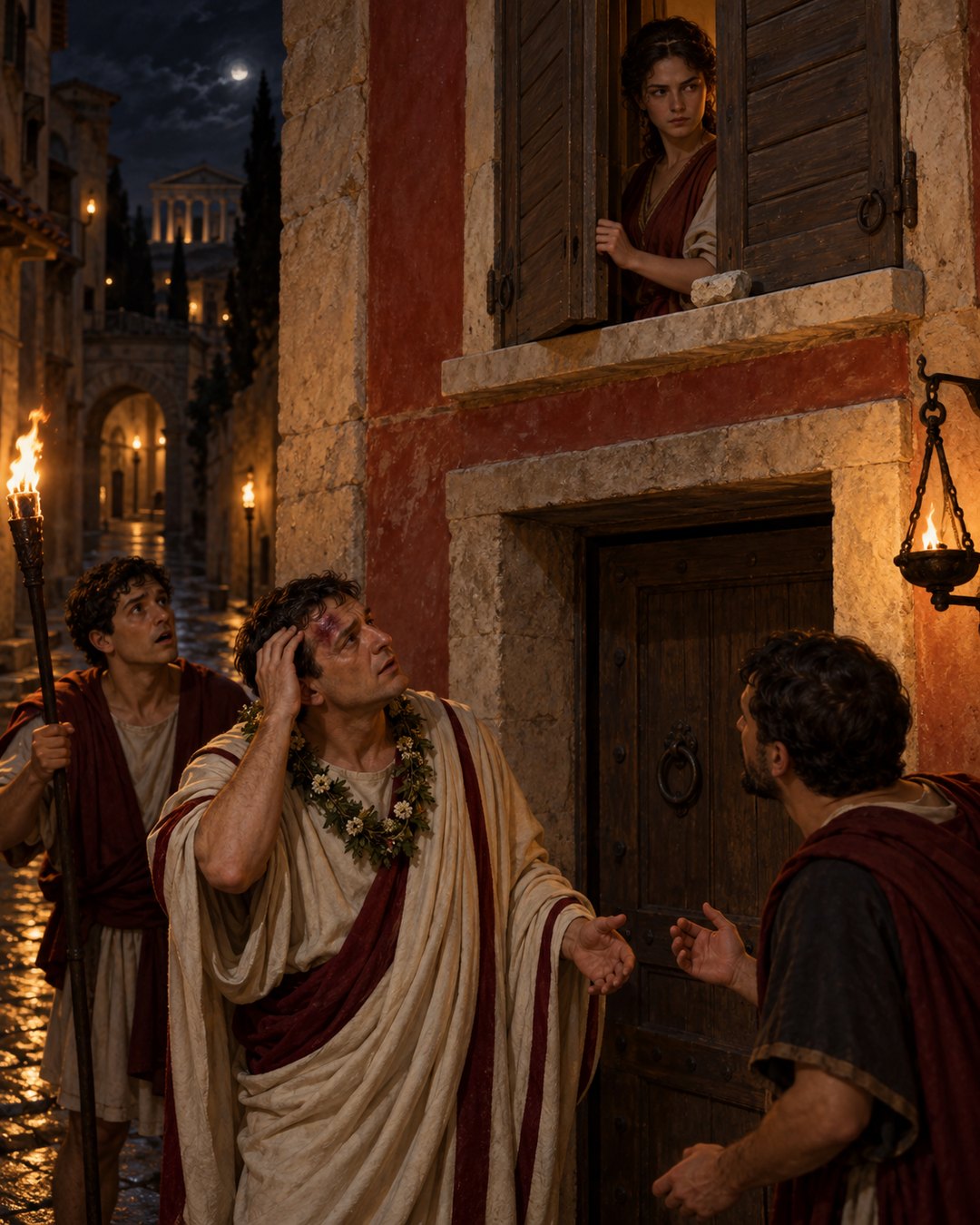
Aulus Hostilius Mancinus had the sort of evidence a crowd could understand at once: a wound on his head. He said that Manilia had struck him with a stone thrown from her apartment at night.
Manilia answered with a setting rather than a denial. The curule aedile had arrived dressed as a reveller, she said, and tried to force his way in after she refused him.
Before the tribunes, the garland changed the wound.
A Visible Injury Opened the Public Case
Aulus Gellius preserves the dispute because he encountered it in Ateius Capito’s On Public Decisions. He calls the decree of the tribunes full of old-time dignity, then gives the facts in a compact sequence.
Mancinus was not an anonymous complainant. He was a curule aedile, one of the magistrates whose public duties made his conduct legible as more than private nightlife. He brought an action before the Roman people against Manilia, whom Gellius identifies as a courtesan.
His accusation started with the physical result. A stone had come from her apartment during the night and struck him. Mancinus displayed the resulting wound. The gesture supplied an object for public attention: injured magistrate, accused woman, visible mark.
That presentation could have compressed the incident into a simple line from assailant to victim. The source gives no reason to doubt that the stone hit him. Yet an injury does not explain by itself why the parties were at the same doorway or what happened immediately before it flew.
Roman law could make circumstances alter an act’s meaning. The Twelve Tables treated a thief caught at night differently from one encountered by daylight. Manilia’s appeal likewise forced attention away from the isolated blow and toward time, place and prior conduct.
The wound opened the case. It did not settle whose conduct had created the danger.
Manilia Reconstructed the Doorway
Manilia appealed to the tribunes of the commons. In Gellius’s compressed report, that move gave her a forum in which to supply the part Mancinus’s display omitted.
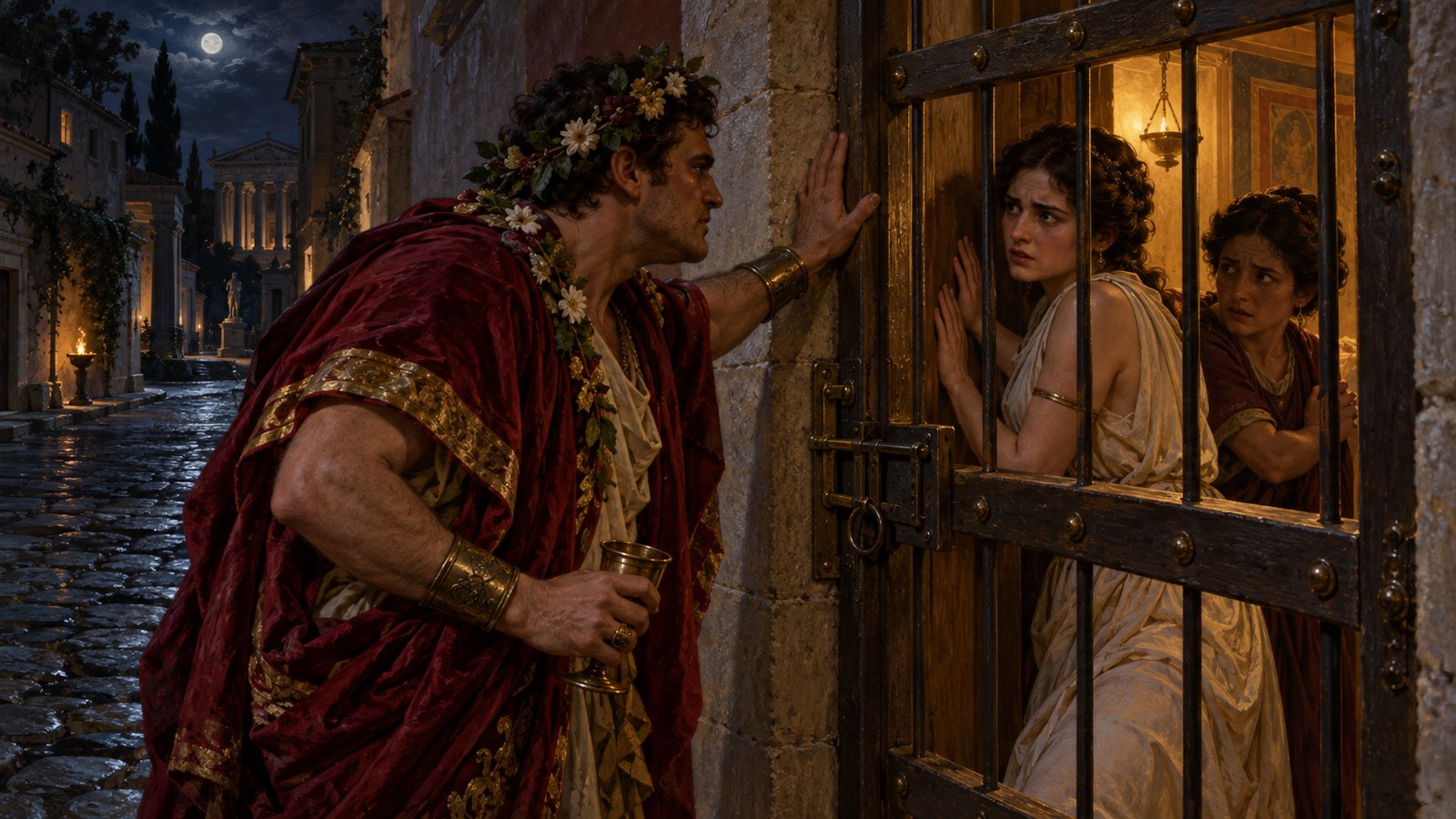
She said the aedile had come to her house in the garb of a reveller. A note in the ancient text explains the garland as the sign of someone coming from a drinking party. The detail placed his visit outside a neutral inspection and inside a night of private appetite and impaired decorum.
Manilia added that admitting him would not have been to her advantage. The phrase is restrained. It does not require the reader to invent dialogue, motive or a prior relationship. It records her practical decision that he should remain outside.
According to her account, refusal did not end the encounter. Mancinus tried to break in by force. Only then was he driven off with stones.
The sequence matters more than the projectile. Arrival came first, then refusal, attempted entry and resistance. A stone described without those stages looked like an attack from above. Restored to the doorway, it became part of repelling an intrusion.
Gellius does not preserve witnesses, cross-examination or competing testimony about each movement. We should not decorate the scene with shouted words that the source never records. What survives is the structure of Manilia’s answer, and that structure was enough for the tribunes to act.
A Garland Made Office Part of the Evidence
The tribunes did not say that Mancinus lacked a wound. Their decision focused on whether a curule aedile ought to have been where he was, in the condition in which he arrived.
They judged that he had rightly been refused admission to a place it was not seemly for him to visit with a garland on his head. The garland was therefore not decorative background. It carried information about revelry, timing and the mismatch between public rank and private behaviour.
An aedile could have official reasons to oversee taverns and brothels. Gellius’s note distinguishes that possibility from this visit. Mancinus did not appear in the surviving story as a magistrate conducting an inspection; he appeared as a garlanded reveller trying to enter after being turned away.
Rank intensified the problem instead of erasing it. A powerful office gave Mancinus a public platform for accusation, but it also supplied a standard against which his conduct could be judged.
The logic was narrow. The tribunes did not formulate a universal doctrine about every nighttime quarrel or every person in sex work. They decided what this aedile, at this door, wearing this sign of revelry, could properly convert into a prosecution before the people.
That restraint keeps the episode useful. It shows authority being tested through facts close enough to touch: wound, doorway, garland and stone.
The Tribunes Changed the Direction of Power
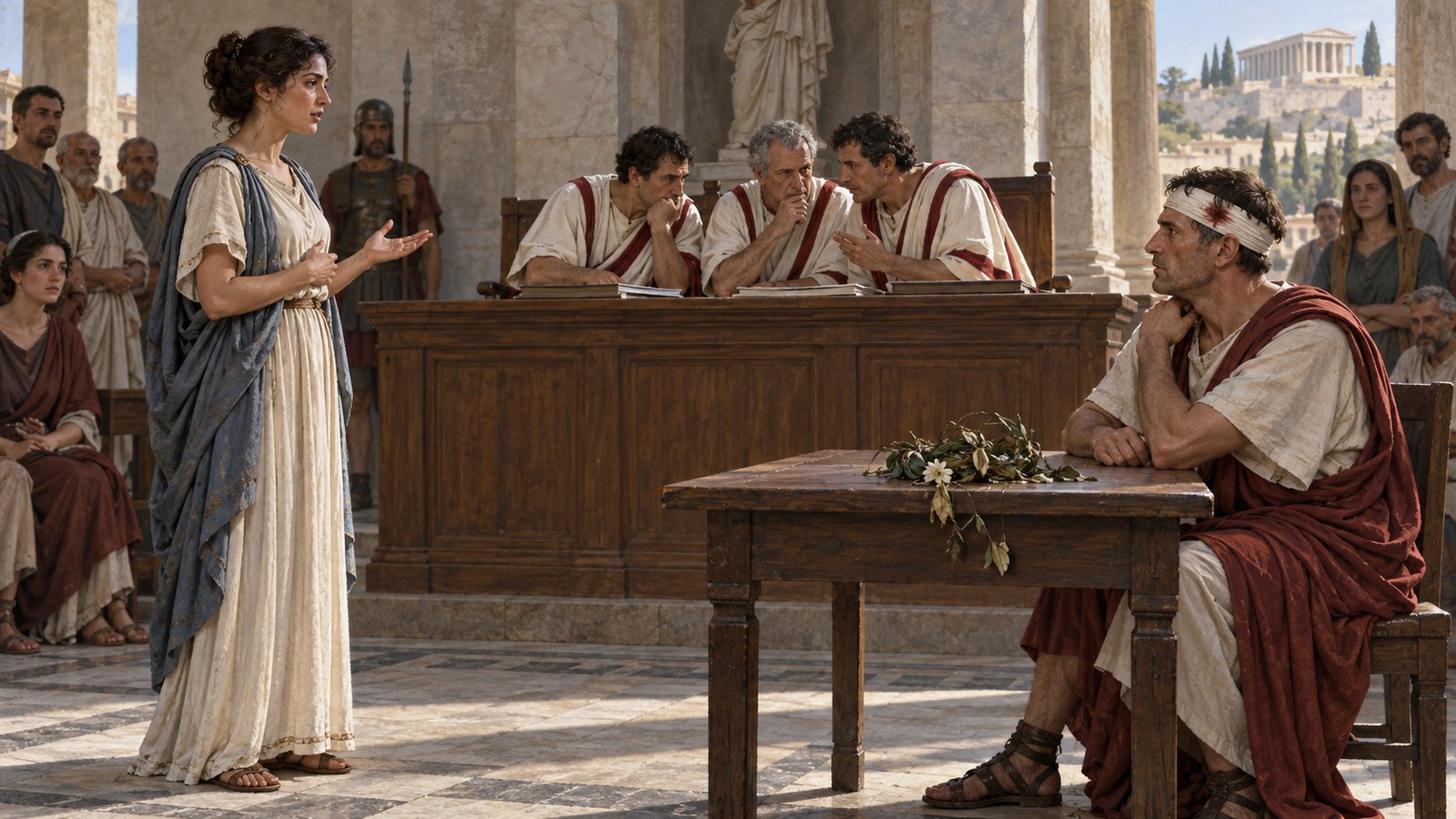
Manilia’s appeal activated an office designed to intervene. The tribunes decided that the refusal at the door had been justified and forbade Mancinus to bring his action before the people.
The result was procedural and decisive. They did not merely criticize his manners while letting the prosecution continue. They stopped him from using a popular proceeding to punish the resistance he met during his own improper visit.
Their power had specific forms. Another surviving legal discussion explains that a tribune could arrest someone even though he lacked the same power to summon. Manilia’s case gives a different view of tribunician intervention: not an abstract list of powers, but a blocked action and a magistrate told that his office could not carry it forward.
The intended audience for Mancinus’s accusation also matters. He was not seeking only a private apology at the doorway. Gellius says he meant to proceed before the people. A nighttime quarrel was being carried toward a civic judgment, where the authority of his office and the sight of his wound could shape the first impression. The appeal interrupted that movement before the public case could reduce Manilia to the person who had thrown the stone.
In that sense, the tribunes ruled on the frame as well as the complaint. They restored the unwanted visit and attempted entry to the same narrative as the injury. Neither office nor spectacle could make the earlier actions irrelevant.
This should not be romanticized into proof that status vanished in Roman law. Gellius identifies Manilia by profession, while Mancinus arrives with name and magistracy. The imbalance remains visible in the way the anecdote is framed.
What the decree demonstrates is more concrete. Her low status did not prevent her appeal from succeeding. His office did not prevent the tribunes from examining the conduct behind his injury.
Power changed direction because context became admissible to judgment. The man who began as prosecutor ended as the official forbidden to prosecute.
Gellius Preserved a Judgment About Context
Gellius wrote centuries after the event he reports, and his immediate source was Capito’s antiquarian collection. The date of Mancinus’s case is uncertain. That distance requires caution about treating the short narrative like a complete court record.
Even so, Gellius tells us why he copied it. The decision struck him as dignified. Its force came from refusing the easiest reading of visible harm.
Mancinus’s wound was real evidence, but incomplete evidence. Manilia’s account did not make the stone disappear. It explained the pressure that preceded it and asked why the complainant had approached her apartment as he did.
The tribunes then attached public meaning to private appearance. A feast garland testified without speaking. It showed that the aedile’s visit could not be separated from revelry, and that a magistrate asking the people to punish someone might first have to answer for his own use of rank.
No sweeping moral needs to be invented. The surviving ruling is striking precisely because it stays close to the incident. A woman refused entry. A man tried to force it. A stone stopped him. The official who displayed the wound could not strip away those earlier steps.
At Manilia’s doorway, Roman procedure turned on sequence. The final blow mattered, but the judgment began one action earlier.
Sources
Aulus Gellius, Attic Nights, book four, chapter fourteen. Gellius cites Ateius Capito, On Public Decisions, book nine.