
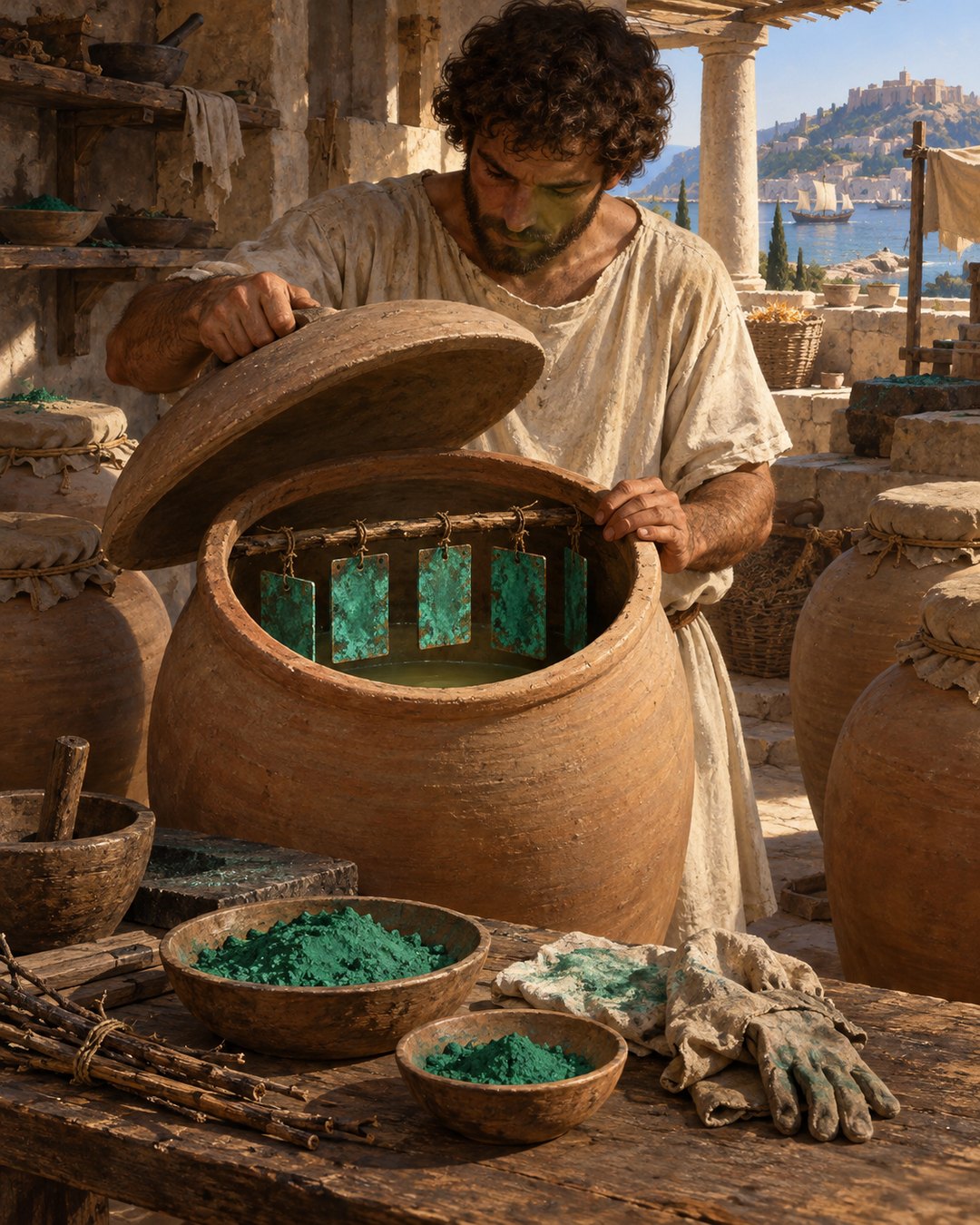
The copper did not need to be dipped into a green dye.
It rested on twigs above vinegar inside a covered vessel. When the lid came off after an interval, the surface itself supplied the colour.
Vitruvius preserved a workshop in which waiting air became a tool.
A Twig Rack Separated Metal from Liquid
Book seven of Vitruvius’s architectural treatise ends with materials that gave finished buildings colour. His account of white lead and verdigris begins not at a painted wall but inside a large vessel.
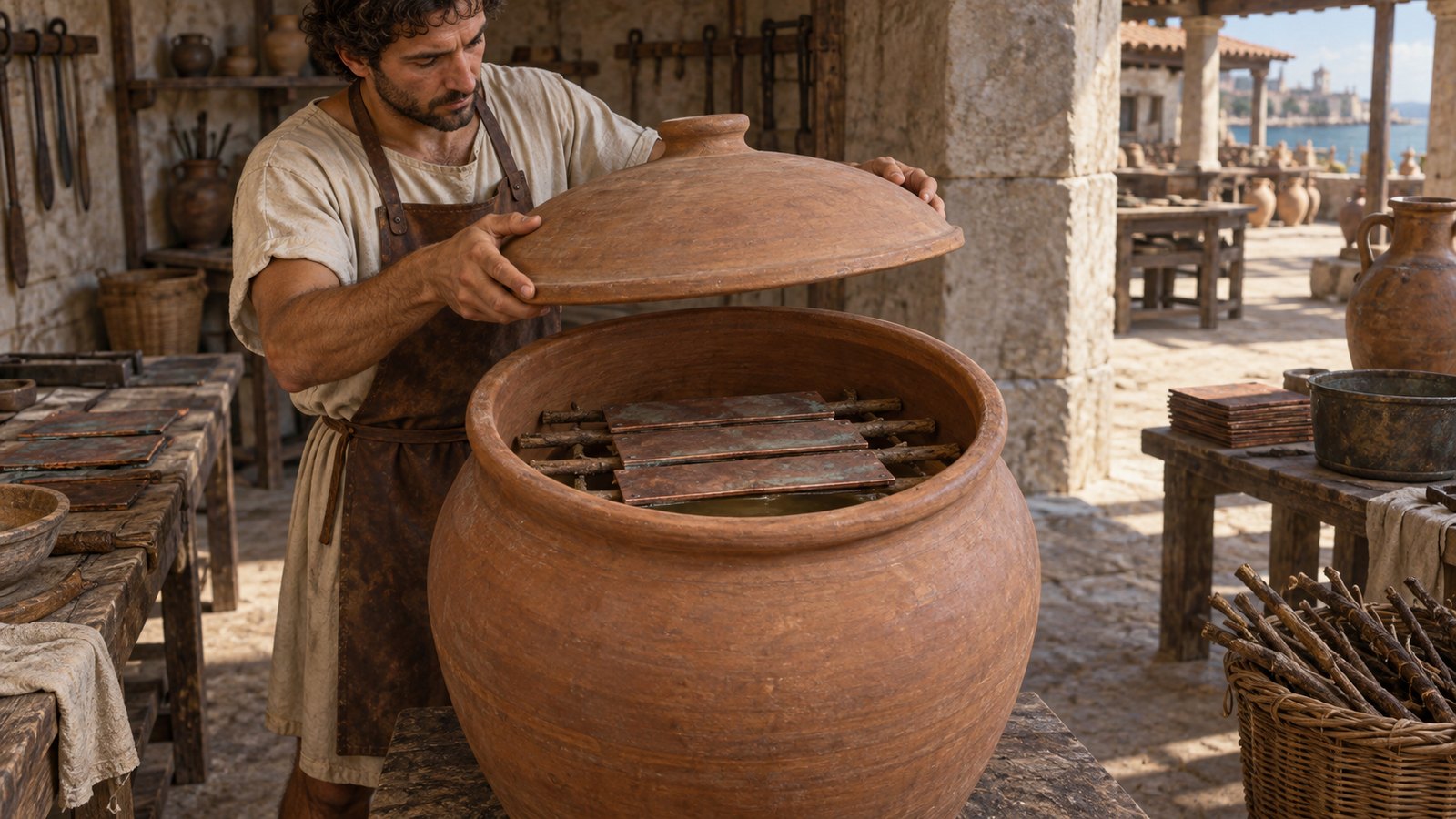
He attributes the procedure to Rhodian makers. They placed a layer of twigs in the lower part of the container and poured vinegar beneath it. Masses of lead then rested on the twigs.
The arrangement is easy to miss if the ingredients are listed without their positions. Vinegar occupied the bottom. The metal sat above it. Twigs created the gap between them.
That gap was not wasted space. It allowed the vinegar’s vapour to surround exposed metal without requiring the whole mass to lie submerged. A broad surface could react while remaining supported and recoverable.
The twig rack also kept the workshop from becoming a simple soaking operation. Liquid, support and metal performed different tasks. If the rack sagged or the vessel tipped, the intended relationship changed.
Large vessels made room for useful pieces of metal and enough vinegar to sustain the enclosed atmosphere. Their mouths still had to accept a cover. Scale and seal belonged to the same design.
Roman makers repeatedly turned humble supports into process controls. A loom held threads in ordered tension before cloth existed. The upright loom’s weights and frame separated strands so crossing them could create fabric. Here a disposable lattice separated ingredients so vapour could create pigment.
Vitruvius does not provide measurements for twig thickness, vinegar depth or vessel capacity. Reconstructing an exact recipe would exceed the passage. What he does preserve is the geometry clearly enough to identify the principle.
A worker preparing the pot was building a tiny environment. The result depended not only on what entered but on where each component remained while time passed.
The Lid Made Evaporation Useful
Once loaded, the vessels were covered. Vitruvius states the reason: to prevent evaporation.
An open pot would lose vinegar vapour to the room. A covered one retained it around the lead. The lid turned a tendency that normally meant loss into the active condition of manufacture.
Covering also made the process less visible. Workers could inspect the ingredients while loading, then had to trust time and their accumulated experience until reopening. Colour developed out of sight.
The source says only “after a certain time.” That omission reminds us that written instructions often assumed workshop knowledge. Temperature, vessel seal, metal surface and vinegar strength could affect when a batch was ready, even if Vitruvius did not list them.
The craft therefore required judgment at two moments. Sealing too poorly allowed the atmosphere to escape. Opening too early interrupted the transformation. Waiting too long might waste capacity even if it did not ruin the batch.
When the vessels were opened, the lead masses were found changed into white lead. The wording makes the surface transformation the reveal: ordinary-looking inputs entered, a new usable material emerged.
This was controlled corrosion rather than the avoidance of corrosion. A change that could damage a finished metal object became valuable when produced deliberately, in the right vessel, on material intended for processing.
Another colour workshop used fire instead of trapped vapour. Egyptian blue joined sand, copper-bearing material and heat into a manufactured pigment. The Rhodian vessel reached its intermediate product without a furnace, by enclosing a reactive atmosphere.
The lid was thus a piece of equipment even though it had no moving part. It conserved the volatile ingredient, defined the treatment chamber and gave time a stable place to operate.
Copper Followed the Same Vessel Logic
Vitruvius then compresses the verdigris method into a comparison. In the same way, he says, makers used plates of copper to produce the green material called aeruca.
The comparison carries the preceding apparatus with it: large vessel, vinegar, raised support, cover and interval. The metal changed, and so did the colour of the product, but the workshop logic remained recognizable.
Plates suited exposure. Their broad faces offered more accessible surface than one compact lump of equal weight. They could be laid across supports, removed, inspected and worked over after the vessel was opened.
Vitruvius does not tell us how the green layer was scraped, ground, washed or bound for painting. Those later operations should not be invented from silence. His focus is the stage that made the coloured substance appear on copper.
The passage is valuable precisely because it links white and green production. It shows a family of practices rather than an isolated trick. Workshop knowledge could move from one metal to another while retaining the same container design.
That transfer demanded observation. Lead did not become green merely because copper did, and copper did not become white merely because lead did. The apparatus created conditions; the material determined the result.
Colour was therefore not simply “found” in a bright stone and crushed. It could be induced on a dull metal by arranging contact at a distance. Vinegar remained below, yet its presence registered on every treated plate above.
The method also divided production into batches. Each sealed vessel enclosed a finite load. Makers could prepare several at different times, open one for inspection and keep others working.
Plain pots, rough twigs and familiar vinegar formed the infrastructure behind a striking surface. The value did not lie in costly machinery. It lay in repeatable arrangement.
Fire Added a Second Colour Change
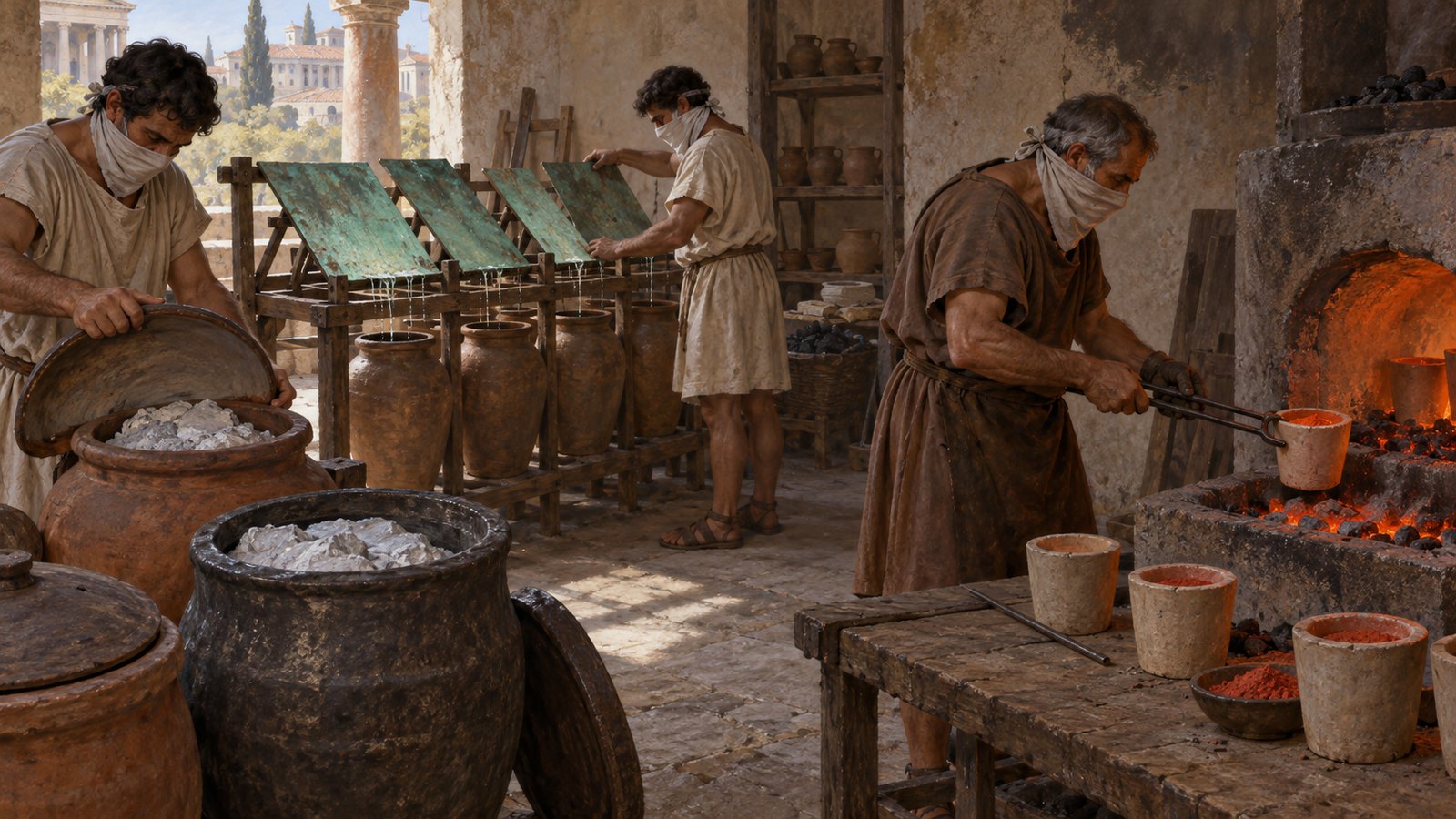
The lead process did not necessarily end with white. Vitruvius says the white product could be roasted in a furnace and changed by fire into red lead.
This second stage used a different agent. The covered vessel conserved vapour and encouraged a slow surface reaction. The furnace applied concentrated heat to material already transformed.
Sequence mattered. The source does not say that raw lead went directly into the furnace to produce the same result. White lead came first; roasting followed.
Vitruvius connects the discovery to observation after an accidental fire. An unwanted event exposed another useful transformation. Workshop practice then made that accident repeatable under deliberate conditions.
He even judges the manufactured red material better than the red material obtained from mines. Whether every buyer agreed cannot be recovered from this statement, but the comparison shows an artificial product competing with a natural source on quality, not merely price.
That claim complicates any simple division between “natural” ancient colours and modern manufactured ones. Roman builders and painters worked with substances created through vessels, vapours and furnaces as well as minerals taken directly from the ground.
Fire had to be controlled just as the lid had been. A furnace could convert the pale material, but uncontrolled burning was the accident from which the observation began. Production required turning destructive heat into a repeatable step.
The chain also created different decisions for a workshop. White material might be retained for one use, copper corrosion harvested as green, or part of the pale batch committed to roasting for red. One arrangement opened several colour paths.
Vitruvius does not discuss the severe toxicity of lead compounds, and the passage should not be mistaken for safe modern instruction. It is evidence for ancient process, not a recipe to reproduce.
Its mechanical lesson is safer to carry forward. The makers controlled height, enclosure, time and heat. They did not merely possess ingredients; they designed conditions in which ingredients would cease to be what they had been.
The green on copper was not workshop damage. Inside the right pot, it was the product.
Sources
Vitruvius, On Architecture, book 7, chapter 12.