
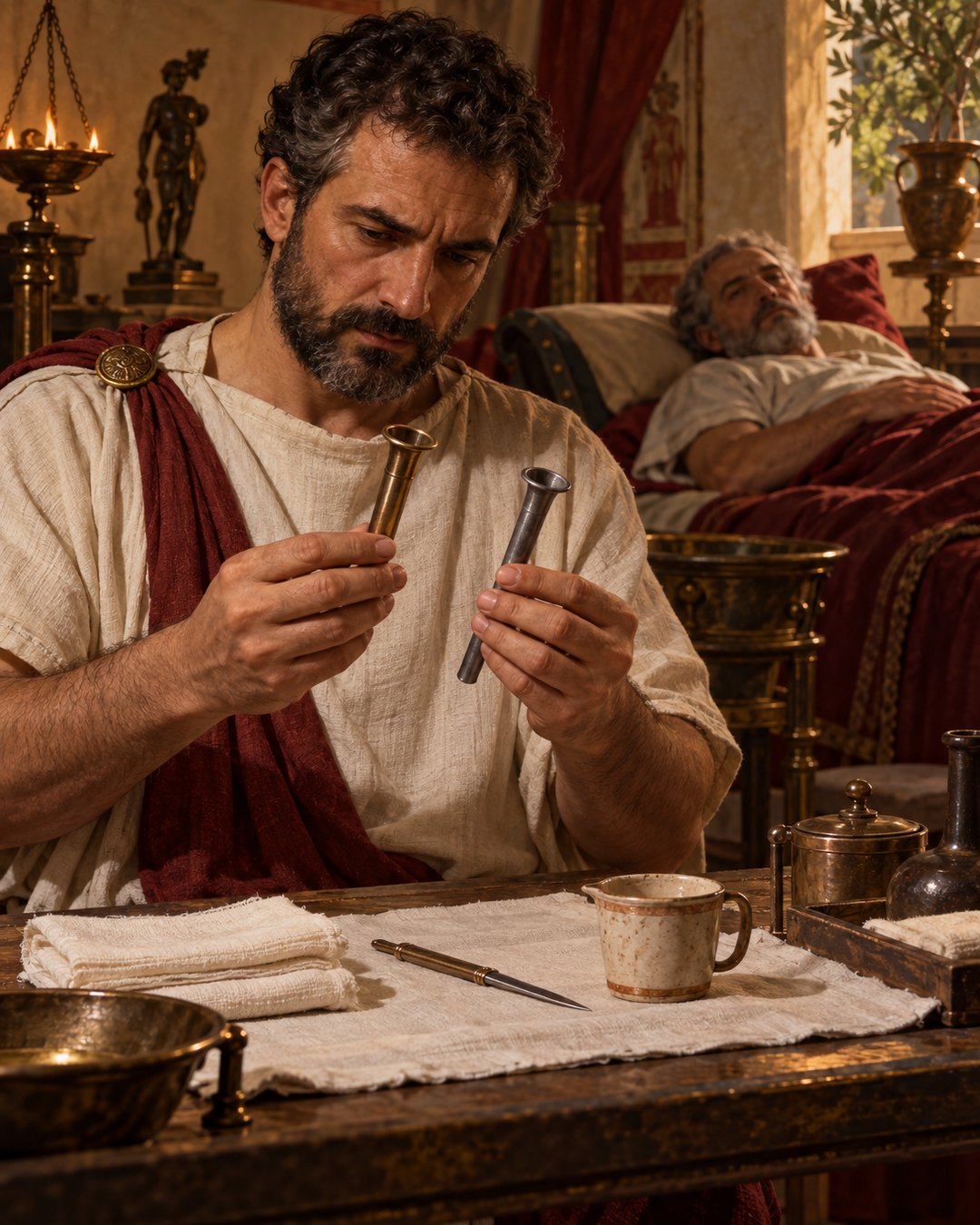
Celsus worried that the drainage tube might disappear into the body.
His answer was mechanical. Turn back the outer lips, or fit a collar around the middle, so the entire tube could not slip inward.
That tiny stop belongs to a larger pattern in his operation for dropsy: control the opening, control the instrument and control how quickly the remaining fluid leaves.
Four Finger-Breadths Fixed One Possible Entry
In De Medicina 7.15, Celsus turns from the general advice that water should be released in dropsical patients to the physical details of doing it.
He records disagreement at the first step. Some operators opened the abdomen about four finger-breadths below the navel and to the left. Others perforated the navel itself.
The alternatives show that the procedure was known but not reduced to a single uncontested route. Celsus does not hide variation behind a polished universal rule. He places it at the start.
There was another choice. Some practitioners first burned through the skin and then cut into the abdominal cavity. Their reason, as Celsus reports it, was that flesh divided by cautery healed more slowly.
In this context, slow closure could be useful. The operation was not designed merely to open and immediately seal. It created a channel through which accumulated fluid would continue to be managed.
The approach differed sharply from a wound that needed fast union. Celsus’s discussion of sutures ties closure to season, tension and the kind of tissue injured. Here the operator may deliberately preserve access.
Whatever entry was chosen, Celsus issues a direct warning: do not cut a blood vessel. The sentence is brief because the anatomy does not forgive a rhetorical detour.
He also limits the blade. Its point should measure about one third of a finger in breadth. The knife must penetrate the membrane between the flesh and the interior, but the opening begins with a narrow working width rather than a broad incision.
The Tube Carried Its Own Stop
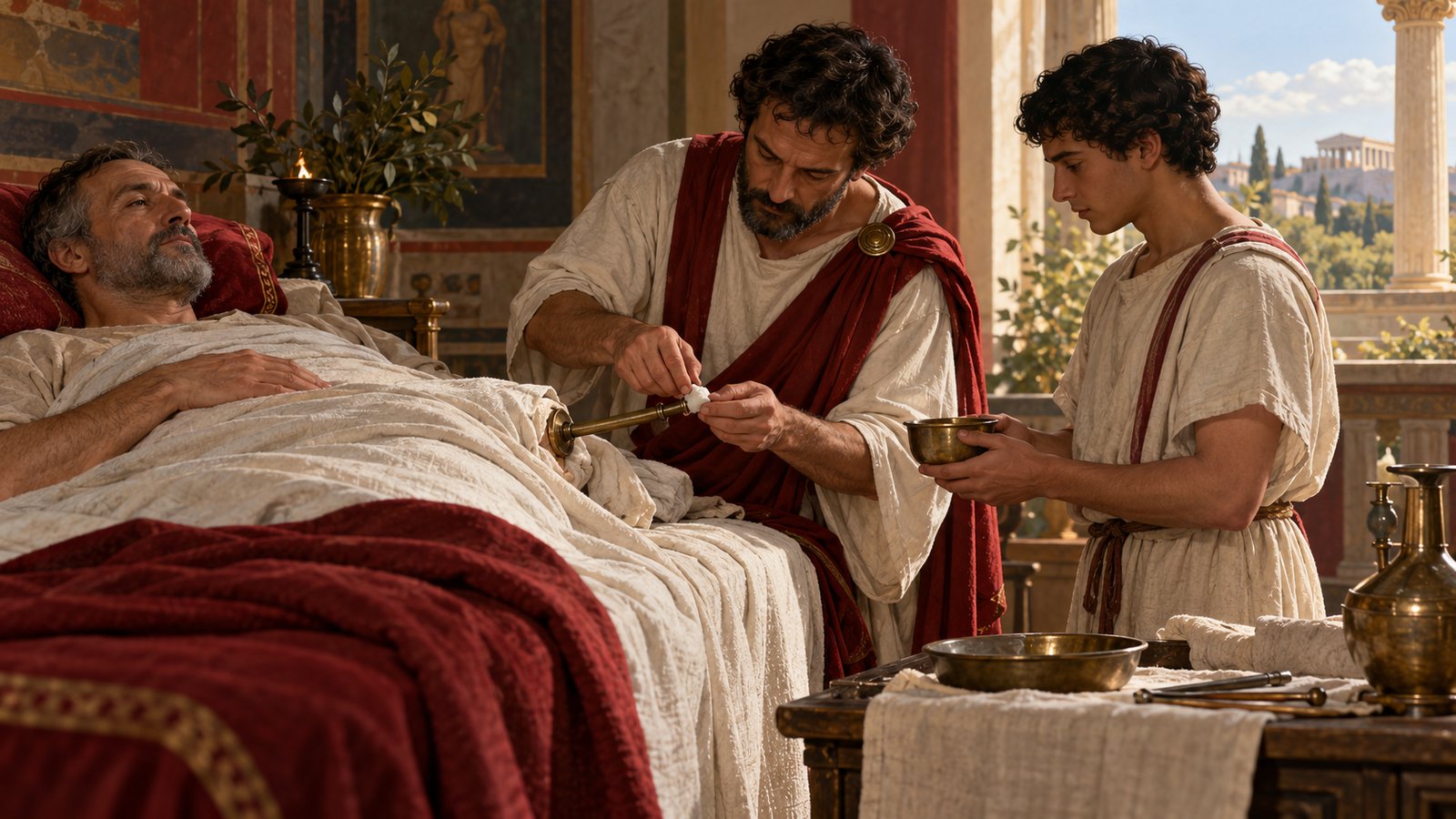
Once the opening had been made, the operator inserted a lead or bronze tube.
Celsus specifies two ways to stop it migrating. The outer end might have lips curved backward. Alternatively, a collar could run around the tube’s middle.
Both designs turn shape into safety. The tube needs to pass through the opening, but it must not be free to continue in the same direction without limit.
The instruction is easy to overlook beside the drama of cutting, yet it may be the most practical detail in the chapter. A smooth narrow cylinder is useful because fluid can pass through it. The same smoothness creates the risk of inward movement. A flare or collar preserves the channel while interrupting that motion.
Celsus adjusts length as well. The internal portion should be a little longer than the external one. It must project beyond the deeper membrane into the cavity rather than ending within the tissue of the opening.
There is a balance. Too shallow, and the device may fail to reach the fluid freely. Unchecked inward movement, and the tube itself becomes a hazard. The author manages both with proportion and a stop.
The choice of lead or bronze also tells us what the device was expected to do. It had to retain an open bore, survive insertion and remain shaped at the lip or collar. Celsus offers two metals rather than attaching the whole procedure to one precious material. His specification concerns function first.
Nothing in the chapter says the tube was disposable. Nor does Celsus provide its total length or internal diameter. Those absences matter when reconstructing it. The text securely gives relative length, placement and the anti-slip feature; a modern replica that supplies every missing dimension would be an interpretation, not a recovered blueprint.
This attention to an instrument’s geometry appears elsewhere in Roman medicine. Celsus’s cataract needle was defined by where and how it entered the eye. His tools are not generic pieces of metal. Their widths, lengths and working ends belong to particular maneuvers.
The dropsy tube is especially clear because the safety feature can be seen before the operation begins.
A Lint Plug Divided One Release into Several Days
Fluid left through the tube.
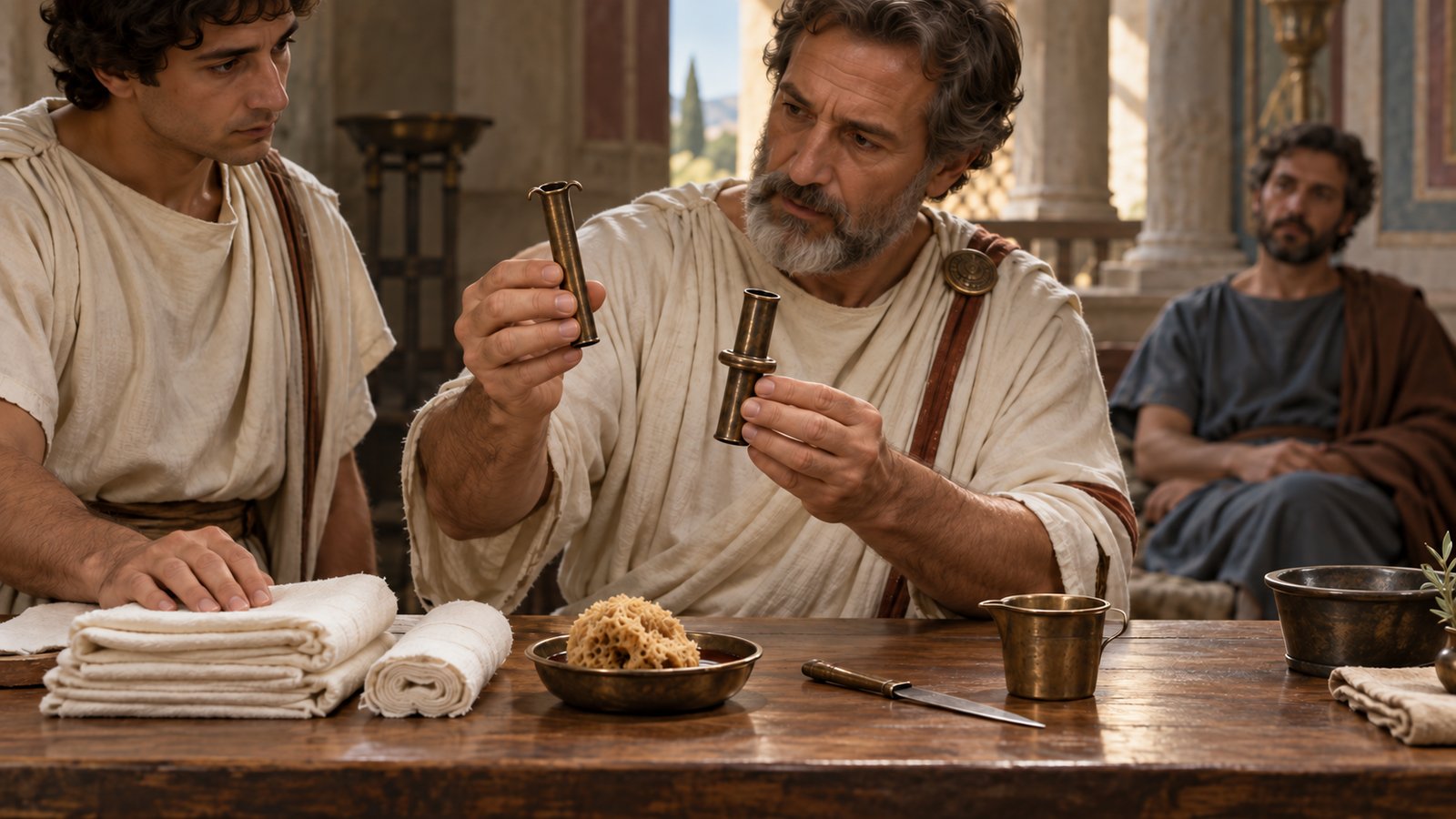
Celsus then separates the first release from what followed. After the greater part had escaped, the tube was to be closed with a plug of lint.
The plug converts an open channel into a controllable one. Removing the accumulated water was the aim, but unbroken flow was not treated as automatically better.
If the opening had not been made with cautery, one method left the plugged tube in the wound. On each following day, about one hemina was released. The process continued until no trace of fluid appeared.
A hemina was a modest ancient liquid measure, roughly half of a sextarius. The exact modern conversion can vary with the standard used; Celsus’s important point is procedural rather than metrological. After the large initial discharge, later removal was portioned.
The daily unit created a schedule that attendants could repeat. Open, release a limited quantity, close again, observe and return.
The schedule also makes the patient’s course part of the technique. The operation is not finished when the knife leaves the hand. Tube, plug, measured vessel and repeated visit extend it across days. That temporal design distinguishes controlled drainage from simply making a hole and waiting for the result.
Celsus does not state in this chapter every physiological fear behind staged drainage. We should not invent one for him. What the text securely shows is a refusal to treat “more” and “faster” as self-evidently safer after the first outflow.
The lint has two roles in the description. It closes the tube, and by doing so preserves the possibility of reopening it without creating a fresh route each time.
Metal maintains the channel. Fibre interrupts it. A liquid measure governs the interval between them.
An Alternative Reopened the Recent Wound
Celsus also records another practice.
Some operators removed the tube immediately even when they had not cauterized the skin. They bandaged a squeezed-out sponge over the wound.
On the next day they inserted a tube again. The recent wound would admit it if stretched slightly, allowing the remaining fluid to escape.
These practitioners were satisfied after doing this twice.
The alternative changes the way access is preserved. The first method leaves hardware in place and closes it with lint. The second removes the hardware, covers the site and relies on the new wound remaining passable for a return.
Celsus does not erase one method in favour of the other. He records differences in entry point, use of cautery and retention of the tube. The chapter reads less like a timeless recipe than a compact report on operative choices.
Across those choices, the same practical questions recur. Where should the opening be? How wide should the blade be? How can the channel reach beyond the membrane? What prevents the tube from slipping? How is flow stopped? When is access used again?
The collared tube answers only one of them, but it captures the chapter’s character. Roman surgery here is not simply courage with a knife. It is anticipation of what a tool might do after the hand lets go.
Celsus’s final image is not a triumphant cure. It is a practitioner returning on the next day, measuring what remains and deciding whether the controlled passage still has work to do.
Sources
Celsus, De Medicina, 7.15.