
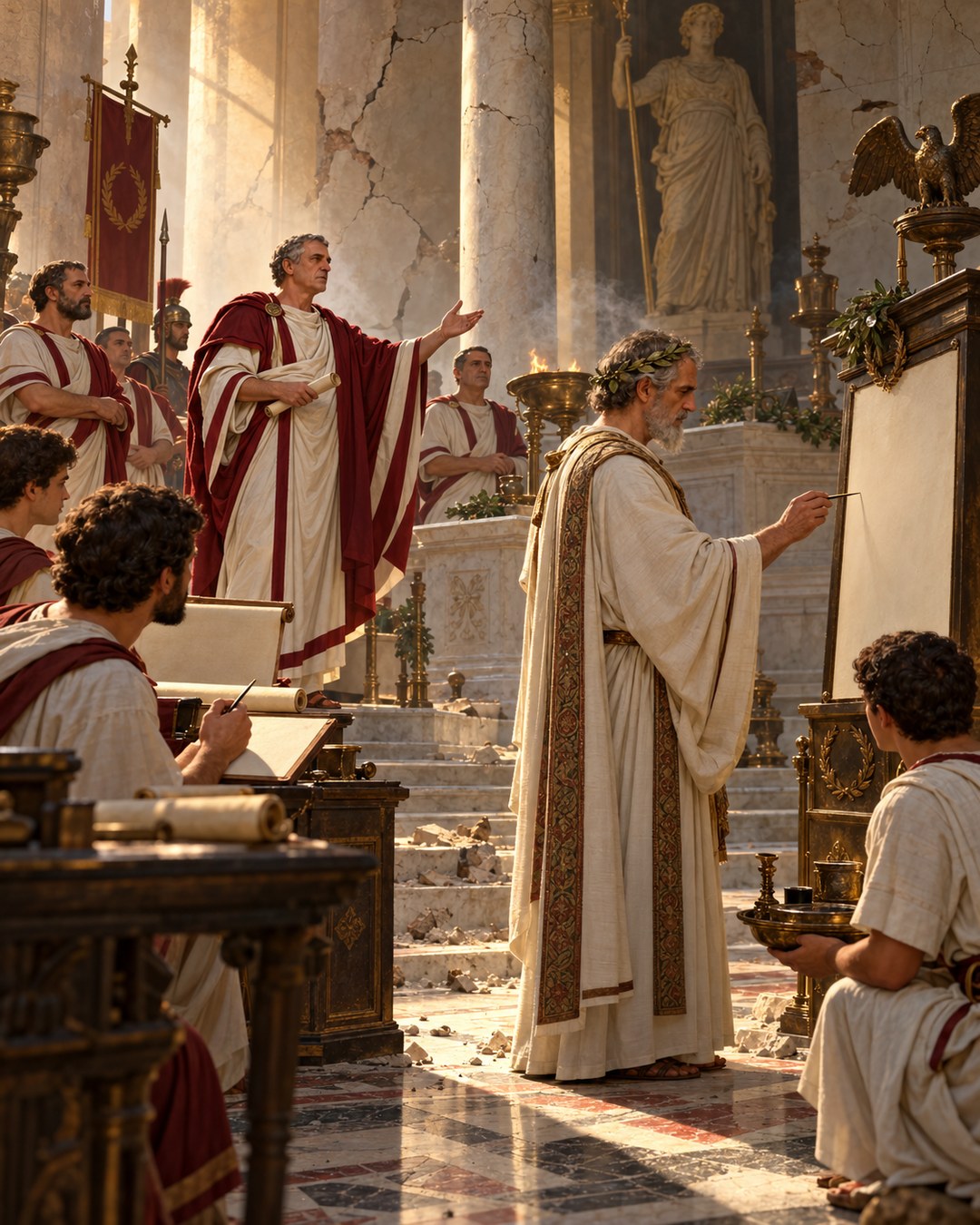
When Romans felt an earthquake, they could declare a holy day without naming the god who should receive it.
The omission was deliberate. Winds in underground caverns, moving subterranean water, Neptune the Earth-Shaker or some other force might be responsible. Naming one divine power too soon risked turning reverence into false observance.
Aulus Gellius presents the blank as a safeguard. Ritual action began immediately; causal certainty did not have to be invented.
Competing Causes Made Confidence Dangerous
Gellius opens with disagreement. Ordinary understanding could not see what caused the earth to move, and natural philosophers had not reached a common explanation.
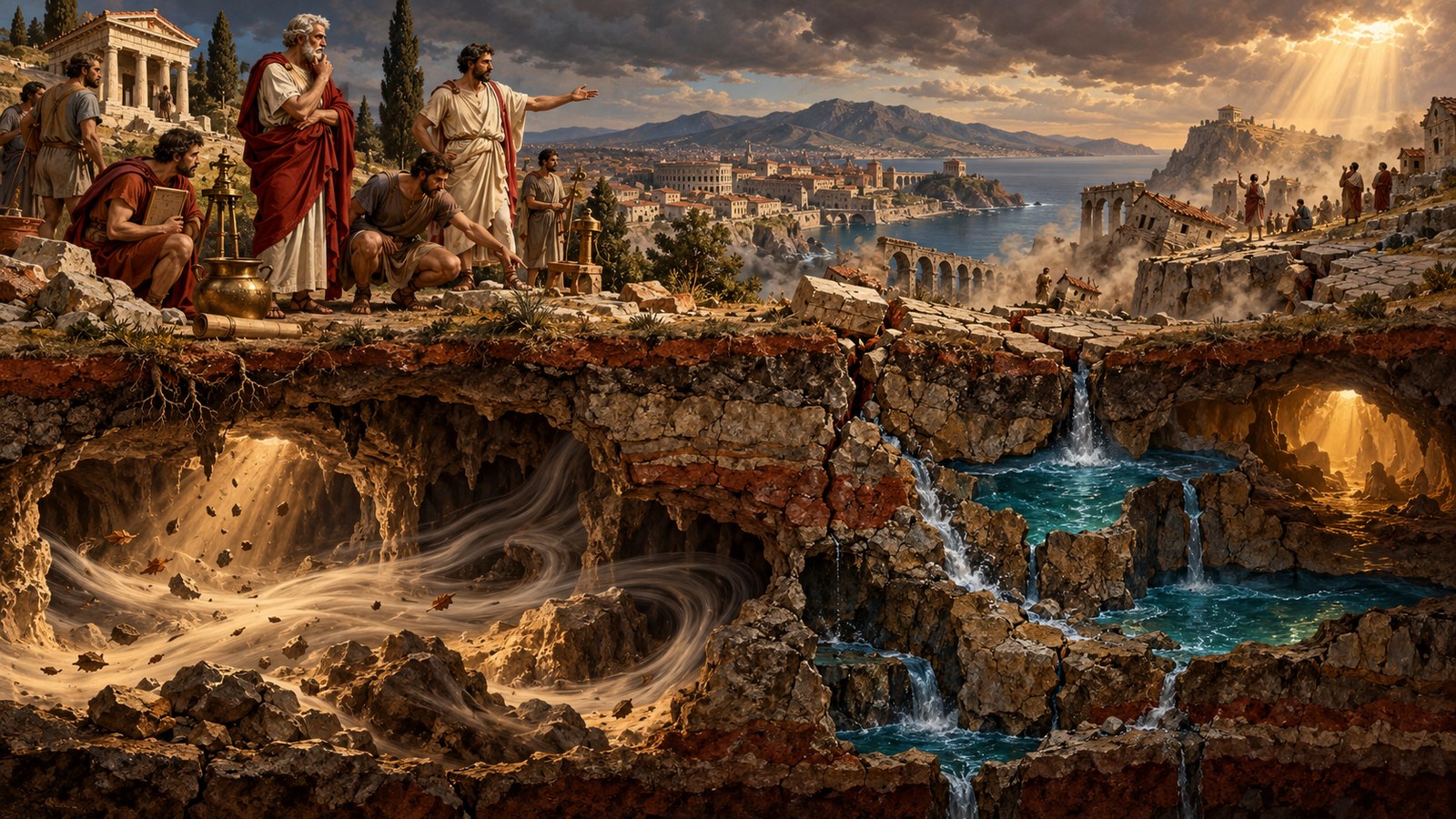
One proposal placed powerful winds in hollows and caverns beneath the ground. Pressure and movement within enclosed spaces could shake the surface above.
Another proposal gave the work to subterranean waters, whose ebb and flow acted within the earth’s cavities. Gellius associates that family of thought with early Greeks who called Neptune “Earth-Shaker.”
He leaves room for something else: another natural cause or the divine power of a different god. The chapter’s secure conclusion is uncertainty, not a disguised endorsement of one model.
That uncertainty resembles Pliny’s treatment of the spring that rose and fell three times a day. Pliny preserved several mechanisms around one observed cycle. Gellius shows ritual administration facing an even more urgent event without collapsing several possibilities into one fact.
An earthquake differs from a quiet spring because response cannot wait for repeated meals beside a waterline. Buildings, people and civic schedules are affected at once. The problem is how to act quickly without pretending to know more than inquiry permits.
The Holy Day Was Certain before Its Addressee Was
Romans of old, Gellius says, were scrupulous in religious duties as well as in other obligations. When they felt an earthquake or received a report of one, they decreed a holy day.
The report clause extends the practice beyond direct sensation. Authorities could respond to an event known through testimony, not only one that shook the room where they sat.
Ordinarily, a decree would specify the deity in whose honour a holy day was observed. In the earthquake case, officials withheld the name.
This did not make the observance secular or empty. It acknowledged that the obligation was real while the proper divine identity remained unresolved.
The procedure divides knowledge into two levels. Something happened that required ritual attention. Who or what caused it was uncertain. The state could be confident about the first statement and cautious about the second.
That separation is the opposite of careless superstition. A careless response would seize the first familiar god-name and proceed as if convention guaranteed accuracy.
The concern recalls bronze noise protecting Roman prayer from disruptive omens. In both cases, ritual design anticipates failure. One manages unwanted signs during an observance; the other prevents the observance from beginning under a falsely certain address.
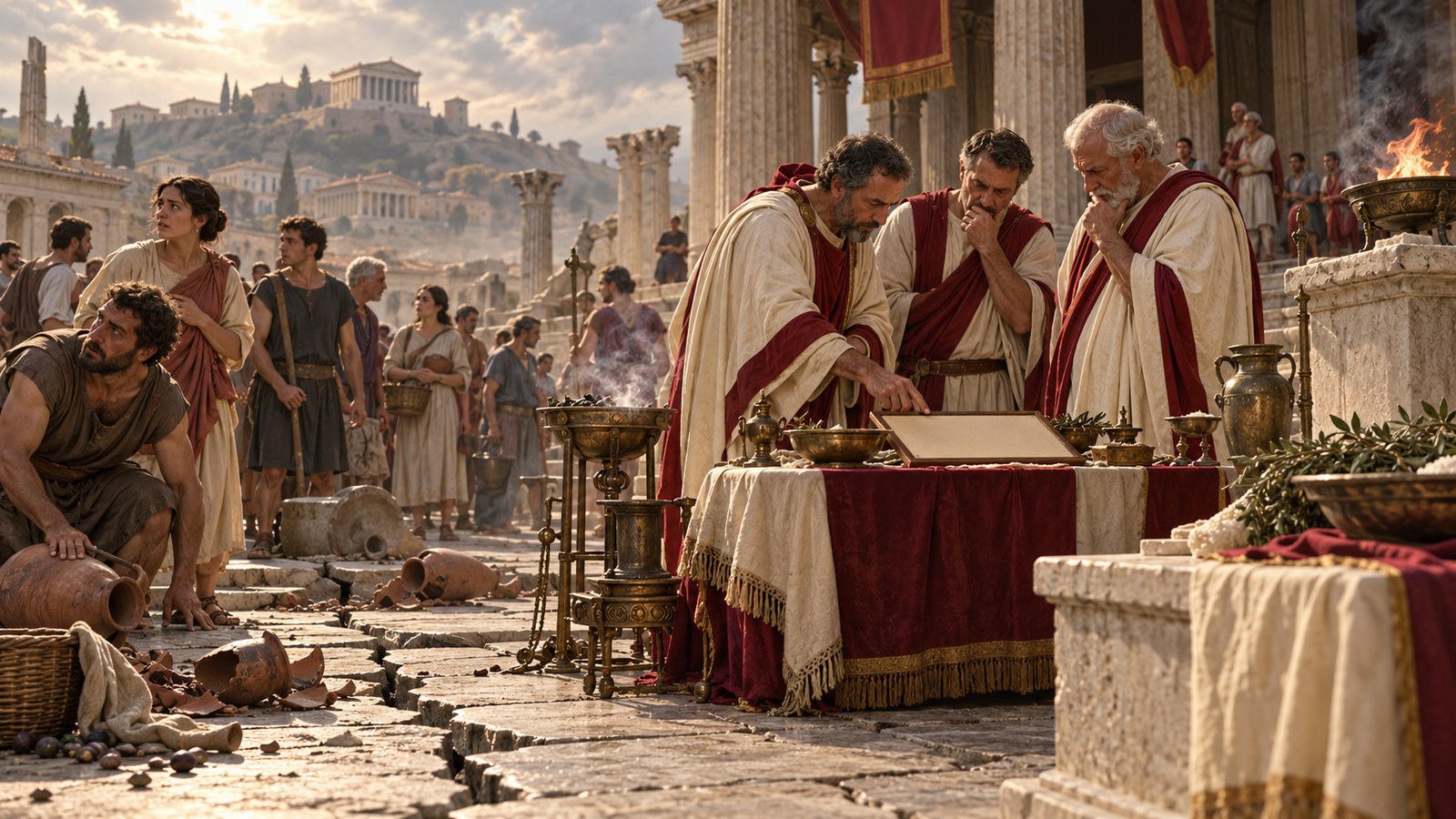
“Either God or Goddess” Worked as a Fail-Safe
A further problem appeared if someone desecrated the earthquake festival. Expiation would be required, and expiation normally needs a recipient.
The Roman answer was a formula: offer a victim “to either the god or goddess.”
Varro, as reported by Gellius, said the usage had been established by decree of the pontiffs. The reason remained the same. Romans did not know which force or which divine person had caused the earthquake.
The phrase is broad but not casual. It covers a binary of divine identity without assigning the event to a known name, sex or cult.
Modern readers may hear vagueness where Roman priests heard protection. The formula narrows the claim to what the ritual actually knows: a divine addressee may exist, but identification is unsafe.
It also prevents a second error from compounding the first. Desecration creates a need to repair observance. If repair required officials to guess the deity, the remedy could generate another false act. The pontifical wording keeps the correction inside the same cautious boundary as the original holy day.
Gellius does not describe the victim, altar or duration. We should not fill the ritual with imagined particulars. The precise surviving mechanism is linguistic: omit the name in the decree and retain an inclusive formula for expiation.
Eclipses Marked a Different Route toward Explanation
Gellius closes by comparing eclipses of sun and moon.
Romans were no less concerned to discover their causes. He quotes Marcus Cato, who had an interest in investigation but treated some inherited eclipse material indecisively.
The contrast prevents a false choice between religion and inquiry. Earthquakes could receive a holy day while philosophers debated physical causes. Eclipses could attract causal investigation while older records and interpretations remained contested.
Ancient explanation was not one straight line from divine story to natural science. Different phenomena accumulated different practices, authorities and degrees of predictability.
The earthquake rule is especially sophisticated because it does not require agreement before action. It creates a protocol for uncertainty.
That protocol has three steps. Recognize the event. Observe the holy day. Refuse to attach a divine name that the evidence cannot support. If a violation later requires expiation, use the pontifical formula rather than manufacture certainty.
The blank in the decree is therefore filled with discipline. Officials know exactly which claim they will not make.
Rome’s old priests could be exact by omission. The ground had moved; duty followed; the cause remained open.
The chapter also distinguishes a cause from an agent. Wind or water might describe a physical mechanism, while a divine name would identify the power honoured by ritual. Ancient thinkers could consider both levels without treating them as mutually exclusive in the modern sense.
That is why uncertainty about nature did not automatically suspend religion. The holy day answered civic and sacred obligation; philosophical argument continued around the event. Procedure held the community while explanation remained unsettled.
The “either god or goddess” formula does not tell us that Romans believed only one hidden deity was possible. It tells us how the reported expiation avoided a false proper name. The wording is evidence for ritual caution, not a complete map of theology.
Receiving a report also raises the problem of distance. A tremor elsewhere could enter Roman action through testimony. Officials did not need to feel the floor move themselves, but they did need to classify the report as the kind of event that triggered observance.
Gellius provides no standard for verifying such news. That silence should remain visible. The reliable claim is simply that felt earthquakes and reported earthquakes belonged to the rule he describes.
Finally, the comparison with eclipses prevents the chapter from becoming a portrait of passive fear. Gellius knew Romans asked causal questions about dramatic celestial events. His earthquake ritual is not a substitute for investigation. It is what a careful institution can do before investigation reaches agreement.
The procedure’s strength lies in refusing two opposite failures: inaction because knowledge is incomplete, and false precision because action feels urgent. A holy day without a named deity occupies the narrow space between them.
Gellius’s language of scruple is important here. The Romans he describes feared not only neglecting worship but performing it wrongly. More ritual was not automatically safer if the additional detail contained a false identification. Restraint could therefore be an act of reverence. By omitting the name, the decree preserved the truth of the community’s position: it had experienced or accepted news of a quake, recognized an obligation, and did not know whose proper name belonged in the formula. Precision lay in making each of those boundaries audible.
Sources
Aulus Gellius, Attic Nights, 2.28, reporting Roman practice and Varro’s account of a pontifical decree.