
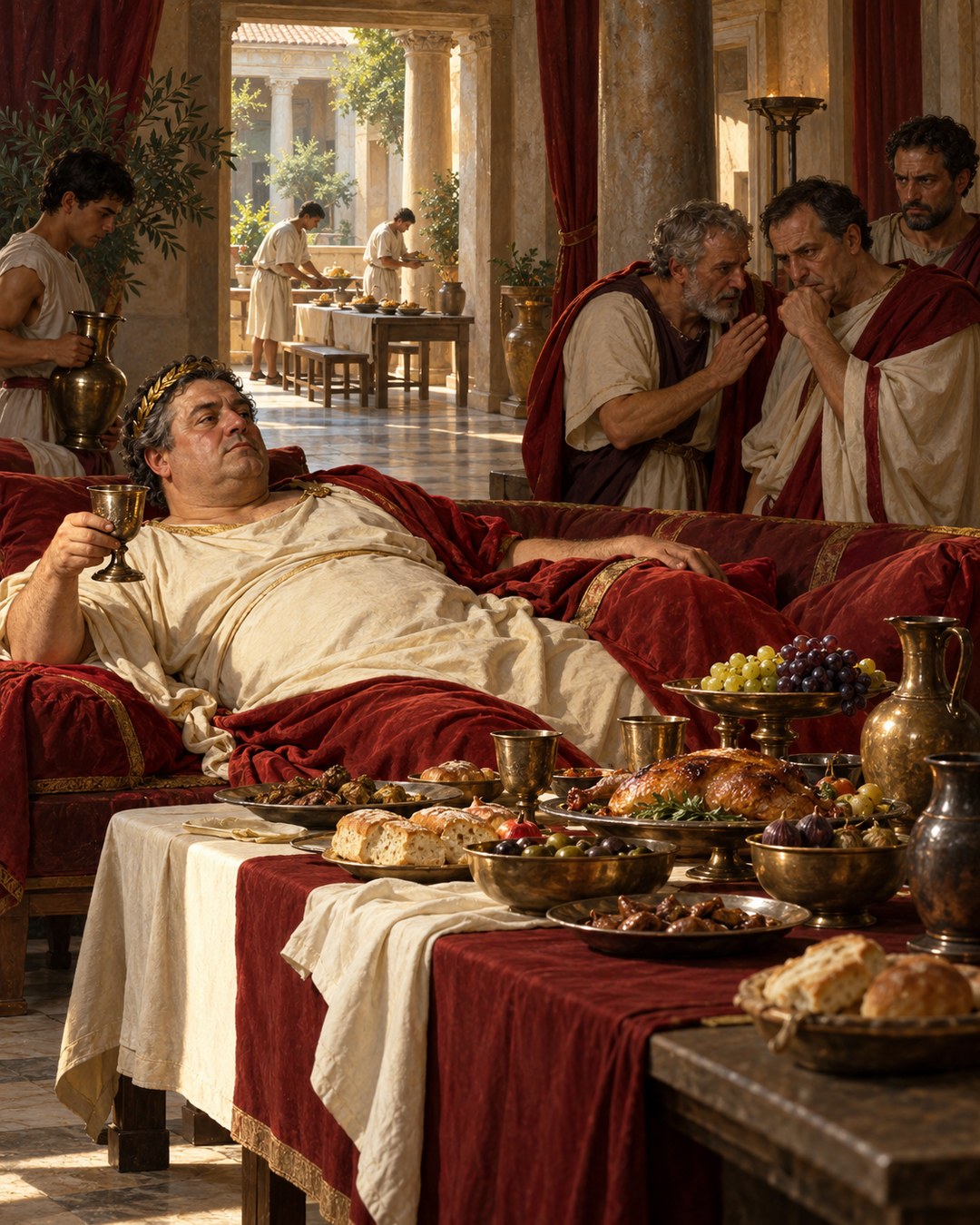
Suetonius did not make Emperor Vitellius’s appetite look like one spectacular lapse. He made it a schedule. Breakfast, luncheon, dinner and a drinking bout could become four separate feasts, each hosted by a different man on the same day.
That arrangement matters more than the menu. An emperor moving from table to table did not simply consume food. He distributed a costly obligation among Romans who had every reason to compete for his presence. The giant platter called the Shield of Minerva became the story’s monument, but the daily circuit was its machinery.
The accusation began with a timetable
Suetonius introduced the episode by naming luxury and cruelty as Vitellius’s ruling vices. The moral verdict comes before the evidence. Readers are told how to classify the emperor, then given meals large enough to fit the judgment.
The biographer said Vitellius divided feasting into three occasions and sometimes four: breakfast, luncheon, dinner and a drinking bout. He attributed the ability to continue through them to emetics. Repetition turns appetite into deliberate routine rather than an isolated celebration.
Roman elite dining already carried social meaning. Guest lists placed people in relation to a host, and invitations could honour, exclude or obligate. A Roman saying that three guests began a dinner and nine made a crowd imagined a table with limits. Suetonius builds Vitellius by erasing the limit and restarting the feast several times.
The source is hostile, and its neat sequence serves character writing. It cannot be read as an audited palace diary. Yet the form of the charge is revealing: Romans could imagine gluttony not only through quantity, but through the corruption of the day’s ordinary divisions.
Different hosts carried the same appetite
Vitellius reportedly arranged to be invited to each meal by a different man. That detail moves the cost away from the emperor’s own stores. Hospitality became a relay, with one host surrendering the burden only when another table took it up.
Suetonius claims that provisions for any one meal never cost less than four hundred thousand sesterces. The precision is rhetorically useful and should be treated cautiously. Its purpose is to make each invitation financially shocking before the narrative even reaches the most famous banquet.
For the host, an imperial visit could not be an ordinary dinner. Ingredients, room, service and display had to match the guest’s rank and the rivalry of other men who might entertain him. Refusing the opportunity risked looking disloyal; accepting it invited an expense whose ceiling the emperor’s appetite seemed to remove.
The mechanism differs from a law that formally caps expenditure. Roman dinner limits shifted with ordinary days, festivals and weddings. In Suetonius’s portrait, proximity to the ruler overwhelms restraint through patronage rather than repealing a statute.
One arrival dinner counted fish by the thousand
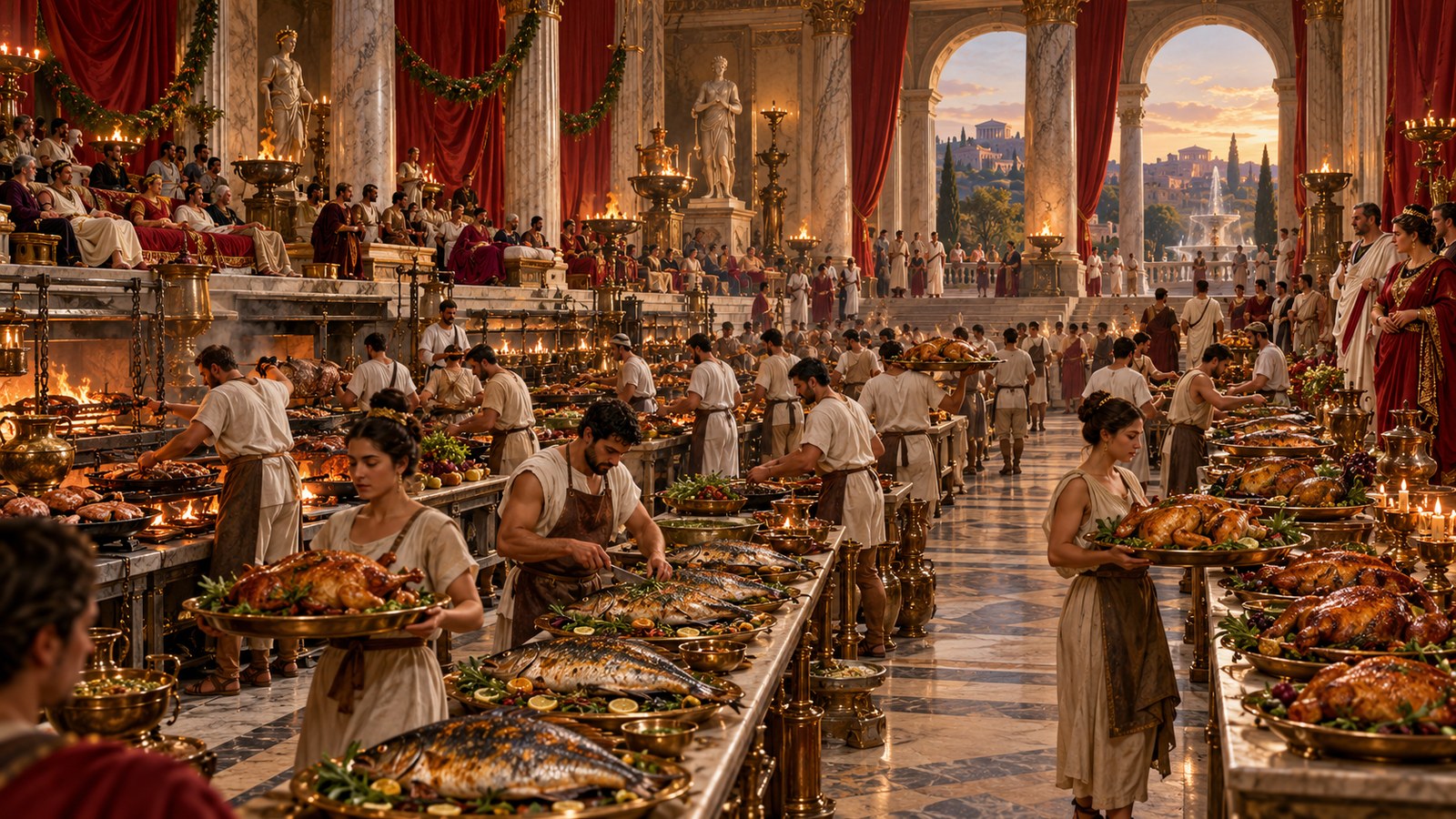
The emperor’s brother hosted the banquet that marked Vitellius’s arrival in Rome. Suetonius says it offered two thousand selected fish and seven thousand birds. The figures transform food into a counted spectacle.
Whether exact or inflated, the numbers perform a clear narrative task. A family celebration for the new ruler becomes an inventory vast enough to imply procurement far beyond one kitchen. Catching, buying, transporting, preparing and serving such abundance required labour that disappears behind the total.
The dinner also created a benchmark within the story. The brother could assemble thousands of creatures for the emperor’s entrance, but Vitellius still had to surpass him. Elite hospitality operated as competition, and an emperor was positioned to demand the last word.
Suetonius does not preserve the names of cooks, fish sellers, bird handlers or servers. His lens stays fixed on the consumer. Reading against that focus reveals the hierarchy: the larger the appetite appears, the more invisible work must stand behind it.
The Shield of Minerva turned empire into a dish
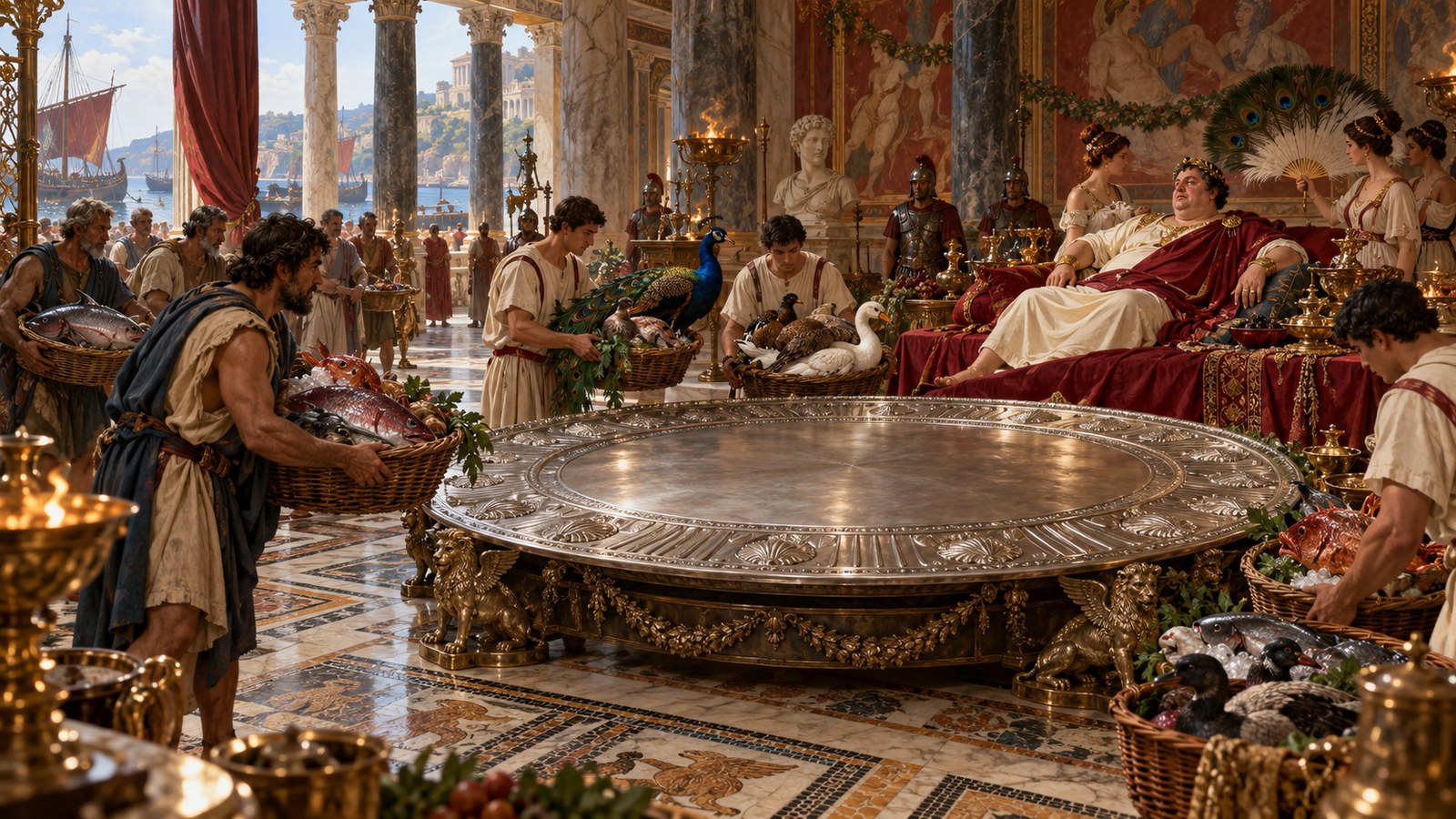
Vitellius’s answer was an enormous platter named the Shield of Minerva, Defender of the City. The title borrowed civic and divine grandeur for tableware. A shield that should protect the city became a surface for displaying rare food.
Suetonius lists the contents for maximum strangeness: pike livers, brains of pheasants and peacocks, tongues of flamingoes and the milt of lampreys. No single ingredient carries the point. The mixture does. Parts selected from many animals created a dish whose excess lay in collection as much as volume.
Captains and warships supposedly brought the ingredients from across the empire, from Parthia to the Spanish strait. The geography turns military command and imperial reach into catering. Seas, ships and officers converge not on a campaign but on the emperor’s platter.
This is exactly where source caution matters. Suetonius was writing moral biography after Vitellius’s short, defeated reign. An enormous named dish with empire-wide ingredients is almost perfectly designed to make bad rule edible. The report may preserve remembered extravagance, hostile elaboration or both.
Roadside eating completed the portrait
After the formal feasts, Suetonius removed Vitellius from the dining room. The emperor supposedly snatched meat and cakes near sacrificial fires and ate during journeys. Roadside cookshops supplied food hot from preparation or left from the previous day.
The movement is deliberate. Rare ingredients and ceremonial plate might be defended as imperial display. Grabbing food at an altar or taking partly consumed leftovers cannot. The biographer wants appetite to look uncontrolled across every setting, from a brother’s banquet to a roadside counter.
Sacrifice makes the accusation sharper because food near an altar belonged to ritual sequence and shared expectation. Vitellius’s hand collapses the distinction between offering, meal and private impulse. Again, the story is arranged to make character visible through broken boundaries.
The most historically useful reading is not to choose between believing every number and dismissing the whole chapter. Suetonius tells us how an emperor’s enemies and later readers could express failed rule. They imagined time consumed by meals, hosts consumed by costs, provinces consumed for ingredients and ritual consumed by appetite.
The Shield of Minerva survives only in words, but its political function is clear. It makes Vitellius appear to place the resources and symbols of empire beneath his dinner. The four-feast timetable makes the indictment still harsher: the platter was not one exceptional object. It was the largest prop in a daily system that made other men keep setting the table.
The chapter’s architecture deserves attention. It moves from a repeated timetable to a claimed minimum price, then to counted animals, rare body parts and finally scraps grabbed on the road. Each step removes a possible defence. Regular meals become expensive; expense becomes grotesque display; display becomes appetite that ignores ceremony and setting.
That escalation is why the figures cannot be detached from the biography’s purpose. Four hundred thousand sesterces, two thousand fish and seven thousand birds are not neutral entries in an account book. They are the measured beats of a prosecution. Suetonius wants every new total to make the previous feast look insufficient.
Hosts are the quiet constant behind those beats. The emperor could finish one invitation and arrive at another, while each household faced the reputational cost of comparison. In that system, generosity was not fully voluntary and extravagance did not remain private. Imperial favour made the dinner table another place where hierarchy collected payment.
The schedule also changed the meaning of abundance. Food prepared for one feast might celebrate an arrival or honour a guest. Four successive occasions made abundance repetitive. Suetonius’s Vitellius does not encounter a limit, pause or satisfied host; he carries expectation forward until hospitality itself looks like extraction.
Sources
Suetonius, Vitellius, 13.