
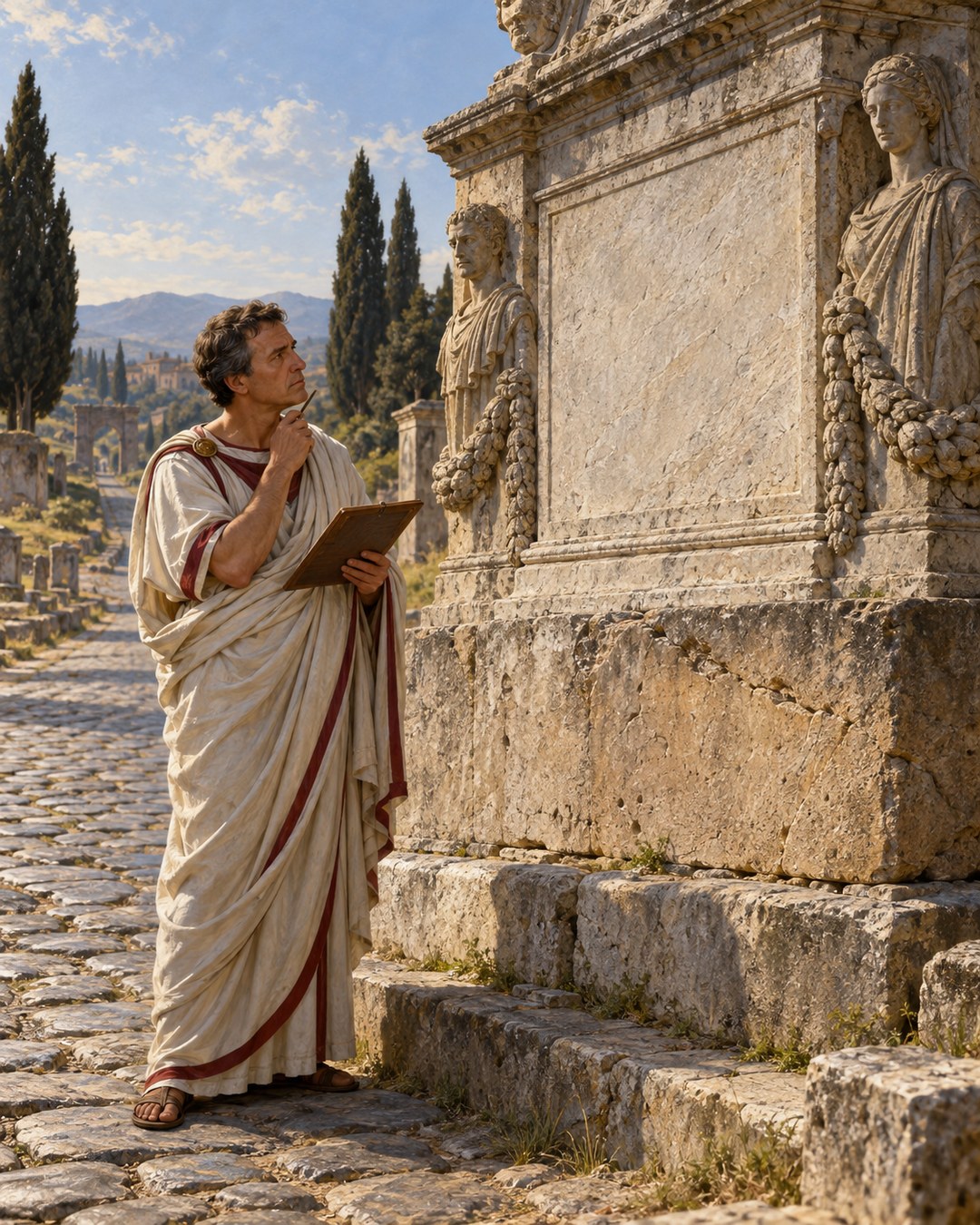
A tomb inscription stopped Pliny the Younger long enough to change his reading list. It praised Pallas, the powerful freedman associated with the emperor Claudius, and recorded that the Senate had granted him praetorian distinctions and a vast sum of money. The final boast was restraint: Pallas had been content with the honour.
Pliny did not leave the sentence on the stone. He looked up the senatorial decree behind it. What he found, he told Montanus in Letters 8.6, was more extravagant than the monument’s compressed version. Senators had thanked the emperor for permitting them to honour Pallas and had treated increasing the freedman’s fortune as an opportunity for Roman generosity.
The episode is a study in political memory. A monument turned a vote into a reputation; an archived decree exposed the language omitted from the epitaph. Pliny’s indignation travels through documents, because documents allowed submission to outlive everyone in the room.
A roadside claim of modesty concealed the scale of the honour
The inscription credited Pallas with loyalty and devotion toward his patrons. In return, it said, the Senate decreed the insignia of praetorian standing and a monetary reward. Pallas declined the cash and accepted the distinctions alone.
That last clause did important work. It made an elevation that already crossed sharp status boundaries look like self-command. The former slave appeared not as a man grasping at senatorial honour, but as someone so restrained that he refused part of what Rome wished to give him.
Pliny had mentioned the monument in an earlier letter. Returning to it in Book 8, he explains that curiosity sent him to the decree itself. The physical inscription was therefore an index to another record, not the whole evidence.
The route from stone to archive changed the object of criticism. At first the monument could look like Pallas’s vanity. The decree made the Senate’s conduct central. Its members had supplied the praise, formulae, and public authority that the tomb later displayed.
This documentary afterlife differs from the bronze law that formalized Vespasian’s powers. That bronze articulated imperial authority. Pallas’s record preserved how an established political body spoke when power gathered around a freedman close to the emperor.
Pliny’s surviving letter is itself another layer. We do not possess the meeting as untouched sound. We encounter his selection of the decree’s language, his comparisons, and his anger. The source is strongest when it shows what he read and how a later senator wanted that reading judged.
The decree made gratitude toward Pallas a senatorial duty
According to Pliny’s quotations, the decree thanked Claudius because the emperor had mentioned Pallas and given the Senate an opportunity to demonstrate goodwill. That formulation reverses the expected direction of favour. The Senate appears grateful for permission to praise an imperial servant.
Pallas was credited with exceptional loyalty and industry. Pliny mocks the scale of the language by comparing it with praise for commanders bearing victory titles such as Africanus, Achaicus, and Numantinus. In his telling, military glory would lie beneath the freedman’s official compliments.
The sarcasm is not a factual claim that Pallas commanded those campaigns. It is Pliny’s measure of verbal inflation. He wants Montanus to feel that the Senate had exhausted the vocabulary of public merit on conduct within the imperial household.
The decree also described support for Pallas’s fortune as an especially welcome outlet for public liberality. Money from the treasury became not an awkward transfer to a wealthy court figure, but a chance for the state to display generosity.
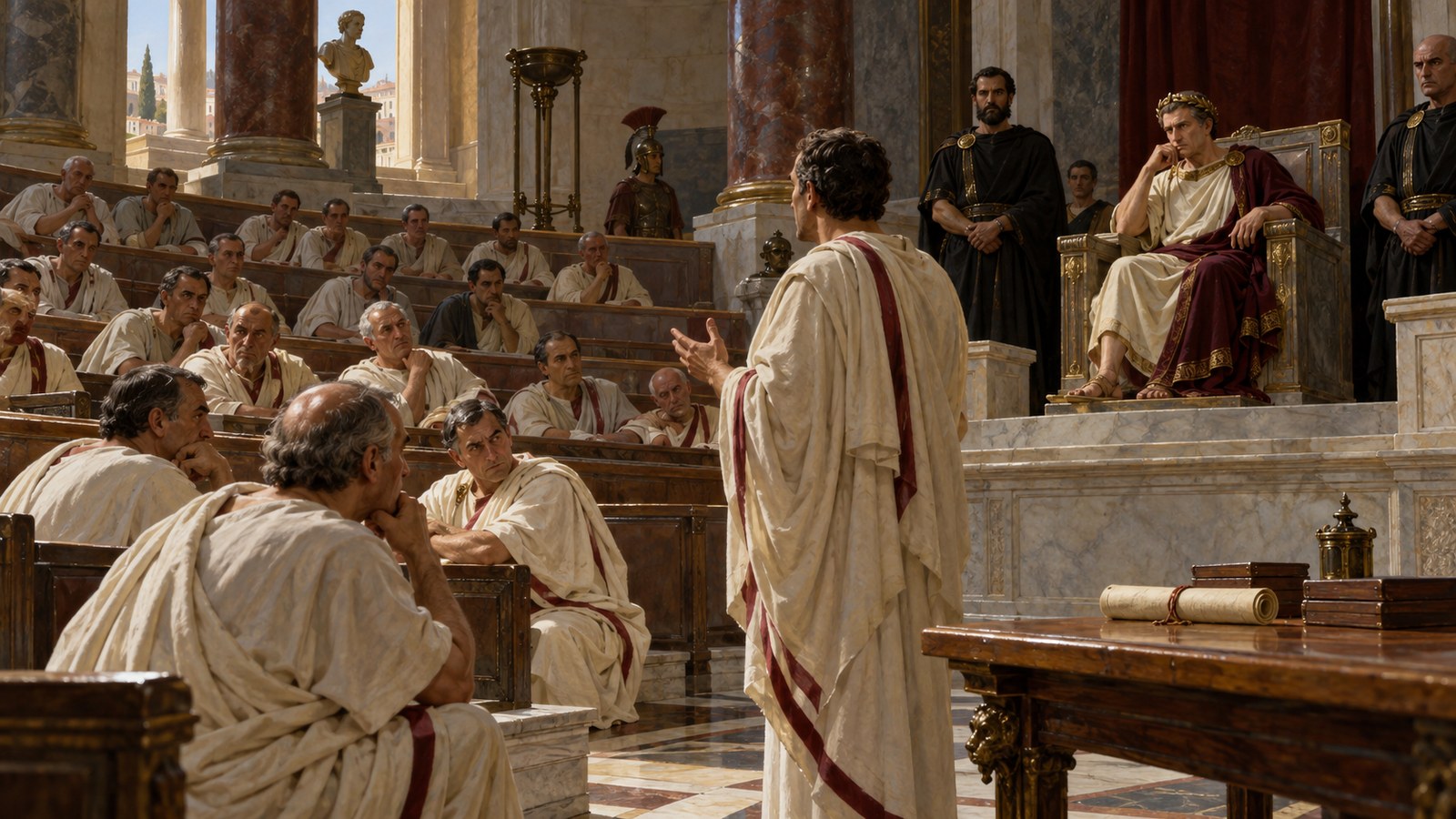
Pliny asks whether the senators were joking or miserable. He rejects the easier excuse that ambition forced them. Advancement, in his argument, could not justify seeking office through the humiliation of the very order whose dignity made office valuable.
That concern belongs beside the dispute over whether a young city prefect could summon the Senate. Both stories turn on institutional form. A meeting, title, or decree can remain technically senatorial while revealing how uncertain the Senate’s independent standing had become.
Pallas refused money but accepted a permanent rank
The decree urged the emperor to persuade Pallas to accept the proposed payment. Pallas then asked that only the honorary distinctions be entered in the final record. Pliny finds no rescue in that refusal.
Money can be spent and disappear into accounts. Praetorian ornaments rearranged public status. They placed the signs of a magistracy around someone who had not followed the ordinary senatorial career. Refusing cash could therefore magnify the prestige of accepting rank.
The tomb inscription made the refusal central because it could be narrated as moderation. Yet the honour remained visible. Pallas’s chosen version told passers-by that the Senate had wanted to give more than he would take.
Pliny’s letter emphasizes that the original decree was not meant to vanish into clerical storage. It ordered the text engraved on bronze and displayed publicly. The same political language that embarrassed him had once been selected for durability.
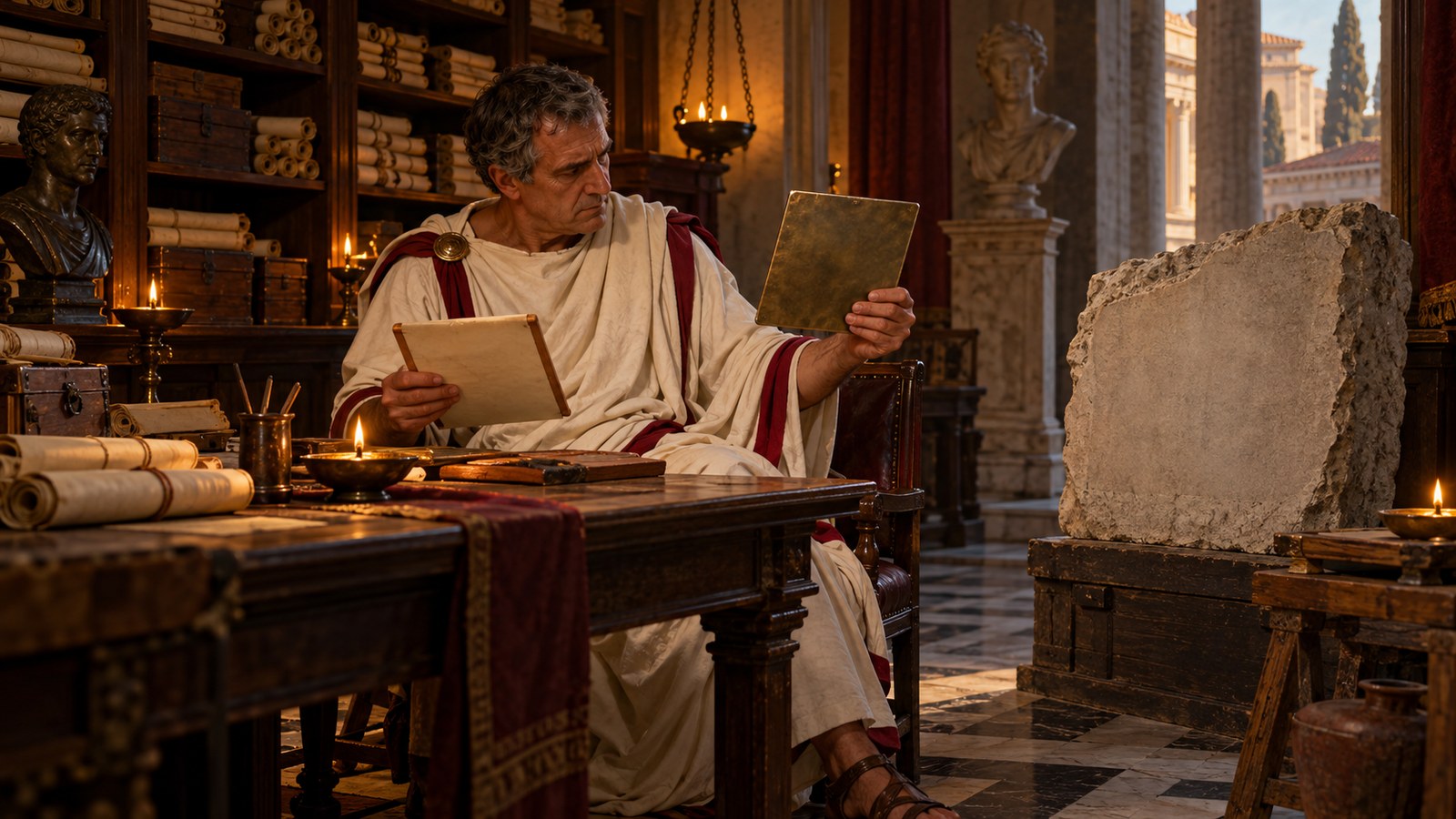
Bronze and stone perform different kinds of compression. The decree preserved procedural abundance: praise, thanks, a proposed payment, Pallas’s response, and instructions for display. The tomb reduced that process to merit, reward, and refusal.
Neither surface is neutral. The decree dignified the Senate’s behaviour when it was issued. The tomb dignified Pallas’s selection from that behaviour. Pliny’s retrieval pits one political artefact against another.
A later senator used the archive as evidence against his own order
Pliny writes after the Claudian court that elevated Pallas. The distance allows him to present the decree as a disgrace belonging to a worse political climate. It also lets him define his own senatorial identity through disgust.
That posture deserves scrutiny. Condemning past servility can flatter the present writer and his audience. Pliny does not give every senator who voted, every pressure applied, or every dissenting voice. His target is the language as a collective product.
Still, the quoted formulae are valuable because they show how dependence could be made ceremonially respectable. Institutions rarely record themselves saying that they were afraid. They record gratitude, unanimity, merit, and generosity. The historian’s work begins by asking what those polished terms were doing.
The order to engrave the decree created the possibility of later embarrassment. Public honour sought permanence, but permanence surrendered control over future interpretation. A text displayed to glorify Pallas and senatorial loyalty became material for Pliny’s accusation.
The tomb had the same vulnerability. Its claim that Pallas was satisfied with honour assumed that refusal of money would always read as modest. Pliny instead reads the sentence as evidence that Rome had placed an imperial freedman in a position to decline the Senate’s wealth.
No invented private motive is needed. The surviving mechanism is public: a monument sends a reader to an official decree; the decree reveals praise more excessive than the monument; a letter circulates that discovery among a new elite audience.
Pallas’s reputation was built through honours, but Pliny’s counter-reputation was built through checking the record. The political conflict continued after death because inscription, archive, and letter preserved different claims about what the Senate had done.
Pliny’s comparison with famous commanders sharpens this point. Victory titles were supposed to condense public danger, command, and conquest into a name. The decree he read had applied an even fuller register of gratitude to palace service. His outrage depends on that mismatch between the scale of the vocabulary and the kind of service being rewarded.
Public display widened the audience beyond senators who knew the immediate pressures of Claudius’s court. A bronze text met readers without those private explanations. Once detached from the meeting, its superlatives had to stand on their own. That is why Pliny can treat the decree as evidence rather than excuse it as a fleeting performance.
The monument then narrowed the same record again. It did not need to quote every expression of gratitude to benefit from them. By naming the honours and the refused payment, it allowed the Senate’s offer to become part of Pallas’s identity while making his refusal the final moral gesture.
Sources
Pliny the Younger, Letters 8.6.