
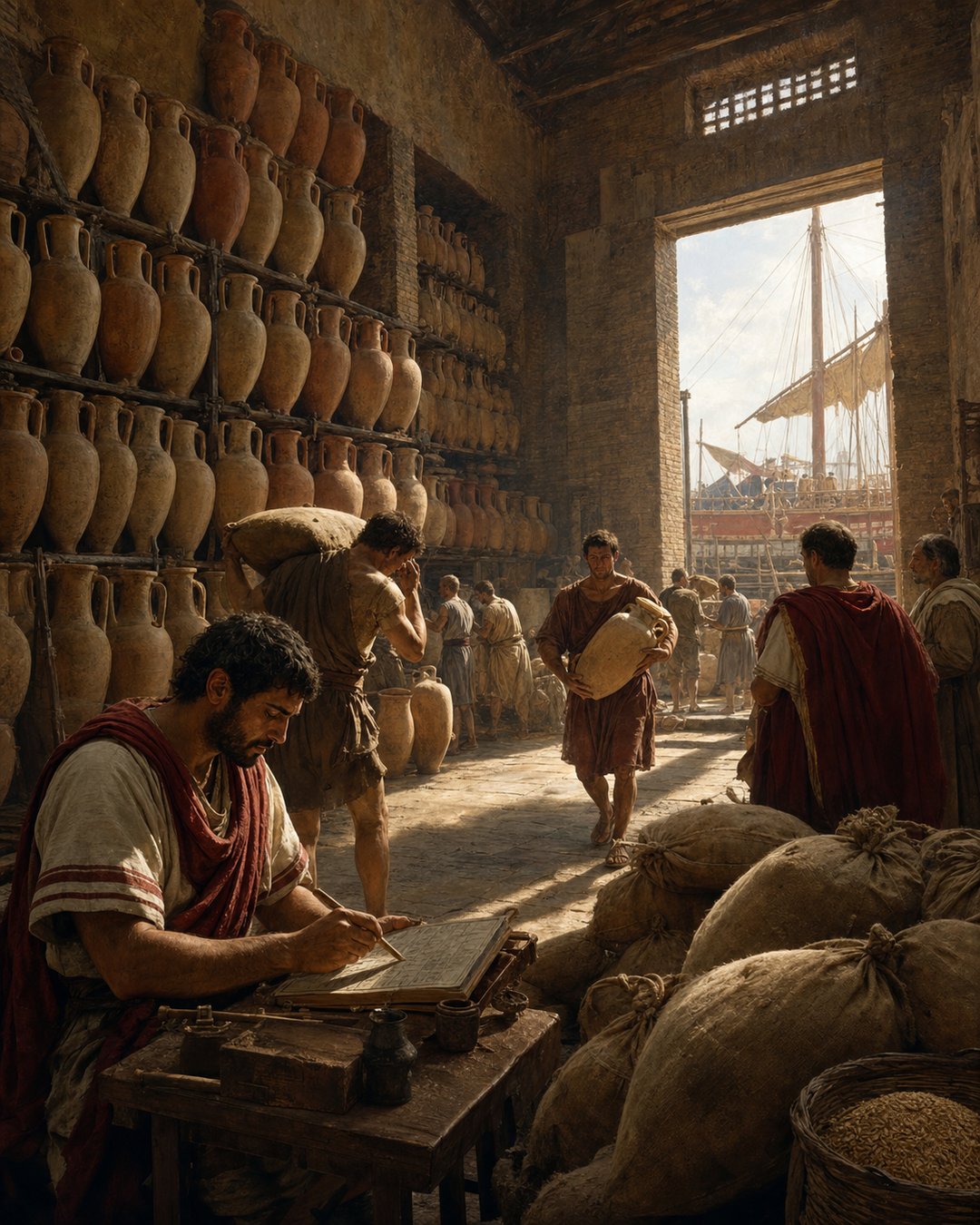
A grain ship reaching the coast did not automatically feed Rome. The cargo still had to be unloaded, measured, stored, guarded, recorded, moved upriver, and released into a city whose appetite never paused. Ostia’s warehouses mattered because they turned arrival into supply.
Rome’s hunger was not only a problem of ships. It was a problem of intervals: days between harvest and sailing, hours at the quay, weeks in storage, delays on the river, and the daily rhythm of bread. The horrea made those intervals manageable.
The port was a hinge, not an endpoint
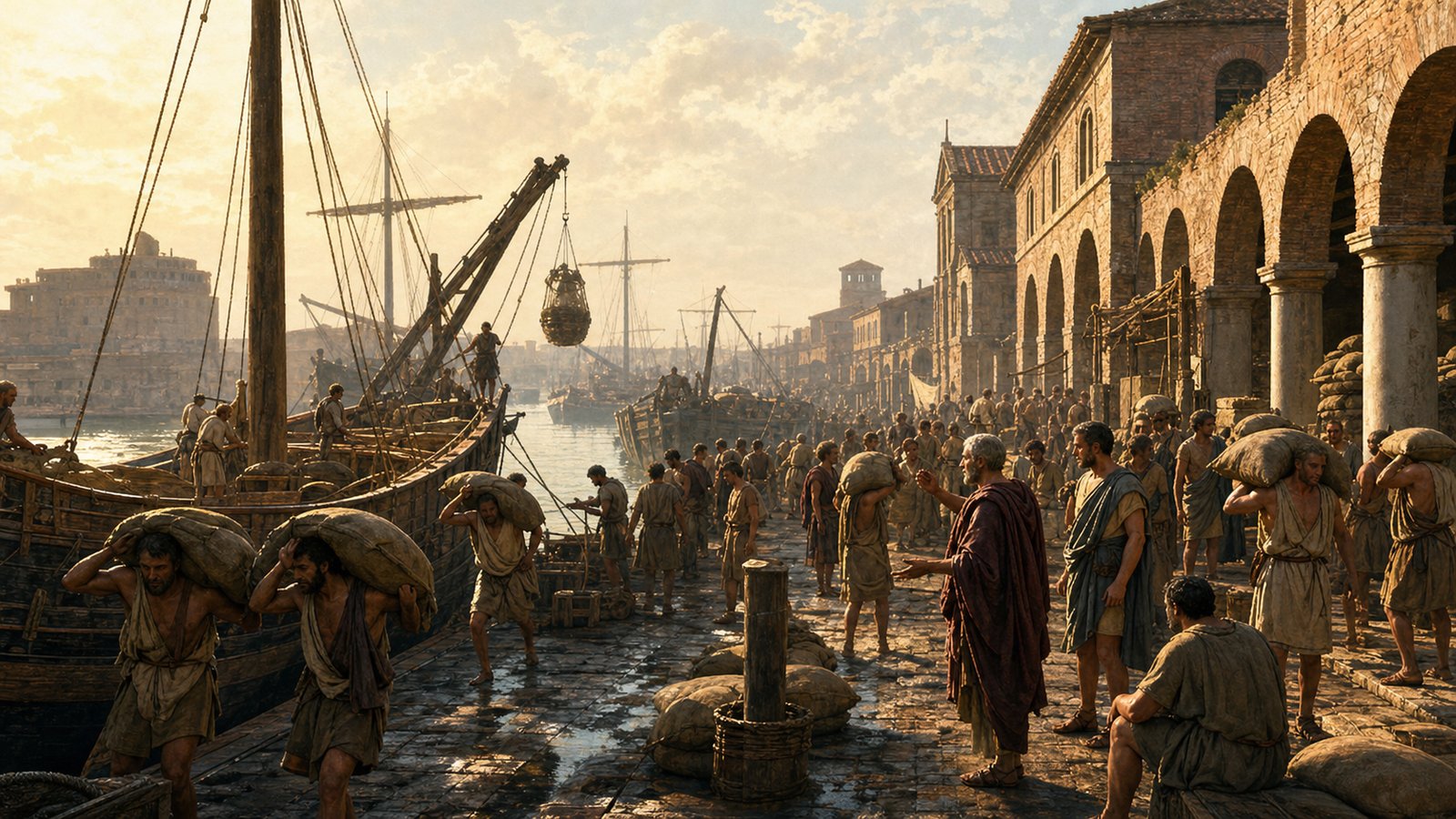
Ostia sat at the mouth of the Tiber, where maritime trade met the route to Rome. Goods arriving by sea had to be transferred into systems that could serve an inland capital. The port was therefore a hinge between the Mediterranean and the city’s stomach.
That hinge could not work by docks alone. Ships delivered mass, but warehouses created control. They gave officials, merchants, and handlers a place to hold goods while paperwork, labor, weather, and transport caught up.
Horrea made food wait safely
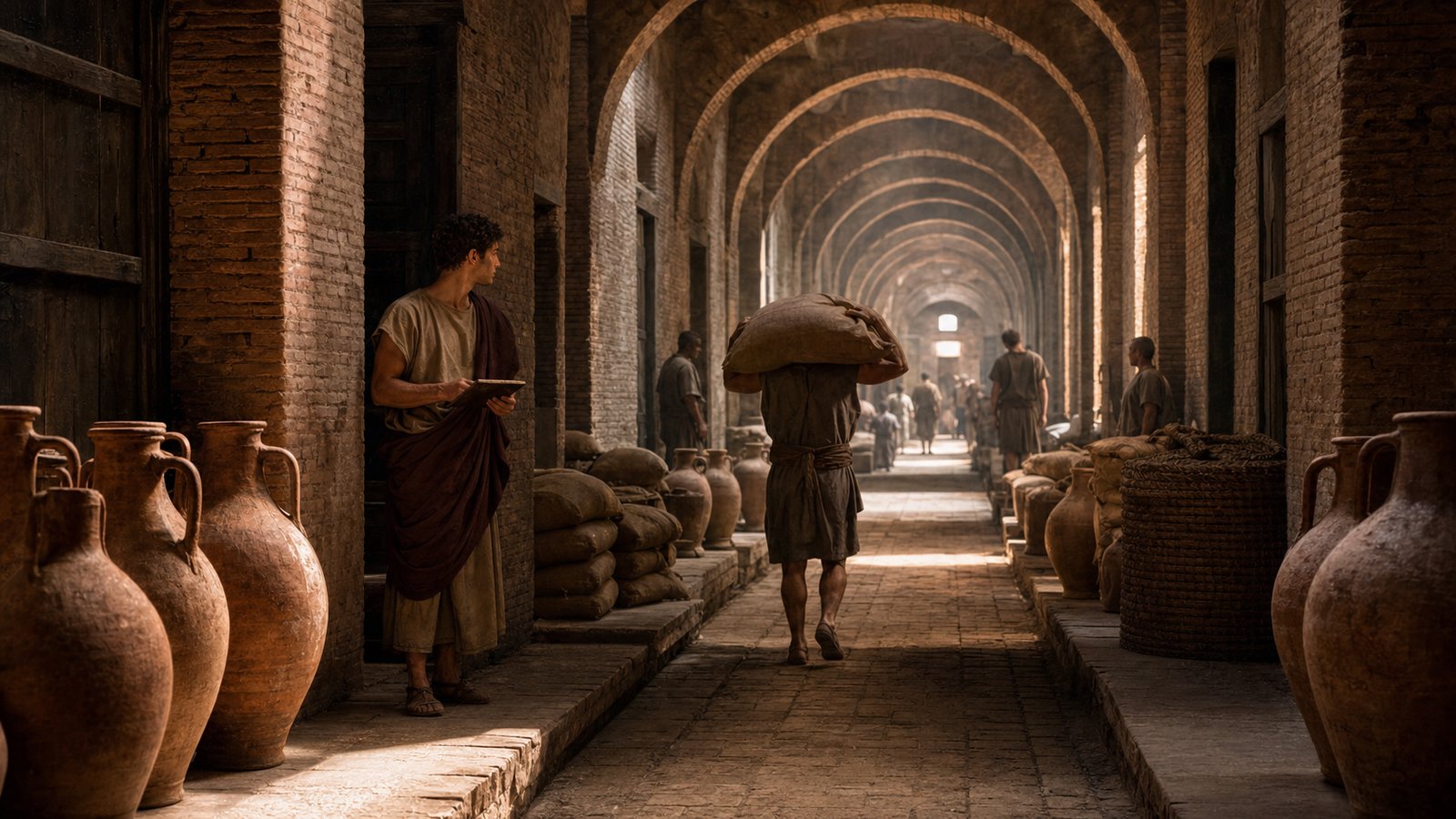
Roman horrea stored grain and other goods in buildings designed for repeated movement, access, separation, and protection. Storage sounds passive, but in a supply city it is active power. A warehouse allows food to wait without becoming lost, stolen, spoiled, or politically invisible.
Picture a brick corridor lined with doors, sacks stacked in shadow, amphorae against a wall, a clerk marking a tablet, and porters moving through dust. That scene is less dramatic than a battle, but it may have mattered more to Rome’s survival.
Rome needed buffers against panic
Imported grain made Rome enormous, but dependence created vulnerability. Bad weather, delayed ships, poor harvests, corruption, war, river trouble, or rumor could turn supply into panic. Warehouses helped create a buffer between disruption and the crowd.
A city of Rome’s size could not live hand to mouth at imperial scale. It needed stored food and visible systems that suggested the next distribution would come. The horrea were part of that promise.
The annona was logistics with political consequences
The annona was more than an administrative term. It named the state’s concern with grain supply and distribution, a concern that could touch imperial legitimacy. A hungry city judged rulers quickly. Bread was never merely bread when crowds gathered.
This is why storage becomes political. If grain sat securely in warehouses, officials had options. If it disappeared, spoiled, or arrived too late, the emperor’s distance from the problem did not protect him from anger.
Ostia and Portus formed a supply machine
Claudius and later Trajan invested in harbor works at Portus to improve the maritime system serving Rome. Ostia remained part of the commercial and administrative landscape linked to that harbor world. The point was not one building or one dock, but a machine of ports, basins, warehouses, roads, river craft, labor, and records.
The machine had many human parts. Sailors, porters, shipowners, clerks, guards, warehouse managers, merchants, muleteers, and officials all stood between a harvest and a loaf. Warehouses gave those people a shared stage.
The quiet infrastructure made imperial life possible
Ostia’s warehouses remind us that Roman power often depended on unglamorous rooms. The empire could celebrate triumphs, emperors, and monuments, but the city also needed dry floors, locked doors, tall stacks, and reliable counting.
For that reason, the horrea deserve attention. They made hunger governable. They did not remove risk, but they slowed it, organized it, and kept it from becoming immediate disaster every time a ship reached the harbor late.
The physicality of storage matters. Grain is heavy. Amphorae break. Sacks tear. Moisture ruins food. Theft follows abundance. A warehouse had to solve practical problems before any official could speak confidently about supply.
Ostia’s surviving commercial landscape lets us see Rome from below the level of imperial ceremony. The city’s survival passed through hands, backs, doors, carts, ledgers, ropes, and river craft. Supply was labor before it was policy.
The warehouses also created knowledge. Stored goods could be counted. Counted goods could be promised, taxed, guarded, sold, or distributed. Without storage, the state and merchants saw only movement; with storage, they could see inventory.
Inventory is a quiet form of power. It lets authorities delay, ration, plan, and reassure. In a city vulnerable to rumor, knowing what was in store could matter almost as much as having it.
The horrea also remind us that infrastructure changes emotion. A port without storage produces urgency. A port with warehouses produces time. Time is what allows decisions, schedules, and public calm to exist.
This does not mean the system always worked. Rome still faced shortages, anxieties, and political pressure over food. But the scale of the warehouse world shows how seriously Romans took the problem. They built spaces where hunger could be managed before it reached the streets.
The ordinary architecture is therefore deceptive. A row of warehouse doors may look less meaningful than a temple façade, but behind those doors sat the material basis of urban peace. Bread riots begin where supply promises fail.
Ostia’s warehouses stood near water, labor, commerce, and administration. They belonged to a world where the empire had to move goods across dangerous distances and then make them seem normal once they arrived.
That normality was the achievement. Rome’s residents did not need to think about every storm, ship, ledger, or sack each morning. If the system worked, food appeared as routine. The warehouses helped turn maritime risk into urban habit.
So Ostia’s importance was not only that ships came there. It was that goods could pause there without falling out of order. The pause made the supply chain governable. For Rome, a controlled pause could be the difference between abundance and fear.
The warehouses also make the scale of dependency visible without turning it into drama. They show a city fed by repeated acts of handling: lift, count, store, check, lock, reopen, move. Each act was small. Together they helped keep a capital from discovering its hunger all at once.
That is why the horrea belong in the story of Roman power. They were not monuments to glory, but they protected the conditions under which glory could be staged. A city cannot applaud triumphs if it does not trust tomorrow’s bread.
The port landscape also made responsibility easier to assign. When goods passed through known warehouses, officials and merchants could argue over quantities, timing, losses, and obligations with something firmer than rumor. A stored cargo left traces: doors opened, tallies marked, workers paid, guards posted.
Those traces did not remove corruption or shortage, but they made supply visible enough to manage. Rome’s food system needed that visibility. Without it, hunger would have arrived not as a problem to administer, but as a shock moving straight from harbor delay to urban crowd without warning.
Sources & Further Reading
- Ostia Antica, Introduction
- Encyclopaedia Britannica, Ostia
- Ostia Antica, Horrea
- World History Encyclopedia, Roman Food Supply
- Smith Dictionary, Annona
- Suetonius, Claudius, 20
- Ostia Antica, Portus
- Ostia Antica, Commerce
- Juvenal, Satires, 3