
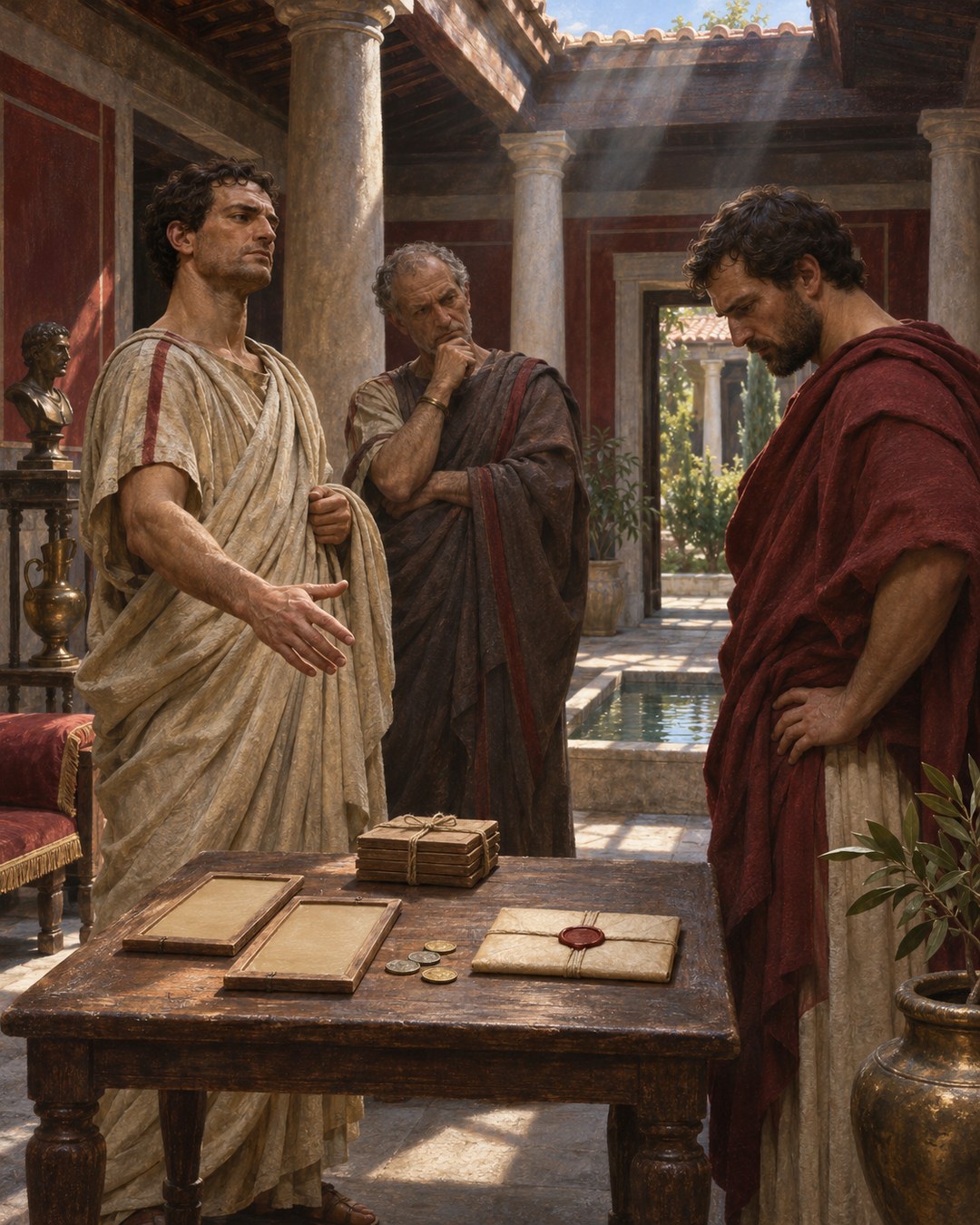
A Roman partner could end a partnership by saying he was done. Consent had created the relationship, and withdrawn consent could dissolve it. But Gaius placed a trap beside that freedom: a man who quit just as an inheritance approached could not use the timing to keep the estate from his partners.
The example is precise. Imagine partners who had agreed to share all their property. One learns that someone has named him heir. If he renounces the partnership in order to collect alone, Gaius says he can be compelled to share the gain. The partnership ends, but the calculated escape does not achieve its purpose.
This was not a rule that every later windfall belonged forever to former associates. Gaius draws a line around intention and timing. A gain acquired without that design belonged to the person who received it. What Roman law resisted was not departure itself, but departure used as a device to capture a benefit already coming into view.
Consent Held the Arrangement Together
Gaius placed partnership among obligations formed by agreement rather than by a ceremonial phrase, a written entry or the physical delivery of an object. The partners’ continuing consent mattered because the relationship depended on choosing to act with particular people.
That made partnership flexible. It also made it personally fragile. Gaius says it continued as long as the partners consented. When one renounced it, the partnership dissolved. Death ended it too, because each partner had selected a specific associate. Loss of civil rights had a similar effect under civil law, although partners who still consented could be treated as forming a new partnership.
The emphasis on chosen associates separates the arrangement from an impersonal pool of assets. Money and property mattered, but the identity of the people sharing risk mattered as well. A replacement was not automatically inserted when one person died or changed legal status. The surviving consent had to support something new.
Roman procedure often attached large consequences to a small formal act. In a property dispute represented by one clod of earth, a substitute object carried a distant field into the magistrate’s presence. Partnership worked differently in form, but it likewise made a legal relationship turn on an intelligible act: agreement began it, and renunciation could stop it.
Services Could Count as Much as Money
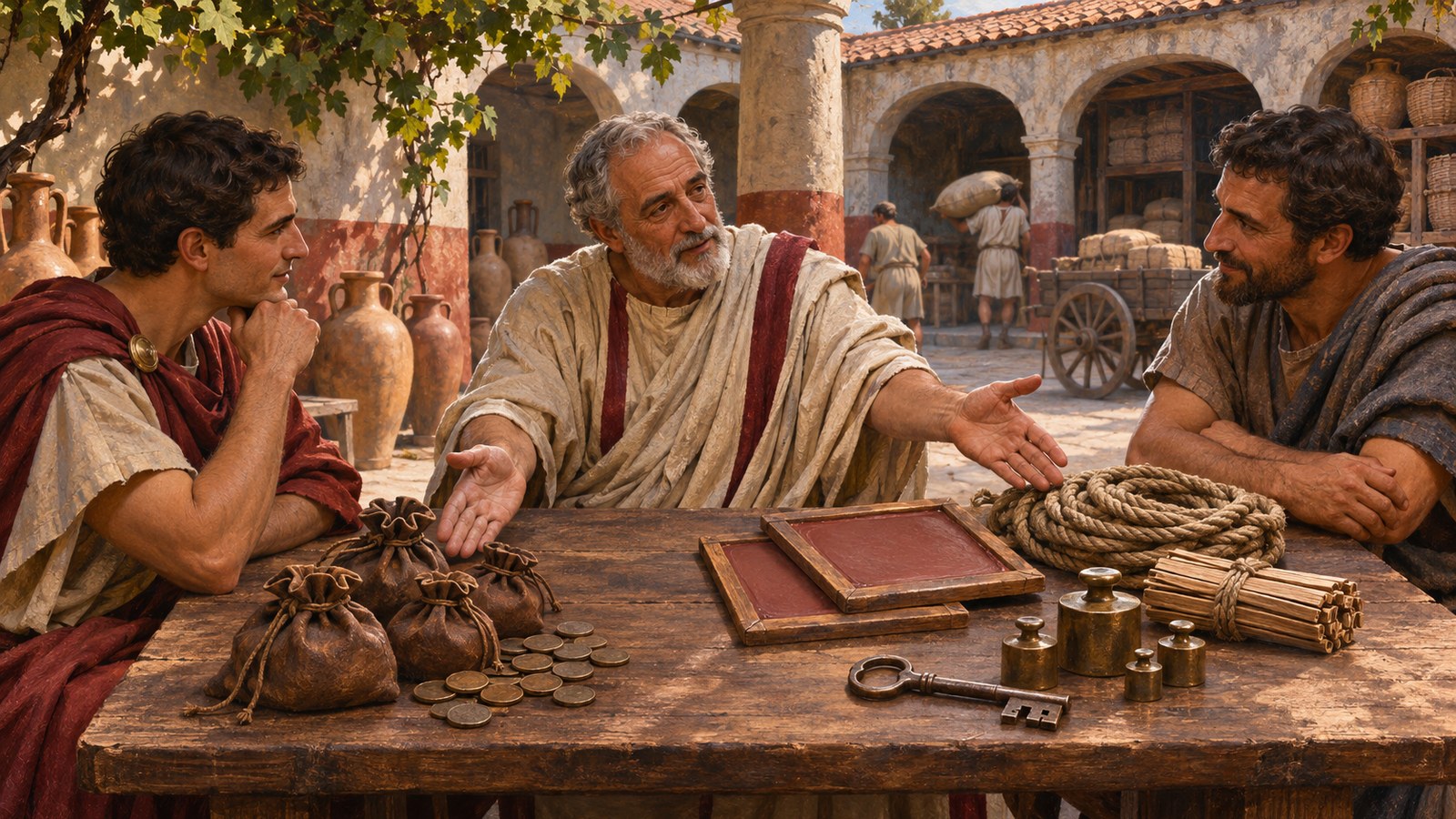
Before explaining how partnership ended, Gaius addressed how its rewards and burdens could be divided. The jurists did not all begin from the same answer. Quintus Mucius thought it contrary to partnership for one member to receive a larger share of profits while bearing a smaller share of losses. Servius Sulpicius disagreed, and Gaius says Servius’s view prevailed.
Under that view, a partner could receive profits while being excused from losses if his services were valuable enough to justify the bargain. One person might furnish all the money while another furnished none, yet they could divide profits equally. Gaius gives the reason in a compact sentence: a person’s work may be worth as much as money.
The rule prevented capital contribution from becoming the only measure of participation. Knowledge, labour, connections or management could enter the bargain through the value assigned to services. The parties did not need to pretend that the non-cash partner had delivered coins. They could recognize a different contribution openly.
Freedom to shape the bargain did not mean silence had no consequence. If the partners said nothing about either profits or losses, both were shared equally. If they specified profit shares but omitted losses, the loss followed the same proportions as profit. The law supplied a pattern when the agreement left a gap.
Those defaults mattered because profit and loss were not separate conversations that could drift without limit. An agreed percentage on one side supplied the missing percentage on the other. Gaius thus moves from the jurists’ broad debate to an ordinary drafting problem: what happens when partners describe the attractive half of their bargain but leave its burdens unstated? The answer keeps the two halves aligned unless they have expressly built another arrangement.
An Expected Estate Exposed Opportunistic Timing
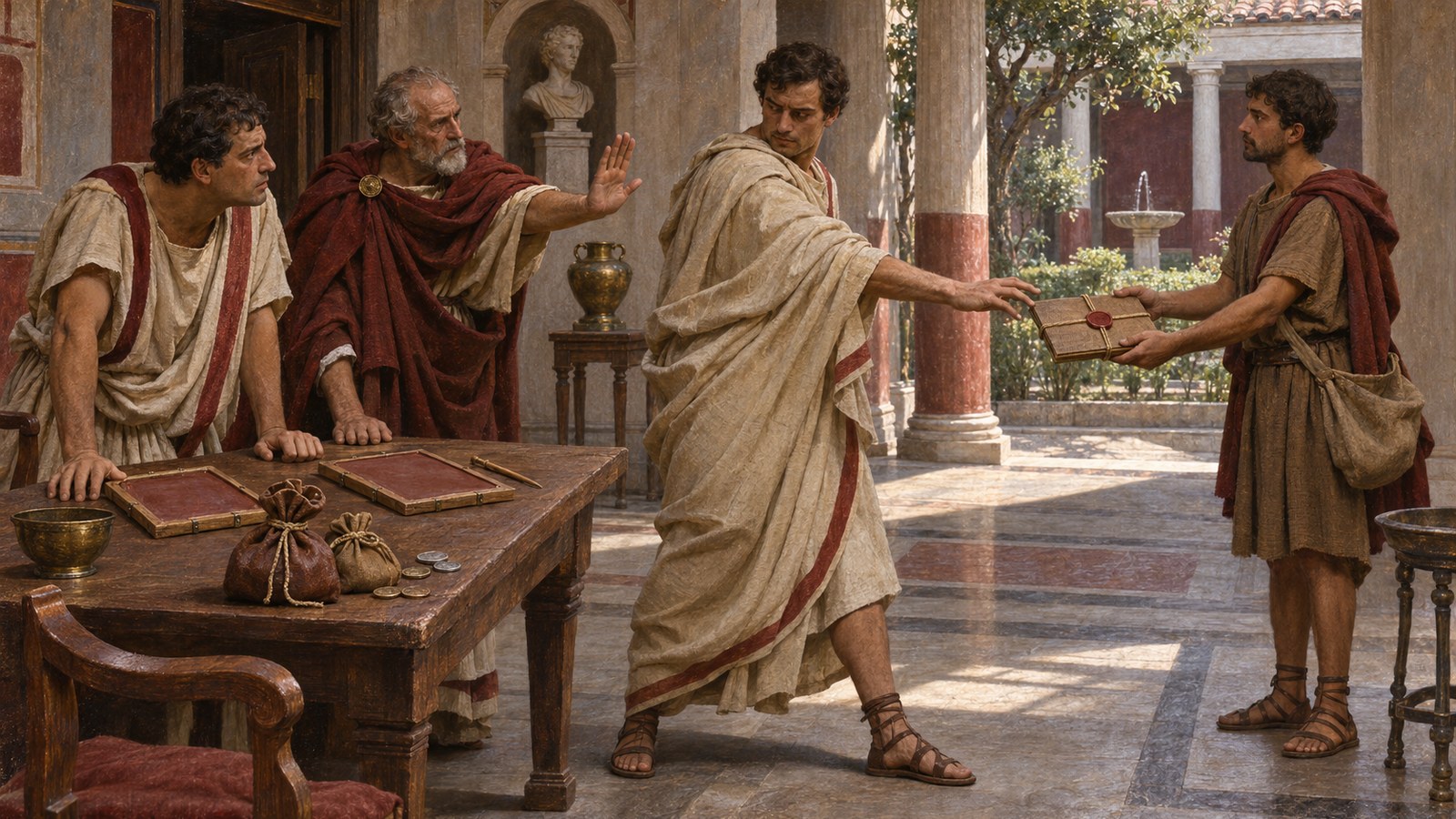
The inheritance example tests the boundary between a genuine exit and a strategic one. A partner in all property learns that he is about to become an heir. He then renounces the partnership so the incoming estate will arrive after the shared relationship has technically ended.
Gaius does not deny that renunciation dissolves the partnership. Instead, he denies the intended pecuniary advantage. The departing partner can be compelled to share the gain. The chronological sequence—renunciation first, inheritance second—cannot by itself cleanse a plan aimed at excluding the others.
This is a narrow and revealing response. The law did not need to claim that consent continued after it had been withdrawn. It could respect the end of the association while correcting the benefit secured by bad timing. The partnership’s future stopped; the anticipated gain remained answerable to the relationship the quitter was trying to evade.
The example also shows why intention mattered. An inheritance was not simply another coin dropped into a common purse. Gaius asks why the partner left and whether the gain was the object of the departure. The legal issue was constructed from a human sequence: knowledge of advantage, renunciation, then receipt.
Unexpected Gains Drew a Different Boundary
Gaius immediately limits the rule. If the former partner obtained a gain without intending to engineer it, the gain belonged to him alone. The other partner was entitled only to what had been acquired before renunciation, not to every benefit that fortune supplied afterward.
That distinction protected the meaning of dissolution. Without it, ending a partnership in all property could leave a permanent shadow over each former partner’s future. A later gift, discovery or unexpected inheritance might be dragged backward into a relationship that no longer existed. Gaius instead preserved a real endpoint while refusing a departure designed around a visible windfall.
The same attention to boundaries appears in other Roman legal mechanisms. A seal described in the article on wax, cord and tampering did not make interference physically impossible; it made the boundary between intact and opened evidence visible. Gaius’s partnership rule made a different boundary visible, between an honest exit and a calculated capture.
There was no universal formula that every departure was suspect. The facts had to show the intended advantage. That makes the inheritance example useful: it is vivid enough to expose the principle without turning the principle into an unlimited claim over later wealth.
Partnership Ended in More than One Way
Renunciation was only one ending. Death dissolved the partnership because the choice of associate was personal. Loss of civil status ended it under the civil-law analogy between such a loss and death. Sale of a partner’s property, whether public or private, also brought dissolution.
Each ending attacked a different support. Renunciation removed present consent. Death removed the selected person. Loss of civil status changed the partner’s legal identity, while sale of his property removed the material position on which the association had operated. Gaius lists them together, but the variety prevents partnership from being mistaken for an immortal entity floating above its members and their estates.
Yet Gaius closes this discussion by returning to consent. The partnership he describes belonged to the law of nations and arose through agreement. If people whose earlier partnership had been disrupted still agreed to continue, their consent could form a new one.
The system therefore held two ideas together. Partnership was easy to create and, in one sense, easy to end because it rested on consent. But that simplicity did not license a partner to manipulate the final instant. A man could walk away; he could not move the finish line around an inheritance and call the gain his alone.
Sources
Gaius, Institutes, 3.148–154