
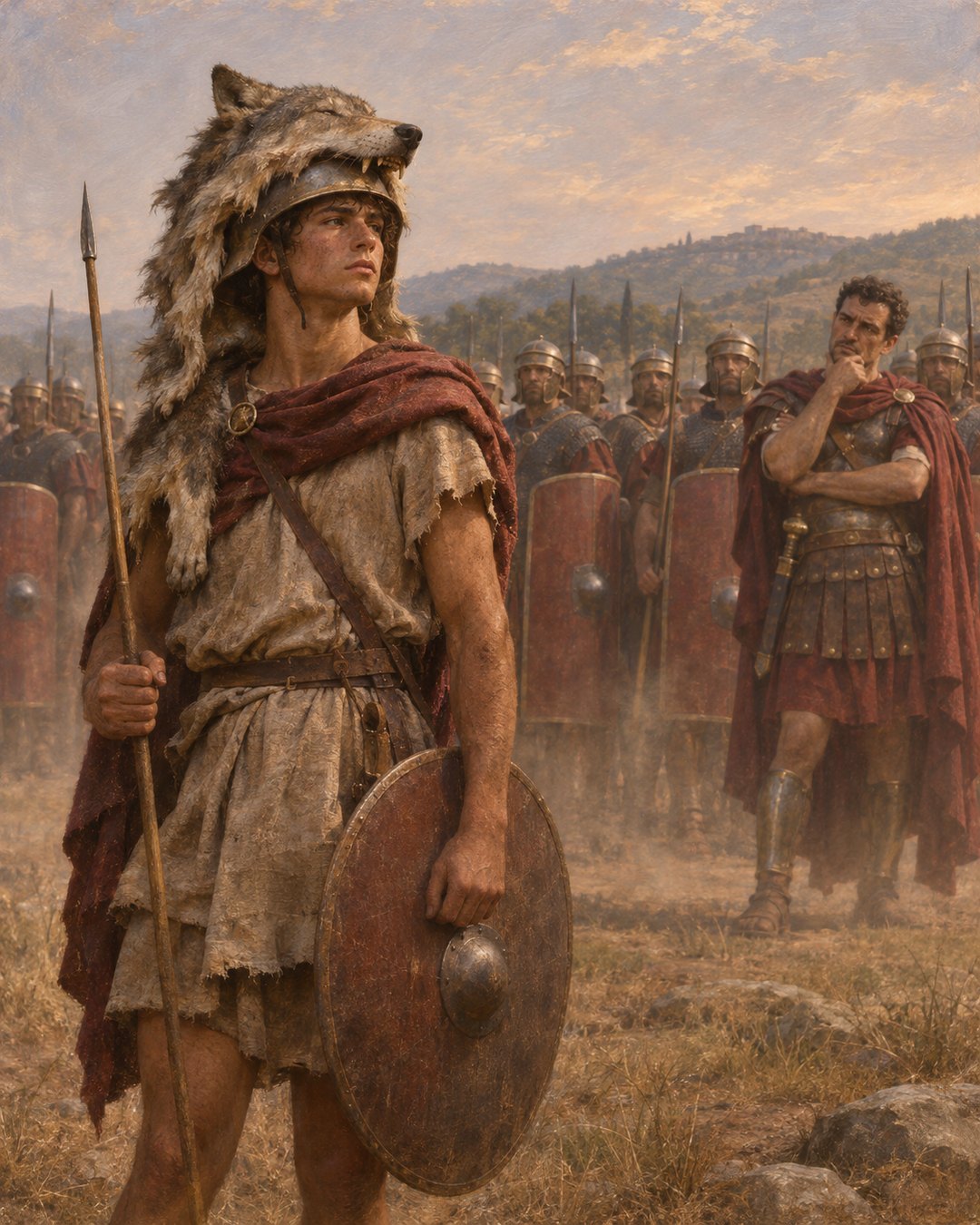
A wolf’s hide rose above the youngest men in a Roman battle line. It was not simply there to make them look fierce. Polybius says the skin let an officer pick out a skirmisher in the confusion and decide whether he had fought bravely. The animal pelt was therefore part helmet cover, part unit marker and part report card.
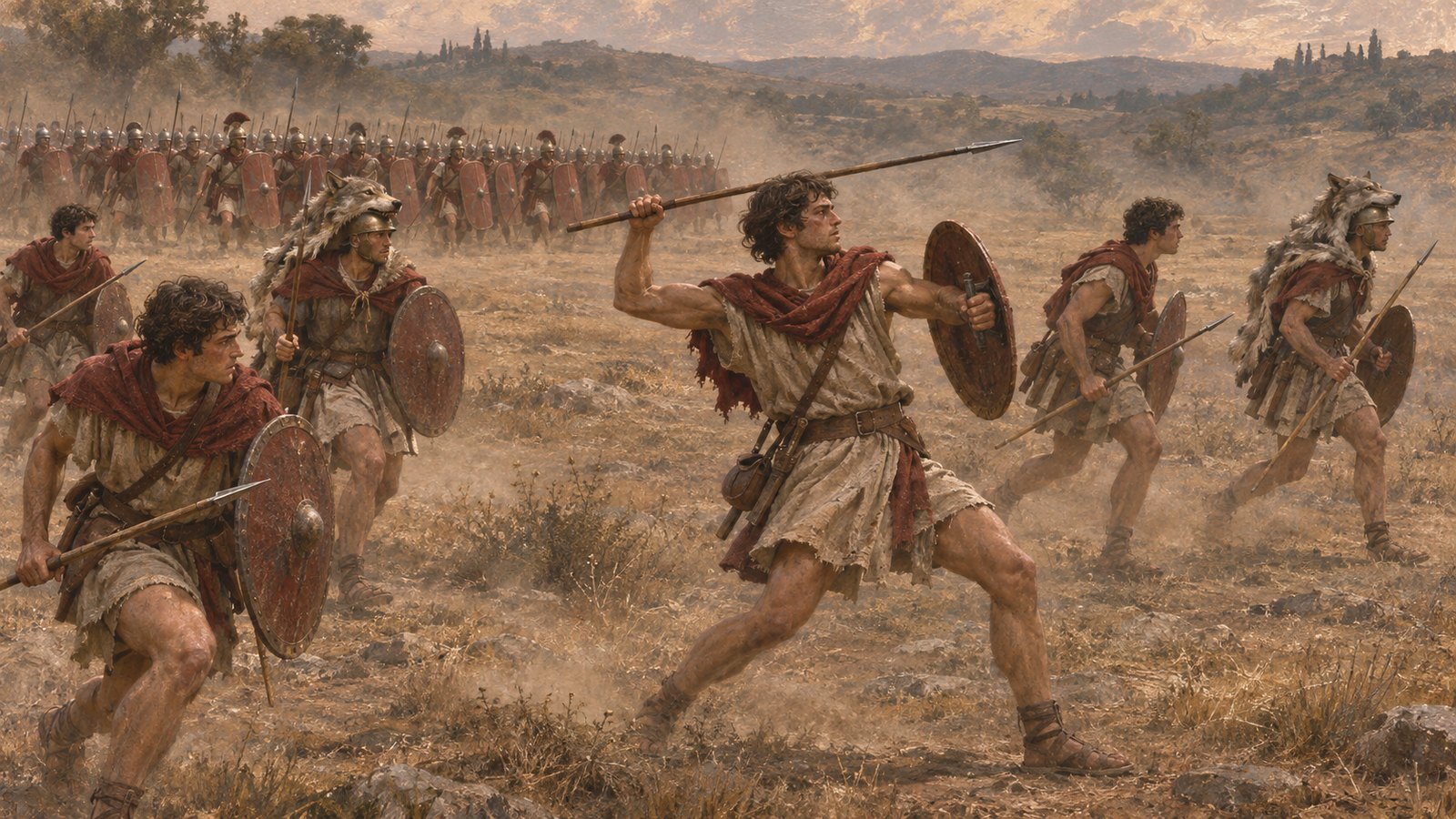
The men beneath it were the velites, the youngest and poorest recruits in the legion Polybius described. They carried neither the great curved shield nor the complete armour he assigned to the heavier infantry. Their tools were a three-foot round target, a sword and light javelins designed to become useless to the enemy after impact. Everything about the kit matched work done before dense ranks met: advance, throw, withdraw and remain visible enough to be judged.
That last demand changes the scene. Skirmishing looks loose when compared with a formed line, but Roman officers still wanted individual conduct to remain legible. The wolfskin helped turn scattered movement into accountable service.
The Levy Sorted Age, Wealth and Battlefield Work
Polybius begins before any animal hide reached a helmet. Military tribunes fixed a day and place for enrolled men to appear without arms. There the levy was divided by age and circumstance. The youngest and poorest became velites. The next group became hastati, men in their prime became principes, and the oldest became triarii.
These were not four picturesque costumes chosen after a soldier entered the legion. They were connected parts of its organization. In Polybius’s standard reckoning, a legion contained 600 triarii, 1,200 principes and 1,200 hastati. The remaining youngest men served as velites. If the legion grew beyond 4,000, the other groups expanded while the triarii remained fixed at 600.
The arrangement put material limits into tactical form. The youngest and poorest were not expected to arrive as miniature heavy infantrymen. Their lighter equipment created a different job. They could move ahead of the main formations, use missiles and then pass through or around troops prepared for close combat. The levy did not erase differences of age and resources; it organized those differences into a sequence of battlefield actions.
The arithmetic reinforced the distinction. Polybius allowed the number of velites, hastati and principes to rise when a legion exceeded 4,000, while keeping the triarii at 600. The youngest troops therefore absorbed part of the legion’s changing size. Their place was not a fixed decorative fringe around an otherwise complete army. It was one of the categories through which a larger body of recruits was distributed, armed and made usable.
Polybius’s description also makes the velites a better lens on Roman organization than the familiar image of one uniformly equipped legionary. A related article on the 200-foot empty strip inside a Roman camp shows the same preference for assigning different functions to different spaces. Here the division was carried on human bodies.
A Three-Foot Target Replaced the Heavy Shield
The velite carried a sword, several javelins and a circular target called a parma. Polybius gives the target a diameter of three Roman feet. It was large enough to offer real cover, but it was not the tall convex scutum he describes immediately afterward for the hastati.
That contrast matters more than a catalogue of equipment. The hastatus received a shield built from two glued planks, faced with canvas and calfskin, and protected at its edges with iron. The velite’s circular target belonged to a body expected to change position quickly. It protected without making the carrier perform the work of a formed heavy infantryman.
The plain helmet followed the same logic. Polybius does not turn the youngest soldiers into naked runners. They possessed protection, but in a deliberately lighter package. A round target could be brought across the torso while throwing, and a simple helmet could carry the one addition that made the wearer conspicuous: a hide laid over its surface.
Read this way, the equipment was not a cheaper imitation of “real” legionary gear. It was a coherent set for a distinct phase of battle. Sword, target and helmet gave the velite means to survive if distance collapsed. The javelins let him act before that happened.
The Javelin Was Made to Fail after One Throw
Polybius becomes unusually physical when he reaches the missile. Its wooden shaft was about two cubits long and roughly a finger thick. The iron head measured a span. It was hammered so fine that the first solid impact bent it.
The bent head was not poor workmanship. It solved a battlefield problem. A sound missile thrown into an enemy formation could be picked up and returned. A head that folded on impact made that much harder. The weapon’s useful life was intentionally brief: carry it forward, cast it once and deny it a second owner.
This small design choice reveals the tactical distance between velites and the men behind them. A heavy infantry shield had to absorb repeated blows. A light javelin could be optimized for a single exchange. Its failure was successful when it prevented reuse.
Roman systems often made an object prove that it had been used. The principle resembles the wax-and-cord arrangements described in Roman document seals: damage made an action visible and difficult to reverse. On a battlefield, the bent point did not authenticate a document, but it likewise changed the object so the previous act could not simply be undone.
The Wolfskin Made Courage Visible from the Rear
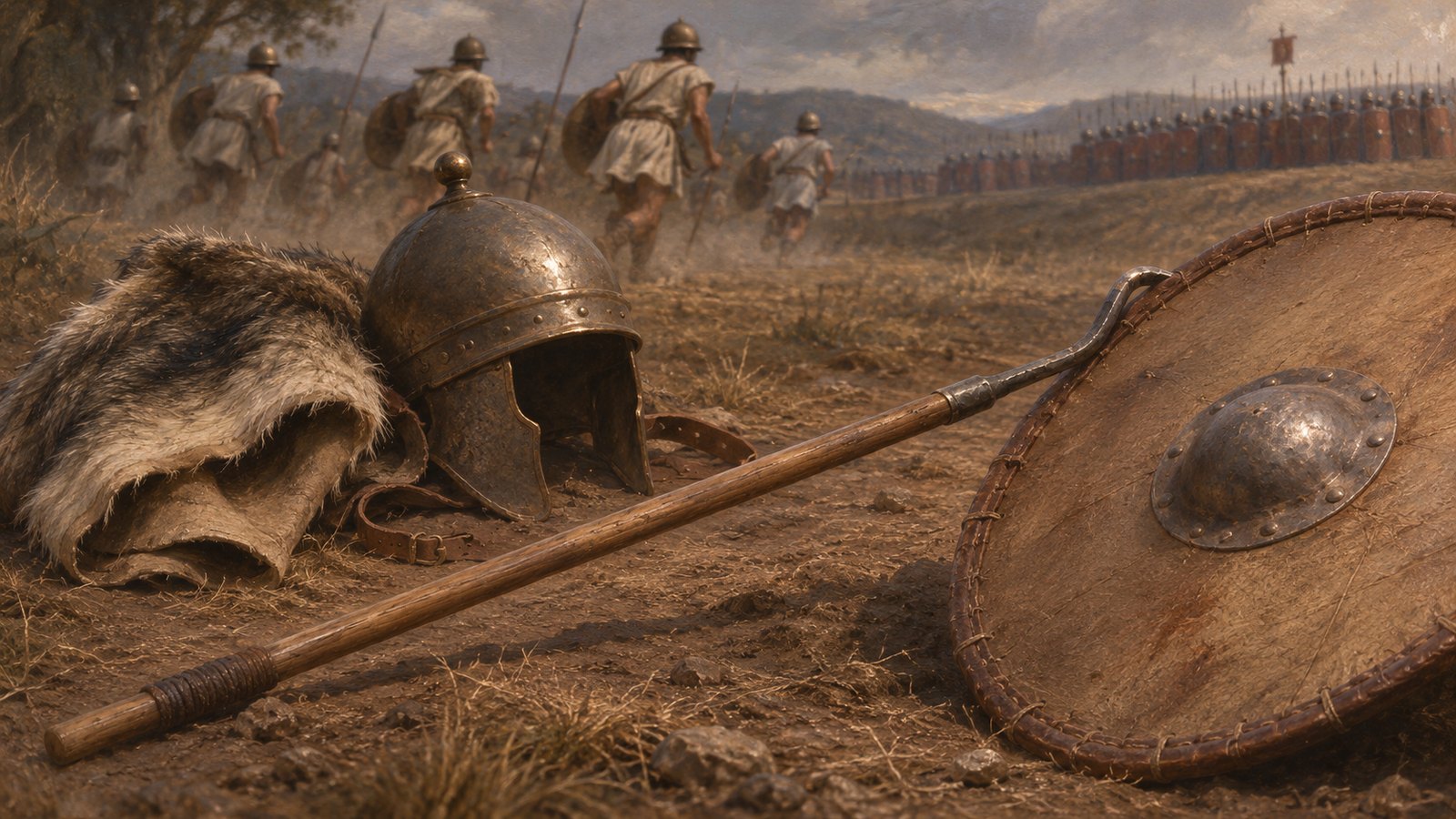
Over the plain helmet, some velites wore a wolfskin or a similar hide. Polybius gives it two functions. The covering provided protection, and it acted as a distinguishing mark. Officers could recognize the men and judge whether they had fought “pluckily” or not.
The detail is easy to romanticize. A wolf suggests speed, aggression and the legendary animal that nursed Rome’s founders. Polybius, however, supplies a practical explanation inside the legion. The hide made identification possible. Its irregular outline and fur would stand apart from a plain helmet, especially when the skirmishers were dispersed in front of the heavier line.
That visibility carried risk. A man sent forward with light protection could not dissolve into an anonymous crowd once missiles began to fly. The officer behind him had a mark to follow. Advance too timidly, throw without effect or leave too soon, and the same pelt that distinguished the role could distinguish the failure.
The mark worked because it was attached to the moving soldier, not planted at a fixed station. A standard could identify a formation, but skirmishers spread across open ground. The hide kept the category readable while its members changed position. Polybius’s wording makes recognition and judgment part of one process: first the officer had to know which young soldier he was watching, then he could assess the conduct.
It also created a channel for recognition. Polybius does not say only that misconduct could be spotted. He says officers judged whether the men fought bravely. The visual marker could attach credit to conduct that otherwise happened in a shifting screen of runners and missiles. The youngest recruits occupied the least stable part of the field, but the army still tried to preserve a view of individual performance.
Light Infantry Was Not Outside Roman Discipline
The velites stood apart from the close ranks, yet their equipment tied them to the legion’s system. The levy assigned the role. Standard numbers placed it beside hastati, principes and triarii. Officers recognized its members by visible marks. Purpose-built javelins controlled what happened after a throw.
This is why “light” should not be mistaken for informal. The velite carried fewer heavy materials, not fewer expectations. His freedom of movement was useful only when it served the sequence of the battle and left room for the formed infantry that followed.
Even the wolfskin belongs to that administrative world. It could evoke an animal and add protection, but Polybius’s explanation ends with supervision. Rome put a wild outline over a young soldier’s helmet so authority could see him more clearly.
Sources
Polybius, Histories, 6.19–23