
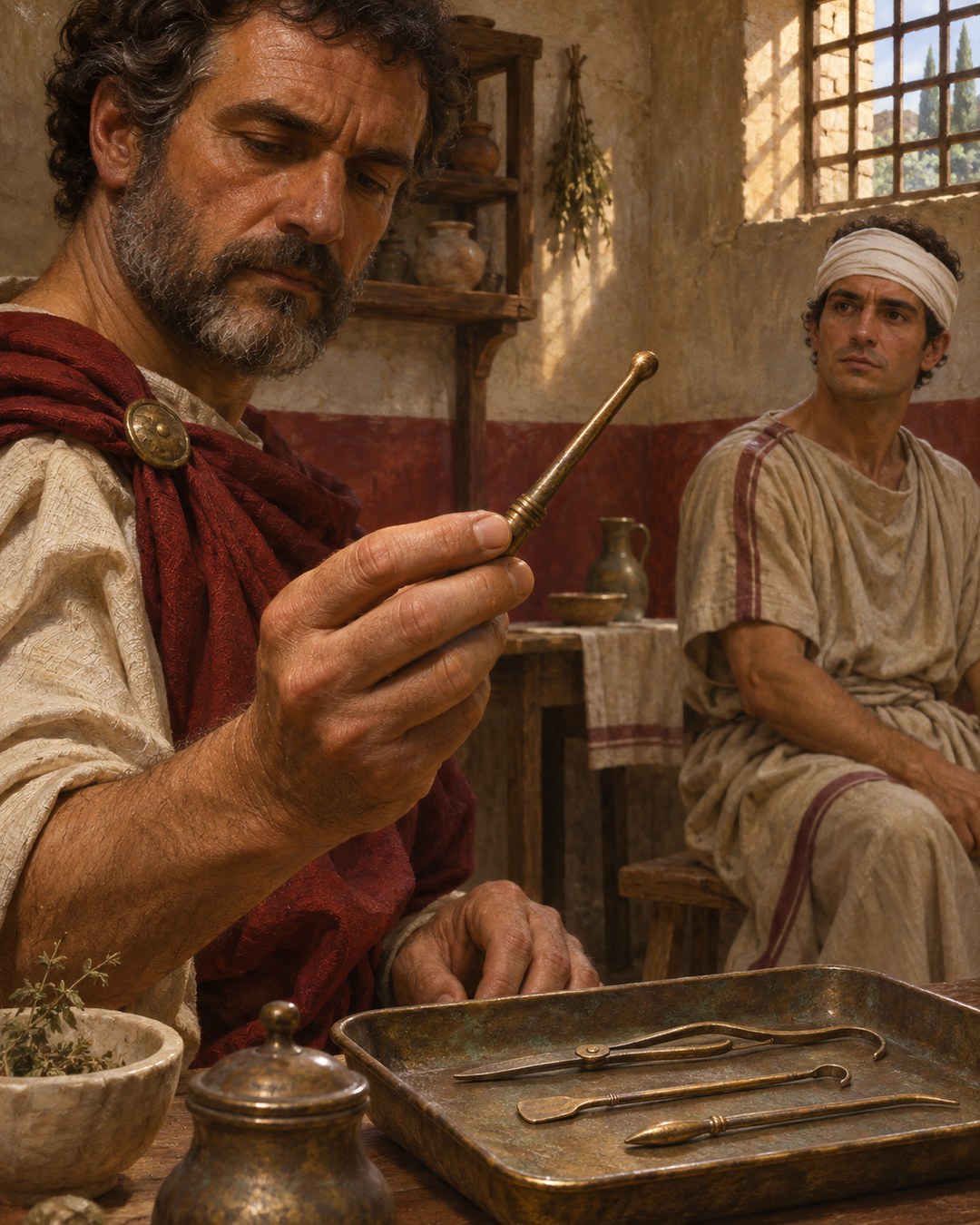
A head wound could mislead the hand that examined it. A groove beneath the skin might be a fracture, but the skull already carried natural seams. A probe narrow enough to slip into one of those sutures could manufacture the very diagnosis it was meant to test. A probe too broad could pass over a hairline fissure. In De Medicina, Celsus made the instrument’s shape part of the reasoning: it should be neither very fine nor pointed, yet not so thick that a small break escaped notice.
That is an unusually precise warning. It shows Roman diagnosis not as a flash of intuition but as a sequence in which every source of error had to be managed. The practitioner considered the symptoms, reconstructed the blow, explored the wound, interpreted texture, and escalated when the first test remained uncertain. The probe did not supply an answer by itself. It turned touch into evidence only when the operator understood how the tool could lie.
A surviving bronze specillum in the Metropolitan Museum of Art gives that hand-held world a physical scale. The museum dates the Roman object to the first or second century CE and records a length of just 11.8 centimetres. Its collection title calls it a probe, while its object classification calls it a spatula. We cannot assign that particular object to Celsus’s skull procedure. What it does preserve is the compact bronze form of a tool family whose usefulness depended on controlled contact.
The Examination Began Before Bronze Touched Bone
Celsus did not begin with the probe. In Book VIII, he first lists what should be asked after a blow to the head: whether the patient had vomited bile, suffered obscured vision, lost speech, bled from the nose or ears, fallen, or lain unconscious as if asleep. Those signs, he says, do not occur without fractured bone. Their presence made treatment necessary and difficult. Stupor, a wandering mind, paralysis, or spasm pointed to injury of the membrane around the brain and left little hope.
When those signs were absent, uncertainty remained. The operator had to consider what caused the wound. Was the weapon a stone, club, sword, or something else? Was it blunt or pointed, light or heavy? How much force had been used? Celsus treated those questions as evidence about what the bone might have resisted, not as a substitute for examination.
This order matters. The tool entered a case already framed by symptoms and mechanics. A lighter blow without dangerous signs lowered suspicion, but it did not magically reveal the skull beneath the wound. Celsus’s “best plan” was to make certain by exploration. The probe therefore joined observation to touch. It was one step in a chain, not a metal oracle.
A Narrow Tip Could Invent a Fracture
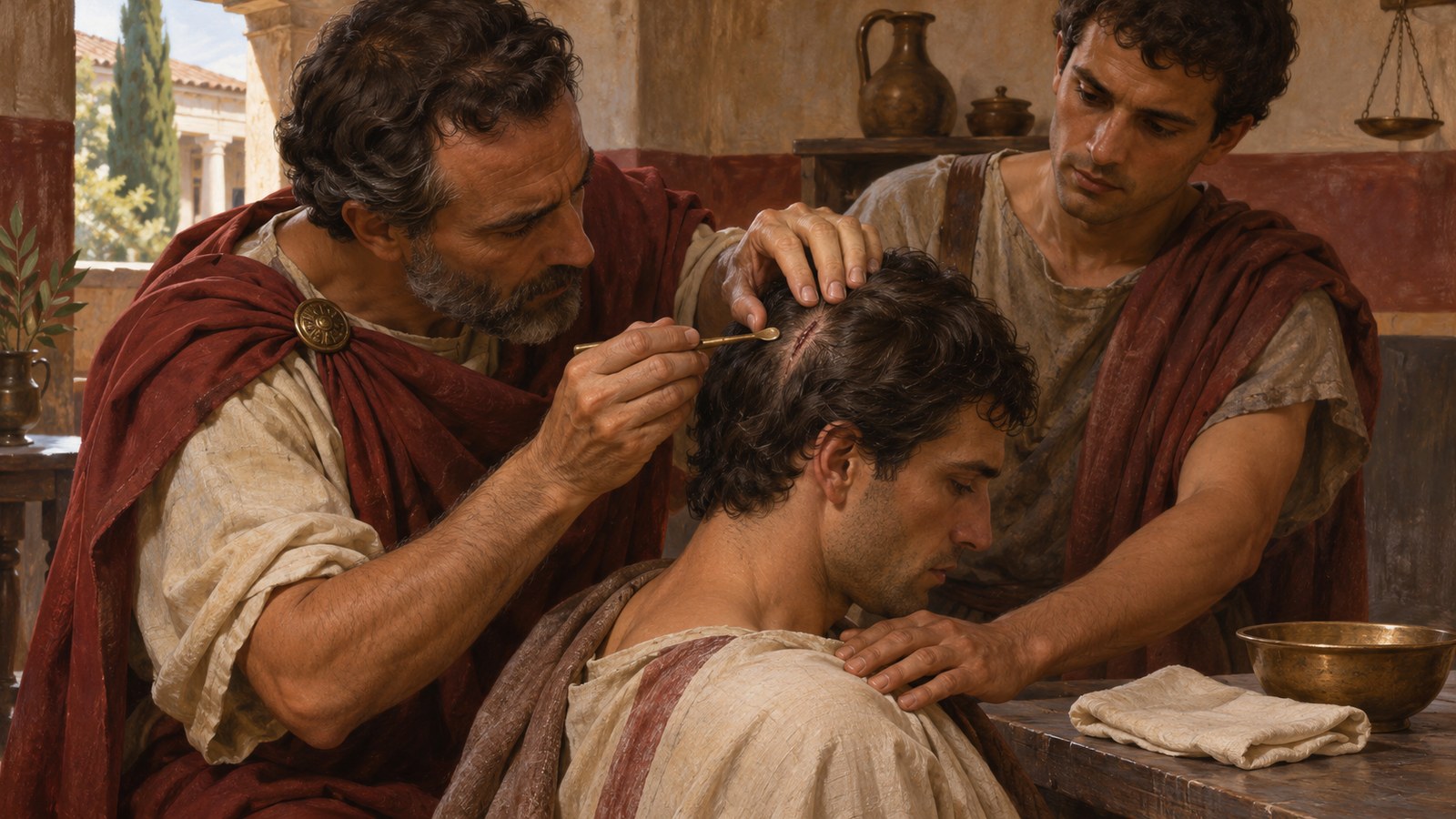
The central problem was the skull’s own construction. Its bones meet at sutures, natural unions that can form grooves and rough lines. Celsus warned that a probe which was very fine or pointed might enter one of them. The operator would feel a channel and mistake ordinary anatomy for damage. The instrument would create a false positive because its geometry allowed it to follow a harmless seam.
The opposite design failed in the opposite direction. If the probe was too thick, it might bridge a small fissure and miss it. The useful tool occupied a middle range: narrow enough to encounter a fine break, broad and blunt enough not to dive eagerly into every natural line. Celsus did not supply a millimetre measurement. He supplied a performance requirement.
That requirement makes the operator’s hand part of the instrument. Pressure, angle, and expectation could affect what was felt. The passage is not a modern engineering specification, but it is disciplined thinking about fit between tool, body, and question. Similar attention to touch runs through the story of why Roman surgery began with the trained hand. Here the bronze extension of that hand had to be chosen so that it did not exaggerate one feature while erasing another.
Smoothness and Roughness Were Evidence, Not Certainty
Once the probe reached bone, Celsus offered a tactile distinction. Smooth, slippery bone indicated that the surface was intact. Roughness, when it appeared away from a natural suture, signalled fracture. The practitioner was reading texture without seeing the whole line directly.
Then Celsus complicates his own rule. He recalls that Hippocrates admitted being deceived by sutures. Celsus praises that admission because a great teacher who records an error can prevent later people from repeating it. The anecdote is more than a bow to authority. It identifies a known failure mode inside the method.
The next section sharpens the warning: a suture can itself feel rough. Its position is not identical in every skull. A fissure may coincide with a natural union or lie close beside it. Roughness was useful evidence, but context determined its meaning. The same sensation could point toward two different structures.
That tension separates this episode from a simple tale of ancient ingenuity. Celsus does not claim the probe made uncertainty disappear. He explains how uncertainty moved. A smooth surface could reassure; a rough surface could alarm; but anatomy could imitate injury. The procedure worked only if the examiner remained prepared to distrust an attractive first answer.
Ink Became the Second Test When Touch Failed
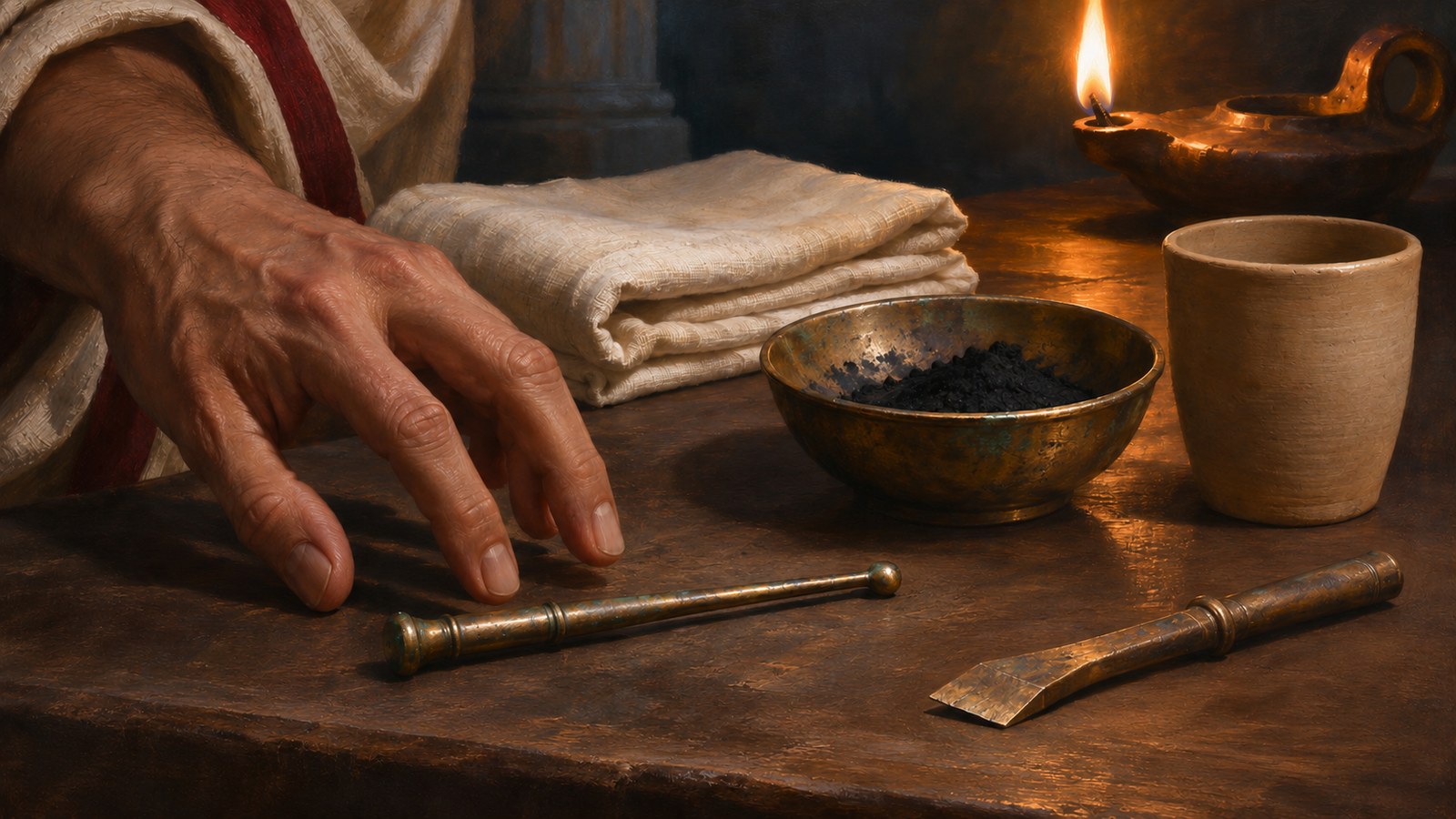
Celsus’s escalation rule was severe. If the blow had been heavy, a negative result from the probe did not close the case. The safer course was to expose the bone. If no fissure was visible even then, ink was applied across the surface and the bone was scraped with a chisel. A crack would retain the blackness.
The sequence changed the kind of evidence. First came reported symptoms and the circumstances of impact. Next came touch through a probe. Then direct exposure and sight. Finally, pigment made a narrow fissure easier to distinguish from the surrounding surface. Each step answered a weakness in the previous one.
Celsus also warned that the break might not sit beneath the obvious scalp wound. After a heavy blow accompanied by bad signs, failure to find a fissure at the injured skin should prompt examination for another soft or swollen area. That place might conceal the broken bone. The visible wound marked where the head had opened, not necessarily where all the force ended.
This insistence on searching elsewhere fits the broader Roman concern with hidden damage described in the vulnerability of the skull’s thinner regions. Celsus’s answer was not faith in one test. It was a controlled refusal to stop when symptoms, impact, and surface findings did not agree.
An 11.8-Centimetre Object Preserves the Scale of the Work
The Met’s bronze specillum is modest: 11.8 centimetres long, or 4 5/8 inches. The museum dates it to the first–second century CE, places it in its Greek and Roman Art department, and classifies it among bronzes. It entered the collection through the Rogers Fund in 1917 under accession number 17.230.96 and is listed in Gallery 171.
Those details do not prove where the object was found or what operation it performed. The record supplies no excavated context, and responsible reading must stop there. Even the paired labels—“probe” in the title and “spatula” as the object name—counsel caution about forcing a single narrow job onto a compact implement.
Yet its size clarifies the human scale of Celsus’s discussion. This was work conducted centimetres from the hand, through subtle differences in resistance and texture. The decisive issue was not grandeur but calibration. Too fine, and natural anatomy became an injury. Too thick, and an actual injury disappeared.
Celsus closes the diagnostic argument with a harsh comparison of risks. An unnecessary scalp incision, he says, generally healed without much trouble; an untreated fracture could produce severe inflammation and become harder to treat. That judgment belongs to ancient medicine, not modern advice. Historically, however, it reveals the purpose of the whole sequence: not to celebrate a clever tool, but to manage the cost of being wrong.
The probe mattered because its limitations were named. Celsus made room for a false channel, a missed fissure, deceptive roughness, displaced injury, and a respected predecessor’s mistake. Roman bronze extended the examiner’s touch, but the method became intelligent only when the operator knew where touch could fail.
Sources
Celsus, De Medicina, Book VIII, 4.1–7
The Metropolitan Museum of Art, “Bronze specillum (probe)” collection record