
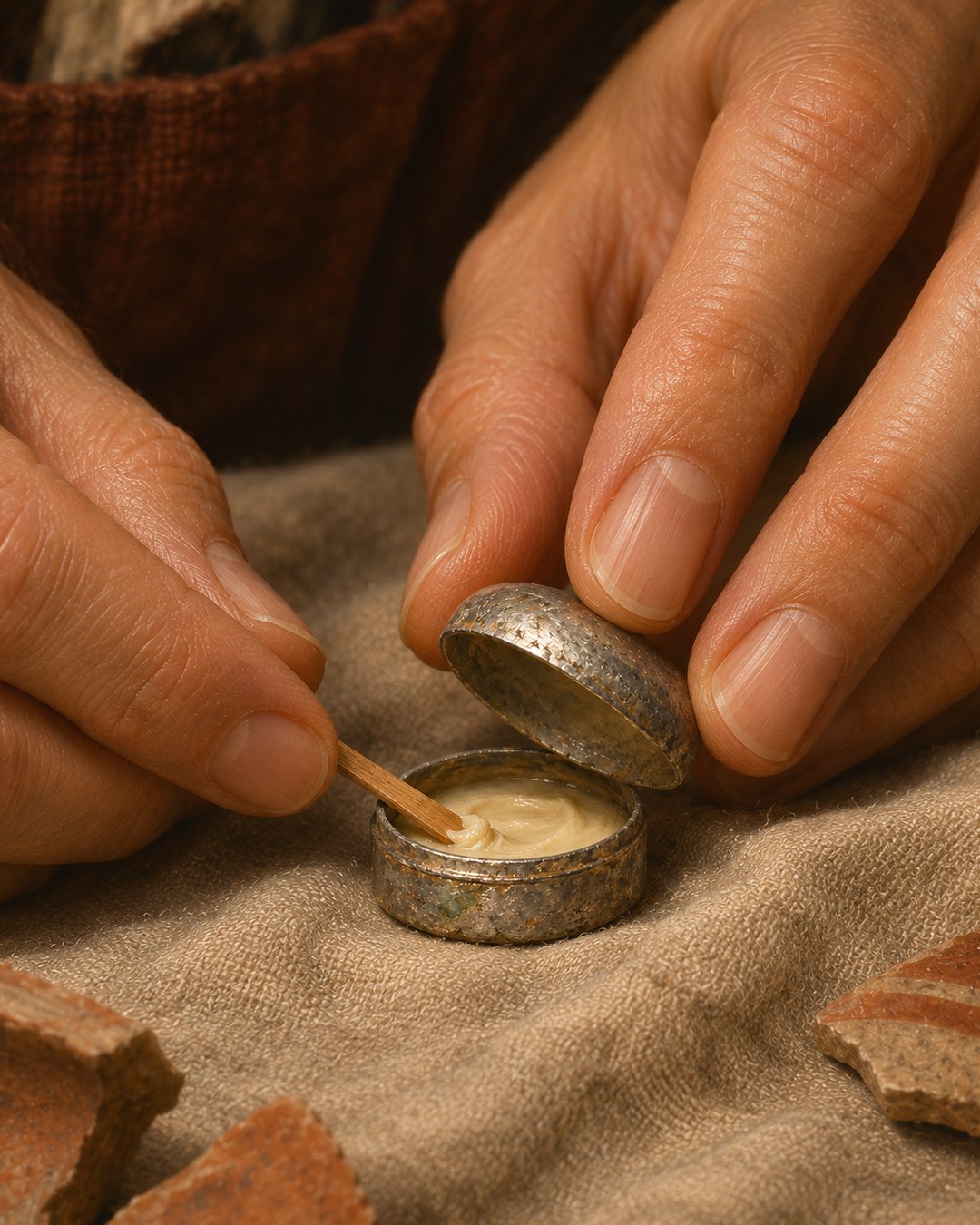
The lid came off a canister that had been closed for roughly eighteen centuries, and the material inside did not look like the dry stain an excavator might expect. It was still a soft cream. Then exposure began to change it: the paste started to solidify almost as soon as the pot was opened.
That brief physical change made the object unusually revealing. The little tin-alloy vessel was not just a container whose purpose had to be guessed from its shape. It still held the substance it had been made to protect. Chemical analysis could connect the canister to animal fat, starch and tin oxide, while the place of discovery connected personal appearance to a Roman temple complex in Southwark.
The result is more interesting than a simple claim that Romans used cosmetics. A canister only 53 millimetres high and 58 millimetres across preserves a chain of work: ingredients had to be chosen, mixed in useful proportions, sealed beneath a close-fitting lid, applied to skin and, finally, deposited in a boundary ditch with other ritual material. The cream belonged to the body, but this particular pot ended in a setting addressed to the gods.
A Close-Fitting Lid Preserved More Than a Residue
The vessel’s small size matters. At 53 millimetres high and 58 millimetres in diameter, it could sit in a hand. Its close-fitting lid turned that compact form into a protected interior. The object record does not require us to imagine a large workshop jar or a bulk shipment. This was a small canister suited to a prepared substance used in limited amounts.
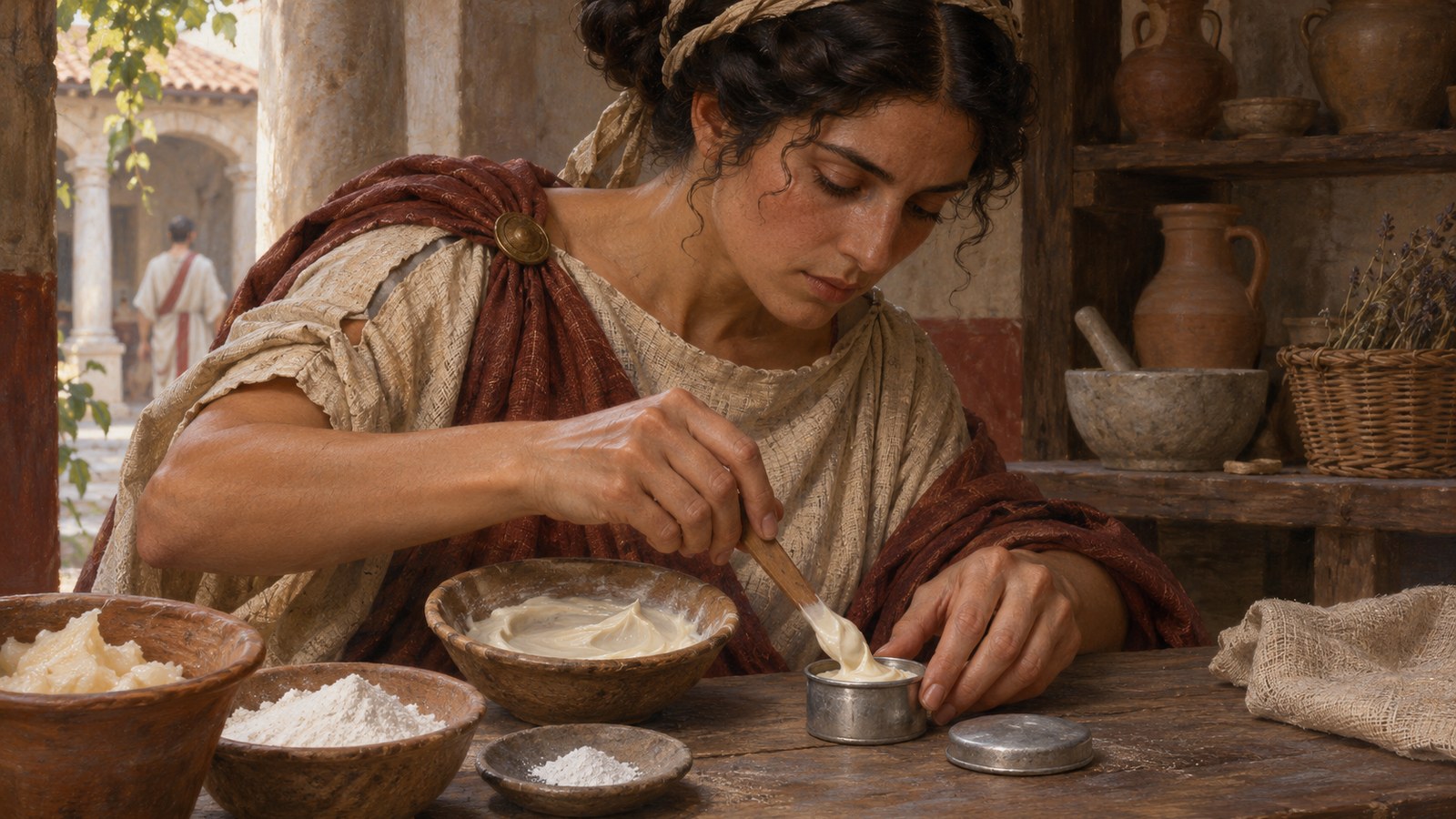
What survived inside was not one unidentified smear. Conservators encountered a soft cream, and chemical analysis identified it as a cosmetic or face cream. The mixture contained animal fat, starch and tin oxide. Each ingredient belonged to the same preparation, yet each helped explain a different part of what the finished cream could do.
Animal fat and starch, mixed in the correct proportions, would have produced a moisturiser. That phrase “correct proportions” is important. It shifts attention from luxury as display to preparation as process. Too much of one component or too little of another would change the texture. A usable cream depended on combining materials well enough to spread on skin and remain contained beneath the lid.
Tin oxide added a visual effect. The museum record explains that it gave the complexion a translucent glow. This was not simply colour painted over the face. The intended result involved the way light met the prepared surface of the skin. The same little pot therefore joined texture and appearance: the base mixture moisturised, while the mineral addition altered the finish.
Roman personal care often becomes visible through durable tools and vessels rather than surviving recipes. A related article on how Roman perfumers built scent layer by layer shows another craft in which preparation mattered as much as the final impression. Here, however, the extraordinary evidence is the preparation itself. The material did not disappear completely. It waited under the lid.
The Paste Changed the Moment the Canister Opened
Few Roman cosmetic creams survive, which makes the canister more than an attractive small find. Metals and ceramics can outlast the substances once stored in them; soft preparations usually decay, leak away or become impossible to identify. In this case the object and its contents remained together long enough for modern analysis to test what the eye first saw.
The moment of opening also supplied a miniature scene. A soft paste met the air and began to harden. That does not recreate an ancient dressing table, but it does demonstrate how much the sealed environment mattered. The close-fitting lid was not a decorative afterthought. It helped preserve a mixture whose consistency was vulnerable to exposure.
That change should make us cautious about treating an archaeological substance as static. The cream had one condition while enclosed and another after excavation. Conservators were not merely looking at a finished artefact; they were watching part of its preservation end. The evidence had to be recorded and analysed while its texture was changing.
The ingredients also resist a false divide between “natural” and “technical.” Animal fat and starch were familiar materials, but usefulness came from controlled combination. Tin oxide introduced another property. The finished paste was neither raw fat nor loose powder. It was a compound prepared for contact with the face.
Its survival lets us describe Roman cosmetics without inventing a user’s identity or motive. We do not know whose skin it touched, how often it was applied or whether its owner considered it ordinary, precious or both. We can say what the analysis supports: the mixture could moisturise, it could give a translucent glow, and it remained soft until the excavated canister was opened.
A Face Cream Entered a Temple Boundary Ditch
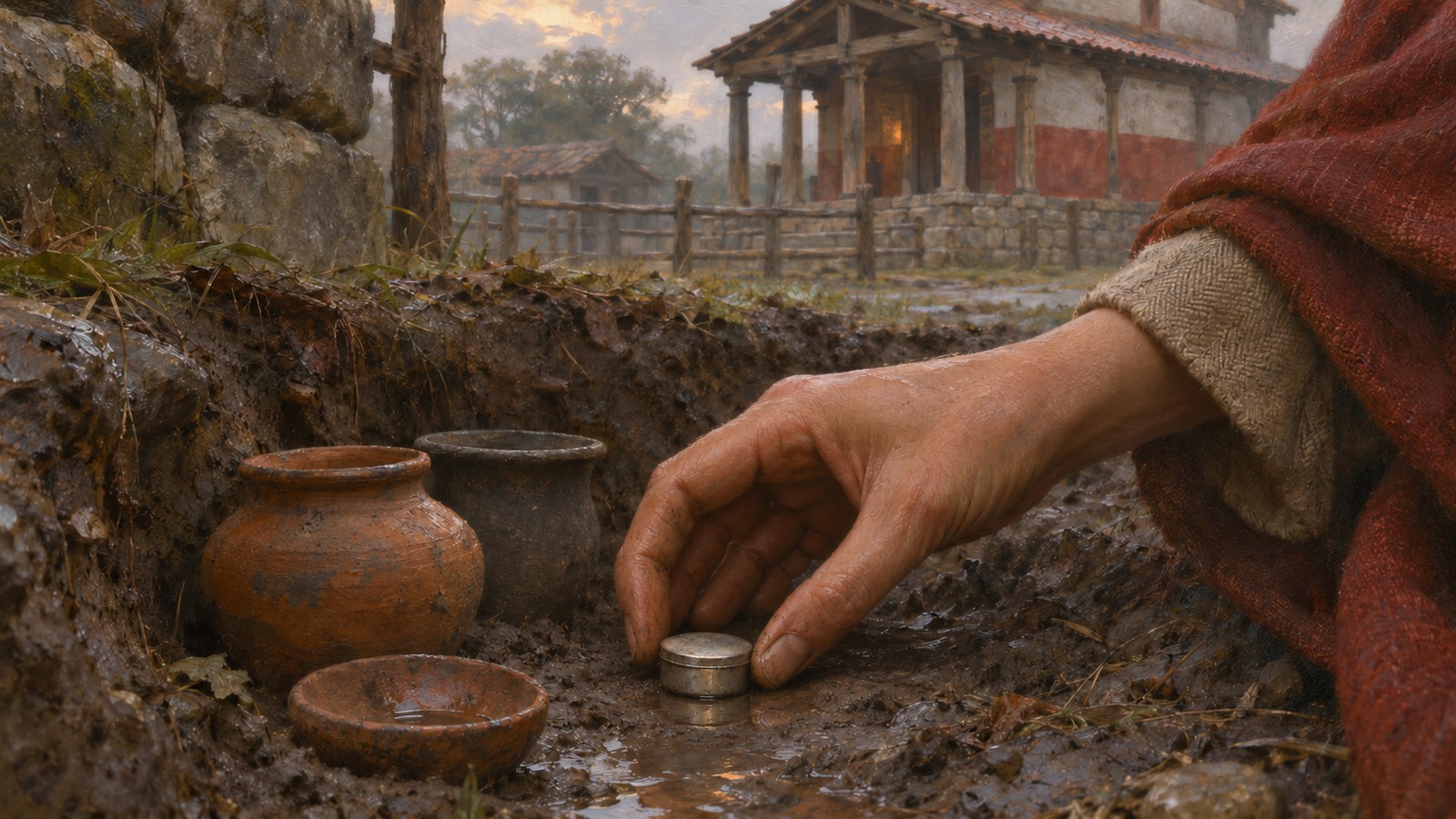
The find spot changes the article’s centre of gravity. Archaeologists recovered the canister in 2003 at Tabard Square in Southwark, during excavation of a Roman temple complex. It was not isolated from context. The pot had been placed with other ritual items in the boundary ditch surrounding the temples, and the group is interpreted as an offering to the gods.
A boundary ditch was not simply empty ground beyond a wall. In this case it became the final location for selected objects. The canister crossed from personal use—or at least a substance made for personal use—into a ritual deposit. We should not claim to know the precise prayer or occasion. The secure point is the association: face cream, other ritual items and the enclosing ditch belonged to the same archaeological context.
That association makes the canister different from a stray loss. A tiny lidded pot could easily have been dropped, discarded or emptied, but the record places it in a deposit interpreted as an offering. Its contents were still present. The vessel did not arrive as an obviously exhausted shell.
Roman religion often worked through material actions that were local, repeatable and physically specific. The discussion of how crossroads shrines made neighbourhoods visible offers another example of worship organised through place. Tabard Square gives us a different scale: a temple boundary and a hand-sized canister set among other ritual objects.
The object therefore refuses to stay in one modern category. It is cosmetic evidence because analysis identifies a face cream. It is craft evidence because the ingredients required proportion and preparation. It is archaeological evidence because the sealed contents changed after opening. It is religious evidence because of where and how the canister was deposited.
Fifty-Eight Millimetres Across, Yet Full of Connections
Around AD 150, the date assigned by the object record, Southwark was part of a Roman urban landscape in which temples, movement, work and domestic routines overlapped. The canister does not provide a panoramic view of that world. It gives something narrower and more reliable: a compact object whose dimensions, contents and context can all be described.
The narrowness is a strength. A claim about “Roman beauty” can become vague very quickly. This pot holds the discussion to measurable details. It was made of tin alloy. It had a close-fitting lid. It stood 53 millimetres high. Its diameter was 58 millimetres. It contained a soft mixture of animal fat, starch and tin oxide. The paste began to solidify when exposed. The canister came from a temple boundary ditch excavated in 2003.
Those details also show why the final deposit did not erase the object’s earlier function. The ritual context matters, but it does not turn the cream into an imaginary sacred recipe. The chemical evidence still points to moisturising and cosmetic effects. Conversely, the cosmetic function does not erase the offering. The canister’s history contains both.
There is a final contrast between glow and darkness. Tin oxide was included to make a complexion appear translucent, yet the cream survived because a lid and buried context kept it enclosed. The effect had been designed for a visible face. The evidence reached us because the preparation remained hidden.
When the lid finally lifted, that hidden material changed at once. The hardening paste was not a theatrical resurrection of Roman life. It was better evidence than that: a physical reminder that ancient routines depended on perishable substances, careful mixtures and containers that did real work. For a short moment after excavation, the canister showed all three together.
Sources
London Museum, “Canister” archaeological object record.