
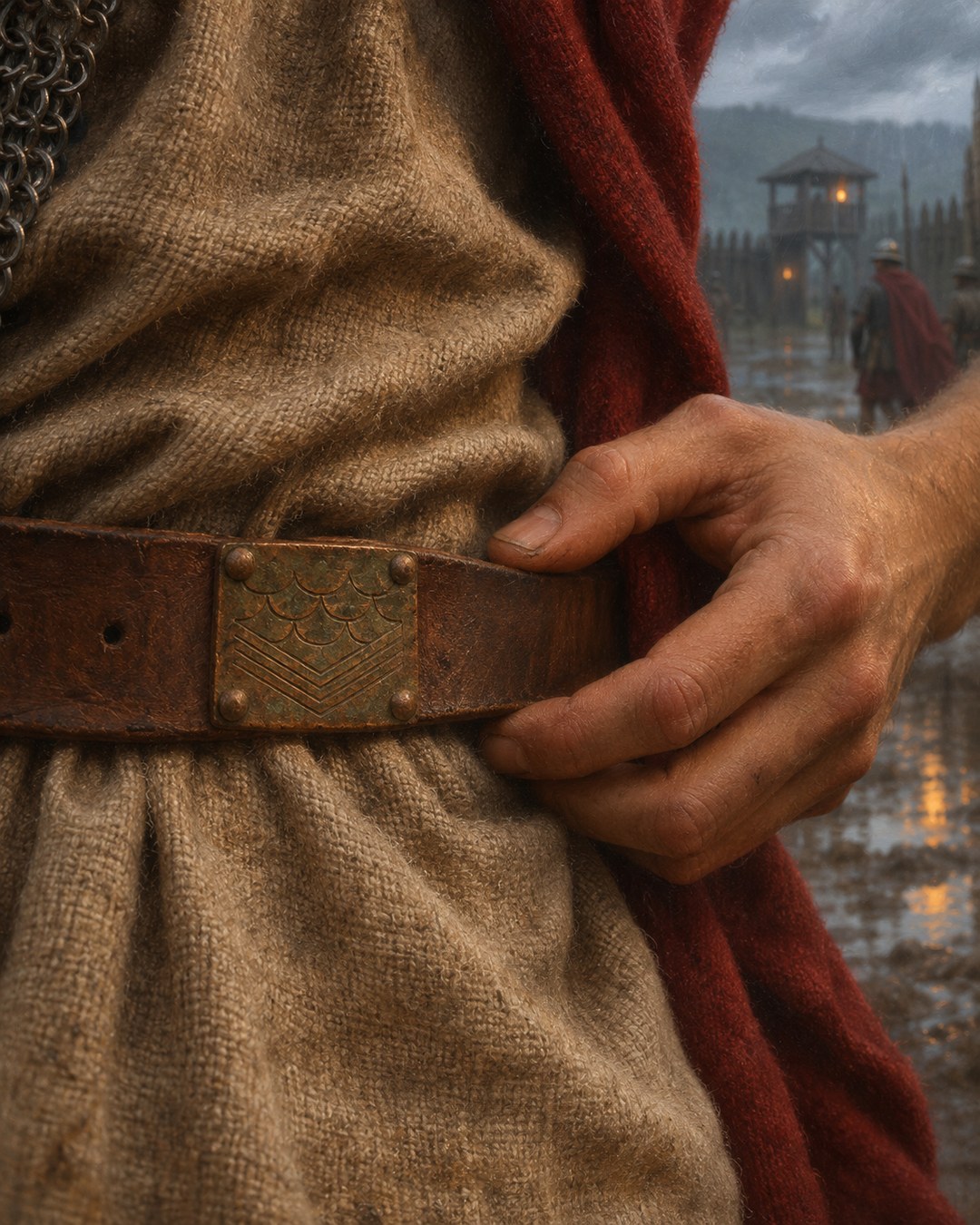
A copper-alloy plate from Roman London is small enough to disappear beneath a modern hand. It measures 47 millimetres long, 33 millimetres wide and 5 millimetres thick with its rivet. Four rivet heads occupy its corners.
The London Museum identifies it as a rectangular military belt plate. Its face carries an incised scale-and-chevron design, while the rivets project through the back. The museum says it decorated a leather belt, perhaps one worn by a Roman soldier.
That “perhaps” matters. The object’s classification and military interpretation are strong enough to guide us, but they do not identify an individual wearer or unit. What the plate reveals most securely is construction: fasteners first, decoration afterward, then attachment to leather.
Four Corners Turned Decoration Into Hardware
A belt plate had two jobs. Its visible face had to contribute to the appearance of the belt, but its hidden side had to stay attached while the leather flexed around a moving body. Four rivets joined those demands.
Placing one rivet in each corner spread the attachment across the rectangle. A single central fastener would have allowed the plate to twist. Two fasteners could resist some movement. Four corners made the mount answer the shape of the plate itself.
The rivets projected through the back because the plate was not meant to float above the leather. Their shanks crossed the hidden boundary between metal and organic material. The visible heads became part of the face while the projecting ends did the fastening work behind it.
The leather has not survived with this object in the museum record. That absence is normal but important. Metal fittings often outlast the straps, belts, cloth and stitching that made them useful. Archaeology can preserve the hard component while losing the flexible system.
The 47-by-33-millimetre size places the plate at the scale of repeated fittings rather than a broad shield-like buckle. It could decorate a belt without becoming the belt’s only visual feature. The museum record does not state how many plates belonged to the original arrangement, so a full sequence should not be invented.
At 5 millimetres thick with the rivet, the object also preserves the depth of attachment, not merely the surface design. That measurement includes the fastening element and reminds us that decorative metalwork occupied three dimensions once it met leather.
Every movement of the wearer tested the joining. Sitting, marching, bending and tightening the belt pulled leather against metal. The plate’s survival says nothing certain about how long one belt remained in use, but its construction was designed for more than a static display.
The Pattern Was Cut After the Rivets Went In
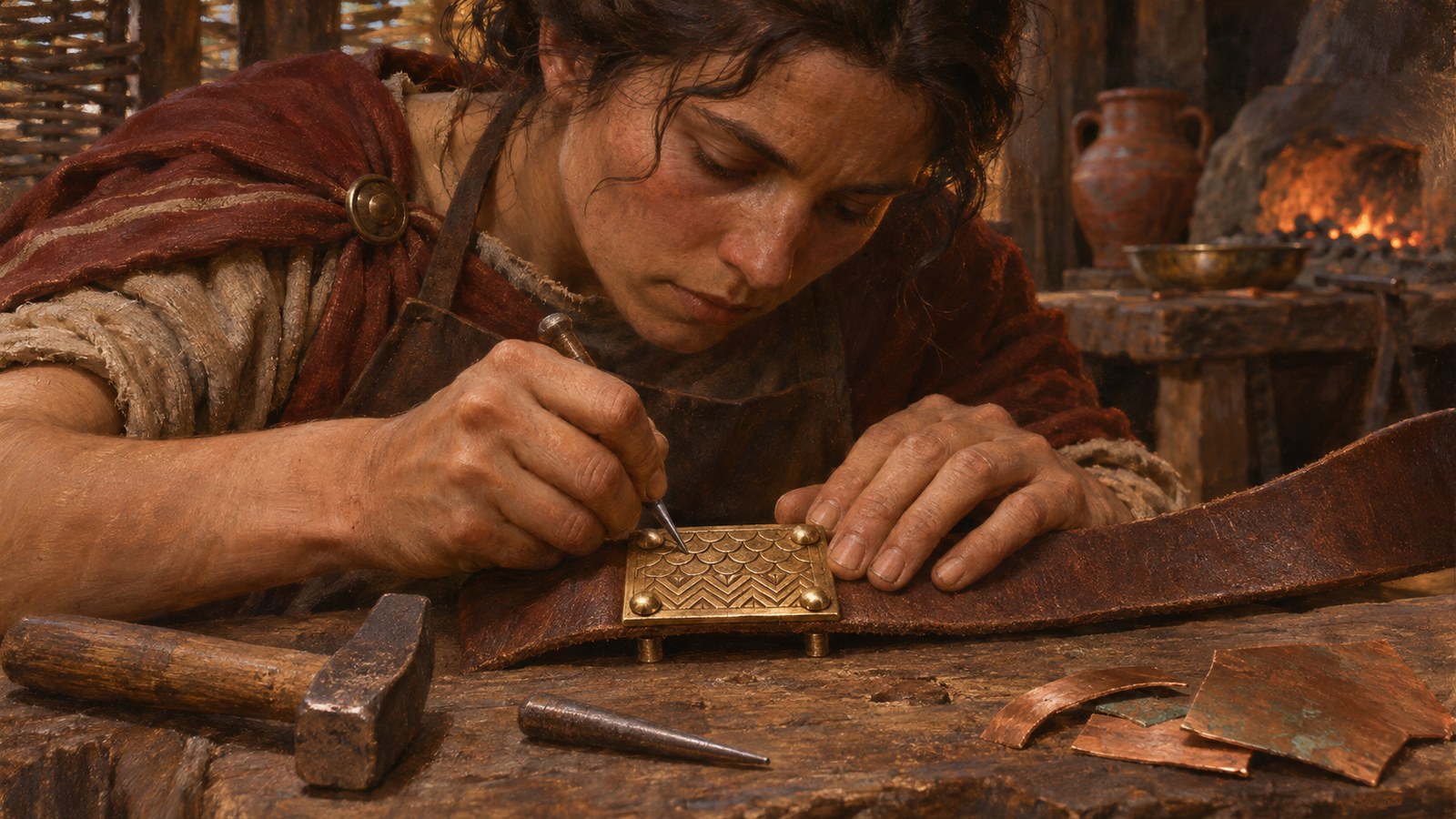
The museum records a rare piece of workshop sequence: the incised scale-and-chevron design was applied after the rivets were attached. Decoration was not completed on a pristine blank and then disturbed by fastening. The craftsperson fixed the hardware before finishing the visible pattern.
That order imposed constraints. The tool cutting the incisions had to work around four rivet heads. The pattern had to acknowledge objects already occupying the corners. A slip could strike a fastener, scar the face or break the visual rhythm.
Why choose that sequence? The record does not give the maker’s reason, so certainty would be false. It may have helped the design respond to the final position of the rivets, or it may simply reflect a workshop routine. The secure fact is the order itself.
Scale and chevron are both repeating geometric forms. They can fill a small rectangle without requiring a portrait, inscription or large scene. On a 47-millimetre plate, repeated incisions could catch light and create texture at viewing distance.
The design also turned fastening marks into a finished composition. Rivet heads could have looked like interruptions. Because they were present before incision, the craftsperson saw the same four points the eventual wearer and viewer would see.
This is a different process from casting decoration directly into a mould. Incision records a tool moving across an already formed surface. The pattern emerged through controlled removal or displacement of metal, line by line.
A related attention to sequence appears in the Roman file that made small metal errors removable. Filing and incision were different operations, but both depended on a craftsperson reading the surface after its basic shape existed.
A Belt Could Carry Identity Without Naming a Unit
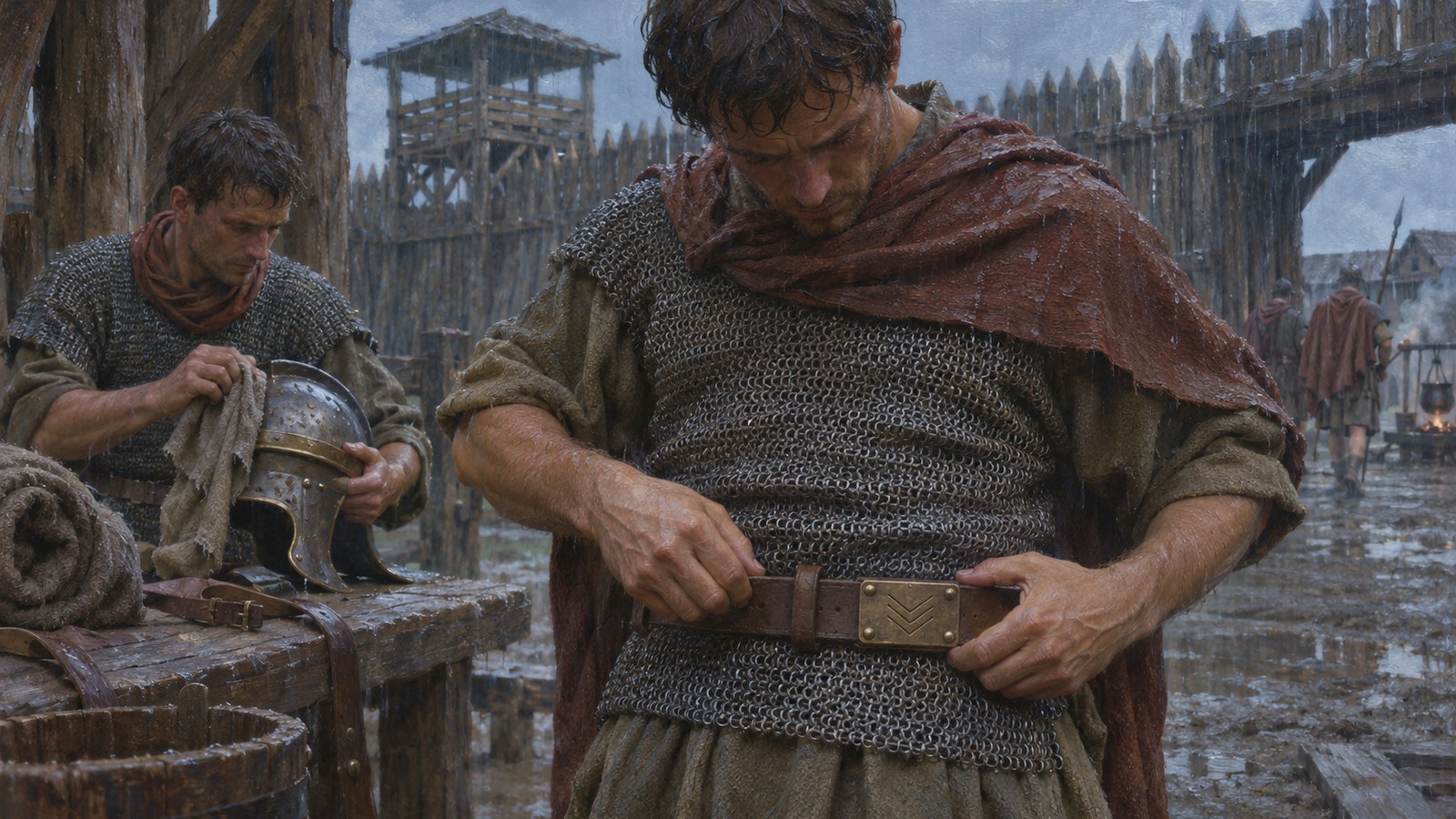
The museum cautiously says the leather belt was perhaps worn by a Roman soldier. The plate’s military classification supports that context, but the object carries no readable unit name in the record. Its visual language worked without text.
A soldier’s belt sat at a highly visible line across the body. Fittings could make ordinary leather appear ordered, maintained and associated with military equipment. The effect came from material and repetition rather than from a written badge.
The plate should not be treated as a universal uniform component worn by every Roman soldier for the entire AD 40–410 date range. That span marks the museum’s broad production dating, not four centuries of unchanged fashion.
Military dress shifted by place, date, role and supply. One fitting can prove a possible construction and decorative choice. It cannot by itself define the appearance of a legion, an auxiliary cohort or the whole army.
Even the word “military” should not make the object only about battle. Belts were worn during movement, guard duty, travel, administration and ordinary life around forts and towns. Equipment created a soldier’s visible presence before any weapon was used.
The distinction between military status and clothing status appears elsewhere in the Greek cloak that marked a Roman senator’s exile. In both cases, what a person wore communicated position, though the belt plate relied on hardware rather than a whole garment.
The copper alloy would have contrasted with leather, especially when new or polished. Its incised lines created further differences between bright edges and darker recesses. Wear could later soften that contrast, but the museum record does not provide a microscopic wear history.
The plate therefore carried identity through form rather than a literal label. Four rivets, a rectangle and a repeated pattern made the belt look made, maintained and intentional.
The Surviving Metal Reconstructs a Lost Leather Object
The plate belongs to the London Museum permanent collection and is associated in the record with Hammersmith and Fulham. Its production range is given broadly as Roman, AD 40–410. Those catalogue facts place it without pretending to recover an owner.
What survives is the part most likely to resist decay. Copper alloy can remain after leather has vanished. The metal therefore becomes a proxy for an absent belt whose width, length, buckle and full set of fittings are not supplied by this single record.
The rivets make that absent leather almost tangible. Their projection through the back identifies the direction of assembly. Face outward, shanks backward: the object tells us which side was meant to be seen and which side gripped the strap.
The incised design adds a second direction. It was intended for the viewer outside the belt, while the fastening mechanism worked against the wearer’s clothing and body. One object had a public face and a private mechanical side.
This split is common in useful decoration. The part that catches the eye may not be the part that bears the load. Here the corner heads belonged to both worlds: visible dots on the front and anchors connected to projecting shanks behind.
Roman military archaeology often preserves helmets, armour fragments and weapons because metal survives. A belt plate is quieter evidence. It describes how equipment met the body and how workshop choices shaped everyday appearance.
The plate’s exact sequence prevents us from reducing it to ornament. Rivets were attached; incisions followed; leather received the finished mount. Each stage depended on the previous one, and a failure at any stage could spoil the piece.
Four corner fasteners made the 47-by-33-millimetre rectangle stay where it was placed. The chevrons and scale pattern made that practical attachment worth looking at. Together they turned a scrap of copper alloy into military dress.
Sources
London Museum, “Mount, military belt plate.”