
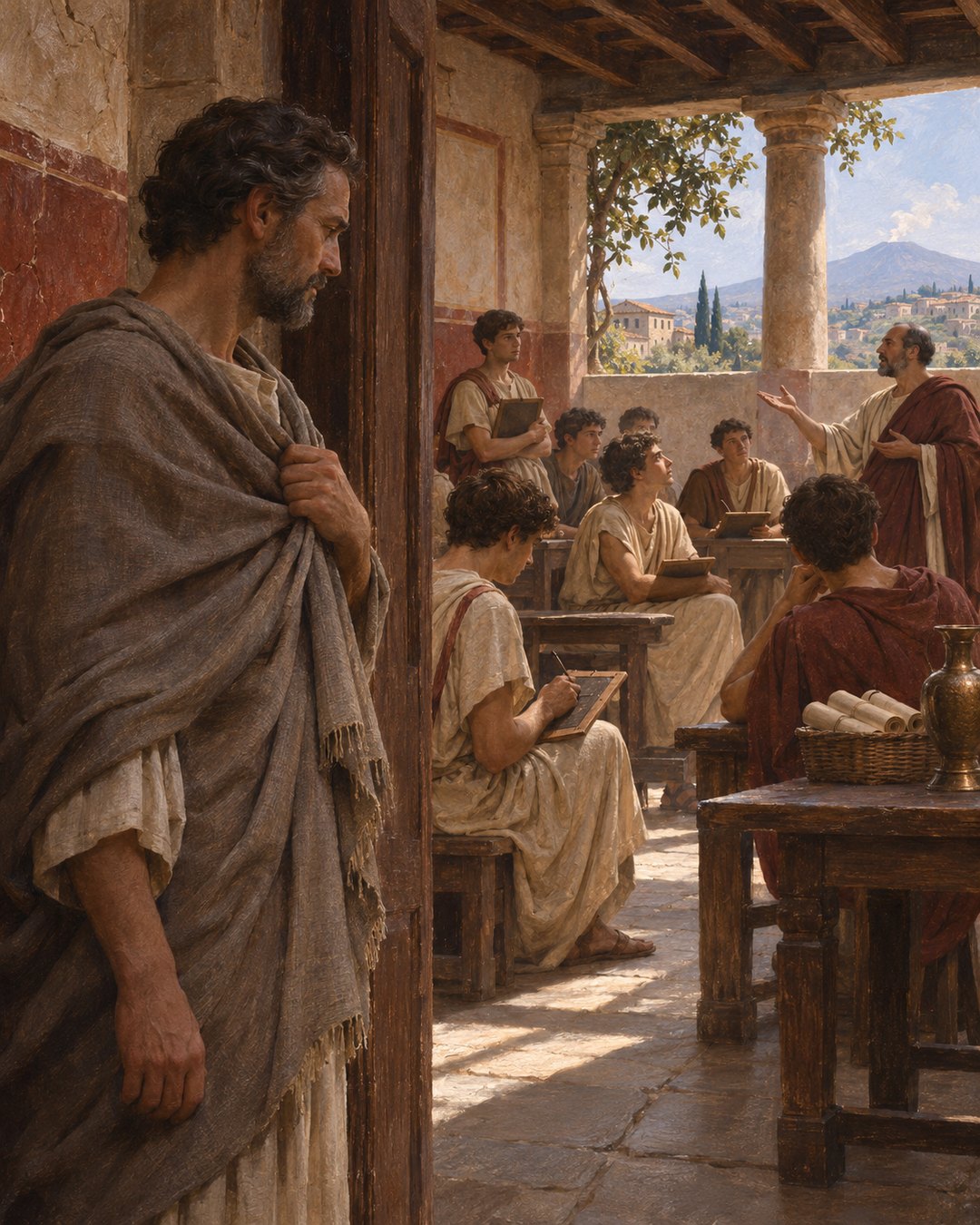
When Valerius Licinianus walked into a classroom in Sicily, his clothes announced the verdict before he spoke. He had once been a praetor, one of the men entitled to sit near the summit of Roman public life. Now he was an exile, and Pliny the Younger says that exiles could not wear the toga. Licinianus therefore faced his new students in a Greek cloak. The garment was not a decorative flourish. It made a political loss visible.
Pliny compressed the whole reversal into a sequence sharp enough to sound staged: Licinianus had fallen from senator to exile, from advocate to teacher of rhetoric. Yet the classroom did not merely display defeat. It offered him one remaining instrument that confiscation, distance, and dress could not immediately remove. He could still speak. His first performance turned the signs of exclusion into the subject of the lesson.
A Praetor Arrived as a Professor
Pliny introduced the news as something that had only just reached his correspondent. Valerius Licinianus, formerly a praetor and a celebrated advocate, had become a professor in Sicily. Each part of that description mattered. A praetorship placed a man inside Rome’s formal ladder of office. Advocacy gave him a public voice in the law courts. A professorship preserved speech, but moved it into a different social setting. Sicily added the physical fact of removal from Rome.
The transformation was not from eloquence to silence. It was from one audience to another. As an advocate, Licinianus had used trained speech amid cases, clients, rivals, and magistrates. As a teacher, he would demonstrate and explain the techniques by which younger speakers learned to perform. The same capacity remained useful, but its public meaning had changed. Pliny’s sentence makes status look less like a possession than a frame around an activity. Take away the frame and even a familiar skill appears different.
That is why the episode belongs beside the story of the censors who tried to close new Latin classrooms. Roman education in rhetoric was never only about elegant sentences. It trained men for the places where rank, law, and persuasion met. Licinianus carried experience from those places into a school, but he arrived as evidence that political standing could be broken while technical mastery survived.
Fortune Became His Opening Exercise
Pliny reports that Licinianus began his inaugural speech with an address to Fortune. The line accused her of playing capriciously with human beings: she made rhetoricians out of senators and senators out of rhetoricians. It was more than a complaint. It was a balanced verbal construction, the kind of reversal a trained speaker could make memorable. Licinianus used his own fall as the material of his first demonstration.
The second half of the contrast widened the joke. If Fortune could turn senators into teachers, she could also elevate teachers into senators. Roman careers were not literally exchanged by a goddess arranging matching pieces, but the formulation exposed how unstable the labels could feel. A man who had possessed office could be stripped of it. Another man’s training and connections could lead him toward public advancement. Fortune gave the reversal a name without requiring Licinianus to offer his students a detailed defence of his past.
Pliny called the remark bitter and full of gall. That judgment keeps the scene from becoming a cheerful tale of reinvention. Licinianus had found a professionally brilliant opening because he had suffered a professionally devastating change. Wit did not cancel exile. It allowed him to control, for a sentence, the way his audience first understood it.
The Cloak Said What the Classroom Did Not
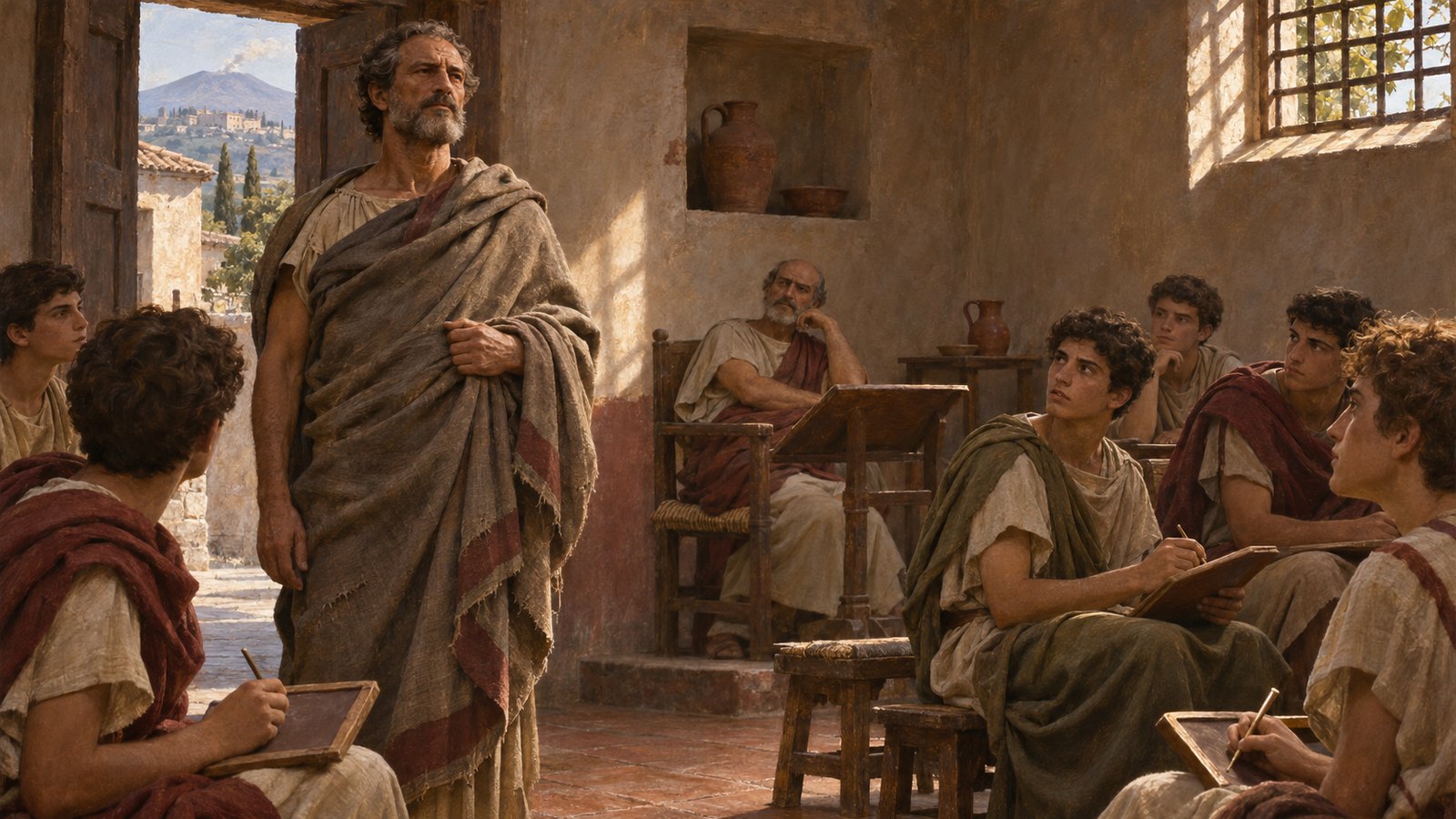
His clothing completed the argument before the lesson continued. Pliny says that Licinianus appeared in a Greek cloak because exiles had no right to wear the toga. A toga could be cumbersome, but in Roman public life its inconvenience was part of its force. It marked a wearer within the civic order. Losing it meant that the body itself no longer presented the old claim to belonging.
The Greek cloak did not make Licinianus culturally foreign. Educated Romans read Greek, quoted Greek authors, and treated Greek rhetorical training as essential. The point was legal and visual rather than a simple opposition between Roman and Greek culture. On this particular man, in this particular setting, the cloak showed that a boundary had been crossed. His education remained recognisably elite; his civic costume did not.
Pliny invites us to picture the pause. Licinianus arranged himself, looked down at what he was wearing, and then spoke. That downward glance matters because it turned the garment into an acknowledged part of the performance. He did not pretend the change was invisible. He made his students notice that he had noticed it too.
Roman public clothing often carried information without a written label. Rank, ceremony, age, and occasion could be read from fabric and form. Licinianus’s pallium worked as a negative badge: not the costume that granted a new office, but the substitute that exposed the removal of an old one. The classroom may have offered him a platform, yet the cloak fixed the terms on which he stood there.
Latin Survived the Loss of the Toga
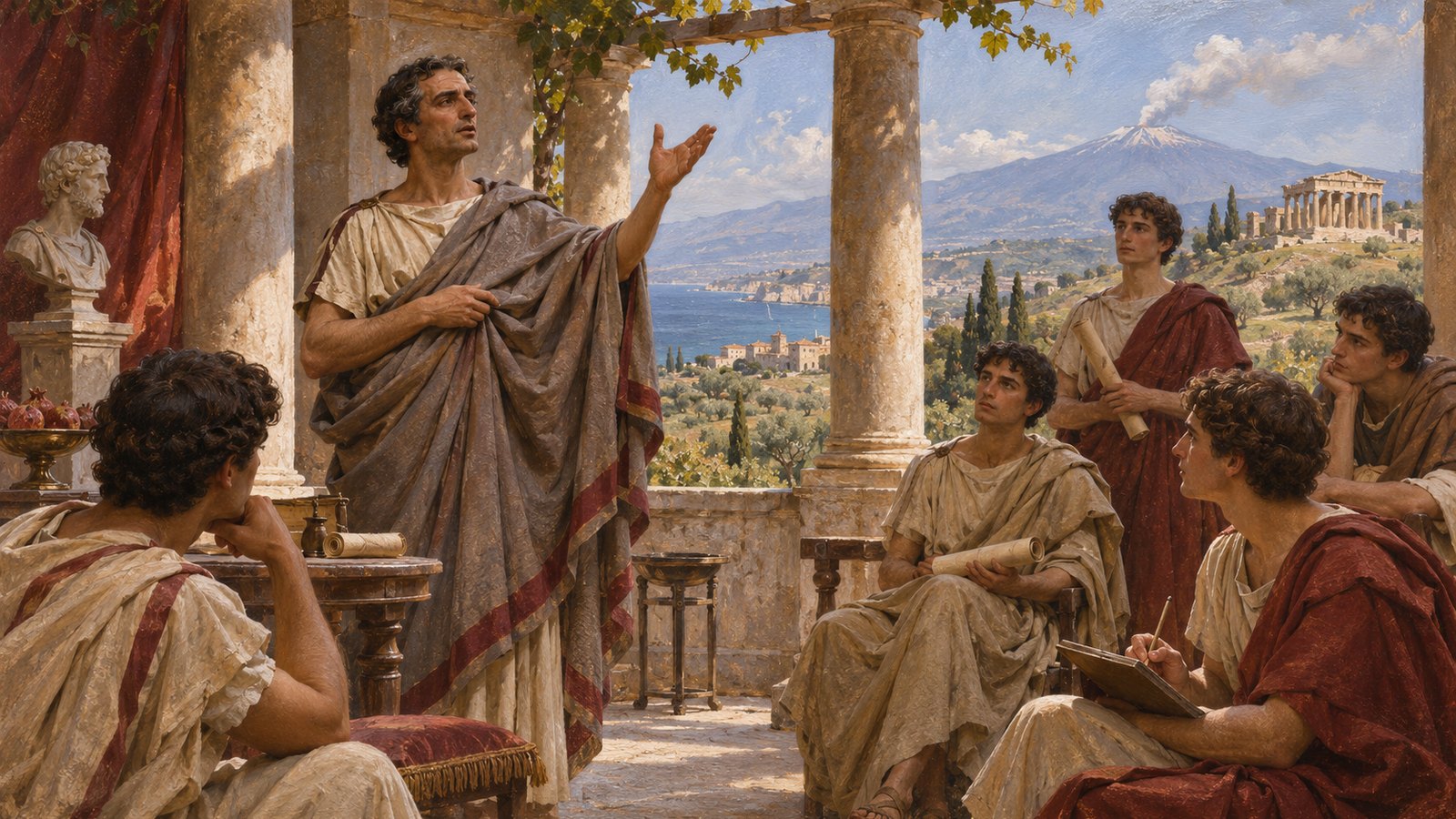
After looking at the cloak, Licinianus declared that he was nevertheless going to declaim in Latin. The sentence drew a boundary around what exile had and had not changed. He could not dress as he once had. He could not simply resume his praetorian place. But he retained the language, memory, and technique through which he had built an orator’s reputation.
“Nevertheless” carried the pressure of the whole scene. Greek clothing did not force Greek speech. Provincial distance did not erase a Roman professional formation. A changed legal position did not instantly empty the mind. Licinianus presented Latin declamation as continuity, perhaps even as defiance, but a limited kind. The students were not watching a restored senator. They were watching an exile prove that one part of the former advocate still functioned.
The choice also made good teaching. An inaugural lecture must establish authority. Licinianus could no longer rely on office alone, so he converted biography into credentials. The room knew that he had pleaded as an advocate and held a magistracy. By naming the mismatch between cloak and language, he showed composure, verbal balance, and control of an awkward audience. His humiliation became the first object on which he demonstrated his craft.
Another Plinian episode, Cornelia’s composure at the edge of execution, shows how elite Romans could make bodily presentation bear enormous political weight. Licinianus’s danger and outcome were different, but the evidentiary problem is similar. Pliny gives us a shaped scene. Gesture, clothing, and a polished sentence reveal how he wanted a ruined career to be remembered.
Pliny Preserved a Performance, Not a Transcript
Pliny’s letter is brief. It does not supply a classroom inventory, a roster of students, or the rest of Licinianus’s lecture. It offers selected lines and a dramatic visual sequence. That selectivity is useful if we handle it honestly. We can say that Pliny represented Licinianus as a former praetor and advocate who taught rhetoric in Sicily after exile. We can say that the letter connected his Greek cloak with the loss of the toga and quoted his promise to declaim in Latin. We cannot turn those details into a complete record of his life as a teacher.
The compression is itself revealing. Pliny expected his correspondent to understand why praetor, exile, professor, toga, Greek cloak, and Latin declamation formed a coherent chain. None needed a long explanation inside the letter. The social machinery was familiar enough that the reversal could land quickly.
That makes the episode more than an anecdote about a clever comeback. It shows Roman status being communicated across several systems at once. Law determined exclusion. Geography placed Licinianus in Sicily. Clothing displayed the consequence. Education preserved a marketable skill. Language let him claim continuity. Pliny’s prose tied them together and gave the scene its afterlife.
Licinianus did not recover his office by speaking well. The Greek cloak remained on his shoulders. Yet the first lecture refused to let the garment have the final word. Exile had changed where he stood, what he could wear, and how Pliny named his career. It had not made him inarticulate. The former senator’s reduced platform became the place where he demonstrated exactly what remained.
Sources
Pliny the Younger, Letters, the letter to Cornelius Minicianus on Valerius Licinianus; Project Gutenberg edition of Letters of Pliny.