
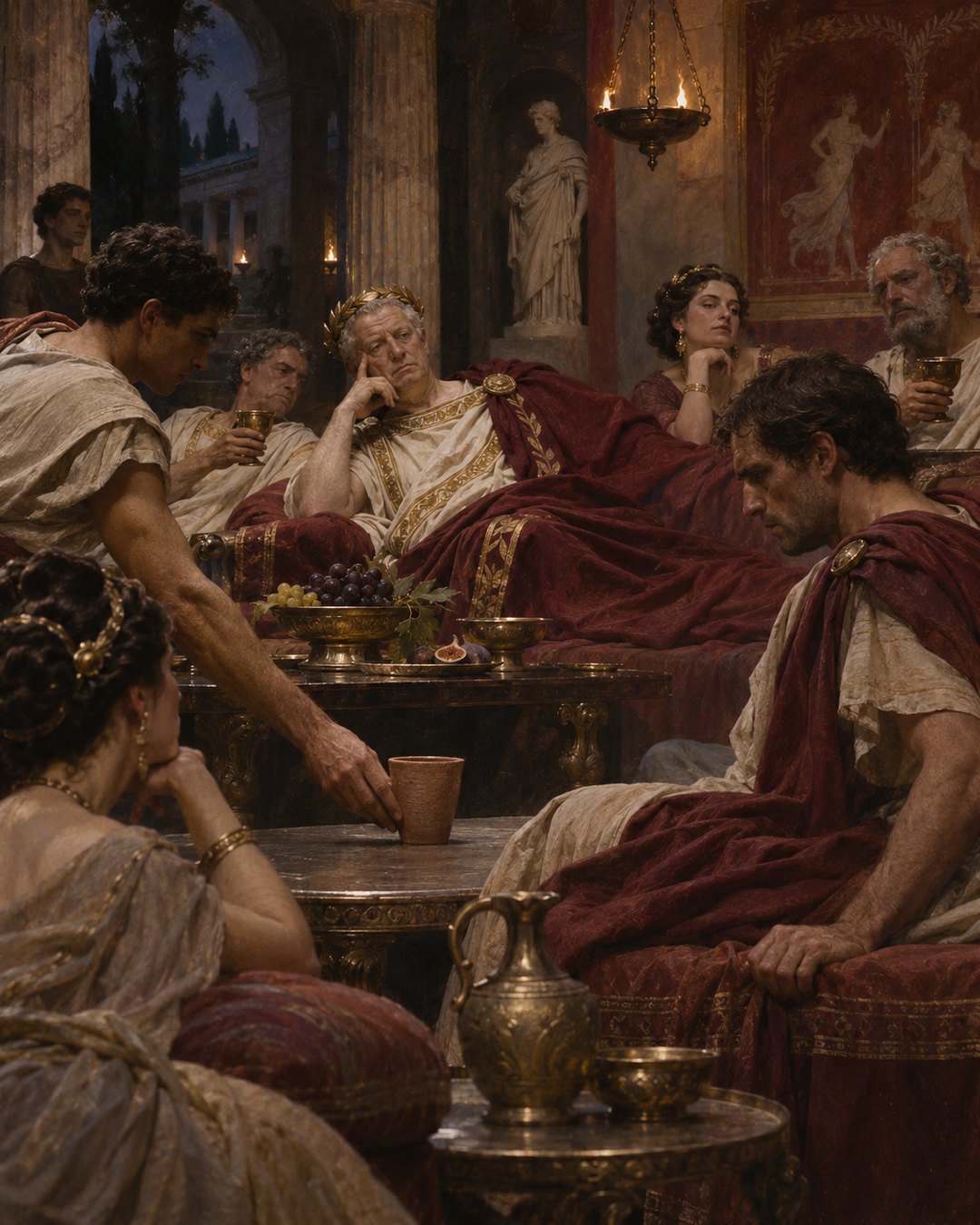
A gold bowl vanished from the emperor Claudius’s dinner table. Suetonius does not give us an investigation, a confession, or a courtroom. He gives us something smaller and more uncomfortable. A guest was suspected of taking the vessel. Claudius invited him back the following day—and placed an earthenware cup before him.
The story occupies only a few lines in the ancient biography, but its mechanism is precise. The suspected man was not barred from the house. He was returned to the same social setting under altered conditions. Everyone could dine again; only one place told a different story. Gold had become clay, hospitality had become surveillance, and suspicion had been turned into tableware.
Claudius Used Dinner as a Public Stage
Suetonius places the anecdote among details about Claudius at meals. The emperor, he says, invited his own children to dine with the sons and daughters of distinguished men. The young guests sat at the arms of the dining couches according to an old custom. This was not a private snack eaten beyond public view. The arrangement joined family, rank, inherited practice, and imperial hospitality in one visible room.
A Roman dinner could carry several kinds of information before anyone began a conversation. Who received an invitation mattered. Where bodies were placed mattered. The vessels brought by attendants mattered. Precious metal made wealth and honour visible, while ceramic served ordinary practical needs. At an imperial table, such differences acquired additional force because the host controlled the room and occupied the highest political position within it.
That does not mean every cup encoded an official rule. It means Suetonius’s readers could understand why changing one guest’s vessel made an effective anecdote. Claudius did not need to issue a long statement. The meal already had an audience, a hierarchy, and a set of objects through which favour could be displayed.
The episode also fits the unstable dinner culture shown in the humiliations Claudius endured before becoming emperor. In that earlier setting, olive stones, date stones, and slippers made a sleeping man the object of a joke. At the imperial table, Claudius controlled the object that defined another man’s discomfort.

The Second Invitation Was the Punishment
The sharpest part of the story is the renewed invitation. If Claudius had simply excluded the suspected thief, the man would have disappeared from the room. By asking him back the next day, the emperor recreated the setting in which the loss had occurred. The guest had to decide whether to refuse imperial hospitality or return to a table where suspicion could be made visible.
Suetonius does not say that Claudius proved the theft. His wording preserves suspicion. That distinction matters. The clay cup was not the recorded sentence after a formal conviction; it was a host’s response to a belief about what had happened. The anecdote therefore shows power operating below the level of a trial. Claudius could alter a guest’s treatment without presenting evidence to a court.
Invitation and punishment were fused. The man remained included enough to be present but excluded from the trust represented by valuable tableware. He could eat with the group, yet the material before him declared that he was no longer treated like the other diners. It was a social penalty designed to be seen.
The timing tightened it further. Suetonius says the bowl was suspected of being stolen the previous day and that the guest was invited again the next day. There was no long interval in which the meaning of the substitution could blur. The memory of the missing object and the sight of its cheap replacement belonged to consecutive meals.

Clay Made Suspicion Visible
The contrast depended on materials. A golden bowl represented concentrated value in an object small enough to pass through many hands during service. An earthenware cup did the same basic job—holding drink—without presenting the same temptation or honour. Claudius did not leave the guest thirsty. He changed the risk and the message at once.
Clay was effective because it was functional. A broken or stolen ceramic vessel would not carry the same loss as gold. Yet the replacement did more than protect property. It publicly narrowed the guest’s access to the signs of elite trust. The cup told him that the host remembered.
Suetonius’s compressed narrative does not identify the vessel’s maker, shape, capacity, or decoration. We should not invent them. Nor does he list the reactions of the other diners. The power of the anecdote lies in what the ancient author selected: a missing gold bowl, suspicion fixed on a guest, a second invitation, and a clay cup placed before that man.
Those details form a miniature sequence of object-based judgment. The first bowl created the loss. The invitation returned the suspected person to imperial space. The replacement vessel prevented repetition and displayed a verdict that had never become a formal verdict.
No Accusation Was Needed at the Table
Suetonius does not quote Claudius confronting the man. Silence makes the scene harsher, not softer. A spoken accusation could be answered. A cup already waiting at a place on the couch offered no obvious debate. Its meaning emerged from comparison with the richer service around it and from the previous day’s disappearance.
This was not legal due process. It was household and imperial authority expressed through hospitality. Claudius owned the vessels, issued the invitation, and determined what would be set before each person. The guest’s presence depended on the host’s will. In that narrow world, rearranging the table was enough to rearrange status.
The story resembles other Roman practices in which portable objects carried authority. A seal could authenticate a closed message, and wax and cord could make interference visible. Claudius’s clay cup was not a seal, but it worked through the same broad Roman confidence that material differences could communicate trust, control, and breach without a paragraph of explanation.
We should also notice the biographer’s craft. Suetonius chose an episode that could be grasped instantly. Gold and clay form a clean opposition. The next-day invitation supplies surprise. The absence of a trial leaves room for readers to judge Claudius as shrewd, mocking, arbitrary, or all three.
A Tiny Object Revealed an Unequal Relationship
It is tempting to treat the episode as a practical anti-theft trick. It was that, but only at the simplest level. Claudius could have protected his property by removing precious vessels from the entire dinner. Instead, in Suetonius’s telling, one suspected guest received different treatment. The solution preserved luxury for the trusted and exposed distrust toward one man.
That asymmetry is the point. Imperial dining joined generosity with dependence. A guest enjoyed access to food, entertainment, company, and valuable objects, but the host could redefine that access overnight. The suspected man’s second invitation proved that he still belonged within reach of the emperor. The earthenware cup proved that belonging did not mean equality or security.
The anecdote cannot tell us how common such substitutions were, whether the guest had actually taken the bowl, or what happened after the second meal. It can tell us how Suetonius made Claudius legible to readers. The emperor responded to suspected theft not with an abstract speech but with a controlled social scene. He invited the man close enough to understand the message.
Gold disappeared; clay arrived; the dinner continued. No herald announced a sentence. No surviving line records the guest’s defence. One cheap cup carried the whole accusation because it stood at a table where every other detail—invitation, position, material, and memory—was unequal.
Sources
Suetonius, Life of Claudius, section 32; Loeb Classical Library translation reproduced by LacusCurtius.