
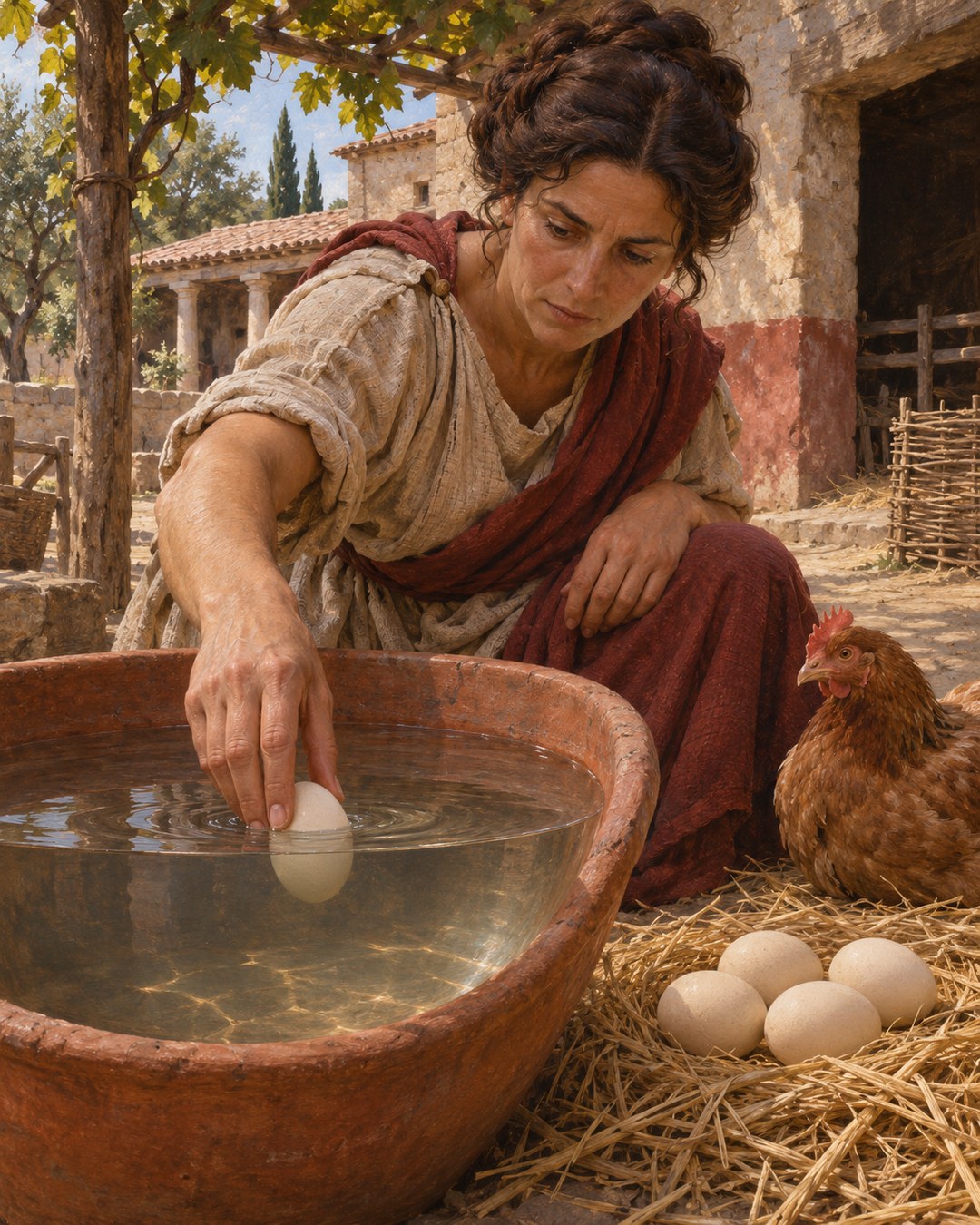
An egg does not announce what is happening behind its shell. To a Roman keeper choosing a clutch, every candidate presented the same pale, sealed surface. Yet the decision mattered. Space beneath a brooding hen was limited, the calendar kept moving, and an egg that contained nothing could occupy warmth that a viable one needed. Pliny the Elder preserves a compact set of checks for this invisible problem. The most memorable required no knife, lamp mechanism or special instrument. The keeper lowered the egg into water and watched whether it sank or floated.
The detail is easy to mistake for a kitchen trick detached from serious work. In Pliny’s account it belongs to a sequence about incubation: when eggs should be set, how they could be examined against light, why shaking was discouraged, and how seasonal heat altered the expected hatch. The water test was therefore not a party curiosity. It was one decision inside a managed process, used before scarce brooding space was committed for weeks.
Ten Days Defined the Useful Window
Pliny begins with time rather than water. He says eggs intended for sitting paid best when they were placed under a hen within ten days of laying. His wording also warns against treating “fresh” as an unlimited virtue: in the translation, both older and fresher eggs are described as infertile. Whatever biological precision we would demand from that sentence today, its practical message is clear. Roman poultry management relied on a preferred interval, not on collecting any egg and hoping.
He adds that an odd number should be put beneath the hen. That instruction gives us a glimpse of work counted one object at a time. A clutch was assembled deliberately, not merely accumulated. The keeper had to know which eggs had been laid when, decide when the sitting would begin, and choose a number the bird could cover. This is the same practical Roman world in which specialised poultry could become a business, as the trade in peacocks raised for elite tables makes unusually visible.
The ten-day rule also explains why testing mattered. A failed egg was not only a failed outcome. It consumed part of a narrow window and one place in a clutch. Identifying an empty shell early protected the rest of the schedule.
Light Offered the First Look Through the Shell
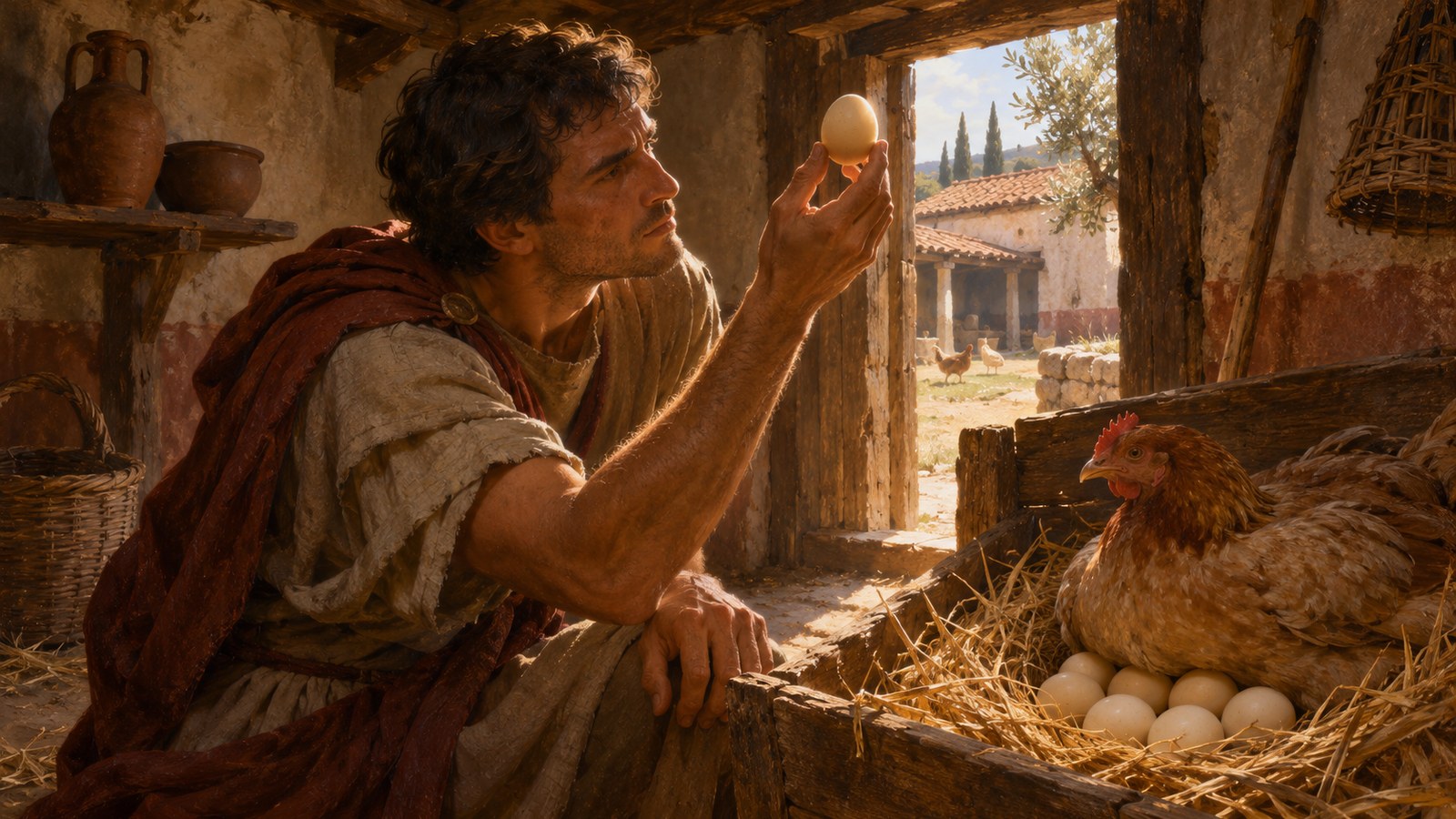
After three days of sitting, Pliny says the keeper could hold the upper part of an egg in the fingertips against the light. If it showed a transparent colour of one uniform hue, it was judged barren and another egg should be substituted. This is not modern candling described with modern anatomy. It is a Roman observation in Roman language: the shell was made briefly legible by changing its relationship to light.
The timing is important. This check came after incubation had started, while replacement still seemed worthwhile. Pliny’s keeper was not waiting passively for a hatch or a smell. The clutch was reviewed, and an egg that looked uniformly transparent could lose its place. The procedure joins sight to scheduling: three days, a held shell, a patch of light, then a decision.
Pliny’s wording does not tell us how consistently different keepers interpreted the colour. It does show that they expected practice to sharpen judgement. Fingertips had to hold the egg without dropping it; the angle had to admit enough light; the observer had to distinguish a suspicious uniformity from a promising interior. Roman agricultural knowledge often lived in repeated gestures of this kind rather than in elaborate equipment.
Water Turned Hidden Fullness into Motion
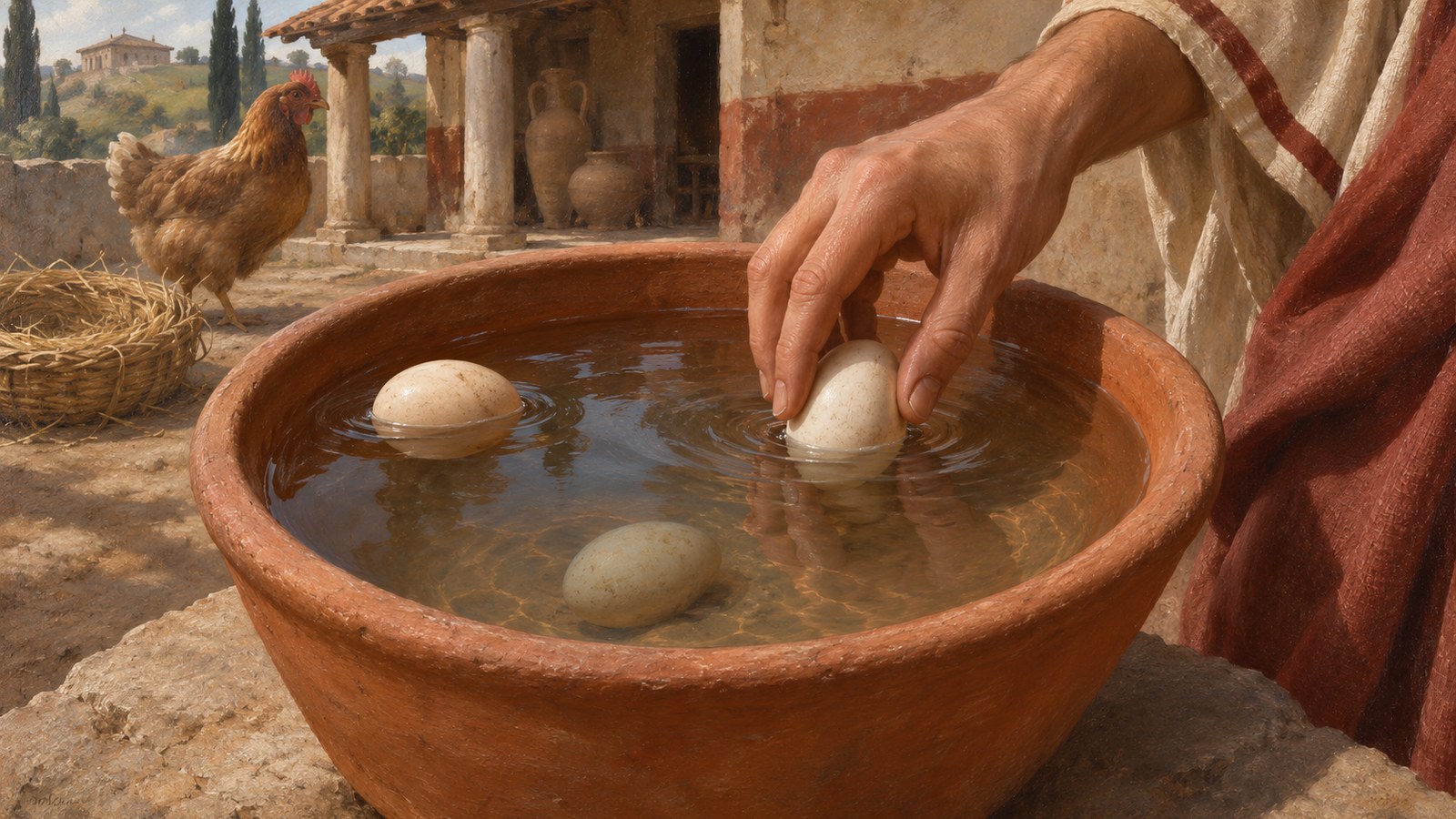
The second test moved the problem from light to buoyancy. Pliny says an empty egg floats. Eggs that sink were preferred for placing under hens because they were considered full. The action converted a hidden interior into an external movement anyone beside the vessel could see. The egg either remained high in the water or travelled downward.
“Full” in this passage should not be expanded into a claim that Roman keepers understood every cause behind buoyancy. Pliny records a working distinction and its consequence. A sinking egg won confidence; a floating one did not. The procedure was quick, repeatable and cheap. Its apparatus was a vessel deep enough to show the difference and water clean enough to see the result.
The test also belonged to selection for incubation, not necessarily to every culinary use. Pliny’s sentence is explicit about preference for eggs “to put under the hens.” That purpose changes the standard. A cook choosing an ingredient and a keeper building a clutch were not asking exactly the same question, even though both handled the same shell. Roman food culture could turn eggs into elaborate disguises, as a surviving recipe behind anchovies transformed with eggs and steam shows; here the egg was valued for the bird it might become.
Shaking Was Rejected as a Destructive Test
Pliny immediately places a boundary around experimentation. He reports a warning against shaking eggs because the “vital veins” might be displaced and the eggs made sterile. The explanation uses ancient reproductive ideas, but the operational rule is unmistakable: do not obtain information by an action believed capable of ruining the thing being tested.
That restraint makes the water and light procedures more coherent. Both sought evidence while leaving the shell intact. One altered illumination; the other let the surrounding water act on the egg. Neither required breaking it open. The keeper’s problem was not merely to know what was inside. It was to know while preserving the possibility of a hatch.
The warning also reminds us not to turn Pliny into a modern laboratory manual. His chapter mixes close observation, inherited rules, seasonal calculations and remedies we would not accept. The practical and the mistaken stand side by side. Reading him responsibly means preserving both: Roman keepers used non-destructive checks, and they explained those checks within an ancient account of life inside the shell.
Eighteen and Twenty-Four Days Made Heat Visible
Pliny gave two expected hatch times: eighteen days in summer and twenty-four in winter. Warmth, in his account, shortened the wait. Those figures supplied a deadline against which the keeper could judge the clutch. They also made season part of husbandry. The same egg-setting routine did not produce the same calendar in every month.
A deadline also changed how failure appeared. Before the expected hatch, a silent egg still represented possibility. After the seasonal interval had passed, the same shell became evidence that time, warmth or selection had gone wrong. Pliny’s figures helped a keeper decide when patience ceased to be useful. The numbers made an invisible process accountable to the calendar.
He assigned the ninth day after a new moon for beginning a hen’s sitting and added warnings about thunder and hawks. He even mentioned an iron nail under the straw as a remedy against thunder. These details reveal a management system wider than the water bowl. Some parts rested on observation; others on cosmology, fear and protective custom. They were not separated for the ancient reader as neatly as a modern handbook would separate evidence from superstition.
The useful historical point is therefore larger than whether the float test “worked.” A Roman clutch was timed, counted, inspected, tested and guarded. The sealed egg became an object of management before it became a chick. Water mattered because it made one otherwise invisible difference available at the exact moment a keeper had to decide which eggs deserved the hen’s warmth.
Sources
Pliny the Elder, Natural History, Book 10, section 75.