
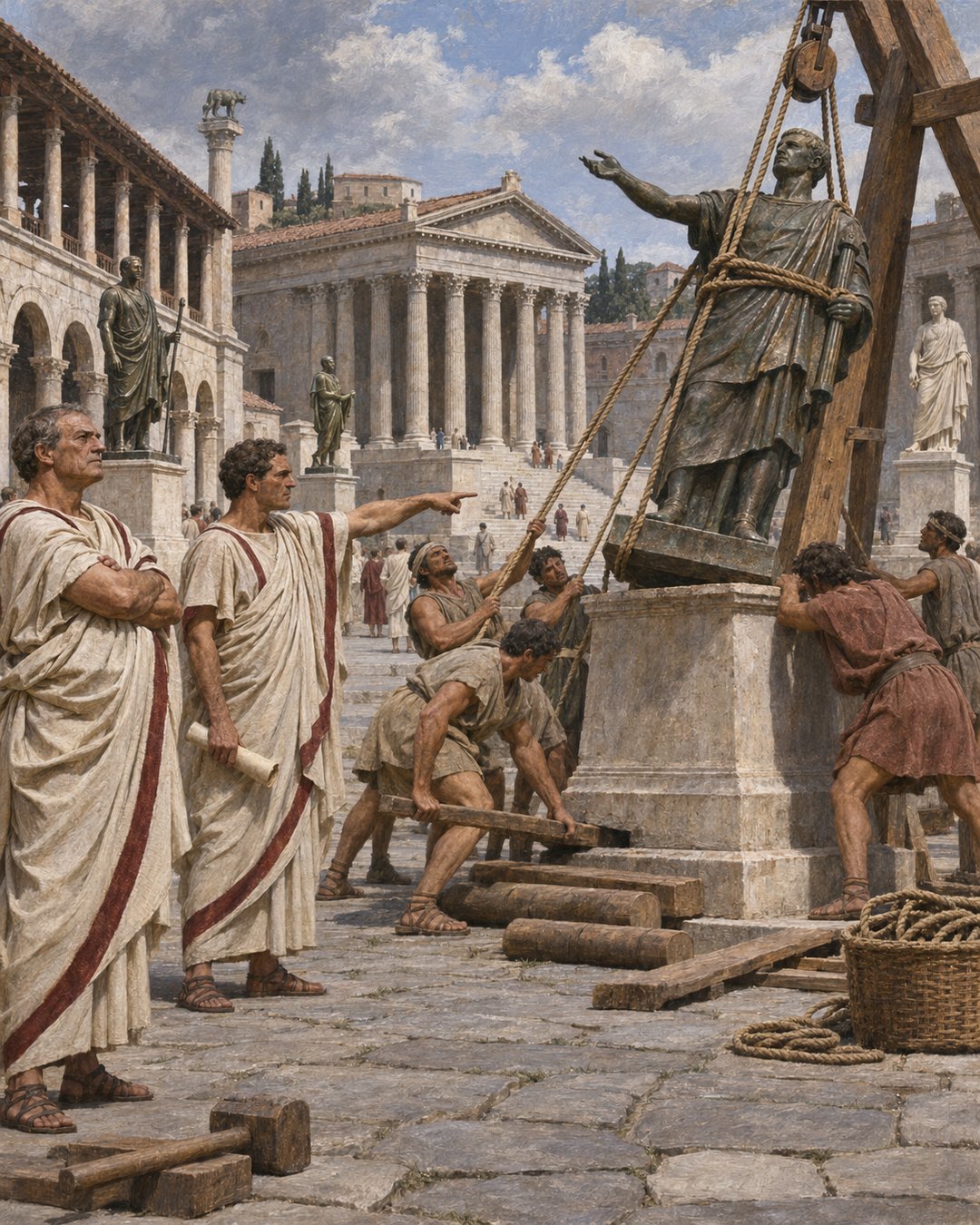
The Roman Forum once underwent a clearance of political images. Pliny the Elder, citing the historian Lucius Piso, says two censors ordered statues of former magistrates removed from around the civic center. The exceptions reveal the rule: an image could remain if the people or the Senate had authorized it.
This was not hostility to every statue. It was a judgment about who had the right to turn personal office into permanent public presence. A magistracy could end, but bronze and stone continued making claims after the officeholder left.
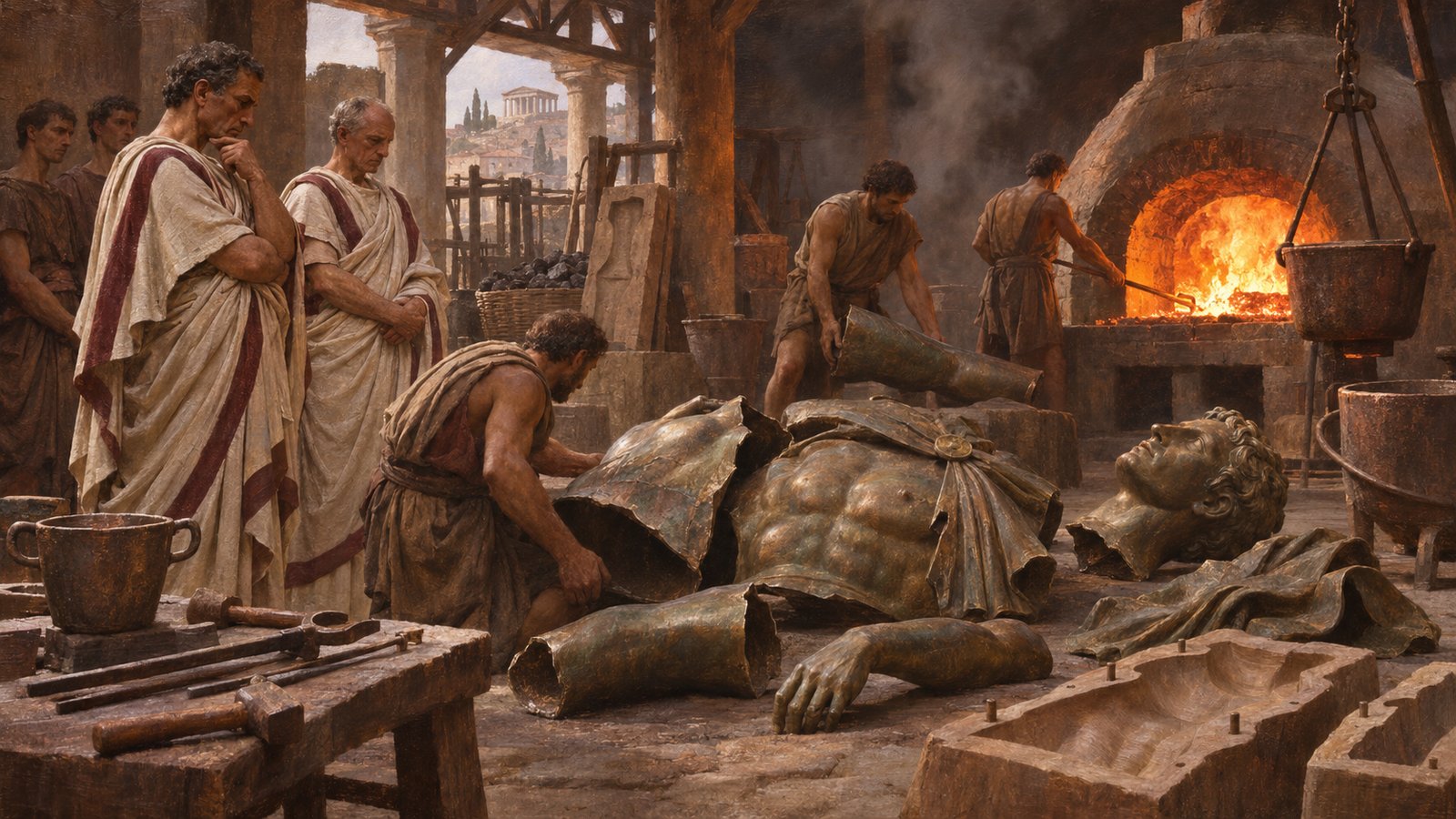
One image received an even harsher treatment. Spurius Cassius had supposedly erected a statue to himself before the Temple of Earth. Pliny says the censors melted it down. The metal itself was denied the chance to keep advertising the man.
The Forum Was a Political Display Surface
A statue in the Forum did more than decorate open space. It inserted a body into the routes of law, business, worship and public memory. Viewers repeatedly encountered the honored person at a scale and in a material designed to outlast ordinary life.
That persistence made placement valuable. A former magistrate represented in the civic center could continue to look like a public authority even when the constitutional term had ended. Repetition turned one grant of office into a durable impression of importance.
The censors’ intervention treated the Forum as regulated space. Pliny does not say they evaluated each statue’s artistic quality. Their test concerned legitimacy: who had authorized this honor? The image’s right to remain depended on a political act outside the portrayed man’s own ambition.
Roman censors already operated where reputation met public consequence. Their broader power could make conduct count, as seen in the censorial scrutiny of status and reputation. The statue clearance applied similar supervision to the physical landscape of prestige.
Authorization Was the Line That Saved an Image
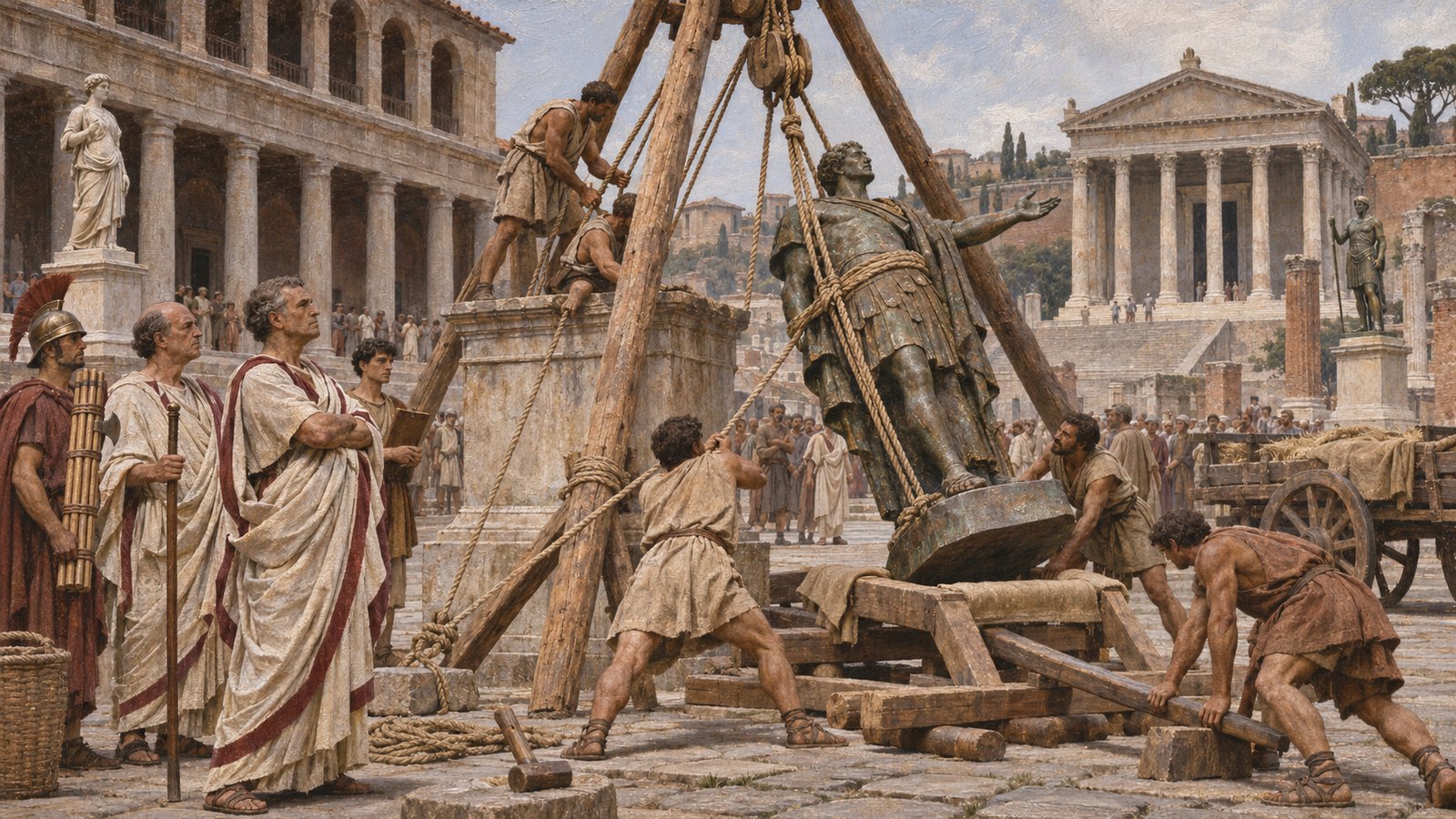
Pliny gives two acceptable sources of approval: a resolution of the people or a resolution of the Senate. That distinction matters because it preserves collective honors while rejecting images that lacked a recognized public decision.
The rule therefore did not erase memory indiscriminately. A statue backed by one of those resolutions could remain even if other images of men with the same office disappeared. Holding a magistracy was not sufficient evidence that a monument belonged in the Forum.
Authorization separated commemoration from self-promotion. An approved statue represented a community claiming that the subject deserved visibility. An unapproved one risked looking like the subject or his allies had converted temporary power into permanent occupation of public space.
The source does not supply a catalogue of removed works, their materials or their ultimate destinations. Some may have been relocated, dismantled or otherwise disposed of, but Pliny only says they were removed. The clear point is the filter, not the fate of every object.
Spurius Cassius Lost More Than a Place
Spurius Cassius’s statue did not receive the ordinary verb of removal. Pliny says it was melted down by the censors. The distinction suggests that relocation would have left too much of its claim intact. Bronze could be placed elsewhere and continue to preserve a recognizable honor.
Pliny identifies two aggravating facts. Cassius had erected the statue in his own honor, and Roman tradition accused him of aspiring to monarchy. The monument stood before the Temple of Earth, so private ambition had acquired a conspicuous public and sacred setting.
Melting reversed that achievement. A portrait turns material into a named person; the furnace returns the named person to anonymous metal. Even if the bronze was reused, it no longer held Cassius’s face, pose or self-selected place.
We should keep Pliny’s politics visible. “Aspiring to monarchy” is his characterization within a Roman tradition deeply suspicious of kingship. The passage is evidence for how later Romans framed Cassius and his image, not a neutral transcript of the man’s intentions.
The Censors Policed Ambition in Bronze
Pliny supplies his own conclusion: earlier Romans took precautions against ambition in statues too. The final word matters. Political ambition could be expressed through speeches, clients, buildings and office, but it could also harden into a body standing where citizens had to see it.
A monument was useful precisely because it made ambition appear settled. Once mounted on a pedestal, an individual claim could begin to resemble part of the Forum’s inherited order. The clearance interrupted that transformation before age supplied false legitimacy.
The operation also required visible labor. Statues had weight. Removing them meant ropes, supports, workers and decisions about the cleared bases. Civic regulation became a physical event, not merely a decree filed away from the square.
Roman stories repeatedly connect statues with the conditions of their visibility. One image was even moved after advice placed it badly in shadow. Here visibility itself was the disputed prize: unauthorized honor in the Forum could not be corrected by better lighting.
The Rule Was Narrower Than a Ban on Honor
The surrounding passage prevents a simple claim that Romans rejected public statues. Pliny goes on to discuss Cato’s protests against statues to women in the provinces and the seated statue of Cornelia, mother of the Gracchi, at Rome. Images continued to multiply, and debates shifted with them.
The Forum clearance is better understood as an authorization audit. It accepted that statues could express legitimate collective gratitude while refusing to treat officeholding as an automatic license for self-commemoration.
That balance made the political source of the honor more important than the subject’s rank. A former magistrate might be impressive, wealthy and well connected, yet his image still lacked standing if no public or senatorial resolution supported it.
The censors Publius Cornelius Scipio and Marcus Popilius therefore acted on memory as well as space. They decided which representations could continue telling citizens that a particular man deserved to be encountered among Rome’s public exemplars.
Their action was also temporary in the larger history of Roman display. Later rulers and patrons filled the city with new monuments. But temporary enforcement still reveals the principle that bothered Pliny: a statue was not passive decoration. It was ambition made durable.
Spurius Cassius’s melted bronze gives that principle its sharpest form. The ordinary unauthorized statues lost their positions. His self-dedicated image lost its identity. The censors did not argue with the monument’s message in words; they removed the body that delivered it.
What remained was the authorization rule itself. The people or Senate could grant permanence, but a magistrate could not safely manufacture it alone. In a Forum crowded with claims about service and rank, the pedestal needed a political foundation as much as the statue needed a physical one.
The named officials also keep the episode from becoming a vague story about austere ancestors. Pliny identifies Publius Cornelius Scipio and Marcus Popilius as the censors and places the action in the second consulship of Marcus Aemilius and Gaius Popilius. The administrative decision is attached to offices and a chronological frame, even though the passage does not preserve the operational order.
Nor does the exception make popular and senatorial approval identical. Each was a separate route by which a monument could acquire recognized standing. Pliny groups them because both placed authority outside the commemorated magistrate. The essential contrast was between honor granted through a public institution and honor installed without that foundation.
The empty spaces left by the clearance would have communicated the ruling too. Citizens did not need to read a legal explanation on every pedestal. They could see that some images remained while others disappeared, and that the most politically tainted self-image had been reduced to metal.
Sources
Pliny the Elder, Natural History, Book 34.