
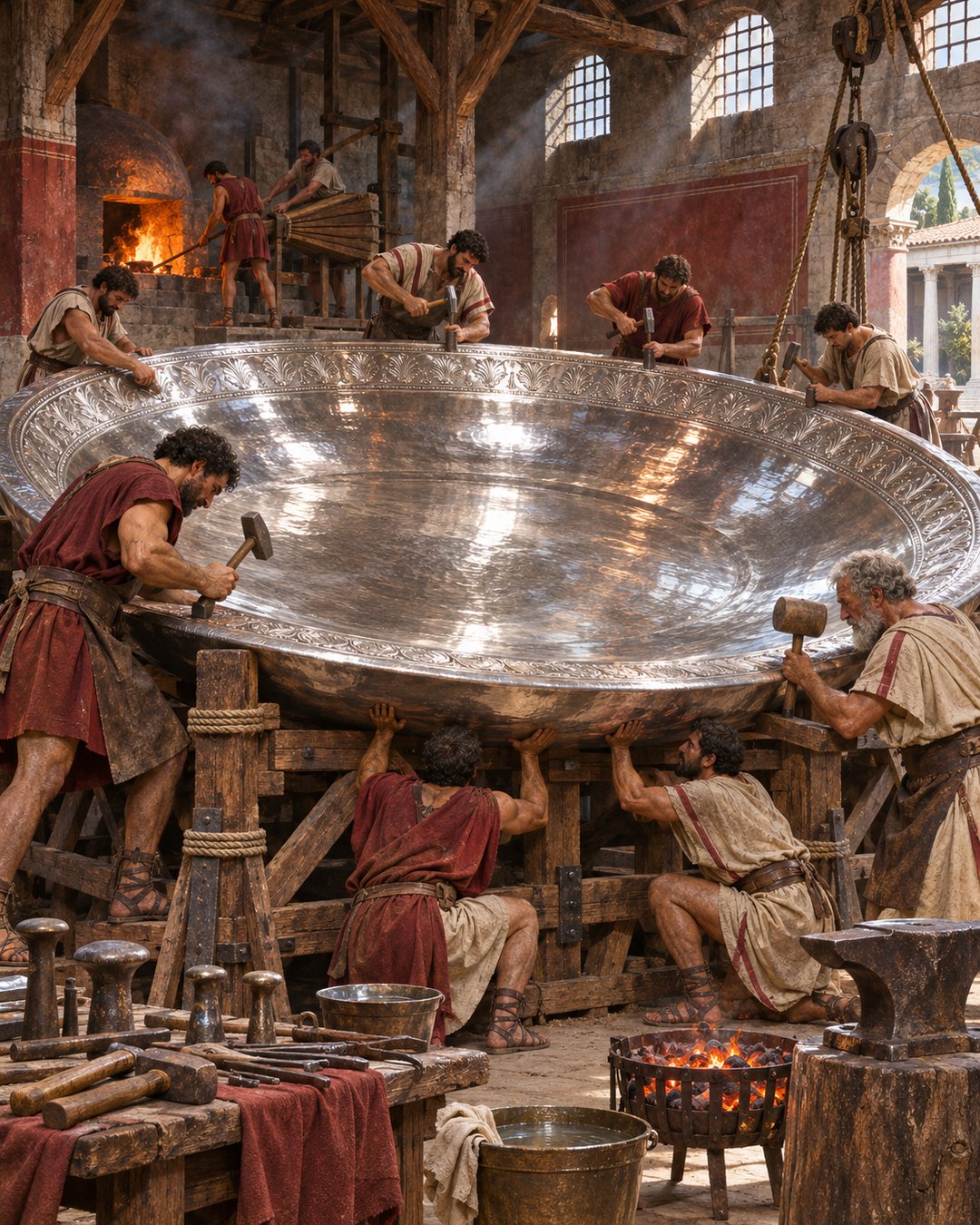
A silver serving charger in the household of Drusillanus Rotundus weighed five hundred Roman pounds. Pliny the Elder says the object was so large that a workshop had to be built specifically to manufacture it.
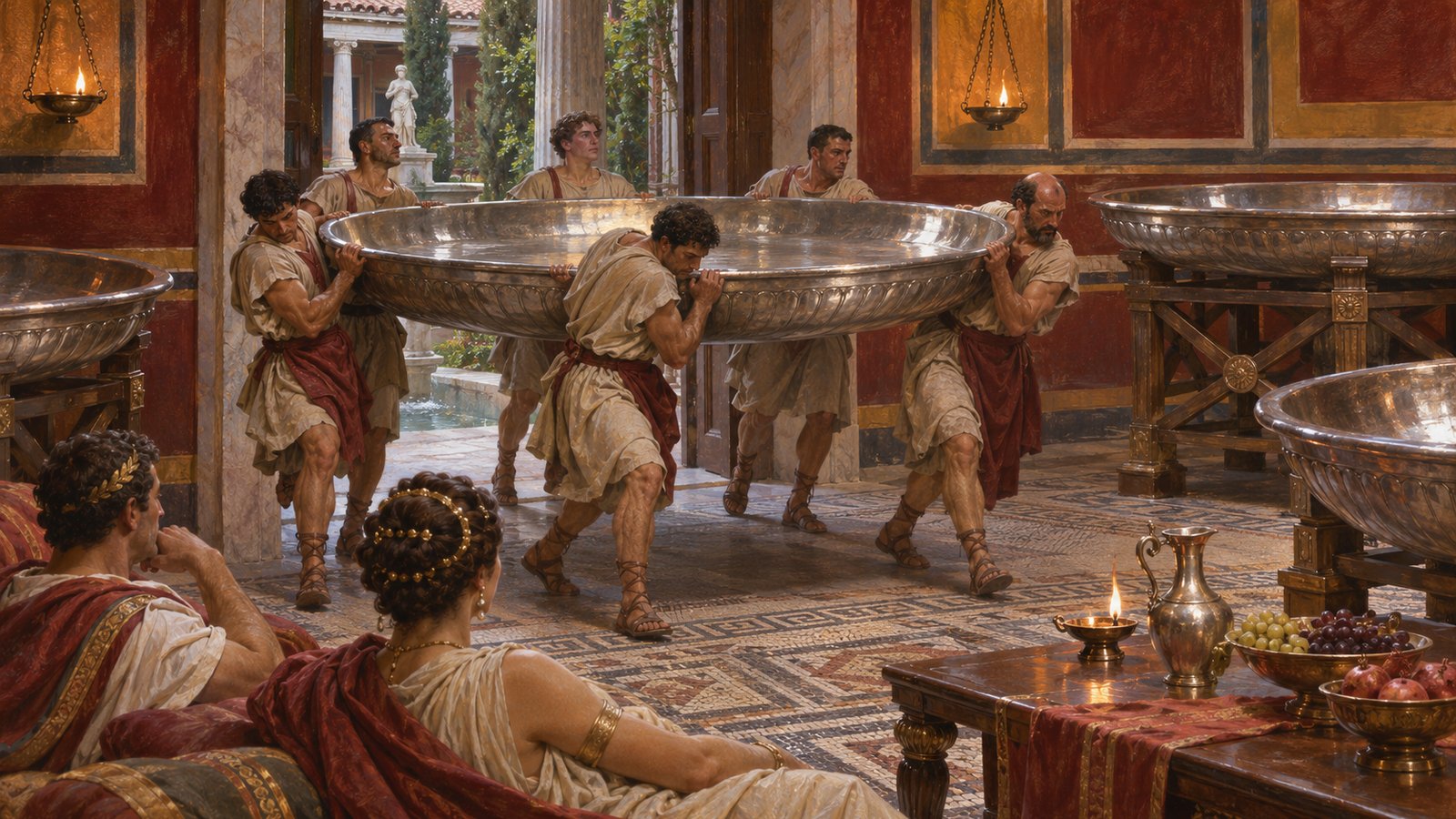
It did not stand alone. Eight companion dishes weighed two hundred and fifty pounds each. Pliny’s first practical question was not what food they held, but how many enslaved attendants it would take to carry them into the room.
The set turned dining plate into infrastructure. Metal had to be acquired, a building prepared, artisans organized and bodies assigned to move the result. Luxury was no longer an ornament placed on a table; it determined the workshop and choreography around the table.
Five Hundred Pounds Changed the Scale of the Workshop
Pliny places the great charger in the reign of Claudius. Its owner, Drusillanus Rotundus, was an imperial slave who served as steward in Nearer Spain. His legal status and administrative position sat beside extraordinary command of material wealth.
A five-hundred-pound piece could not simply be treated like an enlarged household bowl. Its sheet or cast sections had to be formed, supported and joined without collapsing under their own weight. The work surface, heating arrangements and lifting plan all had to match the object.
Pliny gives the strongest evidence of that mismatch in one sentence: a workshop was built expressly for the job. The production space became part of the commission. Before the charger could occupy a dining display, architecture had to accommodate its making.
He does not give its diameter, thickness or precise serving function. “Charger” translates a category in his account, but a confident modern reconstruction of its measurements would outrun the evidence. Weight and dedicated workshop are the secure facts.
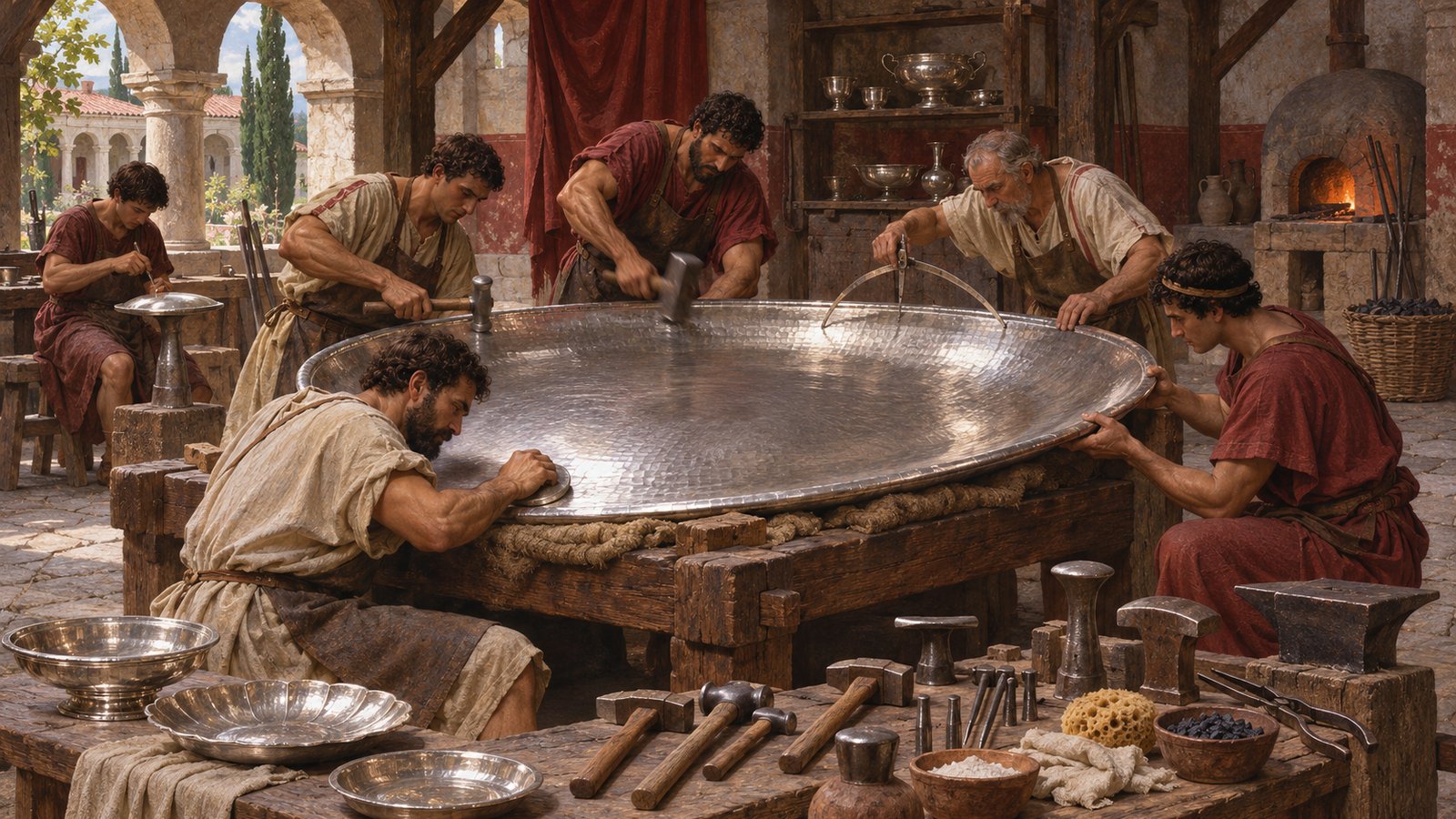
Eight Companion Dishes Made Service a Labour Problem
The central charger came with eight dishes of two hundred and fifty pounds each. Together the named pieces represented two thousand five hundred pounds of silver before stands, fittings or other plate entered the room.
That total explains Pliny’s sarcastic questions. How many of Drusillanus’s fellow slaves would be needed to introduce the dishes? Who could possibly be served from them? The set advertised abundance while making ordinary service difficult.
Carrying was only one stage. Workers had to store the pieces, clean tarnish, protect decorated surfaces and arrange them safely. A display that seemed to concentrate wealth in one owner actually depended on many people handling the consequences.
The social tension is sharpened by Drusillanus’s status. Pliny emphasizes that an imperial slave owned a set requiring the labour of fellow slaves. Court administration could produce hierarchies within legal unfreedom as striking as those between free and enslaved people.
Small Roman dining objects could compress several tools into one portable form. Another Lost Eagles article examines a six-part silver utensil made for a pocket. Drusillanus’s set moved in the opposite direction: dining equipment grew until portability itself became a performance.
One Hundred-Pound Chargers Had Already Become a Target
Pliny says the five-hundred-pound piece followed an earlier fashion for chargers of one hundred pounds. More than one hundred and fifty of those existed in Rome, according to his account.
He links desire for them to proscription. People, he says, used schemes to have others listed so they could seize the silver. The claim belongs to Pliny’s moral history of luxury, but its mechanism is political: portable wealth gave violence a household inventory.
A charger could be recognized, weighed and transferred. Unlike an elaborate room, it did not need to remain attached to a property. Concentrated precious metal made tableware a visible reserve of value and an attractive prize.
Pliny therefore treats civil conflict and dining fashion as connected. The plates were not guilty objects, yet their desirability helped explain why private enemies might exploit public terror for acquisition.
This was not the only way elite risk could be distributed through commerce. Cato’s maritime arrangement limited exposure because fifty ships kept one lender’s risk to a single share. Monumental silver did the reverse: it concentrated wealth into objects whose possession was impossible to hide.
Sideboards Evolved to Carry a Growing Silver Display
Pliny’s history of furniture follows the plate. Cornelius Nepos said that before Sulla’s victory only two dining couches decorated with silver existed at Rome. Fenestella remembered silver appearing on sideboards within his lifetime.
The sideboard itself changed form. Round structures of solid wood, little larger than tables, gave way to square constructions assembled from different woods or veneered with maple or citrus. Later, silver covered corners and seams.
Those details show display growing by stages. Precious metal first accented joinery; larger and more numerous pieces then demanded tiers and supporting surfaces. Furniture became a frame that organized wealth vertically within the room.
Pliny complains elsewhere in the same sequence that fresh ranks of tables were built to hold dishes. The service object and the display architecture pushed each other toward excess.
The shift also altered what guests saw. Food competed with workmanship, metal weight and named artistic styles. A sideboard could operate like an exhibition before anything reached the dining couch.
Fame Could Make Worked Silver Too Valuable to Use
Mass was only one price system. Pliny says plate by a celebrated artist inspired even greater desire. Lucius Crassus paid one hundred thousand sesterces for two goblets chased by Mentor, then admitted he was too ashamed to use them.
The goblets reveal a different failure of function from Drusillanus’s charger. One set became hard to use because it was enormous. The other became unusable because artistic attribution and price made ordinary handling feel improper.
Fashion moved quickly among named workshops and surfaces. Pliny lists Furnian, Clodian and Gratian plate taking turns in favour. At one moment buyers wanted embossing; at another they wanted deeply chased outlines; elsewhere metal was deliberately pared away with a file.
Silver’s value therefore did not rise only with weight. Removing metal could increase desirability if the labour and style matched current taste. An artist’s name could make a smaller piece command attention that bulk alone could not secure.
Pliny uses these examples to condemn luxury, and his rhetoric should remain visible rather than treated as an objective market report. Yet the concrete details survive the moral frame: named styles, changing furniture, exact weights, a purpose-built workshop and service labour.
The five-hundred-pound charger was spectacular because it crossed categories. It was tableware that required architecture, portable wealth that demanded a crew, and an object owned by an imperial slave whose position unsettled easy assumptions about status.
Nothing in the passage proves the dish was regularly filled with food. Its most reliable function may have been to make quantity undeniable. Guests did not need to know the current price per pound; they could see attendants struggle and understand that the room was arranged around silver.
Pliny’s question about who could be served remains the sharpest reading of the set. The charger exceeded the meal. Once plate became heavier than practical service, the burden itself delivered the message.
The companion dishes also prevented the central piece from looking like a solitary experiment. Eight matching weights turned excess into a system. The commission had to anticipate repetition: metal supply, forming methods, storage and coordinated movement were multiplied across a set.
That repetition made the workshop’s special construction more understandable. Artisans were not solving one oversized surface and returning to ordinary work. They were producing a family of objects whose combined mass reshaped the entire commission. Scale became a programme rather than an accident.
The set’s survival is literary, not archaeological. Pliny gives a name, office, reign and weights, but no findspot or surviving object that can be securely matched. Its value for reconstruction lies in the production and labour constraints he chose to emphasize.
Sources
Pliny the Elder, Natural History, Book 33, chapters 49, 52–53.