
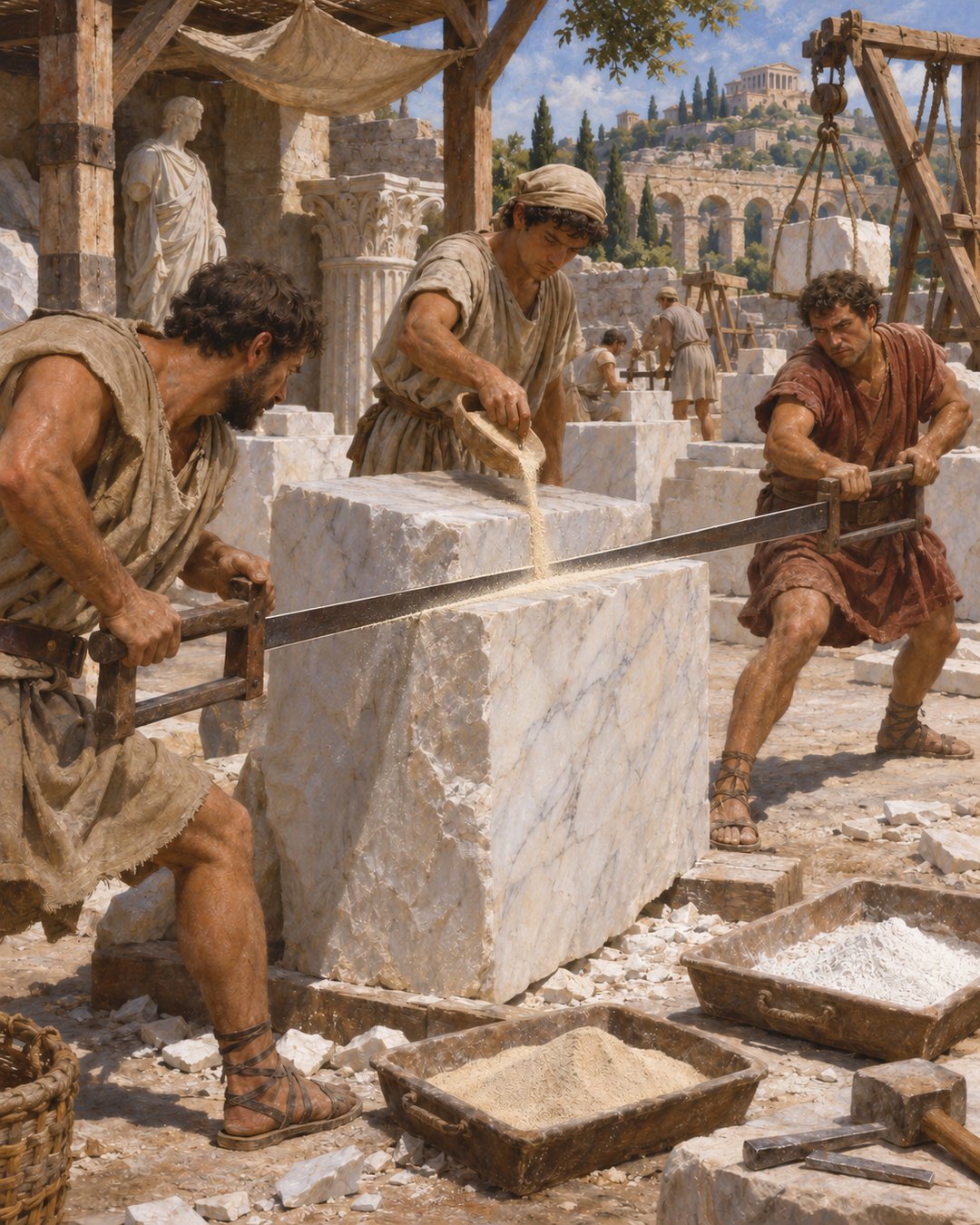
The iron saw in a Roman marble yard was not the part that truly cut the stone. Pliny the Elder says the blade moved back and forth while pressing sand into a fine cleft. The abrasive grains did the work; the iron supplied pressure and motion.
That distinction turned an ordinary-looking material into a long-distance commodity. Workshops judged sand from Ethiopia, India, Naxos, Egypt and an Adriatic creek by the surface it left behind. A poor substitute did not merely slow the job. It widened the cut, wasted marble and forced the finisher to grind away still more thickness.
A polished slab therefore carried two hidden geographies: the quarry that supplied the marble and the source that supplied the abrasive. The gleaming wall began with controlled destruction measured grain by grain.
The Blade Guided What the Sand Removed
Pliny describes the cut as deceptive. It appeared to be made by iron, but the division was really made by sand. The saw pressed abrasive within a very fine opening as workers drove it to and fro.
The blade’s job was essential even if its edge was not doing the cutting in the familiar toothed sense. It kept pressure concentrated along a line. Repeated motion dragged grains against the stone. Each pass removed a minute amount until the cleft deepened through the block.
This explains why abrasive choice affected both speed and finish. Grains had to bite marble, move through the cut and clear crushed material without tearing an unnecessarily broad channel. The saw, sand and stone acted as one system.
Pliny does not provide blade dimensions, the number of workers, a cutting rate or instructions for adding water. His passage should not be expanded into a complete workshop manual. What it securely preserves is the mechanism: iron movement applied loose abrasive inside a narrow cut.
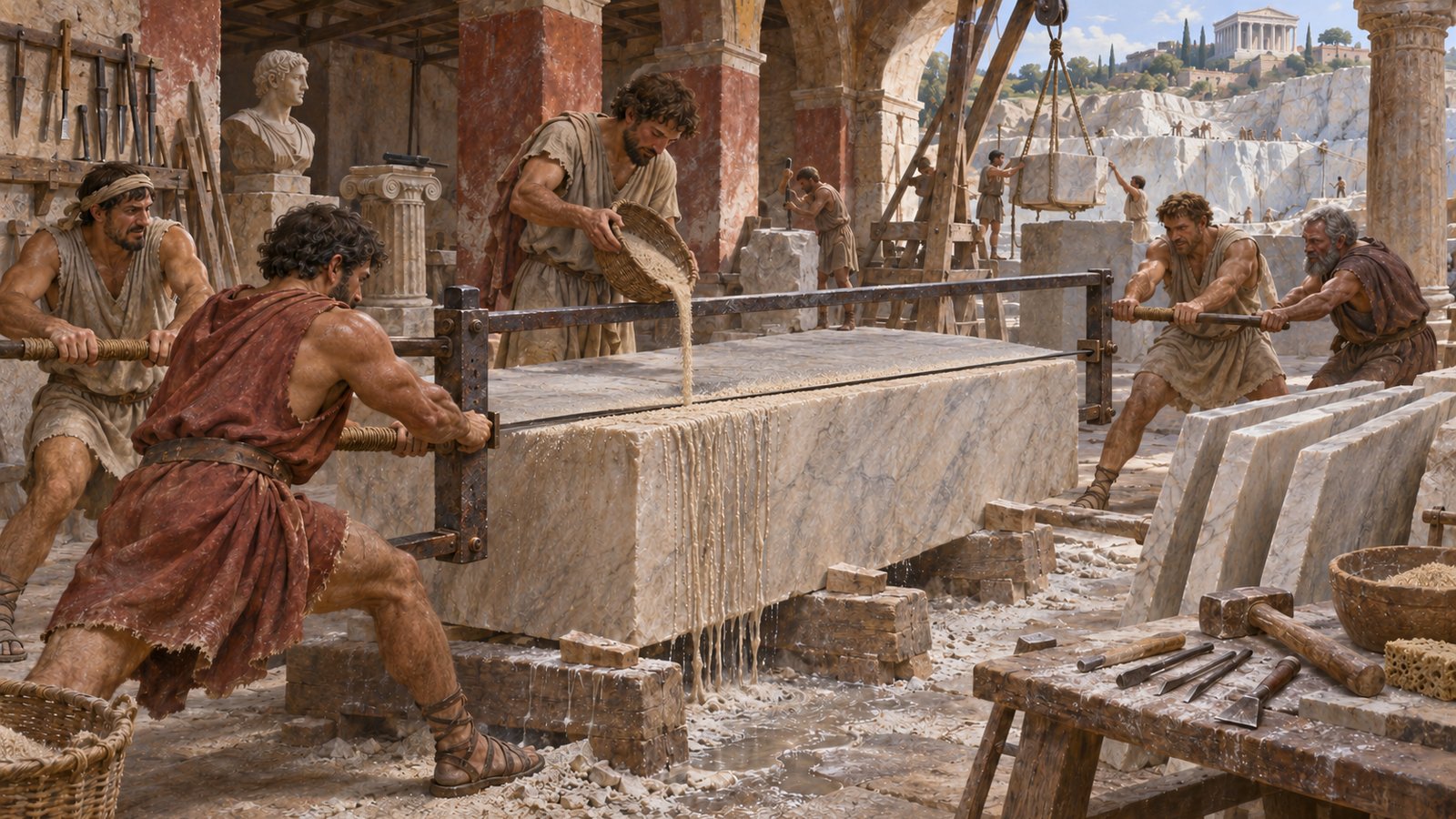
Ethiopian Sand Promised a Smoother Face
Pliny ranks Ethiopian sand first. He calls it softer and better suited to dividing marble without leaving roughness on the surface. Indian sand came next, but it did not leave so smooth a face.
“Softer” did not mean useless. The valued abrasive had to remove stone while controlling the damage around the cut. A harsh grain could work aggressively yet leave pits and ridges that became the next craftsperson’s problem.
The preference also carried transport costs. Pliny complains that marble preparation sent buyers as far as Ethiopia and India. His moral language attacks luxury, but the complaint gives us a practical fact: workshops or suppliers distinguished abrasives by geographic reputation and moved them over immense distances.
Indian sand remained useful beyond sawing. Pliny says that when calcined it was recommended for polishing marble. Heat treatment and a change of task could therefore alter how the same named material entered production.
Sand from Naxos and Coptos, commonly called Egyptian sand, shared the defect of leaving a rougher face. These labels worked as quality signals, but Pliny’s later warning about substitution shows that a label did not guarantee what reached the cut.
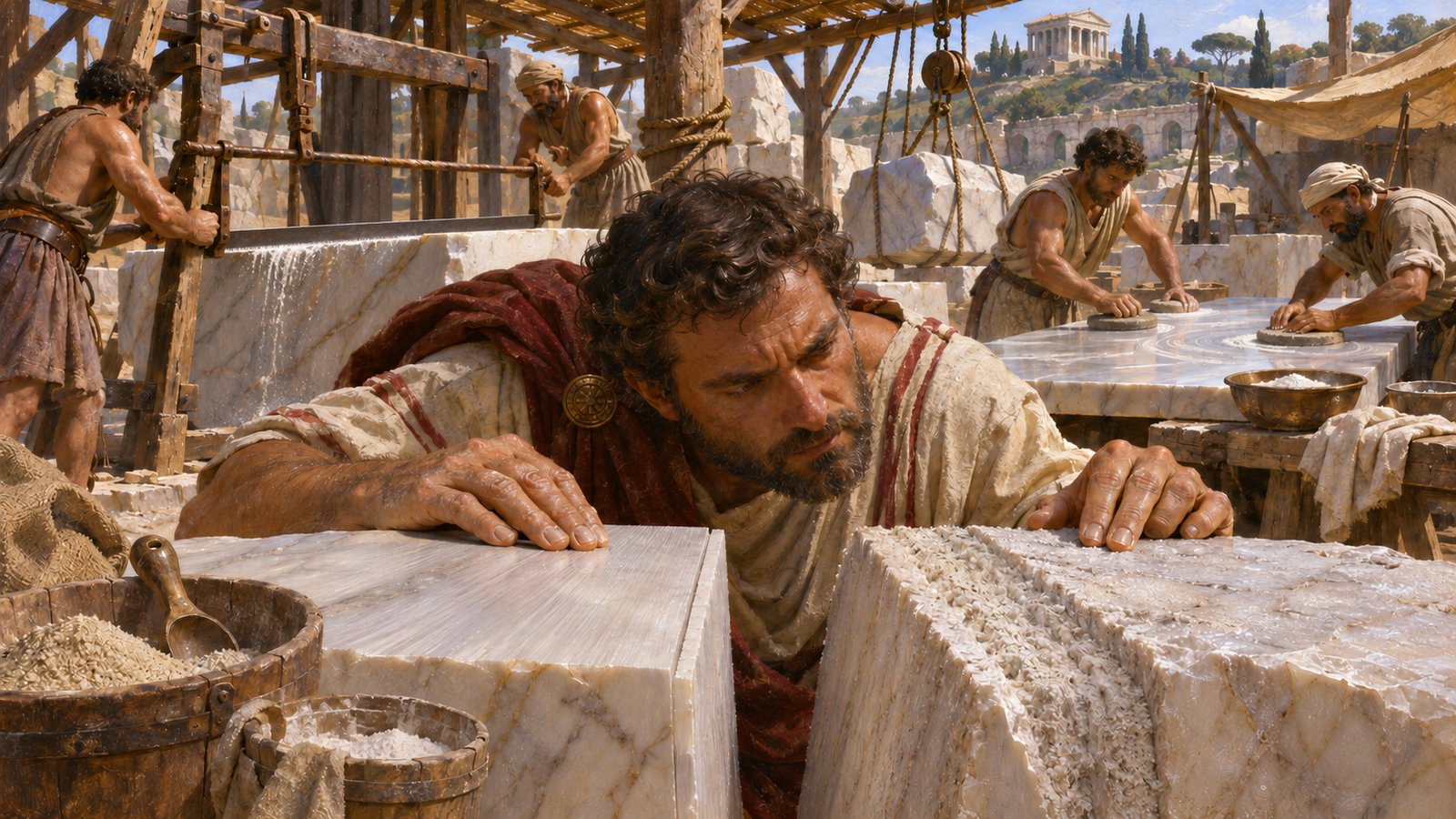
Coarse River Sand Stole Thickness from the Slab
Pliny accuses contemporary marble workers of using any river sand they could obtain. He presents this as fraud because few employers understood the downstream cost.
Coarser sand made a wider division. A wider kerf converted more valuable marble into waste before either slab left the block. If several slabs were planned, every oversized cut multiplied the loss.
The damage continued after sawing. Coarse abrasive left a rough surface, and polishing that surface required removing more material. The finished slab lost thickness twice: first through the broad cut, then through corrective grinding.
This is a precise commercial mechanism. A substitute could be cheaper for the workshop at the moment of purchase while more expensive for the owner in consumed stone and labour. Because the loss appeared gradually, an employer unfamiliar with the process might see only the final smooth face.
Roman builders repeatedly depended on work hidden beneath finishes. Another Lost Eagles article follows how crossed boards, chaff and crushed pottery formed a roof terrace. Marble veneer hid a similar chain: a finished plane concealed the width of every earlier cut.
Low Tide Opened One Adriatic Abrasive Bed
Pliny adds a newer source that workers approved: sand from a particular Adriatic creek. The deposit was exposed only when low water left the place dry, making collection difficult.
The detail joins material quality to timing. Procurement depended not only on reaching the coast but on arriving when the water withdrew. A useful abrasive could be locally concentrated and intermittently accessible.
Such a source complicated supply. Collectors needed knowledge of the creek and its rhythm; merchants needed to keep different sands separate; workshops needed enough stock to continue cuts when the bed was underwater.
Named origins also created opportunities for deception. If buyers paid for a reputed abrasive without understanding its grain, ordinary river sand could travel under a better story. Pliny’s complaint is therefore about expertise as much as honesty.
The final polish used yet another group of materials. He recommends powdered Thebaic stone and porous stone or finely powdered pumice. Sawing established the slab; successive abrasives then reduced the marks until reflected light made the surface read as continuous.
Imported Grit Made Imported Stone Look Effortless
Pliny says Naxian stone was long preferred for polishing marble statues and for cutting and polishing precious stones. Armenian stones later displaced it. Abrasive markets changed even when the visible object remained “marble.”
This succession reveals a workshop culture willing to compare results and replace an established supply. A material earned preference through what it did at the bench: how it cut, what marks it left and how much correction followed.
The finished slab erased most of that evidence. Viewers saw colour, veining and shine. They did not see the grains sacrificed in the cleft or the powder that carried away roughness.
Roman construction often made labour disappear into a clean surface. The five-year rule for tested building material appears in the story of how Utica made mud bricks wait for a magistrate. In marble work, quality control lived in the cut itself and could be recognized only by someone who understood waste and finish.
Pliny’s account also warns against treating “sand” as one undifferentiated ingredient. Provenance, grain size, heat treatment and task all mattered. Material that performed well in the saw might be ranked differently for polishing.
The iron blade naturally attracts attention because it is the moving tool. Pliny redirects attention to what lay beneath it. The effective edge was a stream of loose particles repeatedly trapped between metal and stone.
That mechanism connected distant landscapes to Roman interiors. Ethiopian or Indian abrasive met quarried marble in a workshop; Thebaic stone or pumice refined the face; installers fixed the slab where no one could see the consumed materials. Luxury looked solid and singular only after a chain of expendable grains made it so.
The economics can be read directly from the kerf. If coarse grit broadened every passage, fewer usable slabs came from a block of fixed width. Each surviving slab then demanded extra finishing. Better abrasive protected both yield and labour even when it had travelled farther to reach the yard.
It also changed accountability. A patron judging only the polished installation could miss the stone already lost. Someone who inspected the sawn face, grain and thickness could connect the final object to workshop choices. Pliny’s accusation of fraud assumes precisely that gap in knowledge between producer and employer.
Sources
Pliny the Elder, Natural History, Book 36, chapters 9–10.