
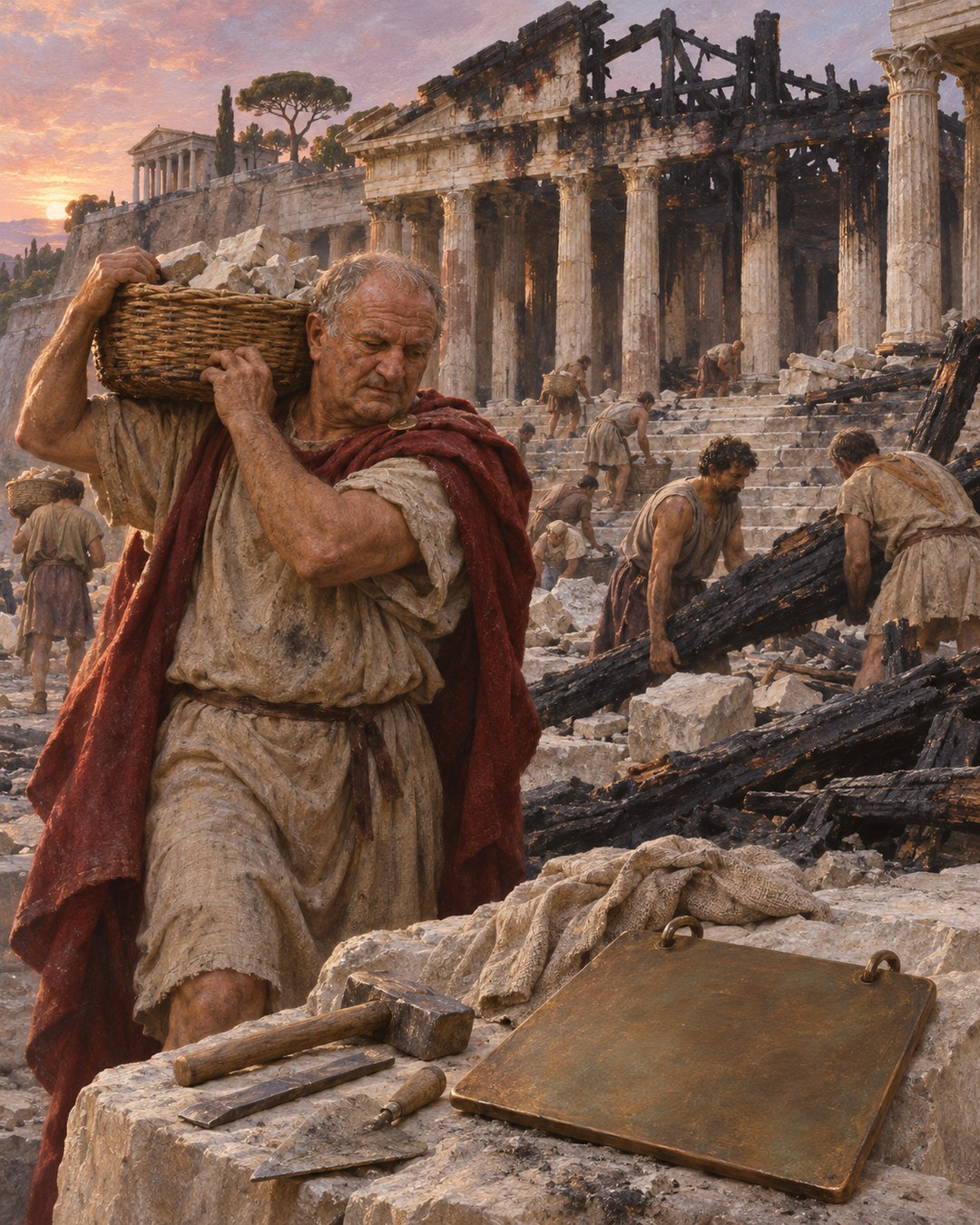
When fire destroyed the Capitol, it did more than blacken a temple. It erased part of Rome’s working memory. Suetonius says that three thousand bronze records disappeared: senatorial decrees, acts of the people, alliances, treaties, and grants of privilege reaching back almost to the city’s foundation.
Vespasian answered with a reconstruction project. He searched widely for copies and undertook to restore the lost bronze texts. The task was not simply monumental rebuilding. It was the recovery of decisions that still defined relationships, rights, and public authority.
The emperor also made the physical recovery visible. Suetonius places him at the ruined Capitol, taking part in clearing debris and carrying some on his own shoulder. That carefully staged labor connected two kinds of repair: stone and timber had to rise again, but the archive also had to be rebuilt line by line from records surviving elsewhere.
Fire Turned Public Memory into a Copy Problem
Bronze gave an official text a durable surface, but durability was never the same as invulnerability. A tablet could resist ordinary handling and weather better than papyrus. Concentrate many tablets in one sacred and administrative center, however, and one fire could destroy an extraordinary range of evidence at once.
Suetonius gives the loss a number: three thousand tables of brass in the translation preserved by Project Gutenberg. The scale is the first important fact. This was not one celebrated law or one diplomatic agreement. It was a mass of distinct public acts accumulated over centuries.
The range mattered as much as the total. The lost material included decrees of the Senate and acts of the Roman people. It also preserved alliances, treaties, and privileges granted to individuals. Those categories connected present institutions to earlier decisions. A treaty could define obligations beyond Rome; a grant could support one person’s standing; an old decree could establish why an office or community claimed a right.
The fire therefore produced an administrative question. How could Rome distinguish an authentic old decision from a convenient new claim once the display copy had vanished? Vespasian’s answer began by looking for other witnesses to the same text.
The Lost Eagles has previously examined how a bronze law confirmed Vespasian’s own authority. The Capitol project looked backward instead. It tried to recover the documentary foundations on which many older acts still rested.
Copies Survived Because Records Had Travelled
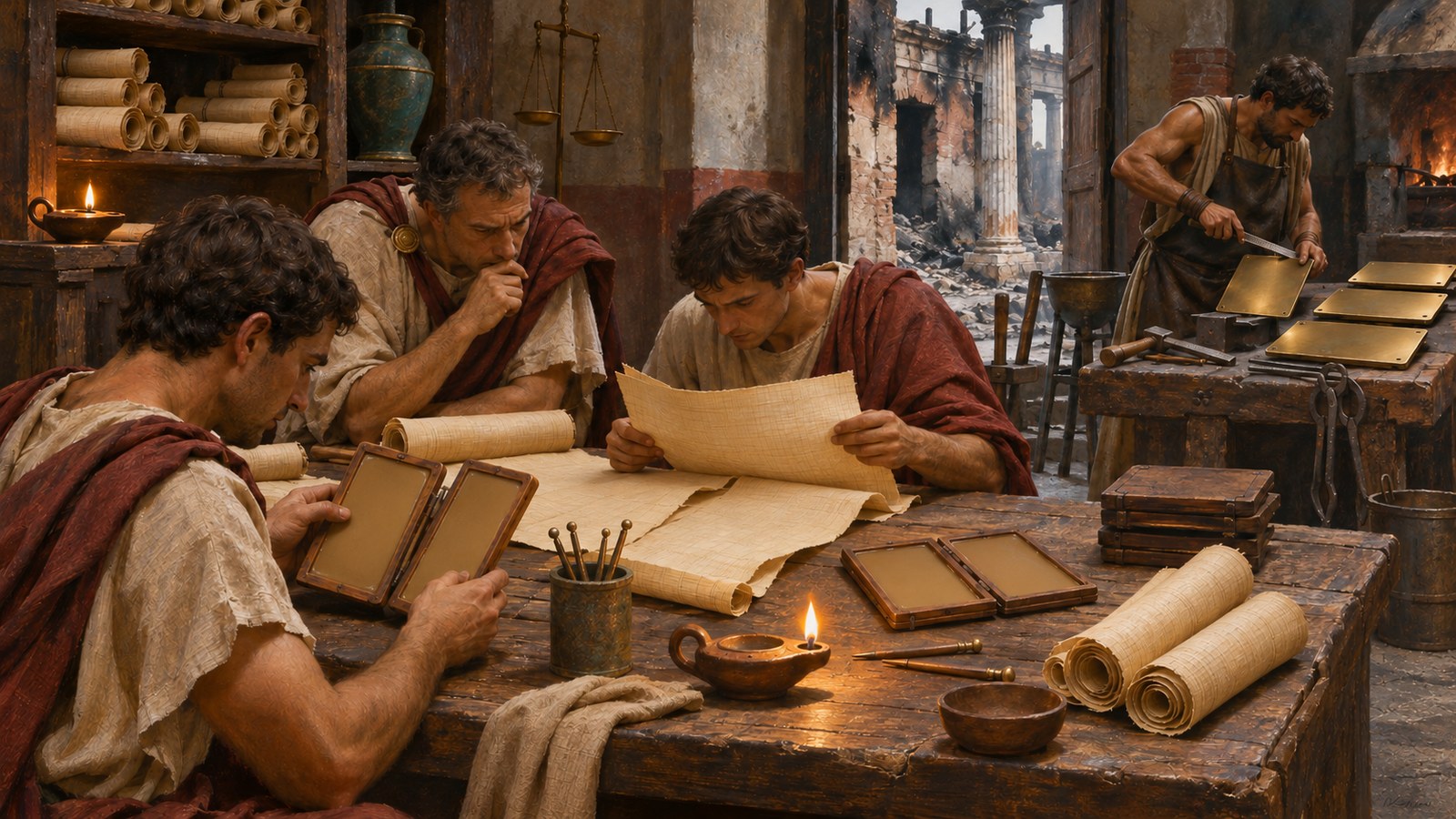
Suetonius says Vespasian searched “in all quarters” for copies. He does not provide an inventory of where each one came from, so the exact reconstruction network should not be invented. The wording nevertheless makes the mechanism clear: the central archive could be rebuilt only because versions of its texts existed outside the burned collection.
Public decisions naturally generated duplication. A community affected by a privilege needed evidence of it. Parties to a treaty needed terms they could consult. Officials, temples, municipalities, and private beneficiaries could preserve texts relevant to them. A decree might be displayed in more than one place or copied into another record.
That dispersal created resilience without anyone needing to design a modern backup system. No single copy was necessarily sufficient for every purpose. Together, scattered copies gave Vespasian’s administration a pool from which lost wording could be recovered.
Recovery still demanded judgment. A surviving text had to be found, identified, and treated as a trustworthy witness. If two copies differed, someone had to decide what should be engraved. Suetonius does not tell us the rules used by the restorers, the names of their clerks, or the number of disputed cases. Those silences matter because they mark the boundary between the ancient report and a modern reconstruction.
What can be said is that restoring three thousand items required far more than ordering fresh metal. Search came before inscription. The archive was reassembled from a documentary landscape spread beyond the archive itself.
Bronze Made the Recovered Decision Public Again
Once a text had been recovered, the replacement had to turn words into a public object. A bronze tablet required material, layout, cutting, and installation. Names, clauses, and formulae had to be transferred accurately. The process converted a copy held somewhere else into a renewed official presence at Rome.
Bronze mattered because it made a claim about endurance. The words did not remain only in a clerk’s temporary notes. They returned on a hard surface that could be inspected and associated with the rebuilt Capitol. Material and location reinforced one another.
That does not mean every Roman read all three thousand tablets. Their value did not depend on continuous mass reading. A visible and retrievable inscription could establish that a decision belonged to the public record. Specialists, litigants, officials, or petitioners could invoke it when a specific question arose.
The archive was therefore active rather than decorative. Treaties and privileges could shape current arguments long after the people who first approved them were dead. Recovering the text restored the possibility of checking a claim against a recognized object.
The six municipal tablets discussed in Rome’s surviving town law show the same basic power at a smaller scale: governance became durable when rules were fixed in metal. Vespasian’s project multiplied that logic across thousands of acts.
Vespasian Put His Shoulder into the Ruins
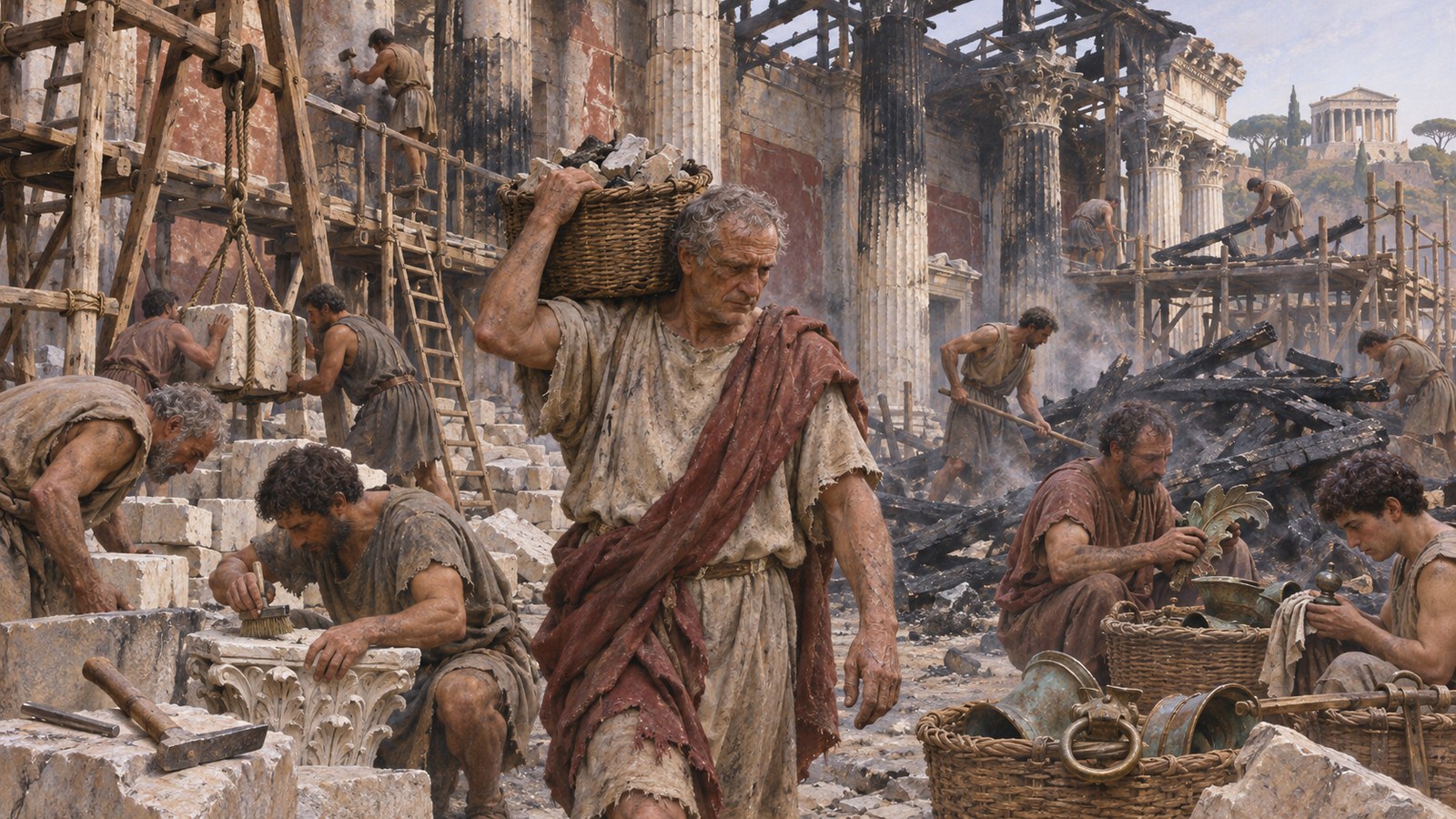
Suetonius introduces the record recovery beside a physical scene. Vespasian resolved to rebuild the Capitol, took the lead in clearing the ground, and carried some rubble on his shoulder. The detail is tactile: broken material had to be removed before reconstruction could become visible.
An emperor did not personally clear the entire site. The point of the scene is exemplary labor. Vespasian’s body represented commitment to the work and invited others to see rebuilding as a shared public task after civil war and fire.
The gesture also suited the political problem he inherited. The year of the four emperors had exposed unstable succession and competing armies. A ruler emerging from that violence needed to present himself not merely as the latest victor but as the restorer of institutions older than his own regime.
Carrying rubble made that claim concrete. Restoring records made it administrative. One act addressed the visible wound on the hill; the other addressed the less visible loss of legal and diplomatic memory.
Suetonius’s sequence prevents us from separating architecture from information. A rebuilt temple without its records would have restored the shell while leaving a documentary void. Fresh tablets without a rebuilt setting would have lacked the place that had given the archive its public authority. Vespasian’s program joined them.
The Oldest Acts Helped a New Dynasty Look Continuous
The recovered records reached, Suetonius says, almost from the building of the city. Whether every claimed early text would satisfy modern historical criticism is a separate question. For Romans using the archive, antiquity itself carried political force.
Vespasian founded a new dynasty, but his restoration emphasized continuity. He did not announce that fire had freed the government from old obligations. He searched for the texts that bound the present to earlier senates, popular assemblies, allies, and beneficiaries.
That choice could protect existing arrangements. A privilege did not automatically disappear because its central tablet burned. A treaty did not become meaningless because the Capitol was damaged. By seeking copies, the administration treated prior acts as recoverable commitments rather than disposable relics.
The project also exposed a paradox in Roman public memory. The state advertised permanence through bronze, yet its continuity depended on duplication, local custody, skilled comparison, and renewed labor after disaster. Metal alone did not save the archive. People who had preserved copies elsewhere did.
Three thousand replacements made recovery visible on an imperial scale, but the decisive work began in scattered holdings beyond the ruined hill. Someone had kept a version. Someone had recognized it. Someone had carried it back into the reconstruction process. Only then could an engraver give the old decision a new bronze body.
Vespasian’s Capitol project was therefore more than a building campaign. It was a demonstration that Roman authority lived in records as well as monuments. The rubble on the emperor’s shoulder represented damage everyone could see. The restored tablets answered the damage that government would feel whenever an alliance, decree, treaty, or privilege needed proof.
Sources
Suetonius, Life of Vespasian, chapter 8.