
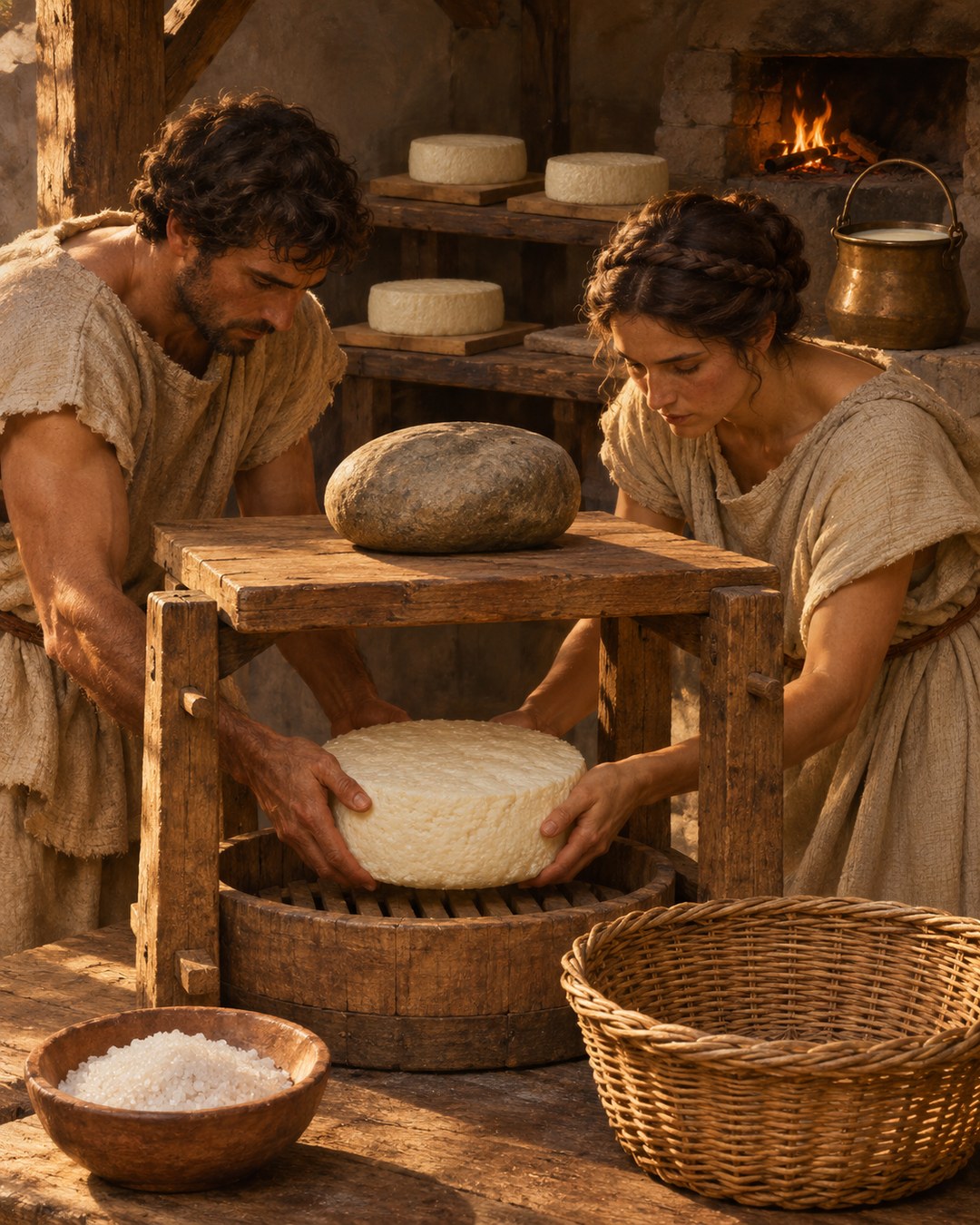
Fresh milk was valuable, perishable and awkward to carry far from a Roman farm. Columella’s answer was not simply to “make cheese.” In On Agriculture 7.8 he recorded a controlled sequence: use the freshest undiluted milk, add very little coagulant, keep the pail warm without touching flame, move the curd quickly, force out the whey, salt and press it repeatedly, then wash and dry the rounds without allowing them to touch.
The striking part is the rhythm. Columella gives several ways to start coagulation, but preservation depended on what happened afterward. Country workers did not wait patiently for liquid to leave by itself. They applied weight, returned the cheese to salt, compressed it again and repeated the cycle for nine days. The recipe turns a fleeting farm surplus into food able to survive time and distance.
Distance Turned Milk into a Problem
Columella introduces cheese-making as a practical obligation in districts far from market. A pail of milk could be sold near a town, but carrying it from a remote estate increased delay, handling and risk. Cheese reduced the liquid and concentrated value into a form that could be stored or moved more easily. The process began with geography before it began with taste.
He distinguishes two results. A thin, moist cheese had to be sold quickly while it was fresh. A richer, thicker cheese could be kept longer. That contrast explains the care given to removing whey. The maker was not merely changing texture. Each decision about moisture changed the product’s commercial clock.
The raw material had its own deadline. Columella insists on pure milk as fresh as possible. Milk left standing, or milk diluted with water, turned sour quickly. That warning makes freshness a process variable rather than a vague mark of quality. The cheese-maker needed to begin before delay or adulteration altered the liquid.
Roman food texts often preserve the final dish, as in the heavy cheese cake baked beneath a heated crock. Columella instead keeps the reader inside the workroom. His subject is the chain of small actions that made a stable ingredient possible in the first place.
A Denarius-Weight Could Set a Pail
The familiar coagulant was rennet from a lamb or kid. Columella also lists alternatives: the flower of wild thistle, safflower seed and the liquid released when green fig bark was cut. These are not presented as decorative flavours. Each could make the milk thicken, giving farms more than one route when animal rennet was unavailable or a different result was wanted.
Restraint mattered. Columella says the best cheese contained only a very small quantity of the “drug,” his general term for the setting agent. He gives a concrete scale: the least rennet required for a pail of milk weighed one silver denarius. The passage does not tell us that every pail was identical, so the figure should not be converted into a universal modern recipe. It does show a producer measuring a potent ingredient rather than pouring by guesswork.
Fig shoots receive special praise. Cheese solidified by them, Columella says, had a very pleasant flavour. That detail joins chemistry to sensory judgment. The maker chose a material because it worked, but the choice could also alter what the finished cheese tasted like.
None of these agents excused poor handling. Fresh milk, a small dose and proper warmth belonged to one system. Too much coagulant could burden the flavour; stale or watered milk could sour; bad heat could damage the batch. Columella’s compact directions assume that success came from keeping several limits at once.
The Pail Stood Near the Fire, Never in It
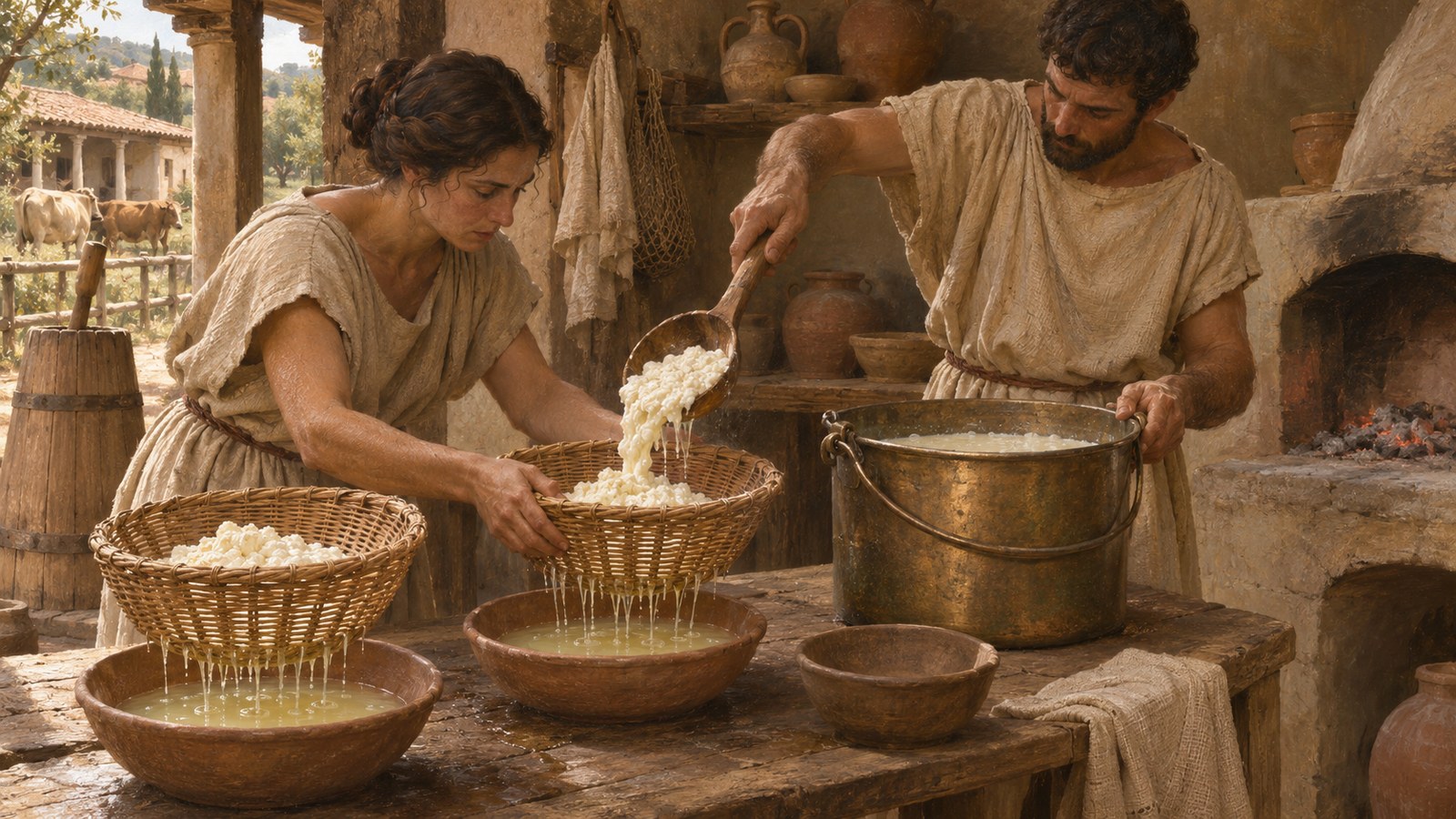
After the milk entered the pail, it had to remain somewhat warm. Columella rejects a shortcut that some people apparently recommended: putting the vessel in contact with flame. The pail should stand not far from the fire instead. The distinction is physical and visible. Gentle surrounding warmth helped the milk set; direct flame threatened uncontrolled heating.
As soon as the liquid thickened, the curd moved into wicker vessels, baskets or moulds. Speed mattered because the whey had to pass away and separate from the solid matter as quickly as possible. Open wickerwork was not rustic decoration. Its gaps made the container part of the drainage equipment.
The transfer created a brief workshop scene: a warmed pail beside the hearth, a newly thickened mass lifted into forms, pale liquid finding routes through woven walls, and workers watching for the moment when the curd could bear pressure. The passage never supplies a romantic dairy tableau. It supplies a sequence in which vessel, temperature and timing each perform a job.
This attention to container design resembles the logic behind Columella’s four-handled jars for hanging grapes. In both cases, the form of a vessel governed air, contact and handling. A farm tool was successful when its shape made a vulnerable food behave predictably.
Country Workers Refused to Wait for Whey
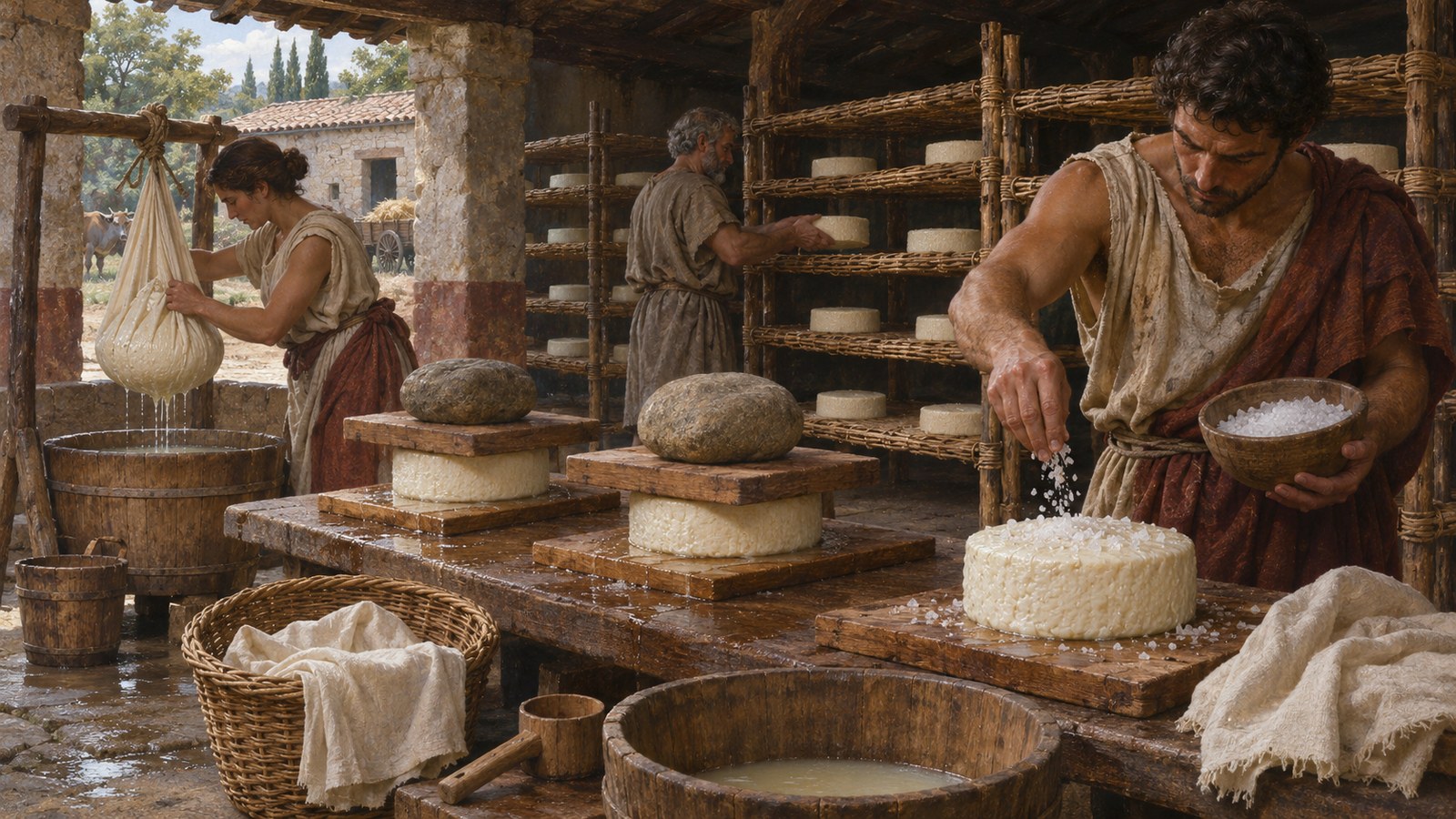
Columella singles out the impatience of country workers. They did not allow the whey to drain slowly under its own weight. Once the cheese became somewhat firm, they placed weights on top so that more liquid would be expressed. Pressure shortened a natural process and gave the maker greater control over the moisture left inside.
The round then left its mould or basket for the cleanest possible boards in a cool, shady place. Heat and dirt both threatened the work already invested. Ground salt was scattered over the surface so that the cheese would “sweat out” acidic liquid. When the mass hardened, it was pressed more strongly to make it dense.
Then the operation repeated. The cheese touched dry salt again and returned beneath weights. Columella’s wording makes preservation cumulative. No single heroic pressing transformed the batch. Salt drew liquid, weight expelled it, rest allowed the structure to firm, and repetition pushed the cheese toward a denser state.
This also explains why the article’s nine days are not merely waiting time. The producer remained active throughout them. A round had to be handled, salted, inspected and compressed without contamination. The labour lay in repetition and judgment: firm enough for more pressure, dry enough for the next stage, protected enough not to spoil before the cycle ended.
Nine Days Ended with Water and Space
Columella says that this salting and pressing continued for nine days. Only then was the cheese washed in fresh water. Washing after repeated salting sounds paradoxical if salt is imagined as a one-time coating. In his process, however, salt had already helped draw liquid from the mass. The final wash removed the surface treatment before drying continued.
The washed cheeses went onto specially made wicker racks in the shade. They were arranged so that one did not touch another. Space was now a tool. Separate rounds exposed more surface, reduced trapped dampness and allowed moderate drying. The maker who had used weight to force liquid out now avoided crowding that could hold moisture against the cheese.
Columella did not want the rounds dried without limit. After moderate drying, they were packed in an enclosed place sheltered from winds so they would remain tender. Preservation therefore did not mean turning food into the hardest possible object. Too much moving air could take the process beyond the desired texture.
The complete method balances opposites: fresh but not delayed, warm but not flamed, drained but not abandoned to gravity, salted but later washed, dried but not wind-hardened. Its precision comes from boundaries. Each stage solves the danger created by the previous one without erasing the qualities the maker still wanted.
That is why Columella’s cheese chapter matters beyond a list of ingredients. It records farm knowledge as an operating procedure. Distance from market created the need; coagulation made milk workable; wicker and weight removed whey; nine days of salt and compression made the result denser; washing, separation and sheltered drying finished the job. A perishable pail became a transportable store of labour because Roman workers controlled moisture one step at a time.
Sources
Columella, On Agriculture 7.8.