
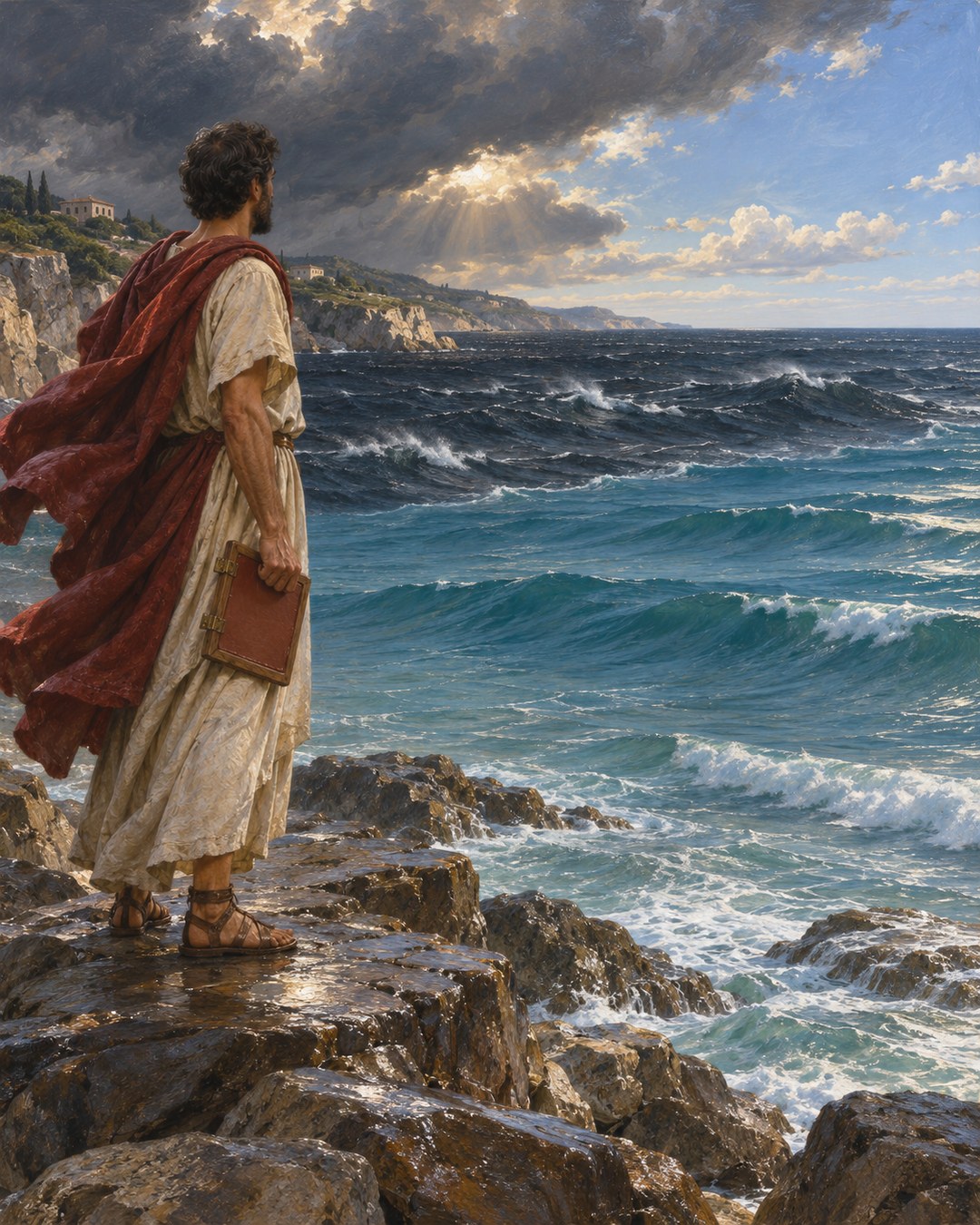
The wind had stopped, but the sea had not. In a short note preserved in Attic Nights, Aulus Gellius separated two kinds of aftermath. Waves raised by a north wind, he wrote, rose high and followed closely, then flattened soon after the air became still. Waves driven by southern and southwesterly winds behaved differently: they continued to swell and surge after the force that started them had gone.
Gellius did not leave the contrast as a sailor’s rule of thumb. He tried to explain it through the imagined angle of the wind, the direction of the water’s motion and even Homer’s choice of verbs. The physics is ancient rather than modern. Its value lies in showing a Roman reader at work: watching a repeated pattern, dividing it into parts, proposing a mechanism and checking his language against poetry.
The First Clue Arrived after the Gusts
Gellius begins with a difference in timing. Under a north wind, the waves are high and crowd one another. Once that wind ceases, however, the surface quickly loses the shape it had been given. The water flattens, and before long the waves disappear. The striking event is therefore not simply the height of the sea while the wind blows. It is the speed with which the disturbance ends.
Southern weather leaves another signature. Gellius groups the south and southwest winds together. Even when they have wholly ceased, he says, the waves continue to swell. The sea keeps surging although no fresh wind is visibly pressing it. Anyone observing only the active storm could miss the difference. The useful evidence appears during the lull.
This is why the passage feels less like a list of wind names and more like a notebook entry. Gellius identifies a variable, compares two outcomes and focuses on what remains after the immediate cause vanishes. He does not provide measurements, instruments or a dated voyage. He offers repeated observation—“often” noticed—and then asks what arrangement of air and water might account for it.
That habit of looking for a material sign also appears in the Roman field practice in which ashes and a noon shadow helped expose a site’s wind lines. The settings differ, but both accounts turn moving air into something readable through its effects.
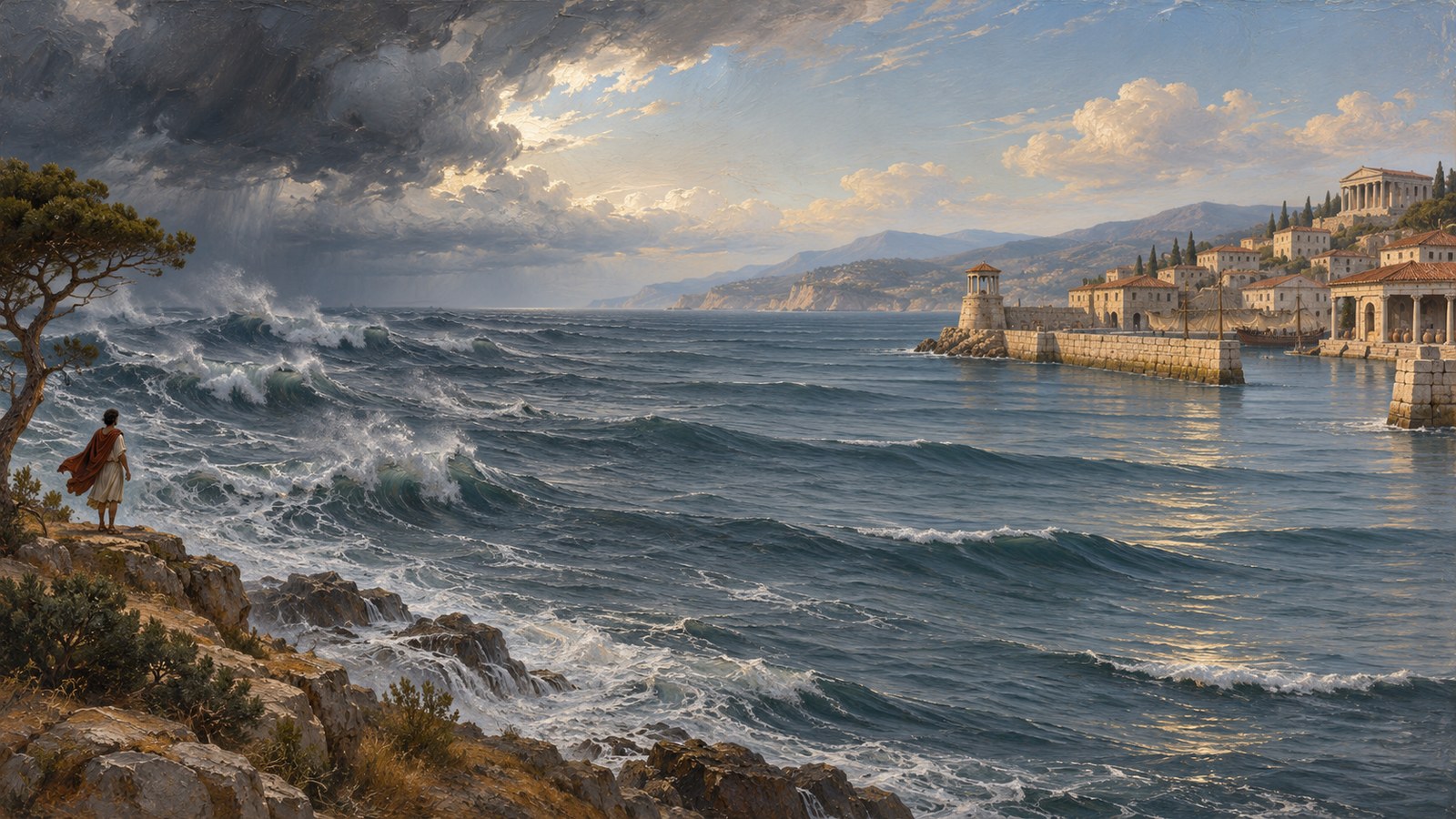
He Split Height from Forward Motion
Gellius’s explanation depends on treating wave height and wave travel as different things. He imagined northern winds descending from a higher part of the sky. They struck downward, drove into the depth and turned water upward from below. The resulting waves could be tall and tightly spaced without being strongly carried onward across the surface.
That model made their quick collapse intelligible to him. If the north wind supplied a downward force that repeatedly rolled water up from within, the waves would last only while that force continued. Remove the wind and the internal turning would stop. Height, in this account, was dramatic but short-lived.
The south and southwest winds occupied a lower, flatter route in Gellius’s imagined sky. Instead of striking the water from above, they passed along the surface. He says they pushed the waves forward rather than simply lifting them. Once the wind ceased, the sea retained some of that imposed motion and continued to surge.
Modern readers should resist converting this directly into present-day meteorology. Gellius’s vertical map of northern and southern air is part of an ancient explanatory system, not a verified account of atmospheric circulation. Yet the distinction he was trying to make is clear. One wind created steep waves by an ongoing downward action; another transferred forward movement that remained visible after the push ended.
South-Wind Water Carried a Memory
The most revealing word in the explanation is not “high” but “retain.” Gellius says the waters kept, for a time, the movement given by the original impulse. The sea became evidence of a force no longer present. Its surface held a temporary history.
That idea gave the southern waves a different narrative shape. A north-wind sea and a south-wind sea might both look violent while air was moving over them. Their identities became unmistakable only when the air fell quiet. One surface settled; the other continued the journey already imposed upon it.
For sailors, fishermen and people living around harbours, the persistence of disturbed water was not an abstract curiosity. The passage does not say that Gellius used it as a navigation rule, and we should not invent one for him. Still, the observation belonged to a Mediterranean world in which a calm sky did not necessarily mean calm water. A boat could meet the previous wind in the waves it left behind.
Roman stories about the sea often focus on ships, cargoes or battles. Gellius pauses before any of those human dramas. He looks at the medium itself. In the same way that a storm could expose the body’s reaction before Stoic reason returned, the sea could continue displaying an earlier pressure after the visible cause had passed.
Homer Became a Second Observation Deck
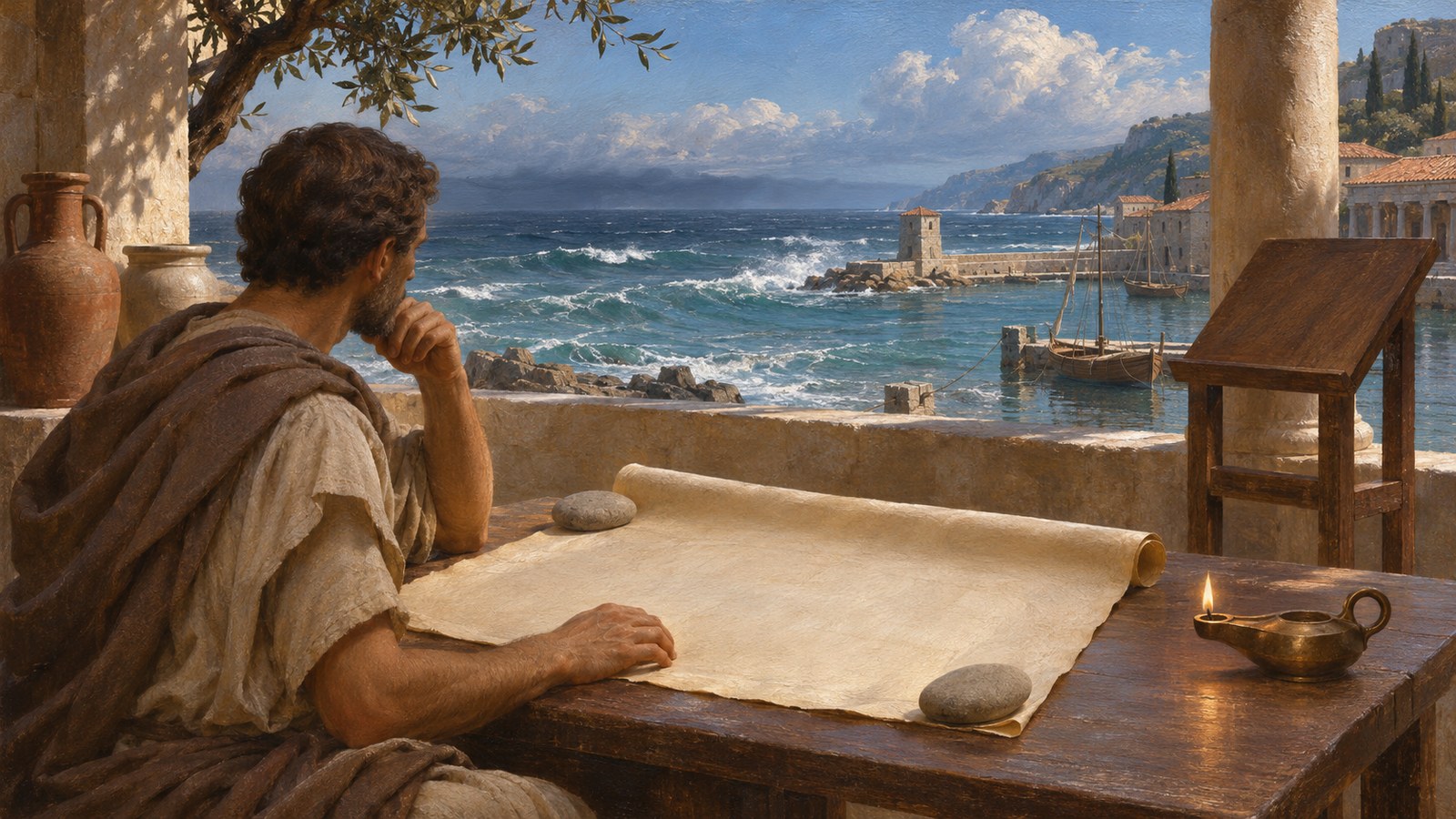
Gellius then tests his suggestion against Homer. He quotes one line in which Notus, the south wind, drives great waves against a western cliff. For Boreas, the north wind, he chooses language about uprolling a great wave. The difference in the verbs matters to him. One pushes; the other rolls.
This is not a modern experiment, and Gellius does not pretend that a poetic line measures the sea. He uses Homer differently. If a poet famous for precise observation had described northern and southern waves with distinct motions, that verbal contrast might support what Gellius thought he had found in nature.
He lingers over the Greek verb for pushing and compares it with another Homeric image: a stone forced toward a hilltop. The comparison lets him sharpen the south wind’s action. Its waves do not merely rise beneath an impact. They are driven onward, as an object is made to move against resistance.
Poetry therefore serves as stored testimony. Gellius reads the verse almost as another witness standing on another shore. Homer’s value is not that age makes him automatically correct, but that close attention to his wording may preserve distinctions casual speech has lost. Natural inquiry and literary criticism occupy the same paragraph because both ask what a carefully chosen verb reveals.
The Sea Changed Colour with the Direction
At the end of the note, Gellius adds a second contrast. Learned investigators of nature, he says, had observed that the sea became blue and bright under southern winds but darker and gloomier under northern ones. He says he copied the cause from the Problems associated with Aristotle, though the surviving paragraph gives the colour claim more clearly than its explanation.
The addition matters because it widens the field of evidence. Duration and direction were not the only clues by which winds could be distinguished. Colour and brightness also seemed to change. Gellius’s sea was a surface that registered forces through shape, persistence and appearance.
He does not claim a single grand theory that settles every detail. Instead, the chapter accumulates correspondences. North: high, close waves; an imagined downward strike; rapid flattening; a darker surface. South and southwest: forward pressure; continued surging; Homer’s language of driving; a brighter blue. The pattern is built from linked observations rather than one spectacular marvel.
That restraint separates the passage from many ancient wonder stories. Nothing impossible occurs. There is no sea monster, divine intervention or prophetic storm. The ordinary surface of the water becomes strange only because Gellius watches it past the moment when most observers would stop. The calm air seems to promise an ending; the southern swell refuses it.
His explanation belongs to its time, but his procedure remains recognizable. Notice the residue. Compare cases. Name the mechanism as precisely as the available model allows. Then return to other records—in his case, Homer and Aristotle—to see whether the distinction survives. Gellius’s notebook did not solve oceanography. It preserved a sharp question: why can one wind disappear while its waves continue to move?
Sources
Aulus Gellius, Attic Nights 2.30.